• More than 1,000 Emiratis who trained at the Drilling Training Centre since 2016 have joined drilling teams working on the company's onshore, offshore, and island rigs. Photo: Adnoc
    More than 1,000 Emiratis who trained at the Drilling Training Centre since 2016 have joined drilling teams working on the company's onshore, offshore, and island rigs. Photo: Adnoc
  • 24/7 monitoring at Adnoc's Digital Real Time Monitoring Centre (RTMC) can remotely monitor up to 120 rig sites simultaneously, enabling a 30 per cent reduction in well duration and contributing to drilling-related savings of $1 billion between 2016 and 2019. Photo: Adnoc
    24/7 monitoring at Adnoc's Digital Real Time Monitoring Centre (RTMC) can remotely monitor up to 120 rig sites simultaneously, enabling a 30 per cent reduction in well duration and contributing to drilling-related savings of $1 billion between 2016 and 2019. Photo: Adnoc
  • RESTRICTED. NO EDITORIAL USE. New staff are put through training that includes simulations and virtual reality to make sure they have as much safe but realistic practice before joining the workforce in the field. Adnoc
    RESTRICTED. NO EDITORIAL USE. New staff are put through training that includes simulations and virtual reality to make sure they have as much safe but realistic practice before joining the workforce in the field. Adnoc
  • Predictive Maintenance AI anticipates well problems early enough to take corrective actions, avoiding hours or days of non-productive time. Photo: Adnoc
    Predictive Maintenance AI anticipates well problems early enough to take corrective actions, avoiding hours or days of non-productive time. Photo: Adnoc
  • RESTRICTED. NO EDITORIAL USE. Performance Engineers at Adnoc Drilling's Digital Remote Technology Centre leverage data and advanced technology that lets them control drilling activity in real time, optimising performance and costs.
    RESTRICTED. NO EDITORIAL USE. Performance Engineers at Adnoc Drilling's Digital Remote Technology Centre leverage data and advanced technology that lets them control drilling activity in real time, optimising performance and costs.
  • A Predictive Maintenance AI pilot launched at an offshore drilling site in 2020 found that AI can identify potential drilling problems as much as two hours in advance. Photo: Adnoc
    A Predictive Maintenance AI pilot launched at an offshore drilling site in 2020 found that AI can identify potential drilling problems as much as two hours in advance. Photo: Adnoc
  • Real time digital monitoring results at drilling rig sites speak for themselves. As a result of improved efficiency, well performance has been improved 5-10 per cent year-on-year. Photo: Adnoc
    Real time digital monitoring results at drilling rig sites speak for themselves. As a result of improved efficiency, well performance has been improved 5-10 per cent year-on-year. Photo: Adnoc
  • For nearly 50 years, Adnoc Drilling has been the bedrock enabling Adnoc to reliably unlock the nation's energy resources in service of the UAE and its people. Photo: Adnoc
    For nearly 50 years, Adnoc Drilling has been the bedrock enabling Adnoc to reliably unlock the nation's energy resources in service of the UAE and its people. Photo: Adnoc

Adnoc Drilling: the race to digitise UAE's upstream oil and gas


In five years, Abu Dhabi National Oil Company’s Drilling unit has generated $2 billion in cost savings for Adnoc, partly through adoption of digital technologies.

The use of state-of-the-art work processes, including advanced analytics, predictive maintenance techniques, and virtual reality training has vastly improved efficiency within exploration and production.

Using real-time technology to analyse big data streams, the company's well performance has improved consistently each year, by five to 10 per cent, since 2016.

We saved around 30 per cent in well duration since 2016, that’s $1 billion in total. To put that into context, whereas before it might have taken 100 days to drill a well, today it takes just 70
Khalid Abdul Samad,
Upstream Production

With a key focus on four main areas of operation, Adnoc Drilling has fully digitised its training practices, real-time monitoring techniques, maintenance prediction and drill cab operations.

Khalid Abdul Samad, senior vice president for Upstream Production, said drilling operations across its 96 rigs were "faster and more accurate", meaning they were less likely to end up with a dry well.

“Our real-time monitoring centre connects all of our rig sites to one central hub where we can read all our parameters,” he told The National.

New recruits are put through training that includes simulations and virtual reality to make sure they have as much safe but realistic practice before joining the workforce in the field. Photo: Adnoc

“We are monitoring 49 KPIs, such as the speed of penetration of a drill and the downtime of a rig if it needs maintenance.

“From this data centre we can see that rig one, for instance, is doing great with connection time, so we make that the benchmark for the other rigs and send the data on to our different sites.

“We saved about 30 per cent in well duration since 2016, that’s $1 billion in total. To put that into context, whereas before it might have taken 100 days to drill a well, today it takes just 70.”

State-of-the-art training centre

In terms of training, Mr Samad said it takes a high school graduate about six months to qualify as an assistant driller at the company.

New staff are put through various stages of practical and theoretical training at the Drilling Training Centre, located in the Al Dhafra region of Abu Dhabi.

There are three different types of simulators located at DTC, alongside training programmes and mechanical and electrical workshops, to help students face real-life situations that they are likely to encounter at rigs.

A virtual reality system is used to give candidates a basic orientation about rig operations and rig equipment.

There are also three additional simulators, accredited by the International Well Control Forum, designed to reinforce and improve the candidate’s knowledge of “kick detection, shut-in procedures and well kill methods”.

Lastly, new staff undergo additional practical training in the “tubular-handling simulator”.

Here, new recruits learn how to trip in and out of a drill hole as well as learn how to make drill pipe connections using a power tong or a top drive, all within a virtual setting.

“In 2004 we established a small drilling school to develop Emiratis in drilling operations and in 2016 it was converted into the Drilling Training Centre,” said Mr Samad.

“More than 4,000 courses have been conducted at the site since 2016. It utilises the best in technology and trainees get to see dashboards and control systems as they would appear on the field.

“The main benefits of a digitised training centre is that candidates are less exposed to health and safety issues. Oil and gasfields are harsh environments, so this limits their exposure to toxic gases.

“Also, in simulators you can make mistakes, in real-time that is not an option without consequences.”

The digitised training approach saves a lot on logistics too, he said, in that there is no need to send trainees to different sites as everything is taught in one place.

Since 2016, more than 1,000 Emiratis who were trained at the centre have joined Adnoc’s drilling teams, working on the company’s onshore, offshore, and island rigs.

Maintenance prediction using AI

Artificial intelligence has become a huge part of operations at the Drilling unit and has been heavily utilised in maintenance prediction practices.

In early 2020, an AI pilot was launched at a number of offshore drilling sites that proved to increase efficiency and save Adnoc millions of dollars while advancing health and safety practices.

Mr Samad said the company’s AI system could "anticipate problems early enough to take corrective actions" and avoid hours or days of non-productive time due to tight holes or stuck pipes.

“When drilling, [imagine there is a certain problem I have], for example, a stuck pipe,” he said.

“There are different formations and zones in the ground so sometimes the pipes get stuck due to certain movements.

“How we predicted such problems before was by a human. They were measuring different parameters such as the speed of penetration of a drill or the amount of pressure when injecting mud into a well.

“Before, they could only predict an issue, like a pipe getting stuck, about two minutes before an incident occurred, that’s too late.

“With AI, it gives us ample time to predict a problem so we can interfere at the right time and execute the right intervention processes to prevent the pipe from getting stuck.”

Performance Engineers at Adnoc Drilling's Digital Remote Technology Centre leverage data and advanced technology that lets them control drilling activity in real time, optimising performance and costs. Photo: Adnoc

The lead time today is about two hours, which is a fast improvement on two minutes, he said.

And in drilling, time is money. Having these sophisticated prediction tools in place, Mr Samad said, greatly reduced the downtime of any rig, meaning less risk of losing money.

Over the next few years, Mr Samad said Adnoc Drilling plans to accelerate the “deployment of digital technology” to significantly increase its production capacity by 2030.

From trainees to field workers

Khalid Abdel Karim started his training at the DTC and is now working in the field as an assistant driller in Abu Dhabi.

“It is amazing to sit in the simulator chair and see on the monitor real operations happening,” he said.

“The simulator helps operators across every level of the organisation, from entry level to senior engineers. Everything I learnt was just like being at a drilling site.”

“When Adnoc Drilling began, it was heavy, hard work on site. Now we are able to precisely and accurately move huge machinery with a joy stick. We practise doing that in the Training Centre so by the time we get to site we are ready.”

“I love my work because it is a way for me to return to my country what my country has given to me.”

Taha Al Hashmi is a drilling IDS engineer at the Bab oil field. In his role, he receives a digital live feed with up-to-date technical information as his team’s drilling occurs.

“Constant improvement is part of the culture of Adnoc Drilling,” he said.

“What is exciting here is our advanced combination of digital and physical drilling aspects.

“Digital real-time monitoring plays a crucial role in ensuring precision and excellence. Drilling is fundamental to the UAE’s growth. I am privileged to be part of it.”

____________________

Adnoc Drilling: years gone by - in pictures

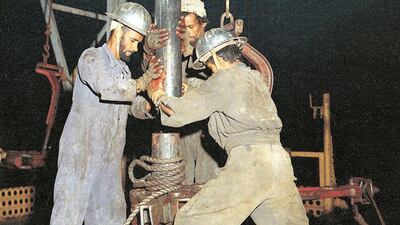
  • Oil workers on Murban 3 at Bab, about 80 kilometres south-west of Abu Dhabi, in 1960. Courtesy Adnoc Drilling
    Oil workers on Murban 3 at Bab, about 80 kilometres south-west of Abu Dhabi, in 1960. Courtesy Adnoc Drilling
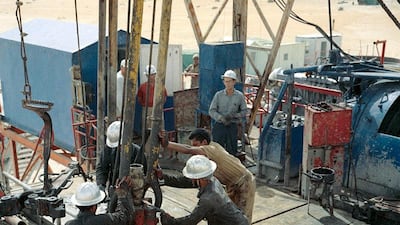
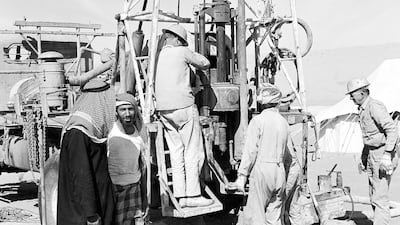
  • Drilling in progress on Murban 5 in Bab in 1961. Commercial quantities of oil had been discovered in Murban in May 1960. Courtesy Adnoc Drilling
    Drilling in progress on Murban 5 in Bab in 1961. Commercial quantities of oil had been discovered in Murban in May 1960. Courtesy Adnoc Drilling
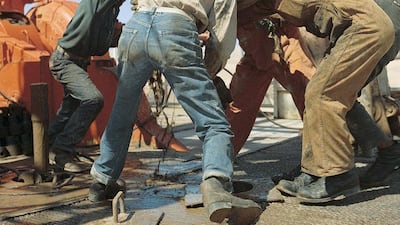
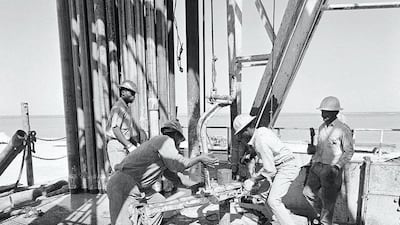
  • Oil workers on a drilling rig in 1968. Adnoc Drilling is now the largest drilling company in the Middle East, with a fleet of 96 rigs. Courtesy Adnoc Drilling
    Oil workers on a drilling rig in 1968. Adnoc Drilling is now the largest drilling company in the Middle East, with a fleet of 96 rigs. Courtesy Adnoc Drilling
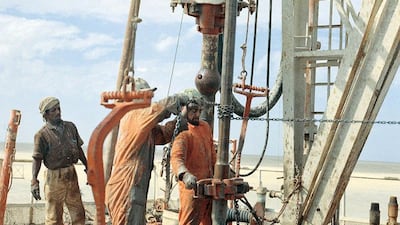
  • Rig work under way in Abu Dhabi, circa 1969. Many drillers talk of the pride they feel when they break through to a reservoir of oil or gas. Courtesy: Adnoc Drilling
    Rig work under way in Abu Dhabi, circa 1969. Many drillers talk of the pride they feel when they break through to a reservoir of oil or gas. Courtesy: Adnoc Drilling
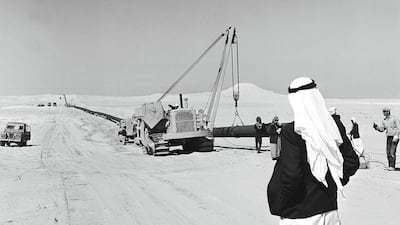
  • A pipeline under construction in Abu Dhabi in 1969. Courtesy Adnoc Drilling
    A pipeline under construction in Abu Dhabi in 1969. Courtesy Adnoc Drilling
  • Drilling for water at Zarrarah oilfield, circa 1969. Today, Adnoc employs more than 50,000 people, with over 100 nationalities represented. Courtesy Adnoc Drilling
    Drilling for water at Zarrarah oilfield, circa 1969. Today, Adnoc employs more than 50,000 people, with over 100 nationalities represented. Courtesy Adnoc Drilling
  • Drilling operations at Zubarra oilfield in 1970. Today, Adnoc has a production capacity of more than 3.5 million barrels of oil and 10.5 billion cubic feet of natural gas a day. Courtesy Adnoc Drilling
    Drilling operations at Zubarra oilfield in 1970. Today, Adnoc has a production capacity of more than 3.5 million barrels of oil and 10.5 billion cubic feet of natural gas a day. Courtesy Adnoc Drilling
MEDIEVIL%20(1998)
%3Cp%3E%3Cstrong%3EDeveloper%3A%3C%2Fstrong%3E%20SCE%20Studio%20Cambridge%3Cbr%3E%3Cstrong%3EPublisher%3A%3C%2Fstrong%3E%20Sony%20Computer%20Entertainment%3Cbr%3E%3Cstrong%3EConsole%3A%3C%2Fstrong%3E%20PlayStation%2C%20PlayStation%204%20and%205%3Cbr%3E%3Cstrong%3ERating%3A%3C%2Fstrong%3E%203.5%2F5%3C%2Fp%3E%0A
How Islam's view of posthumous transplant surgery changed

Transplants from the deceased have been carried out in hospitals across the globe for decades, but in some countries in the Middle East, including the UAE, the practise was banned until relatively recently.

Opinion has been divided as to whether organ donations from a deceased person is permissible in Islam.

The body is viewed as sacred, during and after death, thus prohibiting cremation and tattoos.

One school of thought viewed the removal of organs after death as equally impermissible.

That view has largely changed, and among scholars and indeed many in society, to be seen as permissible to save another life.

A%20MAN%20FROM%20MOTIHARI
%3Cp%3E%3Cstrong%3EAuthor%3A%20%3C%2Fstrong%3EAbdullah%20Khan%0D%3Cbr%3E%3Cstrong%3EPublisher%3A%20%3C%2Fstrong%3EPenguin%20Random%20House%3Cbr%3E%3Cstrong%3EPages%3A%20%3C%2Fstrong%3E304%0D%3Cbr%3E%3Cstrong%3EAvailable%3A%20%3C%2Fstrong%3ENow%0D%3Cbr%3E%3C%2Fp%3E%0A
Squad

Ali Kasheif, Salim Rashid, Khalifa Al Hammadi, Khalfan Mubarak, Ali Mabkhout, Omar Abdulrahman, Mohammed Al Attas, Abdullah Ramadan, Zayed Al Ameri (Al Jazira), Mohammed Al Shamsi, Hamdan Al Kamali, Mohammed Barghash, Khalil Al Hammadi (Al Wahda), Khalid Essa, Mohammed Shaker, Ahmed Barman, Bandar Al Ahbabi (Al Ain), Al Hassan Saleh, Majid Suroor (Sharjah) Walid Abbas, Ahmed Khalil (Shabab Al Ahli), Tariq Ahmed, Jasim Yaqoub (Al Nasr), Ali Saleh, Ali Salmeen (Al Wasl), Hassan Al Muharami (Baniyas) 

ADCC AFC Women’s Champions League Group A fixtures

October 3: v Wuhan Jiangda Women’s FC
October 6: v Hyundai Steel Red Angels Women’s FC
October 9: v Sabah FA

RESULT

West Brom 2 Liverpool 2
West Brom: Livermore (79'), Rondón (88' ) 
Liverpool: Ings (4'), Salah (72') 

Mercer, the investment consulting arm of US services company Marsh & McLennan, expects its wealth division to at least double its assets under management (AUM) in the Middle East as wealth in the region continues to grow despite economic headwinds, a company official said.

Mercer Wealth, which globally has $160 billion in AUM, plans to boost its AUM in the region to $2-$3bn in the next 2-3 years from the present $1bn, said Yasir AbuShaban, a Dubai-based principal with Mercer Wealth.

Within the next two to three years, we are looking at reaching $2 to $3 billion as a conservative estimate and we do see an opportunity to do so,” said Mr AbuShaban.

Mercer does not directly make investments, but allocates clients’ money they have discretion to, to professional asset managers. They also provide advice to clients.

“We have buying power. We can negotiate on their (client’s) behalf with asset managers to provide them lower fees than they otherwise would have to get on their own,” he added.

Mercer Wealth’s clients include sovereign wealth funds, family offices, and insurance companies among others.

From its office in Dubai, Mercer also looks after Africa, India and Turkey, where they also see opportunity for growth.

Wealth creation in Middle East and Africa (MEA) grew 8.5 per cent to $8.1 trillion last year from $7.5tn in 2015, higher than last year’s global average of 6 per cent and the second-highest growth in a region after Asia-Pacific which grew 9.9 per cent, according to consultancy Boston Consulting Group (BCG). In the region, where wealth grew just 1.9 per cent in 2015 compared with 2014, a pickup in oil prices has helped in wealth generation.

BCG is forecasting MEA wealth will rise to $12tn by 2021, growing at an annual average of 8 per cent.

Drivers of wealth generation in the region will be split evenly between new wealth creation and growth of performance of existing assets, according to BCG.

Another general trend in the region is clients’ looking for a comprehensive approach to investing, according to Mr AbuShaban.

“Institutional investors or some of the families are seeing a slowdown in the available capital they have to invest and in that sense they are looking at optimizing the way they manage their portfolios and making sure they are not investing haphazardly and different parts of their investment are working together,” said Mr AbuShaban.

Some clients also have a higher appetite for risk, given the low interest-rate environment that does not provide enough yield for some institutional investors. These clients are keen to invest in illiquid assets, such as private equity and infrastructure.

“What we have seen is a desire for higher returns in what has been a low-return environment specifically in various fixed income or bonds,” he said.

“In this environment, we have seen a de facto increase in the risk that clients are taking in things like illiquid investments, private equity investments, infrastructure and private debt, those kind of investments were higher illiquidity results in incrementally higher returns.”

The Abu Dhabi Investment Authority, one of the largest sovereign wealth funds, said in its 2016 report that has gradually increased its exposure in direct private equity and private credit transactions, mainly in Asian markets and especially in China and India. The authority’s private equity department focused on structured equities owing to “their defensive characteristics.”

The Perfect Couple

Starring: Nicole Kidman, Liev Schreiber, Jack Reynor

Creator: Jenna Lamia

Rating: 3/5

While you're here
'I Want You Back'

Director:Jason Orley

Stars:Jenny Slate, Charlie Day

Rating:4/5

The specs

Engine: 3.8-litre, twin-turbo V8

Transmission: eight-speed automatic

Power: 582bhp

Torque: 730Nm

Price: Dh649,000

On sale: now  

Also on December 7 to 9, the third edition of the Gulf Car Festival (www.gulfcarfestival.com) will take over Dubai Festival City Mall, a new venue for the event. Last year's festival brought together about 900 cars worth more than Dh300 million from across the Emirates and wider Gulf region – and that first figure is set to swell by several hundred this time around, with between 1,000 and 1,200 cars expected. The first day is themed around American muscle; the second centres on supercars, exotics, European cars and classics; and the final day will major in JDM (Japanese domestic market) cars, tuned vehicles and trucks. Individuals and car clubs can register their vehicles, although the festival isn’t all static displays, with stunt drifting, a rev battle, car pulls and a burnout competition.

RESULTS

Light Flyweight (48kg): Alua Balkibekova (KAZ) beat Gulasal Sultonalieva (UZB) by points 4-1.

Flyweight (51kg): Nazym Kyzaibay (KAZ) beat Mary Kom (IND) 3-2.

Bantamweight (54kg): Dina Zholaman (KAZ) beat Sitora Shogdarova (UZB) 3-2.

Featherweight (57kg): Sitora Turdibekova (UZB) beat Vladislava Kukhta (KAZ) 5-0.

Lightweight (60kg): Rimma Volossenko (KAZ) beat Huswatun Hasanah (INA) KO round-1.

Light Welterweight (64kg): Milana Safronova (KAZ) beat Lalbuatsaihi (IND) 3-2.

Welterweight (69kg): Valentina Khalzova (KAZ) beat Navbakhor Khamidova (UZB) 5-0

Middleweight (75kg): Pooja Rani (IND) beat Mavluda Movlonova (UZB) 5-0.

Light Heavyweight (81kg): Farida Sholtay (KAZ) beat Ruzmetova Sokhiba (UZB) 5-0.

Heavyweight (81 kg): Lazzat Kungeibayeva (KAZ) beat Anupama (IND) 3-2.

The biog

Date of birth: 27 May, 1995

Place of birth: Dubai, UAE

Status: Single

School: Al Ittihad private school in Al Mamzar

University: University of Sharjah

Degree: Renewable and Sustainable Energy

Hobby: I enjoy travelling a lot, not just for fun, but I like to cross things off my bucket list and the map and do something there like a 'green project'.

UAE tour of Zimbabwe

All matches in Bulawayo
Friday, Sept 26 – UAE won by 36 runs
Sunday, Sept 28 – Second ODI
Tuesday, Sept 30 – Third ODI
Thursday, Oct 2 – Fourth ODI
Sunday, Oct 5 – First T20I
Monday, Oct 6 – Second T20I

Women%E2%80%99s%20T20%20World%20Cup%20Qualifier
%3Cp%3E%3Cstrong%3EUAE%20results%3C%2Fstrong%3E%0D%3Cbr%3EIreland%20beat%20UAE%20by%20six%20wickets%0D%3Cbr%3EZimbabwe%20beat%20UAE%20by%20eight%20wickets%0D%3Cbr%3EUAE%20beat%20Netherlands%20by%2010%20wickets%0D%3C%2Fp%3E%0A%3Cp%3E%3Cstrong%3EFixtures%3C%2Fstrong%3E%0D%3Cbr%3EUAE%20v%20Vanuatu%2C%20Thursday%2C%203pm%2C%20Zayed%20Cricket%20Stadium%0D%3Cbr%3EIreland%20v%20Netherlands%2C%207.30pm%2C%20Zayed%20Cricket%20Stadium%0D%3C%2Fp%3E%0A%3Cp%3E%3Cstrong%3EGroup%20B%20table%3C%2Fstrong%3E%0D%3Cbr%3E1)%20Ireland%203%203%200%206%20%2B2.407%0D%3Cbr%3E2.%20Netherlands%203%202%201%204%20%2B1.117%0D%3Cbr%3E3)%20UAE%203%201%202%202%200.000%0D%3Cbr%3E4)%20Zimbabwe%204%201%203%202%20-0.844%0D%3Cbr%3E5)%20Vanuatu%203%201%202%202%20-2.180%3C%2Fp%3E%0A
UAE jiu-jitsu squad

Men: Hamad Nawad and Khalid Al Balushi (56kg), Omar Al Fadhli and Saeed Al Mazroui (62kg), Taleb Al Kirbi and Humaid Al Kaabi (69kg), Mohammed Al Qubaisi and Saud Al Hammadi (70kg), Khalfan Belhol and Mohammad Haitham Radhi (85kg), Faisal Al Ketbi and Zayed Al Kaabi (94kg)

Women: Wadima Al Yafei and Mahra Al Hanaei (49kg), Bashayer Al Matrooshi and Hessa Al Shamsi (62kg)

Greatest Royal Rumble match listing

50-man Royal Rumble - names entered so far include Braun Strowman, Daniel Bryan, Kurt Angle, Big Show, Kane, Chris Jericho, The New Day and Elias

Universal Championship Brock Lesnar (champion) v Roman Reigns in a steel cage match

WWE World Heavyweight ChampionshipAJ Styles (champion) v Shinsuke Nakamura

Intercontinental Championship Seth Rollins (champion) v The Miz v Finn Balor v Samoa Joe

United States Championship Jeff Hardy (champion) v Jinder Mahal

SmackDown Tag Team Championship The Bludgeon Brothers (champions) v The Usos

Raw Tag Team Championship (currently vacant) Cesaro and Sheamus v Matt Hardy and Bray Wyatt

Casket match The Undertaker v Rusev

Singles match John Cena v Triple H

Cruiserweight Championship Cedric Alexander v Kalisto

Director: Laxman Utekar

Cast: Vicky Kaushal, Akshaye Khanna, Diana Penty, Vineet Kumar Singh, Rashmika Mandanna

Rating: 1/5

ESSENTIALS

The flights

Emirates flies from Dubai to Phnom Penh via Yangon from Dh2,700 return including taxes. Cambodia Bayon Airlines and Cambodia Angkor Air offer return flights from Phnom Penh to Siem Reap from Dh250 return including taxes. The flight takes about 45 minutes.

The hotels

Rooms at the Raffles Le Royal in Phnom Penh cost from $225 (Dh826) per night including taxes. Rooms at the Grand Hotel d'Angkor cost from $261 (Dh960) per night including taxes.

The tours

A cyclo architecture tour of Phnom Penh costs from $20 (Dh75) per person for about three hours, with Khmer Architecture Tours. Tailor-made tours of all of Cambodia, or sites like Angkor alone, can be arranged by About Asia Travel. Emirates Holidays also offers packages. 

The specs: 2018 Jaguar E-Pace First Edition

Price, base / as tested: Dh186,480 / Dh252,735

Engine: 2.0-litre four-cylinder

Power: 246hp @ 5,500rpm

Torque: 365Nm @ 1,200rpm

Transmission: Nine-speed automatic

Fuel consumption, combined: 7.7L / 100km

The specs: 2018 GMC Terrain

Price, base / as tested: Dh94,600 / Dh159,700

Engine: 2.0-litre turbocharged four-cylinder

Power: 252hp @ 5,500rpm

Torque: 353Nm @ 2,500rpm

Transmission: Nine-speed automatic

Fuel consumption, combined: 7.4L  / 100km

Updated: August 31, 2021, 10:50 AM