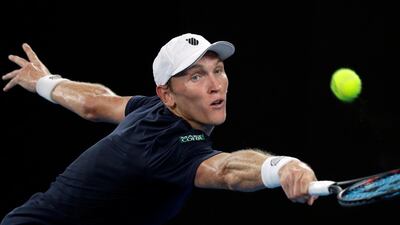
Loss of income due the coronavirus pandemic has already had a big impact on tennis player Mitchell Krueger, who has started to look for unemployment benefits.
The 26-year-old American wants to sign up for assistance but has failed so far; over the last two weeks the Dallas resident has tried, unsuccessfully, to contact the Texas Workforce Commission.
While Krueger is a professional athlete, ranked 195th in the world, he doesn’t receive a salary. He, like hundreds of players and coaches like him, need tournaments to happen so they can earn money.
While superstars like Roger Federer and Serena Williams have millions of dollars in the bank, players like Krueger face an uncertain future.
“You’re going to have a lot of players who feel they can’t survive, not making any money," Krueger told the Associated Press.
"After a while, they might get into something else, for what they think will be the meantime. Then maybe they realise, ‘Hey, this is actually better.’ If this goes on for the next nine months, who’s to say that they’re even going to bother trying to come back and play again?” said Krueger, who earned a little under $40,000 (Dh146,000) in prize money in 2020 before expenses.
“I would be lying if I said this whole situation hasn’t made me give a little bit of consideration to what I would do.”
________________
Djokovic against vaccinations
-

Novak Djokovic is against vaccination and says that could impede his return to tennis if it is made mandatory after the coronavirus crisis subsides. AP -

Novak Djokovic said he will have to take a decision if vaccination is made mandatory in tennis, if and when it gets developed. Getty Images -

World No.1 Novak Djokovic’s opposition to vaccines could stand in the way of his return to tennis once it resumes from the coronavirus pandemic. PA -

Novak Djokovic had earlier revealed he has held discussions with Roger Federer and Rafael Nadal, left, regarding creating a relief fund for players lower down in the rankings. AFP -

Roger Federer, left, and Novak Djokovic, right, along with Rafael Nadal and other senior players are being consulted about the plans for the rest of the tennis season. AFP -

Novak Djokovic of Serbia during his final singles match against Rafael Nadal of Spain during day 10 of the ATP Cup in Sydney in January. Getty Images -

Novak Djokovic after defeating Roger Federer at the 2019 Wimbledon Championships. EPA -
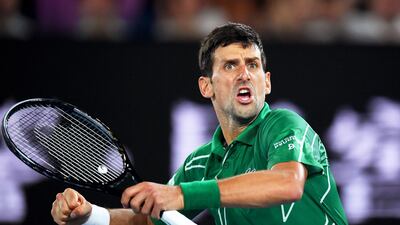
Novak Djokovic during his semi-final against Roger Federer at the Australian Open in January. EPA -

Novak Djokovic against Kevin Anderson of South Africa on day 2 of the ATP Cup in Australia in January. EPA -

Novak Djokovic is hoping to create a contingency fund for lower-ranked tennis players hit hard by the pandemic and shutdown. EPA


________________
David Haggerty, the International Tennis Federation president, had earlier said the game's governing bodies are “collaborating on a tennis solidarity fund that will assist some lower-ranked players.”
The men’s and women’s tours declined to offer specifics, other than to say they will administer the fund, which is expected to top $6 million. Separately, WTA CEO Steve Simon said his tour “delivered over $3 million in benefits since the suspension of play began,” without saying exactly where that money came from or where it went.
Novak Djokovic, who leads the ATP player council, has talked about using donations from other players to help those ranked outside the top 200. But that might not go far enough.
The 125th-ranked woman, Katarzyna Kawa of Poland, earned $22,944 in prize money in 2020; the 175th-ranked man, Carlos Taberner of Spain, $34,114.
“We are such a global sport, with people traveling all over from everywhere and to everywhere, so I don’t see how it’s going to be easy for us to resume,” said 111th-ranked Denis Kudla, a 27-year-old based in Virginia, with about $45,000 in 2020 earnings. “I could be wrong. I hope I’m wrong.”

