


The T20 World Cup in India will be the fifth time the UAE have appeared on the global stage across the sport’s two main events.
They are not quite mainstream yet, but at least increasingly recognisable on the big stage. They will be wearing a natty new blue-and-gold kit, as one of 20 countries playing in the World Cup of the international game’s fastest format. Which is all very modern, and a world away from where it all started.
The first World Cup, in 1975 in England, involved cricket’s six old elites – Australia, England, India, Pakistan, West Indies, and New Zealand – plus two invitees – East Africa and Sri Lanka. All wore whites, and innings were 60-overs per side.

The idea that the UAE might be invited would never have crossed anyone’s mind. The country, which was itself only four years old, did not yet have a single grass cricket field at the time.
Even suggesting the game was just starting to take root is a push. It had been played on British Army bases since the turn of the century, and informally among South Asian expatriates.
But it took the vision of an Emirati businessman who had grown up in a yet-to-be-developed Sharjah to lay the foundations for the sport here.
Abdulrahman Bukhatir was born while World War II was still underway, and the effects were being felt in what was then the Trucial States.
The pearl industry had collapsed. Trade was limited while the British military controlled sea and land routes because of the war effort. Even fishing was restricted.
Cricket's rise in Sharjah - in pictures
-
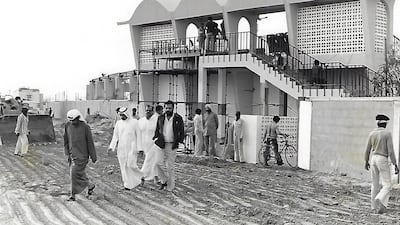
Abdulrahman Bukhatir visits the Sharjah Cricket Stadium while under construction in 1980. Photo: Sharjah Cricket -
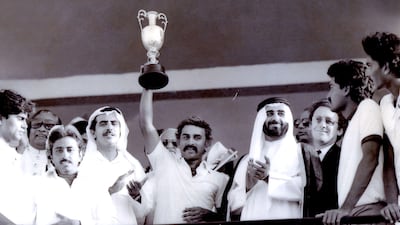
Abdulrahman Bukhatir, left, with India captain Sunil Gavaskar at the first Asia Cup that was held in Sharjah in 1984. Photo: Sharjah Cricket -
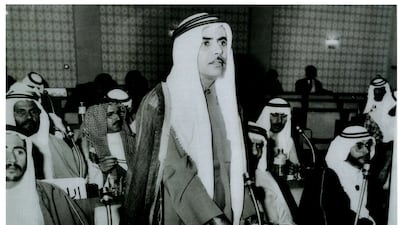
Abdulrahman Bukhatir during a session at the Federal National Council. Photo: Sharjah Cricket -

Abdulrahman Bukhatir in 13 ARB 1983 -
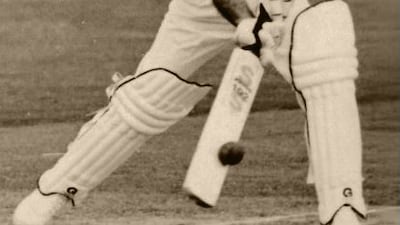
Abdulrahman Bukhatir developed a keen interest in cricket during his formative years. Photo: Sharjah Cricket -
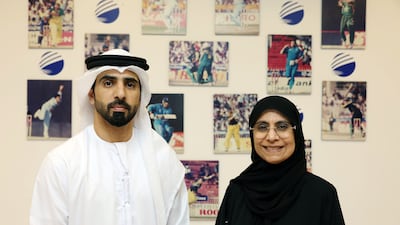
Khalaf and Safa Bukhatir, the son and daughter of Abdulrahman Bukhatir - the great patron of cricket in the UAE. Chris Whiteoak / The National -
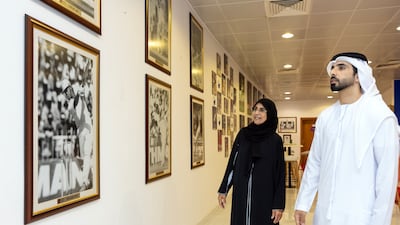
Khalaf and Safa Bukhatir at the Sharjah Cricket Stadium. Chris Whiteoak / The National -

Businessman and cricket patron Abdulrahman Bukhatir. Photo: Sharjah Cricket


“I remember my grandmother saying there was a time when we would crush grasshoppers to mix it with the bread because there was nothing to eat,” said Safa Bukhatir, his daughter.
“It is a delicacy in France now, but it wasn't a delicacy here. Those times were very, very difficult, and it was in those times where my father's generation was encouraged to pursue education.”
Safa, one of Bukhatir’s 10 children, has had the responsibility of editing the final draft of her father’s autobiography, which will be published on February 14.
It details his unlikely beginning in the sport, and the effect he had on shaping the game in a country which has become major centre for cricket.
Sharjah has staged more international matches than any other ground in the world. Dubai International Stadium, of which Bukhatir was a founding partner, is already ninth on that list, having only opened in 2009. And the sport’s governing body, the ICC, are based in Dubai.
All of which has its origins in Bukhatir opting to move to Pakistan to continue his studies after finishing primary school in Sharjah.
“He asked his father to go with him when he travelled to Karachi so he could study,” Safa said.
“There’s a lot of people in this region [who think] it's all about playing, and enjoying life. But he had that thing in him from a very early age, that said, ‘I want to go and I want to learn and I want to become something’.”

Khalaf Bukhatir, one of five brothers among the siblings, said the UAE and Pakistan of that time bore little similarity to today.
“It’s not like he was that rich person who moved there,” Khalaf said. “Comparing the lives between UAE and Pakistan, Pakistan were educated, they were rich, and we were the ones who were working there.”
When Bukhatir was 12, he had his first experience of cricket. “He remembers certain things that happened to him that made him feel small, that he never liked, and he always wanted to overcome that and become something in his life,” Khalaf said.
“He speaks about hearing kids playing behind his window. That is when the cricket started. He saw boys playing in the alley behind the house.”

The sport he saw the boys playing looked faintly similar to a traditional Arabian game played with a stick and stones, but was still mostly alien. As was the language they were speaking.
“It took courage to come down and meet kids from a different country and ask them to play with them,” Khalaf said of his father, who quickly became fluent in Urdu.
“He started making friends, and he started playing cricket with them and learning the game. There is where the love of the game came to his heart. He started playing it, and then he mastered it, and he got the passion of cricket.”
Bukhatir did not bring the game back to his homeland directly. First, he went to England to continue his studies. That was curtailed when his brother went to Baghdad for education, meaning Bukhatir was called back to work.
He took up a job in banking, which took him to Kuwait and then Khobar in Saudi Arabia. When he returned to Sharjah to live, he started a business empire which now includes construction, real estate, education and IT sections.
And, cricket. His friendship with Sharjah’s then ruler saw him allotted land in Al Khan, near the coast, to stage cricket matches.
“He had a great courage for initiatives, and many of them were risks,” Safa said. “He had that courage, plus he was a very convincing.
“Sheikh Sultan [bin Muhammad Al Qasimi] only needed Abdulrahman to speak because he knew him very well and he knew he's a very rational, logical, pragmatic, and ambitious person. He has the courage to take the initiative and see it through.”
His vision for cricket turned Sharjah into the most active centre for international cricket in the 1980s and 1990s in the world. As unlikely as it feels in the present day, that came about because of Bukhatir’s ability to bring India and Pakistan together on the field.
His children have taken over the overseeing of Sharjah Cricket, but Khalaf says his father still needs his dose of the sport.
“Even today, he must see three hours of cricket a day,” Khalaf said. “At the beginning of his day, after his physiotherapy, he will sit and watch the matches, wherever they are happening. Even if they are recorded.”
So, which team does he support? “I swear, I don't know,” Khalaf said.
“I can't tell because there were times he supported Pakistan or Australia, or in some matches, he would support one team and then in another tournament, another team.
“I think he's connected to everyone. He can’t be biased to a team. He would always base it on emotions at that time, for a reason. [If a side] has just come out of a bad time and now he wants to support them. He would rather do that than support [a particular team] all the way.”

