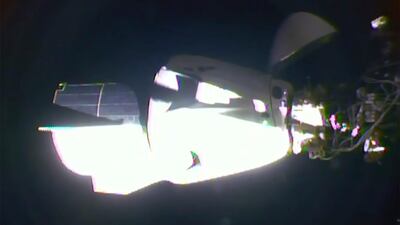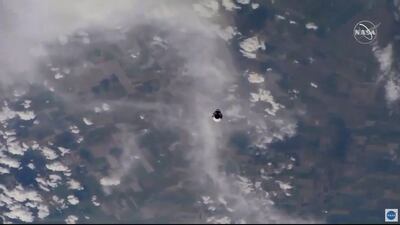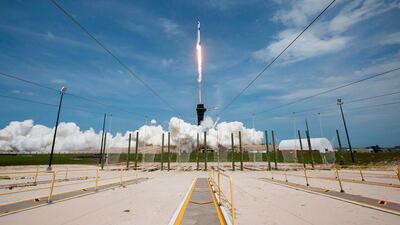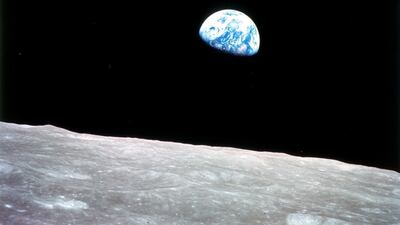
Apollo 8, the first manned mission to the moon, entered lunar orbit on Christmas Eve, Dec. 24, 1968. That evening, the astronauts-Commander Frank Borman, Command Module Pilot Jim Lovell, and Lunar Module Pilot William Anders-held a live broadcast from lunar orbit, in which they showed pictures of the Earth and moon as seen from their spacecraft. Said Lovell, "The vast loneliness is awe-inspiring and it makes you realize just what you have back there on Earth." They ended the broadcast with the crew taking turns reading from the book of Genesis. Image Credit: NASA
Apollo 8, the first manned mission to the moon, entered lunar orbit on Christmas Eve, Dec. 24, 1968. That evening, the astronauts-Commander Frank Borman, Command Module Pilot Jim Lovell, and Lunar Mod

Space exploration is about adventure, but also responsibility


  • English
  • Arabic

I never look at the Moon without being reminded of Neil Armstrong and Buzz Aldrin – and of the day, July 20, 1969, when they left their first footprints on its dusty surface. The exploit seems even more heroic in retrospect, when we realise how "primitive" the technology was: Nasa's entire suite of computers was less powerful than a single smartphone today.

Apollo 11 was only 12 years after the USSR's first Sputnik satellite launched into orbit around the Earth. Had the pace of missions been sustained in the subsequent half-century, there would surely have been footprints on Mars long before today.

But this has not happened.

The reason, of course, is that Apollo was motivated by the US strategic imperative to "beat the Russians"; it consumed up to four per cent of the US federal budget. Once US primacy was achieved, continuing gargantuan levels of funding was not justifiable, and the Apollo Programme ended in 1972 with the safe return of Apollo 17.

Hundreds more people have ventured into space in the ensuing decades, but – anti-climactically – they have done no more than circle the Earth in low orbit, mostly in the International Space Station.

Space technology has nonetheless burgeoned. There is participation from more than 70 nations, as well as the commercial sector. We routinely depend on orbiting satellites for communication, navigation, environmental monitoring, surveillance and weather forecasting. And space technology offers a huge boost to astronomers, lifting telescopes into orbits far above the blurring and absorptive effects of Earth's atmosphere.

The sector has been energised by private companies, such as Elon Musk's SpaceX and Jeff Bezos's Blue Origin. These ventures bring a can-do Silicon Valley culture into a domain long dominated by Nasa and a few aerospace conglomerates. They have developed the techniques to recover and reuse the main launch rocket, presaging real cost savings.

Machine learning is advancing quickly, as is sensor technology. In coming decades, the entire solar system – planets, moons, and asteroids – will be explored by fleets of tiny, automated probes interacting with one another like a flock of birds.

Giant robotic fabricators will construct, in space, solar energy collectors, telescopes and other giant structures. Indeed, much industrial production could eventually happen away from Earth.

Ever more capable instruments have been sent to Mars to orbit around the red planet or land on its surface. They will be joined next year by the UAE's Hope spacecraft to study the Martian climate – hopefully a pathfinder for other projects, both inspirational and practical, from the Middle East.

But the extra cost of sending humans – and returning them safely – remains significant. So will humans once again venture into what we call “deep space”, rather than simply orbiting the Earth?

To today’s young people, the Apollo programme is ancient history. It was all over long before they were ever born. Of the 12 men who walked on the moon, only three are still living. We could be nearing a time when no human has a first-hand memory of standing on another world.

Along with millions of others, I would be saddened if human exploration of deep space faded into history.

Mars is a more alluring target than the Moon, albeit more remote. I hope that some people alive today will walk on the red planet’s surface – as an adventure, and as a step towards the stars.

Nasa’s Space Shuttle, when it was operational, was launched more than 130 times. Its two crashes were national traumas because it had been promoted unwisely as a safe vehicle for civilians (and because a schoolteacher, Christa McAuliffe, was one of the casualties). Test pilots and adventurers would readily accept much more risk than the two per cent implicit in the experience of the Space Shuttle programme.

China has the resources, the dirigisme and maybe even the willingness to undertake an Apollo-style programme. It already achieved a "first" by landing on the far side of the Moon, and will surely follow this up with a manned Lunar base. But a clearer-cut "great leap forward" in Chinese space exploration would involve footprints on Mars, not just on the Moon.

Looking further ahead, the UAE envisages that, by 2117, there could be a real "city" on Mars, and it is welcome to have this inspirational goal to inspire interest among the next generation and inspire innovation in the region.

I think the future of manned spaceflight also lies with privately funded adventurers who are prepared to participate in a cut-price programme far riskier than the kind Nasa has been able to impose upon its astronauts thus far.

The phrase “space tourism” should be avoided. It lulls people into believing that such ventures are genuinely safe. And if that is the perception, the inevitable accidents will be as traumatic as those of the Shuttle. These exploits must be sold, so to speak, as dangerous sports, or intrepid exploration.

So I hope that adventurers and thrill-seekers later this century might establish a fragile base on Mars. But do not ever expect mass emigration from Earth. And here I disagree with Mr Musk and with my late Cambridge colleague Stephen Hawking, who enthuse about a rapid build-up of large-scale Martian communities.

Space does not offer an escape from all of Earth’s problems. We have got to solve these here. Coping with climate change may seem daunting, but it is simple compared to terraforming Mars. No place in our solar system offers an environment as clement as even the Antarctic, or the top of Everest. There is no “Planet B” for ordinary, risk-averse people. We must cherish our Earthly home and our global heritage – but continue to seek inspiration from the stars.

Martin Rees is the UK’s Astronomer Royal and the author of On the Future: Prospects for Humanity

Normcore explained

Something of a fashion anomaly, normcore is essentially a celebration of the unremarkable. The term was first popularised by an article in New York magazine in 2014 and has been dubbed “ugly”, “bland’ and "anti-style" by fashion writers. It’s hallmarks are comfort, a lack of pretentiousness and neutrality – it is a trend for those who would rather not stand out from the crowd. For the most part, the style is unisex, favouring loose silhouettes, thrift-shop threads, baseball caps and boyish trainers. It is important to note that normcore is not synonymous with cheapness or low quality; there are high-fashion brands, including Parisian label Vetements, that specialise in this style. Embraced by fashion-forward street-style stars around the globe, it’s uptake in the UAE has been relatively slow.

THE BIO

Favourite car: Koenigsegg Agera RS or Renault Trezor concept car.

Favourite book: I Am Pilgrim by Terry Hayes or Red Notice by Bill Browder.

Biggest inspiration: My husband Nik. He really got me through a lot with his positivity.

Favourite holiday destination: Being at home in Australia, as I travel all over the world for work. It’s great to just hang out with my husband and family.


The specs: 2017 Ford F-150 Raptor

Price, base / as tested Dh220,000 / Dh320,000

Engine 3.5L V6

Transmission 10-speed automatic

Power 421hp @ 6,000rpm

Torque 678Nm @ 3,750rpm

Fuel economy, combined 14.1L / 100km

MATCH INFO

Manchester United 1 (Fernandes pen 2') Tottenham Hotspur 6 (Ndombele 4', Son 7' & 37' Kane (30' & pen 79, Aurier 51')

Man of the match Son Heung-min (Tottenham)

Tips to avoid getting scammed

1) Beware of cheques presented late on Thursday

2) Visit an RTA centre to change registration only after receiving payment

3) Be aware of people asking to test drive the car alone

4) Try not to close the sale at night

5) Don't be rushed into a sale 

6) Call 901 if you see any suspicious behaviour

New schools in Dubai
COMPANY%20PROFILE
%3Cp%3E%3Cstrong%3EName%3A%3C%2Fstrong%3E%20Floward%0D%3Cbr%3E%3Cstrong%3EBased%3A%20%3C%2Fstrong%3ERiyadh%2C%20Saudi%20Arabia%0D%3Cbr%3E%3Cstrong%3EFounders%3A%20%3C%2Fstrong%3EAbdulaziz%20Al%20Loughani%20and%20Mohamed%20Al%20Arifi%0D%3Cbr%3E%3Cstrong%3ESector%3A%20%3C%2Fstrong%3EE-commerce%0D%3Cbr%3E%3Cstrong%3ETotal%20funding%3A%20%3C%2Fstrong%3EAbout%20%24200%20million%0D%3Cbr%3E%3Cstrong%3EInvestors%3A%20%3C%2Fstrong%3EAljazira%20Capital%2C%20Rainwater%20Partners%2C%20STV%20and%20Impact46%0D%3Cbr%3E%3Cstrong%3ENumber%20of%20employees%3A%20%3C%2Fstrong%3E1%2C200%3C%2Fp%3E%0A
WORLD CUP SEMI-FINALS

England v New Zealand

(Saturday, 12pm UAE)

Wales v South Africa

(Sunday, 12pm, UAE)


Match info

Champions League quarter-final, first leg

Liverpool v Porto, Tuesday, 11pm (UAE)

Matches can be watched on BeIN Sports

LAST-16 FIXTURES

Sunday, January 20
3pm: Jordan v Vietnam at Al Maktoum Stadium, Dubai
6pm: Thailand v China at Hazza bin Zayed Stadium, Al Ain
9pm: Iran v Oman at Mohamed bin Zayed Stadium, Abu Dhabi

Monday, January 21
3pm: Japan v Saudi Arabia at Sharjah Stadium
6pm: Australia v Uzbekistan at Khalifa bin Zayed Stadium, Al Ain
9pm: UAE v Kyrgyzstan at Zayed Sports City Stadium, Abu Dhabi

Tuesday, January 22
5pm: South Korea v Bahrain at Rashid Stadium, Dubai
8pm: Qatar v Iraq at Al Nahyan Stadium, Abu Dhabi

The specs

Engine: 4.0-litre V8 twin-turbocharged and three electric motors

Power: Combined output 920hp

Torque: 730Nm at 4,000-7,000rpm

Transmission: 8-speed dual-clutch automatic

Fuel consumption: 11.2L/100km

On sale: Now, deliveries expected later in 2025

Price: expected to start at Dh1,432,000

Results

2pm: Maiden (PA) Dh 40,000 (Dirt) 1,200m, Winner: AF Thayer, Tadhg O’Shea (jockey), Ernst Oertel (trainer).

2.30pm: Maiden (PA) Dh 40,000 (D) 1,200m, Winner: AF Sahwa, Nathan Crosse, Mohamed Ramadan.

3pm: Handicap (PA) Dh 40,000 (D) 1,000m, Winner: AF Thobor, Szczepan Mazur, Ernst Oertel.

3.30pm: Handicap (PA) Dh 40,000 (D) 2,000m, Winner: AF Mezmar, Szczepan Mazur, Ernst Oertel.

4pm: Sheikh Hamdan bin Rashid Al Maktoum Cup presented by Longines (TB) Dh 200,000 (D) 1,700m, Winner: Galvanize, Nathan Cross, Doug Watson.

4.30pm: Handicap (PA) Dh 40,000 (D) 1,700m, Winner: Ajaj, Bernardo Pinheiro, Mohamed Daggash.

States of Passion by Nihad Sirees,
Pushkin Press

The%20specs
%3Cp%3E%3Cstrong%3EEngine%3A%3C%2Fstrong%3E%201.8-litre%204-cyl%20turbo%0D%3Cbr%3E%3Cstrong%3EPower%3A%20%3C%2Fstrong%3E190hp%20at%205%2C200rpm%0D%3Cbr%3E%3Cstrong%3ETorque%3A%3C%2Fstrong%3E%20320Nm%20from%201%2C800-5%2C000rpm%0D%3Cbr%3E%3Cstrong%3ETransmission%3A%20%3C%2Fstrong%3ESeven-speed%20dual-clutch%20auto%0D%3Cbr%3E%3Cstrong%3EFuel%20consumption%3A%3C%2Fstrong%3E%206.7L%2F100km%0D%3Cbr%3E%3Cstrong%3EPrice%3A%3C%2Fstrong%3E%20From%20Dh111%2C195%0D%3Cbr%3E%3Cstrong%3EOn%20sale%3A%20%3C%2Fstrong%3ENow%3C%2Fp%3E%0A
Can NRIs vote in the election?

Indians residing overseas cannot cast their ballot abroad

Non-resident Indians or NRIs can vote only by going to a polling booth in their home constituency

There are about 3.1 million NRIs living overseas

Indians have urged political parties to extend the right to vote to citizens residing overseas

A committee of the Election Commission of India approved of proxy voting for non-resident Indians

Proxy voting means that a person can authorise someone residing in the same polling booth area to cast a vote on his behalf.

This option is currently available for the armed forces, police and government officials posted outside India

A bill was passed in the lower house of India’s parliament or the Lok Sabha to extend proxy voting to non-resident Indians

However, this did not come before the upper house or Rajya Sabha and has lapsed

The issue of NRI voting draws a huge amount of interest in India and overseas

Over the past few months, Indians have received messages on mobile phones and on social media claiming that NRIs can cast their votes online

The Election Commission of India then clarified that NRIs could not vote online

The Election Commission lodged a complaint with the Delhi Police asking it to clamp down on the people spreading misinformation

The%20US%20Congress%2C%20explained
%3Cp%3E-%20US%20Congress%20is%20divided%20into%20two%20chambers%3A%20the%20House%20of%20Representatives%20and%20Senate%3C%2Fp%3E%0A%3Cp%3E-%20435%20members%20make%20up%20the%20House%2C%20and%20100%20in%20the%20Senate%3C%2Fp%3E%0A%3Cp%3E-%20A%20party%20needs%20control%20of%20218%20seats%20to%20have%20a%20majority%20in%20the%20House%3C%2Fp%3E%0A%3Cp%3E-%20In%20the%20Senate%2C%20a%20party%20needs%20to%20hold%2051%20seats%20for%20control%3C%2Fp%3E%0A%3Cp%3E-%20In%20the%20event%20of%20a%2050-50%20split%2C%20the%20vice%20president's%20party%20retains%20power%20in%20the%20Senate%3C%2Fp%3E%0A
The specs

Engine: 2.3-litre, turbo four-cylinder

Transmission: 10-speed auto

Power: 300hp

Torque: 420Nm

Price: Dh189,900

On sale: now