FRANCE: In this handout photo provided by the National Orchestra of France on April 1, 2020, musicians are shown in the screenshot as a patchwork, each performing parts of "Bolero" alone in lockdown. National Orchestra of France via AP
NETHERLANDS: A salesperson in a converted ice cream parlour, sells his FFP2 face masks at 9 euros a piece, or 3 for 25 euros, as protection against the coronavirus in Amsterdam, on April 19, 2020. AP Photo
BELGIUM: Customers wait in line outside a Brico hardware store in Brussels, on April 18, 2020, on the first day of it's re-opening. From April 18, onwards gardening and hardware stores are allowed to receive costumers, as Belgium is in its fifth week of lockdown to stop the spread of coronavirus. AFP
LITHUANIA: A dog looks at cats through the window of the "Cat Cafe" which remains closed in Vilnius, Lithuania on April 19, 2020. In Lithuania, cafes and restaurants were closed to limit the spread of coronavirus. AFP
SLOVENIA: People ride their bicycles as a photograph by local photographer Ciril Jazbec is projected on a facade in Ljubljana on April 16, 2020, amid the outbreak of coronavirus. Galleries are closed due to the outbreak, so a group of photographers decided to exhibit their works in a slideshow projected on facades and other public spaces. AFP
CYPRUS: A family hold lighten candles symbolizing the Holy Light at the window of their apartment, as people are not allowed to attend the Orthodox Easter midnight mass, in Nicosia, on April 19, 2020. EPA
CROATIA: Two girls watch online on their computer streaming live a global concert 'One World Together at home' in Zagreb, on April 18, 2020. EPA
GERMANY: People hold a banner reading: "Everything prohibited except working" as they protest for the evacuation of refugees from camps in Greece, as the spread of coronavirus continues in Berlin, on April 19, 2020. Reuters
FINLAND: Violinist Teppo Ali-Mattila performs in an empty concert hall during the coronavirus outbreak, in Helsinki, on April 14, 2020. Reuters
SWEDEN: Erik Nyrenius during a training session with his football team in Lerum, Sweden, on April 18, 2020. Sweden has adopted more relaxed measures in response to the coronavirus outbreak in comparison to other areas of the EU. EPA
ITALY: Migrants are being transferred form the NGO boat Aita Mari to the Italian ship Rubattino, to be quarantined because of the coronavirus outbreak, off the coast of Palermo, on April 19, 2020. Reuters
POLAND: A man wears a face mask in Warsaw, on April 19, 2020, during an anniversary ceremony for the ill-fated struggle of the 1943 Warsaw Ghetto Uprising. AP Photo
SPAIN: A handout photo from the Spanish Government showing Spanish Health Minister Salvador Illa speaking during a press conference at Moncloa Presidential Palace in Madrid on April 19, 2020. EPA
PORTUGAL: Members of the National Institute for Medical Emergency and the Public Security Police (PSP) conduct an evacuation operation at a hostel in Lisbon, on April 19, 2020. EPA
FRANCE: The Ukrainian Antonov An-225 Mriya aeroplane lands at Paris-Vatry airport from China to deliver 8,6 million face masks and 150 tonnes of sanitary equipment ordered by a private customer, in Bussy Lettree, on April 19, 2020. AFP
The coronavirus pandemic is unlike any other challenge our world has faced. No one was ready for it, and many were caught off guard. As Ambassador of the European Union to the UAE, it pains me to see how normally bustling cities like Abu Dhabi, Dubai, Brussels and Milan have been brought to at a standstill.
Being Milanese myself, I saw first-hand the terrible toll this pandemic has inflicted on vulnerable people. However, to confront this pandemic, and to survive it together, we need a global response. The pandemic has painfully shown us that, more than ever before, global challenges can only be confronted by global cooperation and strong multilateral institutions.
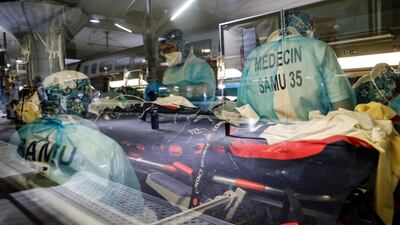
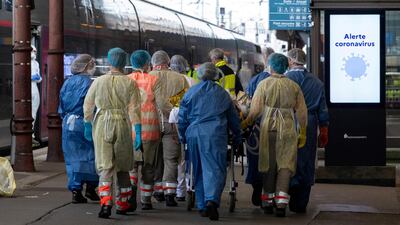
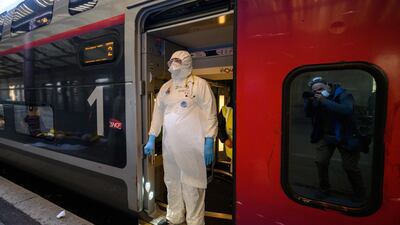
Medical staff take care of a patient infected with the coronavirus in a train at the Gare d'Austerlitz train station in Paris. Pool via AP, File
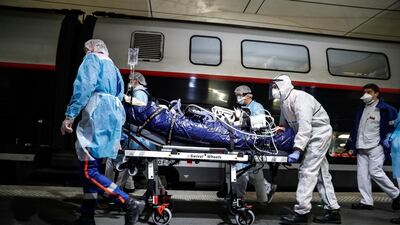
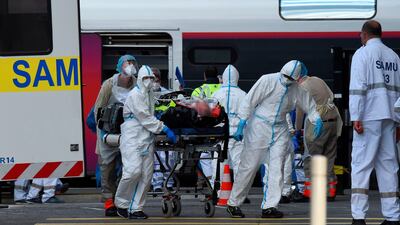
Medical staff transfer a patient infected with the coronavirus to a train at the Gare d'Austerlitz train station in Paris. Pool via AP
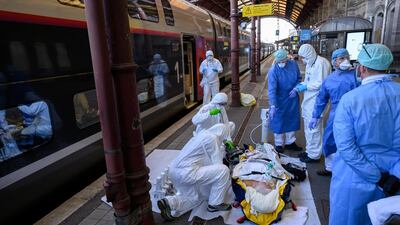
Medical staff carry a patient infected with the Covid-19 onboard a medicalized TGV high speed train at the railway station in Strasbourg. Pool via Reuters
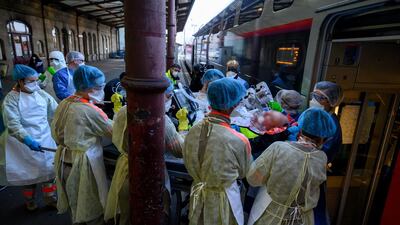
Medical staff members gather before carrying patients infected with the novel coronavirus as they arrive at the Saint-Jean train station in Bordeaux, southwestern France. AFP
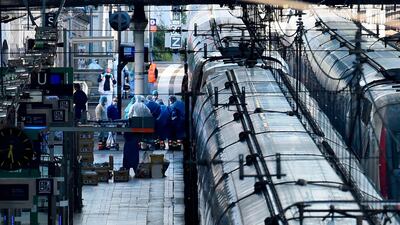
This aerial picture of the deserted Saint-Jean train station in Bordeaux, southwestern France. AFP
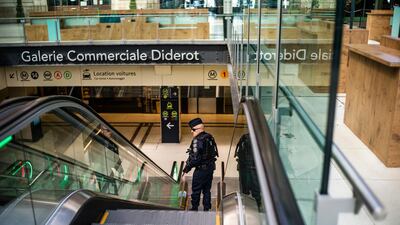
A French Police officer patrols inside an empty Gare de Lyon train station in Paris, France, 04 April 2020. EPA
Yes, it has been challenging – even confusing – to deal with this public threat.
Yes, we could have reacted more swiftly.
And yes, our continent has been severely affected.
But critics miss a crucial point: after an initial phase in which national reactions prevailed (because public health is a national competency), the EU has been quick to generate European responses in a spirit of solidarity.
Doctors and nurses were sent across border to provide help. Millions of masks and protective equipment were provided to resolve shortages abroad. Some patients were even hosted by hospitals outside of their home countries in order to alleviate pressure on the hardest hit areas.
Therefore, based on our past, I would venture a prediction. Throughout European history, what has not killed the EU has made it stronger. It is in crises that the EU rises to the challenge. With a greater sense of the common good that binds us together, I am confident that the coronavirus will leave us stronger than ever.
Critics have said the pandemic has left the EU in disarray; I strongly beg to differ
We are now putting everything we have into doing everything we can to prevent further spread of the virus. We are protecting citizens in Europe and around the world, supporting those in need. We have worked on ensuring smooth border management and the flow of goods. We have adopted strong measures to protect our economies and support vulnerable workers, families and businesses.
The EU and the European Central Bank have injected record amounts into the economy, paving the way for its recovery. Beyond the borders of our continent, we are working with our international partners, including the UAE, to repatriate thousands of EU citizens stranded abroad. So far, this has allowed some 500,000 Europeans to go home.
We are also devoting huge resources towards the development of a vaccine. The EU has mobilised €140 million to fund vaccine research, as well as the diagnosis and treatment of Covid-19. Some of our companies are at the forefront of the race to find a safe vaccine. This will not only benefit Europeans, but all of humanity.
The EU is taking the lead in developing a truly global agenda for enhanced pandemic preparedness. The President of the European Commission, Ursula von der Leyen, has called for a global online pledging conference to be hosted on May 4. This will further accelerate work towards the development of possible treatments against the virus and bring an effective vaccine further within our reach. “This is our collective best shot at beating the virus,” Mrs von der Leyen said.
To promote international solidarity, the EU and its Member States are also contributing to the UN's worldwide humanitarian call to help countries with the most fragile health systems. So far, the EU has mobilised more than €400 million to boost global preparedness, prevention and containment of the virus. This shows a Europe that has not only the interest of its own people at heart, but also those of the rest of the world.
And, thankfully, we are not alone in this. The UAE has also shown its leadership and generosity at this critical time. Its massive testing programme and the quality of its healthcare system are remarkable. The dedication of frontline employees in this country are commendable: doctors, nurses, teachers, supermarket staff, community police, delivery workers and all those who perform critical functions for our wellbeing are our heroes. And we are proud that many of these jobs are being carried out by Europeans living in the UAE.
I also commend the Emirati leadership in taking a leading role in international solidarity – from deliveries of medical supplies to countries in need to helping reunite a seven-year old European girl with her family in Abu Dhabi. Emirati flights delivering critical medical equipment to European countries such as Italy, Bulgaria, Cyprus and Croatia have not gone unnoticed. These and other Emirati solidarity gestures to vulnerable countries in this region and beyond have weakened the impact of the pandemic worldwide.
This is what mankind needs right now. Only united we can deal a death blow to this virus. We will then find ourselves in a changed world. Hopefully, it will be a world characterised by mutual care, compassion, comprehension and solidarity.
Andrea Matteo Fontana is the European Union Ambassador to the UAE

UAE currency: the story behind the money in your pockets
SolarWinds supply chain attack: Came to light in December 2020 but had taken root for several months, compromising major tech companies, governments and its entities
Microsoft Exchange server exploitation: March 2021; attackers used a vulnerability to steal emails
Kaseya attack: July 2021; ransomware hit perpetrated REvil, resulting in severe downtime for more than 1,000 companies
Log4j breach: December 2021; attackers exploited the Java-written code to inflitrate businesses and governments
Goalkeepers: Ali Khaseif, Fahad Al Dhanhani, Mohammed Al Shamsi, Adel Al Hosani
Defenders: Bandar Al Ahbabi, Shaheen Abdulrahman, Walid Abbas, Mahmoud Khamis, Mohammed Barghash, Khalifa Al Hammadi, Hassan Al Mahrami, Yousef Jaber, Salem Rashid, Mohammed Al Attas, Alhassan Saleh
Midfielders: Ali Salmeen, Abdullah Ramadan, Abdullah Al Naqbi, Majed Hassan, Yahya Nader, Ahmed Barman, Abdullah Hamad, Khalfan Mubarak, Khalil Al Hammadi, Tahnoun Al Zaabi, Harib Abdallah, Mohammed Jumah, Yahya Al Ghassani
Forwards: Fabio De Lima, Caio Canedo, Ali Saleh, Ali Mabkhout, Sebastian Tagliabue, Zayed Al Ameri
Who's who in Yemen conflict
Houthis: Iran-backed rebels who occupy Sanaa and run unrecognised government
Yemeni government: Exiled government in Aden led by eight-member Presidential Leadership Council
Southern Transitional Council: Faction in Yemeni government that seeks autonomy for the south
Habrish 'rebels': Tribal-backed forces feuding with STC over control of oil in government territory
65 - Henrik Stenson (SWE), Sebastian Soderberg (SWE), Adri Arnaus (ESP), Victor Perez (FRA), Jhonattan Vegas (VEN)
66 - Phil Mickelson (USA), Tom Lewis (ENG), Andy Sullivan (ENG), Ross Fisher (ENG), Aaron Rai (ENG), Ryan Fox (NZL)
67 - Dustin Johnson (USA), Sebastian Garcia Rodriguez (ESP), Lucas Herbert (AUS), Francesco Laporta (ITA), Joost Luiten (NED), Soren Kjeldsen (DEN), Marcus Kinhult (SWE)
68 - Alexander Bjork (SWE), Matthieu Pavon (FRA), Adrian Meronk (POL), David Howell (ENG), Christiaan Bezuidenhout (RSA), Fabrizio Zanotti (PAR), Sean Crocker (USA), Scott Hend (AUS), Justin Harding (RSA), Jazz Janewattananond (THA), Shubhankar Sharma (IND), Renato Paratore (ITA)
If you go...
Flying
There is no simple way to get to Punta Arenas from the UAE, with flights from Dubai and Abu Dhabi requiring at least two connections to reach this part of Patagonia. Flights start from about Dh6,250.
Touring
Chile Nativo offers the amended Los Dientes trek with expert guides and porters who are met in Puerto Williams on Isla Navarino. The trip starts and ends in Punta Arenas and lasts for six days in total. Prices start from Dh8,795.
Favourite breed of dog: All of them. I can’t possibly pick a favourite.
Favourite place in the UAE: The Stray Dogs Centre in Umm Al Quwain. It sounds predictable, but it honestly is my favourite place to spend time. Surrounded by hundreds of dogs that love you - what could possibly be better than that?
Favourite colour: All the colours that dogs come in
For first two Test in India Joe Root (captain), Jofra Archer, Moeen Ali, James Anderson , Dom Bess, Stuart Broad , Rory Burns, Jos Buttler, Zak Crawley, Ben Foakes, Dan Lawrence, Jack Leach, Dom Sibley, Ben Stokes, Olly Stone, Chris Woakes. Reserves James Bracey, Mason Crane, Saqib Mahmood, Matthew Parkinson, Ollie Robinson, Amar Virdi.
Emirates flies from Dubai to Seattle from Dh5,555 return, including taxes. Portland is a 260 km drive from Seattle and Emirates offers codeshare flights to Portland with its partner Alaska Airlines.
The car
Hertz (www.hertz.ae) offers compact car rental from about $300 per week, including taxes. Emirates Skywards members can earn points on their car hire through Hertz.
Parks and accommodation
For information on Crater Lake National Park, visit www.nps.gov/crla/index.htm. Because of the altitude, large parts of the park are closed in winter due to snow. While the park’s summer season is May 22-October 31, typically, the full loop of the Rim Drive is only possible from late July until the end of October. Entry costs $25 per car for a day. For accommodation, see www.travelcraterlake.com. For information on Umpqua Hot Springs, see www.fs.usda.gov and https://soakoregon.com/umpqua-hot-springs/. For Bend, see https://www.visitbend.com/.
Keep it fun and engaging
Stuart Ritchie, director of wealth advice at AES International, says children cannot learn something overnight, so it helps to have a fun routine that keeps them engaged and interested.
“I explain to my daughter that the money I draw from an ATM or the money on my bank card doesn’t just magically appear – it’s money I have earned from my job. I show her how this works by giving her little chores around the house so she can earn pocket money,” says Mr Ritchie.
His daughter is allowed to spend half of her pocket money, while the other half goes into a bank account. When this money hits a certain milestone, Mr Ritchie rewards his daughter with a small lump sum.
He also recommends books that teach the importance of money management for children, such as The Squirrel Manifesto by Ric Edelman and Jean Edelman.
Timeline
2012-2015
The company offers payments/bribes to win key contracts in the Middle East
May 2017
The UK SFO officially opens investigation into Petrofac’s use of agents, corruption, and potential bribery to secure contracts
September 2021
Petrofac pleads guilty to seven counts of failing to prevent bribery under the UK Bribery Act
October 2021
Court fines Petrofac £77 million for bribery. Former executive receives a two-year suspended sentence
December 2024
Petrofac enters into comprehensive restructuring to strengthen the financial position of the group
May 2025
The High Court of England and Wales approves the company’s restructuring plan
July 2025
The Court of Appeal issues a judgment challenging parts of the restructuring plan
August 2025
Petrofac issues a business update to execute the restructuring and confirms it will appeal the Court of Appeal decision
October 2025
Petrofac loses a major TenneT offshore wind contract worth €13 billion. Holding company files for administration in the UK. Petrofac delisted from the London Stock Exchange
6.30pm: Sheikh Zayed bin Sultan Al Nahyan Jewel Crown Prep Rated Conditions (PA) Dh 125,000 (T) 2,200m. Winner: Somoud, Richard Mullen, Jean de Roualle.
7pm: Wathba Stallions Cup Handicap (PA) Dh 70,000 (T) 1,600m. Winner: AF Arrab, Tadhg O’Shea, Ernst Oertel.
Thu Mar 15 – West Indies v Afghanistan, UAE v Scotland
Fri Mar 16 – Ireland v Zimbabwe
Sun Mar 18 – Ireland v Scotland
Mon Mar 19 – West Indies v Zimbabwe
Tue Mar 20 – UAE v Afghanistan
Wed Mar 21 – West Indies v Scotland
Thu Mar 22 – UAE v Zimbabwe
Fri Mar 23 – Ireland v Afghanistan
The top two teams qualify for the World Cup
Classification matches
The top-placed side out of Papua New Guinea, Hong Kong or Nepal will be granted one-day international status. UAE and Scotland have already won ODI status, having qualified for the Super Six.
Thu Mar 15 – Netherlands v Hong Kong, PNG v Nepal
Sat Mar 17 – 7th-8th place playoff, 9th-10th place playoff
So what is Spicy Chickenjoy?
Just as McDonald’s has the Big Mac, Jollibee has Spicy Chickenjoy – a piece of fried chicken that’s crispy and spicy on the outside and comes with a side of spaghetti, all covered in tomato sauce and topped with sausage slices and ground beef. It sounds like a recipe that a child would come up with, but perhaps that’s the point – a flavourbomb combination of cheap comfort foods. Chickenjoy is Jollibee’s best-selling product in every country in which it has a presence.
Race card
6.30pm: Al Maktoum Challenge Round-3 Group 1 (PA) US$100,000 (Dirt) 2,000m
6.30pm: Shahm, 7.05pm: Well Of Wisdom, 7.40pm: Lucius Tiberius, 8.15pm: Captain Von Trapp, 8.50pm: Secret Advisor, 9.25pm: George Villiers, 10pm: American Graffiti, 10.35pm: On The Warpath
First Job: Abu Dhabi Department of Petroleum in 1974
Current role: Chairperson of Al Maskari Holding since 2008
Career high: Regularly cited on Forbes list of 100 most powerful Arab Businesswomen
Achievement: Helped establish Al Maskari Medical Centre in 1969 in Abu Dhabi’s Western Region
Future plan: Will now concentrate on her charitable work