

April 30 marks the 45th anniversary of the fall of Saigon at the end of the Vietnam War, although the famous picture of the evacuation from the rooftop of the American embassy was taken the previous day, on April 29, 1975.
The anniversary will pass without much global attention – in part because much of the world's gaze is fixed on the present-day Covid-19 crisis – although it has been pointed out that more than 58,000 US servicemen died or are missing in action in Vietnam, while more than that number of people in the US have so far lost their lives to the coronavirus. To put those numbers into historical perspective, more than three million Vietnamese died in the same conflict.
Another anniversary from another conflict – the "war to end all wars" – went by quietly last week.

The 105th anniversary of the first deadly use of chemical weapons during the First World War at the Second Battle of Ypres was on April 22. The moment was observed with dignity at the Menin Gate Memorial to the Missing in Belgium, with the Last Post being played through the streets of a town in lockdown.
It is worth recalling the events that sparked such sombre remembrance.
Historical accounts of April 22, 1915 suggest that those soldiers fighting on the Western Front woke to the kind of cloudless skies that many of us seem to be living under today.
It was warm, too, especially so for a northern European spring day in Ypres and, crucially, a fresh breeze softened the sunshine. A strange sound announced the beginning of the chemical weapons attack late that afternoon.
According to George H Cassar's 2010 book, Hell in Flanders Fields, "French troops heard a loud hissing noise coming from the German lines. As it continued, they saw an approaching greenish-yellow cloud".
-
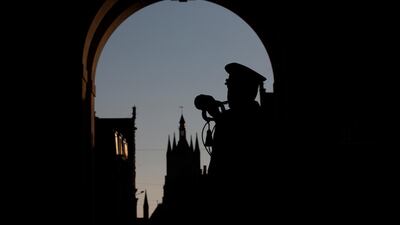
A lone bugler plays the nightly Last Post under the First World War monument, Menin Gate, in Ypres, Belgium last Saturday. All commemorative ceremonies, honouring thousands of Australians and New Zealanders who fought during the war in Belgium, were cancelled this year due to the coronavirus pandemic. AP Photo -
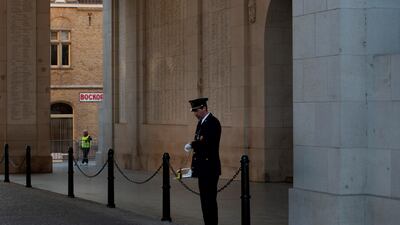
A lone bugler looks at his clock before playing the nightly Last Post under the First World War monument, Menin Gate, in Ypres, Belgium last Saturday. AP Photo -
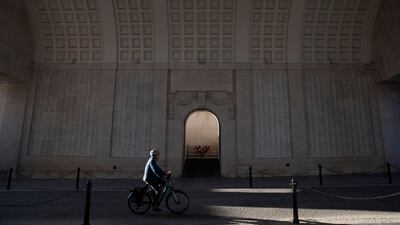
A man cycles under the First World War monument, Menin Gate, in Ypres, Belgium last Saturday. AP Photo -

A man stands in the sunlight under the First World War monument, Menin Gate, in Ypres, Belgium last Saturday. AP Photo -
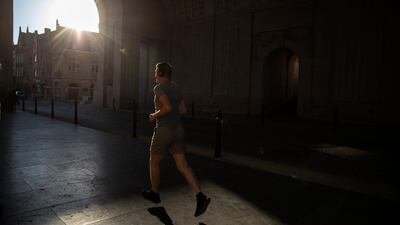
A man jogs under the First World War monument, Menin Gate, in Ypres, Belgium last Saturday. AP Photo -

A lone bugler looks at a wall with the names of the missing prior to playing the nightly Last Post under the First World War monument, Menin Gate, in Ypres, Belgium last Saturday. AP Photo


The coloured fumes, which were later found to have been the product of more than 160 tonnes of pressurised liquid chlorine, initially caused confusion among the ranks of soldiers: some thought them to be a smokescreen that had been set up to mask oncoming German troops, others believed it to be the discharge from spent munitions.
Both assumptions quickly unravelled as the smoke drifted towards a trench manned by Algerian soldiers, part of the so-called Army of Africa branch of the French military, in which men from Morocco and Tunisia also served.
Within seconds, Cassar continues: “The men choked, their eyes and lungs burned and they were gripped by violent nausea and stabbing pains in the chest.”
-
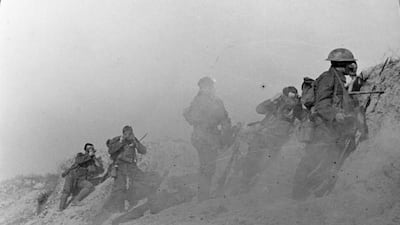
During the Second Battle of Ypres, the Germans released more than 160 tonnes of chlorine gas at the front, in the first deadly gas attack of the war. Getty Images -
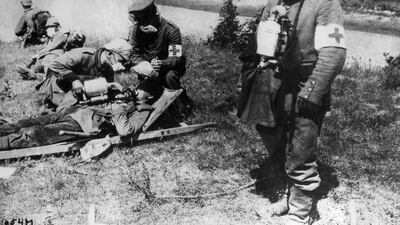
German Red Cross members treat victims of a gas attack during the First World War. AP Photo -

German soldiers after a gas attack during the First World War. Getty Images -
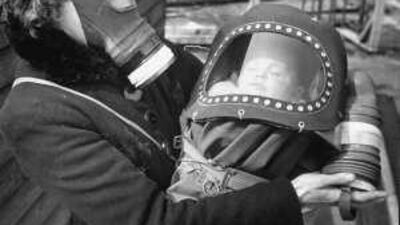
In the Second World War, they had gas masks to guard against noxious fumes. -
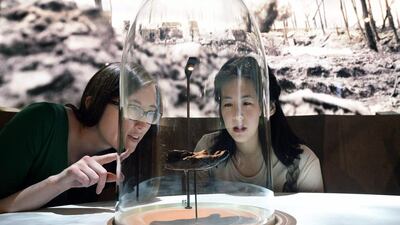
Museum staff look over an officer's glove shrunk by poison gas at the First World War Galleries exhibit at the Imperial War Museum in London. EPA -
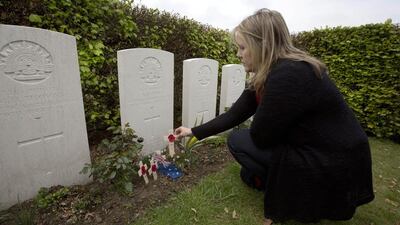
Kaylene Biggs, great-granddaughter Australian soldier Andrew Bayne, places a wooden cross with a poppy and a message on the grave at Westhof Farm Commonwealth Cemetery in Nieuwkerke, Belgium. AP Photo


As the smoke moved on, other troops spilled out of the trenches and tried to outrun the cloud, but the wind was by then too strong for them. It was a horrific scene. Around 1,000 soldiers died in the attack.
Far from creating moral outrage, the incident propelled an intense arms race.
An estimated 100,000 tonnes of chemical weapons were used by both sides before the war ended in 1918, by which time the death toll from gas attacks ran into the tens of thousands, with at least a million more injured as a direct result of their use.
Later this year, the 95th anniversary of the accord that was designed to prevent their further use was signed, although the Geneva Protocol of June 1925 and its successors, including the 1997 Chemical Weapons Convention, have sometimes proved a blunt sword to wield.
Despite the horrors of Ypres in 1915, chemical weapons remain a persistent and pernicious feature of the Syrian conflict.
In August 2013, a chemical weapons attack by Bashar Al Assad's regime in Ghouta appeared to be the moment when inertia within the international community over the civil war would be replaced by action.
Instead, the then US president Barack Obama and other prominent members of the international community walked their way back from possible confrontation by talking dismissively of "someone else's civil war" that they had no right to meddle with. Clear red lines were blurred in the prevarication.
As in Europe in 1915, the events in Syria seven years ago produced the opposite result to the one the situation compelled.
-
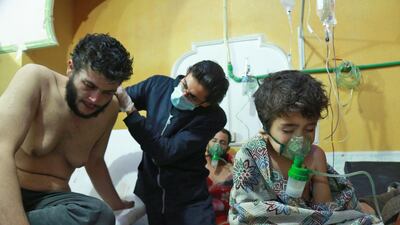
Syrian children and adults receive treatment for a suspected chemical attack at a makeshift clinic on the outskirts of Damascus on February 25, 2018. AFP -

Members of a family from Douma, Syria, who fled after enduring weeks of bombing, near-starvation from a crippling siege and a suspected chemical attack, stand outside a tent in a northern Syrian displaced-persons camp on May 29, 2018. AP -
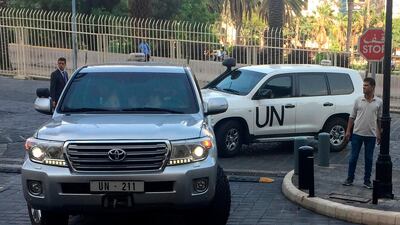
UN vehicles carrying the team of the Organization for the Prohibition of Chemical Weapons arrive at a hotel in Damascus on April 14, 2018, hours after the U.S., France and Britian launched an attack on Syrian facilities for suspected chemical attack against civilians. AP -

Syrian authorities distributed bread, vegetables and pasta to residents of Douma, the site of a chemical weapons attack suspected to have been carried out by the Syrian government, on April 16, 2018. AP Photo -
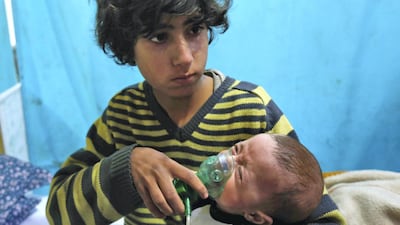
A Syrian boy holds an oxygen mask over the face of an infant at a make-shift hospital following a reported gas attack on the town of Douma, Syria, on January 22, 2018. AFP -
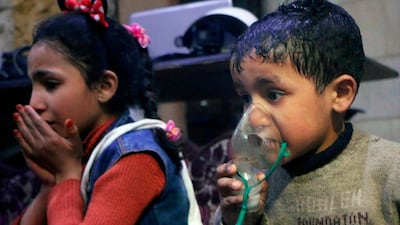
A child receiving oxygen through a respirator following an alleged poison gas attack in Douma on April 8, 2018. Syrian Civil Defense White Helmets via AP -
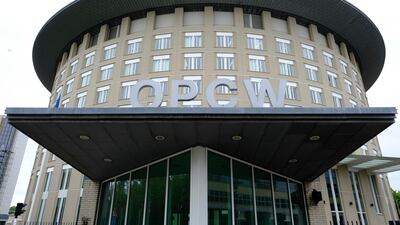
The headquarters of the Organisation for the Prohibition of Chemical Weapons, The Hague, Netherlands. AP -
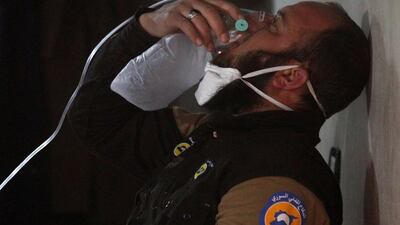
A civil defence member breathes through an oxygen mask after the sarin gas attack on Khan Sheikhoun on April 4, 2017. Reuters


The abuses have continued, despite the Assad regime agreeing to dispense with his chemical weapons in the aftermath of the Ghouta attack.
The country's stockpile was said to have been destroyed by 2014, but the list of chemicals that have been used in Syria since then reads like a roll call of terror: sarin, chlorine and white phosphorus.
Earlier this month, the Organisation for the Prohibition of Chemical Weapons categorically confirmed that Syrian regime forces repeatedly attacked Ltamenah, a rebel town, in 2017 using chemical weapons under orders that could only have come from the top. There have been many other incidents, too.
Mr Al Assad's Syria is a broken country that will take decades to reconstruct when the war ends. When that moment comes, truth and reconciliation represent the only way through the smouldering rubble. The actions and verifications of the OPCW and others will prove crucial.
Those who perpetrated illegal acts must be brought to justice. Their crimes must be recounted. Their punishment must reflect the severity of their actions.
The only way forward is to match barbarity with the rule of law. Some of that process is currently under way at a trial of two former Syrian intelligence officers in Germany, who are accused of torture.
While their trial is a small piece in a vast jigsaw, it is still a signal that the path to reconciliation among a fractured society can only be found through truth and justice. It is also a sign that only by confronting the past and breaking the anguish of the present can the future be truly realised.
Nick March is an assistant editor-in-chief at The National

