


How much are "two balls of roasted snow" worth? Not much. But this is what Nobel laureate John Hume famously gave for those who suggested that he was on the wrong path to building peace in Northern Ireland.
His remark pointed to a single-mindedness that alienated party colleagues, earned him media criticism and led to him being accused of delivering his so-called single transferable speech – the same points over and over again.
But Hume, who died on Monday aged 83, had the last laugh because the post-nationalist vision he so relentlessly championed ended up at the heart of the Good Friday Agreement, the 1998 deal that took Northern Ireland, as one observer put it, "from something like war, to something like peace".
In an age of reality-TV presidents, Hume’s death sees him re-emerge as a figure of the utmost seriousness. Not in his personal dealings – the Derryman could be affable, and his singing was up there with the best of Ireland’s famously musical politicians – but his fixation on ending decades of discrimination as well as paramilitary and state violence energised and consumed him.
-
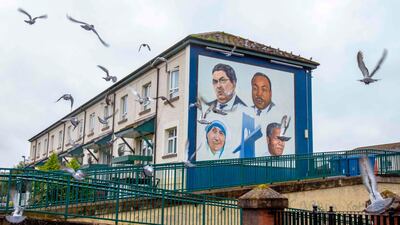
Pigeons fly past a mural depicting John Hume and other Nobel laureates, Martin Luther King Jr, Mother Teresa and Nelson Mandela in Derry, Northern Ireland. AFP -
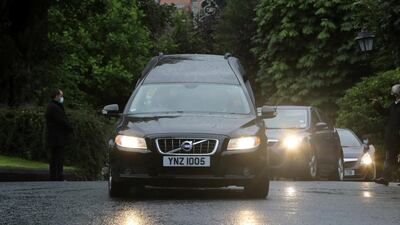
The funeral procession of John Hume arrives at St Eugene's Cathedral in Derry on Tuesday. Reuters -

Mourners waiting for the funeral procession of John Hume gather outside St Eugene's Cathedral. Reuters -
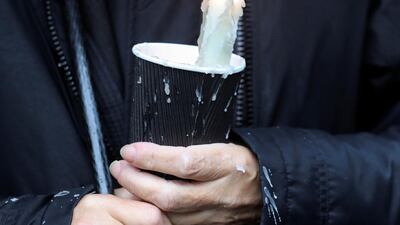
A mourner waiting for the funeral procession of John Hume holds a candle outside St Eugene's Cathedral. Reuters -
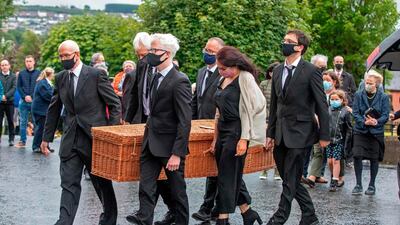
The remains of John Hume are taken into St Eugene's Cathedral. AFP -

Members of the family carry the coffin of John Hume into St Eugene's Cathedral. AP Photo -
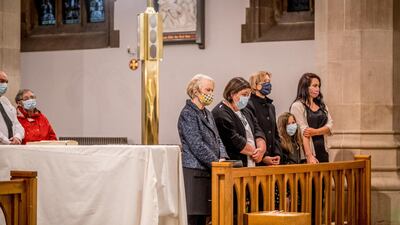
Pat Hume, left, is pictured alongside family members as her late husband John Hume lies at rest in St Eugene's Cathedral. Getty Images -
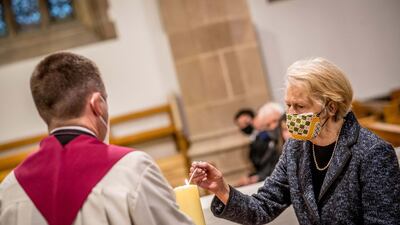
Pat Hume, right, lights a candle at St Eugene's Cathedral. Getty Images -
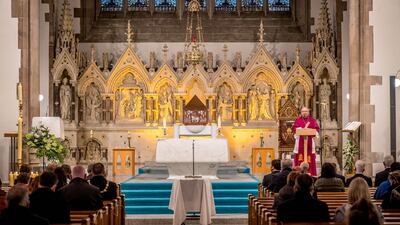
John Hume lies at rest in St Eugene's Cathedral. Getty Images -

Colum Eastwood, the current leader of the Social Democratic and Labour Party, speaks to the media while waiting for the funeral of John Hume outside St Eugene's Cathedral. Reuters -
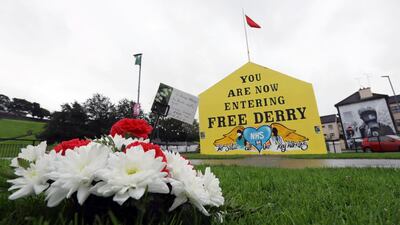
A floral tribute in memory of John Hume is pictured at the Free Derry Corner in Derry. Reuters -
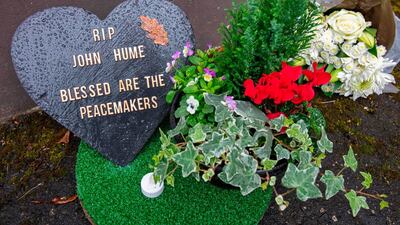
A floral tribute is pictured at the Free Derry wall in the Bogside area for John Hume in Derry. AFP -

A photograph and message is pictured at the Free Derry wall in the Bogside area for John Hume in Derry. AFP -
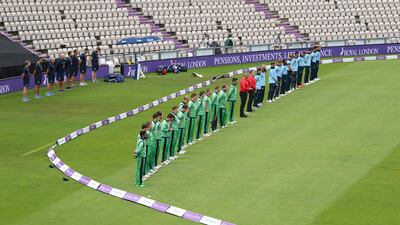
Cricketers and umpires observe a minute's silence for John Hume - a cricket fan - as play resumes behind closed doors following the outbreak of Covid-19 in Southampton on Tuesday. Reuters


This is not the stuff of the career politician. Hume, who had already displayed his innate seriousness by initially choosing to study for the priesthood, turned to the distinctly unglamorous grind of local politics in Derry. Housing rights, schools, visiting those picked up by the police or British army: Hume and those around him knew first-hand what the absence of peace looked and felt like.
Hume often said it was his role in the credit union movement – in which my maternal grandfather John McCluskey rubbed shoulders with the young future Nobel laureate – that gave him most pride.
Still, then, a world away from international peace conferences and Nobel Prizes, Hume had decided early on how a settlement in Northern Ireland would look, and would to talk to anyone to make it a reality. For him, making peace in this way would mean considerable personal and political sacrifice.
Disgruntled colleagues in his Social Democratic and Labour Party accused him of ignoring their advice, particularly over the divisive issue of talking to the republican movement. One suspects Hume knew that bringing Gerry Adams and Sinn Fein into the political process would spell disaster for the SDLP – this sort of political sacrifice to achieve a goal has few parallels.
On a personal level, too, he suffered. Photographs of Hume, weeping at the gravesides of eight people gunned down by loyalist paramilitaries in 1993, made it clear he knew full well the price of failure and the need to persevere, even when the odds seemed stacked against him. That he fell into dementia in his later years, his achievements shrouded in a fog of forgetting, seemed an extravagant cruelty.
Being a “peacemaker” can sometimes be unfairly conflated with a hippy-ish, milquetoast tendency. But Hume’s triumph reveals the patience, pragmatism and persistence needed to be left at the end of the day holding more than a handful of roasted snow.
Declan McVeigh is a sub-editor for The National

