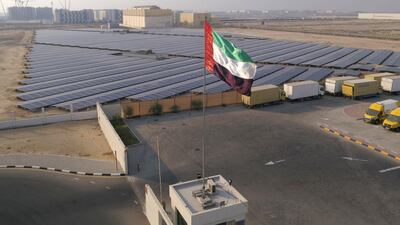
The UAE’s largest ground-mounted private solar plant at Nestle Middle East’s Al Maha factory in Dubai. The UAE intends to derive 44% of its power requirements from clean energy by 2050.
Whatever our new normal looks like, it will be defined by the actions that we take now, during the more difficult moments of the coronavirus pandemic, which has turned our world upside down. Amid the sea of dark and gloomy clouds that have gathered in the skies of 2020, there are some strong silver linings – unexpected ripples of hope that we cannot afford to let evaporate with the eventual passing of the Covid-19 storm.
Perhaps the most striking silver lining is the sudden burst of environmental health and radiance that Earth is enjoying. With traditional energy consumption plummeting by as much as six per cent across the globe since the start of the year, carbon emissions have fallen at a similar rate. The Himalayas are visible from certain parts of India for the first time in 30 years. There is a sudden profusion of marine life swimming in the waters of Sardinia. And in the UAE, rays have been seen meandering through the Dubai Canal and Dubai Marina.
Mother Nature is breathing again.
But with this momentary resuscitation, we must heed a critical warning from recent history. In the immediate aftermath of the global financial crisis in 2008/09, carbon emissions dropped by 1.4 per cent, according to statistics published by the Global Carbon Project in 2011. But this respite was short-lived. As the economy began to pick back up, industry went full throttle to regain what revenue had been lost. Subsequently, carbon emissions rocketed by up to 5.9 per cent, totally eclipsing any environmental recovery our planet had just experienced.
The rush to return to “business as usual” led to a decade of unprecedented greenhouse gas emissions and the hottest 10 years in human history, and the 2010s will be remembered as the years that sent us hurtling towards a potentially catastrophic 3.2 degrees Celsius of global warming.
Dr Nawal Al Hosany warns the world cannot return to 'business as usual' after it recovers from the pandemic. Victor Besa / The National
We cannot afford to repeat the same mistakes. This time, we must get it right. We cannot revert to the same paradigm that stemmed from an unsustainable economic model which valued unmitigated growth at the expense of all else and focused on a toxic, ecologically disastrous pursuit of short-term rewards. The old attitude of getting the economy back on track at the expense of the planet must fundamentally change.
The solution to this problem was the topic of discussion at the first Renewables Talks session, co-hosted by the International Renewable Energy Agency (Irena) and the UAE Mission to Irena from Abu Dhabi last week. More than 100 members dialled in for the webinar, and they came to a consensus: the world needs to harness renewable energy to energise a sustainable economic recovery.
How we do that is the next important step. As Irena's first Global Renewables Outlook (GRO) report makes clear in its prediction of energy scenarios up to 2050, the worldwide recovery from the Covid-19 disruption can only be led by the global energy transition if we collaborate to integrate renewable energy stimulus packages into national budgets across the planet. As an interconnected international community, Irena is well-placed to influence this imperative call to action.
In this February 6, 1969 file photo, state forestry conservation crews gather up oil-soaked straw on a beach in Santa Barbara, California. More than 50 years after the first Earth Day helped spur activism over pollution, significant improvements are undeniable but monumental challenges remain. AP Photo
Indeed, the GRO report suggests that renewable solutions could add $98 trillion to the global economy in 30 years’ time, promising more jobs, greater economic growth, cleaner living conditions and significantly improved welfare in a sustainable, low-carbon climate that lays the foundations for stable, long-term economic development.
The scenarios outlined in the Energy Transformation 2050 report, published in April 2020, build from the position we have arrived at since Irena’s inception in 2010. In the past decade, the world has invested $3tn in renewables, which has more than doubled installed renewable energy capacity. Renewables today account for around a quarter of global power generation and represent a third of global power capacity. And the costs of solar and wind power have fallen significantly, meaning they are now often the cheapest sources of new energy capacity.
The UAE has invested billions into renewable energy sources. AFP
With this amount of wind in its sails, the global energy transformation cannot simply be blown off course by volatile oil prices or Covid-19 on our path towards the decarbonisation of our societies and economies.
That is not to say that neither of these factors will affect our journey to a greener future. Of course they will. The havoc caused to global supply chains will have a direct bearing on the renewables industry, with parts, materials and supplies for projects being shipped from all over the world. The severity of its impact remains to be seen.
But even in the worst of times, we cannot lose sight of our goals. Seeing through the global energy transition in time to avoid cataclysmic climate change requires intensified international co-operation, a value that lies at the beating heart of Irena and its member states. Our aim is to enable institutions to adopt a variety of ambitious policies that strengthen public resolve and ensure no one is left behind as we build a brighter future for all.
Dr Nawal Al Hosany is the UAE’s permanent representative to Irena

MATCH INFO
Uefa Champions League final:
Who: Real Madrid v Liverpool Where: NSC Olimpiyskiy Stadium, Kiev, Ukraine When: Saturday, May 26, 10.45pm (UAE) TV: Match on BeIN Sports
Infiniti QX80 specs
Engine: twin-turbocharged 3.5-liter V6
Power: 450hp
Torque: 700Nm
Price: From Dh450,000, Autograph model from Dh510,000
The idea of pound parity now seems less far-fetched as the risk grows that Britain may split away from the European Union without a deal.
Rupert Harrison, a fund manager at BlackRock, sees the risk of it falling to trade level with the dollar on a no-deal Brexit. The view echoes Morgan Stanley’s recent forecast that the currency can plunge toward $1 (Dh3.67) on such an outcome. That isn’t the majority view yet – a Bloomberg survey this month estimated the pound will slide to $1.10 should the UK exit the bloc without an agreement.
New Prime Minister Boris Johnson has repeatedly said that Britain will leave the EU on the October 31 deadline with or without an agreement, fuelling concern the nation is headed for a disorderly departure and fanning pessimism toward the pound. Sterling has fallen more than 7 per cent in the past three months, the worst performance among major developed-market currencies.
“The pound is at a much lower level now but I still think a no-deal exit would lead to significant volatility and we could be testing parity on a really bad outcome,” said Mr Harrison, who manages more than $10 billion in assets at BlackRock. “We will see this game of chicken continue through August and that’s likely negative for sterling,” he said about the deadlocked Brexit talks.
The pound fell 0.8 per cent to $1.2033 on Friday, its weakest closing level since the 1980s, after a report on the second quarter showed the UK economy shrank for the first time in six years. The data means it is likely the Bank of England will cut interest rates, according to Mizuho Bank.
The BOE said in November that the currency could fall even below $1 in an analysis on possible worst-case Brexit scenarios. Options-based calculations showed around a 6.4 per cent chance of pound-dollar parity in the next one year, markedly higher than 0.2 per cent in early March when prospects of a no-deal outcome were seemingly off the table.
Members of Syria's Alawite minority community face threat in their heartland after one of the deadliest days in country’s recent history. Read more
Skewed figures
In the village of Mevagissey in southwest England the housing stock has doubled in the last century while the number of residents is half the historic high. The village's Neighbourhood Development Plan states that 26% of homes are holiday retreats. Prices are high, averaging around £300,000, £50,000 more than the Cornish average of £250,000. The local average wage is £15,458.
Mercer, the investment consulting arm of US services company Marsh & McLennan, expects its wealth division to at least double its assets under management (AUM) in the Middle East as wealth in the region continues to grow despite economic headwinds, a company official said.
Mercer Wealth, which globally has $160 billion in AUM, plans to boost its AUM in the region to $2-$3bn in the next 2-3 years from the present $1bn, said Yasir AbuShaban, a Dubai-based principal with Mercer Wealth.
“Within the next two to three years, we are looking at reaching $2 to $3 billion as a conservative estimate and we do see an opportunity to do so,” said Mr AbuShaban.
Mercer does not directly make investments, but allocates clients’ money they have discretion to, to professional asset managers. They also provide advice to clients.
“We have buying power. We can negotiate on their (client’s) behalf with asset managers to provide them lower fees than they otherwise would have to get on their own,” he added.
Mercer Wealth’s clients include sovereign wealth funds, family offices, and insurance companies among others.
From its office in Dubai, Mercer also looks after Africa, India and Turkey, where they also see opportunity for growth.
Wealth creation in Middle East and Africa (MEA) grew 8.5 per cent to $8.1 trillion last year from $7.5tn in 2015, higher than last year’s global average of 6 per cent and the second-highest growth in a region after Asia-Pacific which grew 9.9 per cent, according to consultancy Boston Consulting Group (BCG). In the region, where wealth grew just 1.9 per cent in 2015 compared with 2014, a pickup in oil prices has helped in wealth generation.
BCG is forecasting MEA wealth will rise to $12tn by 2021, growing at an annual average of 8 per cent.
Drivers of wealth generation in the region will be split evenly between new wealth creation and growth of performance of existing assets, according to BCG.
Another general trend in the region is clients’ looking for a comprehensive approach to investing, according to Mr AbuShaban.
“Institutional investors or some of the families are seeing a slowdown in the available capital they have to invest and in that sense they are looking at optimizing the way they manage their portfolios and making sure they are not investing haphazardly and different parts of their investment are working together,” said Mr AbuShaban.
Some clients also have a higher appetite for risk, given the low interest-rate environment that does not provide enough yield for some institutional investors. These clients are keen to invest in illiquid assets, such as private equity and infrastructure.
“What we have seen is a desire for higher returns in what has been a low-return environment specifically in various fixed income or bonds,” he said.
“In this environment, we have seen a de facto increase in the risk that clients are taking in things like illiquid investments, private equity investments, infrastructure and private debt, those kind of investments were higher illiquidity results in incrementally higher returns.”
The Abu Dhabi Investment Authority, one of the largest sovereign wealth funds, said in its 2016 report that has gradually increased its exposure in direct private equity and private credit transactions, mainly in Asian markets and especially in China and India. The authority’s private equity department focused on structured equities owing to “their defensive characteristics.”
The most expensive investment mistake you will ever make
When is the best time to start saving in a pension? The answer is simple – at the earliest possible moment. The first pound, euro, dollar or dirham you invest is the most valuable, as it has so much longer to grow in value. If you start in your twenties, it could be invested for 40 years or more, which means you have decades for compound interest to work its magic.
“You get growth upon growth upon growth, followed by more growth. The earlier you start the process, the more it will all roll up,” says Chris Davies, chartered financial planner at The Fry Group in Dubai.
This table shows how much you would have in your pension at age 65, depending on when you start and how much you pay in (it assumes your investments grow 7 per cent a year after charges and you have no other savings).
Age
$250 a month
$500 a month
$1,000 a month
25
$640,829
$1,281,657
$2,563,315
35
$303,219
$606,439
$1,212,877
45
$131,596
$263,191
$526,382
55
$44,351
$88,702
$177,403
The biog
Fatima Al Darmaki is an Emirati widow with three children
She has received 46 certificates of appreciation and excellence throughout her career
She won the 'ideal mother' category at the Minister of Interior Awards for Excellence
Her favourite food is Harees, a slow-cooked porridge-like dish made from boiled wheat berries mixed with chicken
Lt Gen Erik Petersen, deputy chief of programs, US Army, has argued it took a “three decade holiday” on modernising tanks.
“There clearly remains a significant armoured heavy ground manoeuvre threat in this world and maintaining a world class armoured force is absolutely vital,” the general said in London last week.
“We are developing next generation capabilities to compete with and deter adversaries to prevent opportunism or miscalculation, and, if necessary, defeat any foe decisively.”
Hobbies: Salsa dancing “It's in my blood” and listening to music in different languages
Favourite place to travel to: “Thailand, as it's gorgeous, food is delicious, their massages are to die for!”
Favourite food: “I'm a vegetarian, so I can't get enough of salad.”
Favourite film: “I love watching documentaries, and am fascinated by nature, animals, human anatomy. I love watching to learn!”
Best spot in the UAE: “I fell in love with Fujairah and anywhere outside the big cities, where I can get some peace and get a break from the busy lifestyle”
Meydan Racecourse racecard:
6.30pm: The Madjani Stakes Listed (PA) | Dh175,000 | 1,900m
7.05pm: Maiden for 2-year-old fillies (TB) | Dh165,000 | 1,400m
7.40pm: The Dubai Creek Mile Listed (TB) | Dh265,000 | 1,600m
8.15pm: Maiden for 2-year-old colts (TB) | Dh165,000 | 1,600m
8.50pm: The Entisar Listed (TB) | Dh265,000 | 2,000m
1. Sebastian Vettel, Ferrari 1:39:46.713
2. Kimi Raikkonen, Ferrari 00:00.908
3. Valtteri Bottas, Mercedes-GP 00:12.462
4. Lewis Hamilton, Mercedes-GP 00:12.885
5. Max Verstappen, Red Bull Racing 00:13.276
6. Fernando Alonso, McLaren 01:11.223
7. Carlos Sainz Jr, Toro Rosso 1 lap
8. Sergio Perez, Force India 1 lap
9. Esteban Ocon, Force India 1 lap
10. Stoffel Vandoorne, McLaren 1 lap
11. Daniil Kvyat, Toro Rosso 1 lap
12. Jolyon Palmer, Renault 1 lap
13. Kevin Magnussen, Haas 1 lap
14. Lance Stroll, Williams 1 lap
15. Pascal Wehrlein, Sauber 2 laps
16. Marcus Ericsson, Sauber 2 laps
17r. Nico Huelkenberg, Renault 3 laps
r. Paul Di Resta, Williams 10 laps
r. Romain Grosjean, Haas 50 laps
r. Daniel Ricciardo, Red Bull Racing 70 laps
World Series: South Africa Women’s World Series: Australia Gulf Men’s League: Dubai Exiles Gulf Men’s Social: Mediclinic Barrelhouse Warriors Gulf Vets: Jebel Ali Dragons Veterans Gulf Women: Dubai Sports City Eagles Gulf Under 19: British School Al Khubairat Gulf Under 19 Girls: Dubai Exiles UAE National Schools: Al Safa School International Invitational: Speranza 22 International Vets: Joining Jack
Tips on buying property during a pandemic
Islay Robinson, group chief executive of mortgage broker Enness Global, offers his advice on buying property in today's market.
While many have been quick to call a market collapse, this simply isn’t what we’re seeing on the ground. Many pockets of the global property market, including London and the UAE, continue to be compelling locations to invest in real estate.
While an air of uncertainty remains, the outlook is far better than anyone could have predicted. However, it is still important to consider the wider threat posed by Covid-19 when buying bricks and mortar.
Anything with outside space, gardens and private entrances is a must and these property features will see your investment keep its value should the pandemic drag on. In contrast, flats and particularly high-rise developments are falling in popularity and investors should avoid them at all costs.
Attractive investment property can be hard to find amid strong demand and heightened buyer activity. When you do find one, be prepared to move hard and fast to secure it. If you have your finances in order, this shouldn’t be an issue.
Lenders continue to lend and rates remain at an all-time low, so utilise this. There is no point in tying up cash when you can keep this liquidity to maximise other opportunities.
Keep your head and, as always when investing, take the long-term view. External factors such as coronavirus or Brexit will present challenges in the short-term, but the long-term outlook remains strong.
Finally, keep an eye on your currency. Whenever currency fluctuations favour foreign buyers, you can bet that demand will increase, as they act to secure what is essentially a discounted property.
