

The Donald Trump administration's purported peace plan for Israelis and Palestinians was resoundingly rejected at an Arab League foreign ministers' meeting in Cairo last Saturday. The plan, the ministers said, did "not meet the minimum rights and aspirations of Palestinian people", and Israel should not implement it by force.
Such a reaction was never much in doubt. Israel’s friends had for some time engaged in wishful thinking about the attitude of certain Arab states toward Israel, under the assumption that both share a common enemy in Iran. However, until now no Arab leader has been willing to break the consensus established by the Arab Peace Initiative, agreed at an Arab summit in Beirut in 2002.
In fact the initiative was specifically mentioned at the Cairo summit as a possible framework for peace. However, that is not enough. The Arab initiative has for too long been a neglected proposal that the Arab states allowed Israel and the US to dismiss, though it is based on a series of United Nations decisions that hold considerable international legitimacy.
The proposal was first floated in February 2002 by then-Saudi crown prince Abdullah to journalist Thomas Friedman. At the Beirut summit, the Arabs picked up Abdullah’s thread, proposing that in exchange for a full Israeli withdrawal from Arab lands occupied in June 1967, in line with UN Security Council Resolutions 242 and 338 and reaffirmed by the Madrid conference of 1991 and the land for peace principle, they would agree to comprehensive peace. Arabs and Israel could then “live in peace and good neighbourliness and provide future generations with security, stability, and prosperity". The 57 members of the Organisation of Islamic Cooperation also supported the Arab peace initiative and declared that they would sign up to any peace deal based on its principles.
-
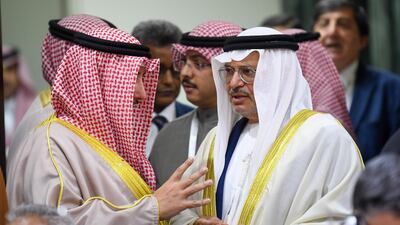
UAE's Minister of State for Foreign Affairs Anwar Gargash (right) arrives for an emergency ministerial meeting of the Organisation of Islamic Cooperation (OIC) in Jeddah to address US President Donald Trump's Middle East plan. AFP -
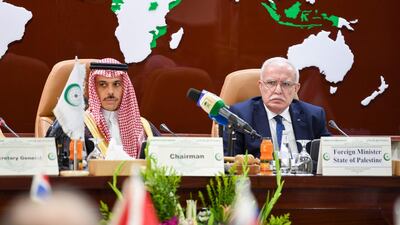
Palestinian Foreign Minster Riyad al-Maliki (right) delivers a speech during an emergency ministerial meeting of the Organisation of Islamic Cooperation (OIC) in Jeddah, to address US President Donald Trump's Middle East plan. AFP -
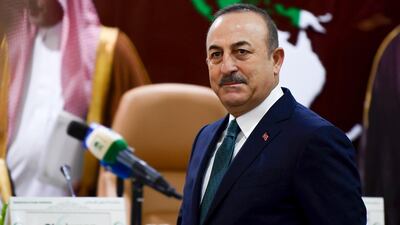
Turkish Foreign Minister Mevlut Cavusoglu arrives for an emergency ministerial meeting of the Organisation of Islamic Cooperation (OIC) in Jeddah. AFP -
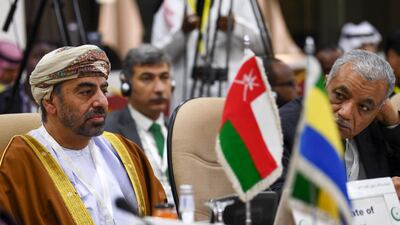
Omani ambassador to Saudi Arabia Ahmad bin Hilal Albusaidi attends an emergency ministerial meeting of the Organisation of Islamic Cooperation (OIC) in Jeddah. AFP -
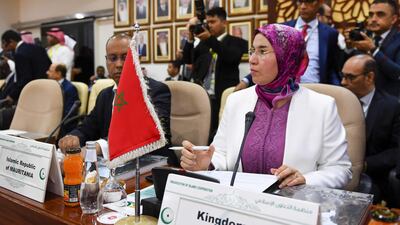
Morocco's Secretary of State Nezha El Ouafi attends an emergency ministerial meeting of the Organisation of Islamic Cooperation (OIC) in Jeddah. AFP -
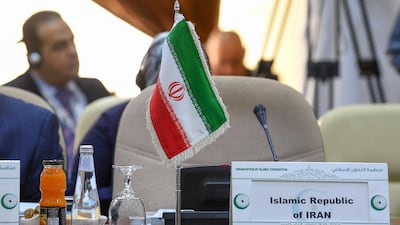
The seat reserved for the Iranian delegate is pictured during an emergency ministerial meeting of the Organisation of Islamic Cooperation (OIC) in Jeddah. AFP -
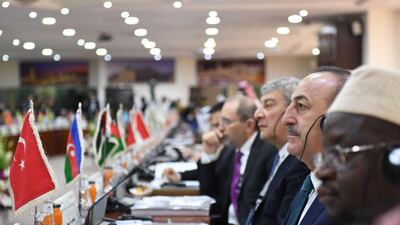
Turkish Foreign Minister Mevlut Cavusoglu (second right) attends an emergency ministerial meeting of the Organisation of Islamic Cooperation (OIC) in Jeddah. AFP -
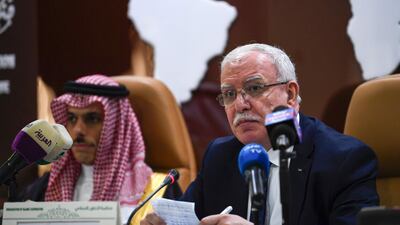
Palestinian Foreign Minster Riyad Al Maliki delivers a speech during an emergency ministerial meeting of the Organisation of Islamic Cooperation. AFP -
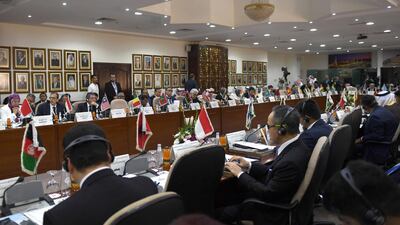
The emergency ministerial meeting of the Organisation of Islamic Cooperation (OIC) in the Saudi port city of Jeddah. AFP -
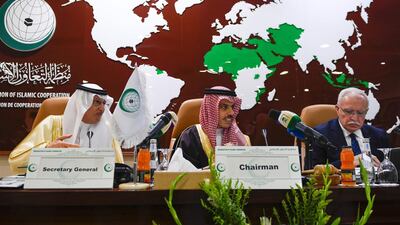
Palestinian Foreign Minster Riyad Al Maliki (right) delivers a speech during an emergency ministerial meeting of the Organisation of Islamic Cooperation (OIC) in Jeddah. AFP -
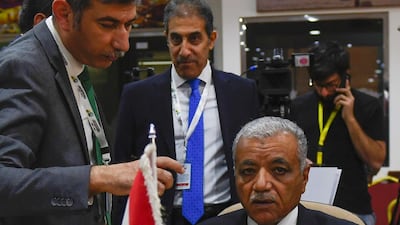
Representative of Iraq Ali Abbas Bandar Al Ameri attends an emergency ministerial meeting of the Organisation of Islamic Cooperation (OIC) in Jeddah. AFP


For the Israelis, the proposal posed several problems. It obliged them to surrender the occupied territories and go back to the June 4 lines, which they had always rejected – an approach the US supported by accepting the principle of modified borders. The initiative also supported a solution to the refugee problem according to General Assembly Resolution 194. For Israel and its backers, this too was unacceptable because it could open the door to a return of Palestinians to pre-1948 Palestine, posing a demographic threat to Israel's Jewish majority.
Certainly, there are aspects of the Arab Peace Initiative that might have to be negotiated in the present context. Yet the major weapon the Arabs have against the so-called peace plan prepared by the trio of US officials led by Jared Kushner, Mr Trump’s son in law – all supporters of the hard line of Israel’s Prime Minister Benjamin Netanyahu – is to give new momentum to the Arab plan.
There are several reasons for this. First, the Trump plan is an effort to change the foundation for negotiations between Palestinians and Israelis, away from a two-state solution. The Arabs need to undermine this unilateral attempt to change the rules of the game. The Arab initiative takes negotiations back to a level that is anchored in UN resolutions, thereby neutralising Washington’s efforts. The US and Israel might oppose this, but then let them be isolated internationally.
Second, restating the Arab initiative would help prevent Iran from hijacking the anti-Israel, anti-American mood prevailing today and pushing for a more violent Palestinian reaction to the US plan. Not only would the Arabs reaffirm their promise to recognise Israel, they would do so on the basis of international decisions once supported by the US that mandate a return to negotiations.
A third advantage of restating the Arab Peace Initiative is that it could be turned into a rallying point for those – and they are many – who believe the US is no longer an acceptable mediator in the Palestinian-Israeli conflict. That is not to say that peace between Palestinians and Israelis can take place without Washington, but nor does it mean that the Americans must be given the latitude to define the parameters of peace on their own, by favouring one side over the other.
Why should this matter? Because Israel has interpreted Arab concerns about Iran’s actions as a blank cheque to do anything it wants and ignore Arab and Palestinian priorities. The Arab states must put such illusions to rest. The Palestinian cause might no longer be as dominant as it once was in the region, but nor does it mean that everyone is willing to suddenly and unreservedly abandon Palestinian rights.
An Arab reaffirmation that the unilateral measures of the Trump administration have no acceptance internationally will help bring that message home, while providing a much fairer solution based on an Arab consensus and UN decisions.
The Arab Peace Initiative was never given the importance it merited. Israel ignored it, as only a country ill at ease with a far-reaching peace plan that could undermined its annexationist ambitions could. Washington erred in following the same path. The latest US plan is a dud, so the Arabs need to remind everyone that a reasonable, widely accepted solution has existed in plain sight for almost two decades.
Michael Young is editor of Diwan, the blog of the Carnegie Middle East programme, in Beirut

