
Americans cannot breathe these days. The sense of suffocation is compounded by pervasive dread that the worst may be yet to come. Culturally and emotionally, many have not fully registered the scale of national calamity in a dreadful year that is not yet half over.
Attention is now focused on city streets around the country as angry protesters condemn yet another apparent police murder of an unarmed black man, George Floyd. He was suspected of the minor offence of trying to pass a counterfeit $20 bill in Minneapolis, Minnesota. A white officer, Derek Chauvin, pinned him face down on the ground and kept his knee pressed into the back of his neck.
For almost nine minutes, three other police officers did not intervene as bystanders, filming the killing, begged them to stop the brutal assault. Floyd pleaded for mercy, cried for his mother and repeatedly uttered the haunting phrase "I can't breathe". When paramedics arrived, he was dead.
-
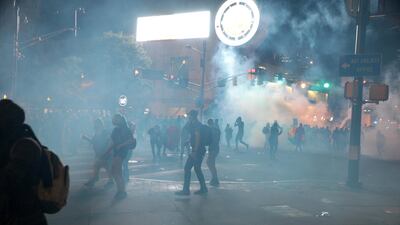
Demonstrators flee tear gas during a protest against the death in Minneapolis police custody of African-American man George Floyd, in Atlanta, Georgia on May 29, 2020. Reuters -
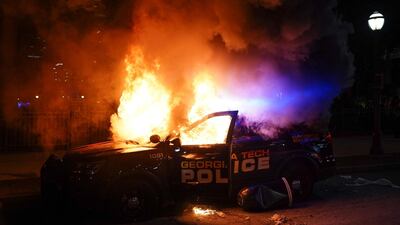
A police car burns during a protest on May 29, 2020 in Atlanta, Georgia. Getty Images/AFP -
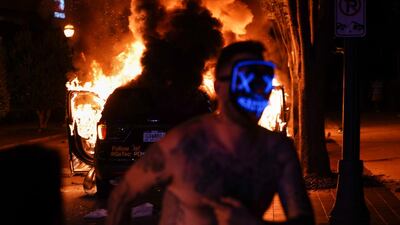
A masked protester runs in front of a burning police car in Atlanta, Georgia. Getty Images/AFP -

Protesters throw rocks at a hotel in Atlanta on May 29, 2020. Reuters -
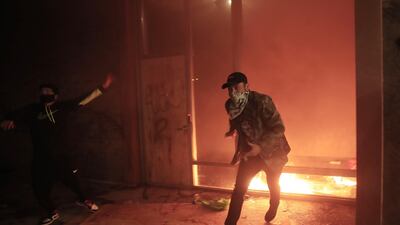
A protester runs after setting a fire in a Wells Fargo bank during a fourth day of protests over the arrest of George Floyd in Minneapolis, Minnesota on May 29, 2020. EPA -
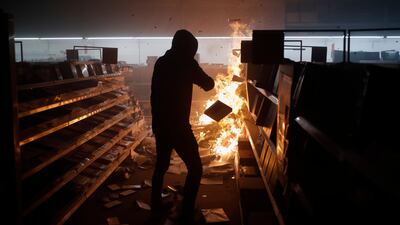
People loot then burn an Office Depot in Minneapolis on May 29, 2020. AP Photo -
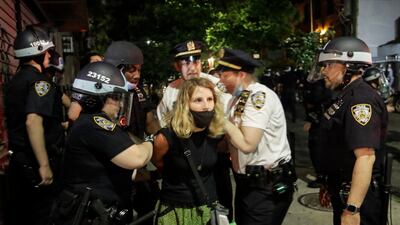
Police officers arrest protesters near Barclays Centre in the Brooklyn borough of New York on May 29, 2020. AP Photo -
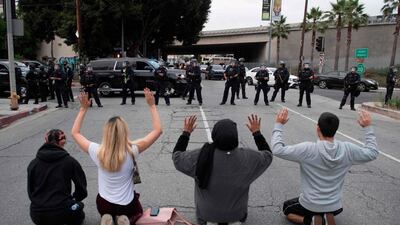
Demonstrators face a row of police as they block a road leading to the 110 freeway to protest the death of George Floyd, in downtown Los Angeles, California on May 29, 2020. AFP -
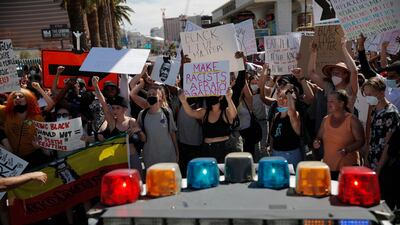
People protesting over the death of George Floyd block traffic along Las Vegas Boulevard in Las Vegas. AP Photo -
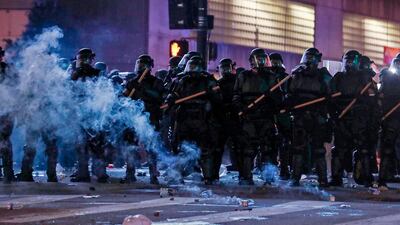
Police in riot gear form a line near the Centennial Olympic Park and CNN centre in Atlanta, Georgia. Atlanta Journal-Constitution via AP -

A man tosses back a tear gas canister during a protest on May 29, 2020 in Atlanta, Georgia. Getty Images/AFP -

Police officers move forward to clear the street during a protest for George Floyd in downtown Los Angeles. AP Photo


"I can't breathe" is a phrase that already resonates powerfully in American culture, defining regular police killings of unarmed black Americans under mundane law enforcement circumstances. In July 2014, Eric Garner, a young black man suspected of selling untaxed cigarettes, famously repeated "I can't breathe" 11 times as police slowly choked the life out of him, again in full view of the public and a video camera.
None of the officers involved in Garner's death were ever charged with a crime, but following this weekend's protests Mr Chauvin was arrested and charged with third-degree murder.
The outrage is driven by how casually some police and self-appointed vigilantes, as in several other notorious recent cases, appear to feel entitled to snuff out the life of young black Americans with no justification, and how often they get away with it.
Justice, and the public's belief in justice, has been put under stress.
President Donald Trump, however, appears to be revelling in the chaos. It has changed the subject from the mismanaged pandemic to disorder he can cast in racial terms, posing as the champion of the white, non-urban Americans against what some of his supporters perceive as a black and brown "urban menace".
His first reaction to the protests was to vow that "when the looting starts, the shooting starts", a phrase made notorious by a racist Florida police chief in the late 1960s. Invoking this grim legacy, the President was threatening to punish property crimes with summary executions.
This appalling tweet finally caused Twitter, which has tried desperately to avoid applying its normal terms of service to its most prominent user, to label it as violating the company's rules against "glorifying violence".
Twitter, however, has yet to do anything about Mr Trump's numerous recent tweets bizarrely accusing one of his critics, TV commentator Joe Scarborough, of having an affair with, and then murdering, one of his staffers when he was a Republican congressman 20 years ago.
Both claims appear to be completely baseless. They met just three times and she died in a tragic accident when he was more than 1,000 kilometres away. Her widower has begged Twitter to take down this cruel defamation.
Mr Trump’s reaction to protests outside the White House also seemed to welcome the prospect of violence and implied disappointment that none of the protesters were “really badly hurt, at least".
This comes in a week when the US passed the grim milestone of at least 100,000 Americans dying from Covid-19 over the past 100 days. This lung infection, which literally asphyxiates its victims, has also choked the life out of the American economy, which now resembles the years of the Great Depression.
This figure of 100,000 dead in 100 days is so colossal that it has not been fully comprehended by many Americans, particularly since most of the deaths have been concentrated in urban settings and among ethnic minority victims. Nonetheless, whether, as seems entirely plausible, a major second wave of illness is preparing to hit in the coming months, the scale of the human devastation will finally sink in sooner or later.
-
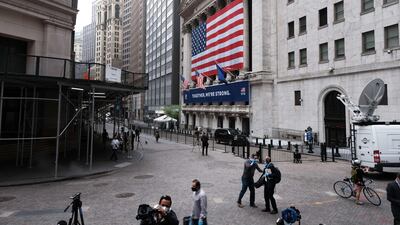
The New York Stock Exchange in Lower Manhattan on the first day that traders are allowed back on to the floor of the exchange on May 26, 2020 in New York City. Getty Images via AFP -
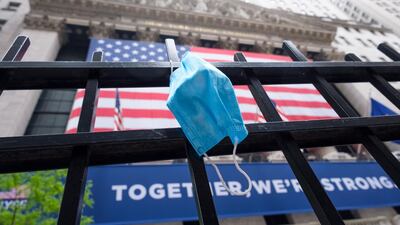
A face mask hangs on a fence in front of the New York Stock Exchange in New York. EPA -
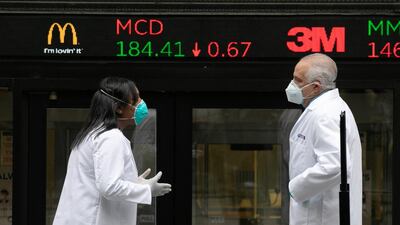
The NYSE floor, known worldwide for an anarchic atmosphere with traders shouting orders over one another, has been closed since mid-March due to the coronavirus outbreak. Fewer traders will be allowed back at a given time for now in order to support six-feet social distancing requirements and they also must wear masks. AP -
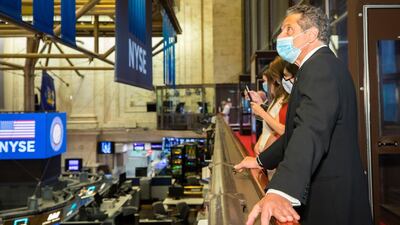
New York mayor Andrew Cuomo looks over the floor of the New York Stock Exchange on Tuesday as he rings the opening bell. New York Stock Exchange via AP -
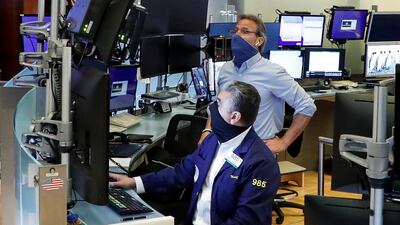
Traders wearing masks work on the first day of in-person trading since the closure during the outbreak of the coronavirus disease on the floor at the New York Stock Exchange. Reuters -
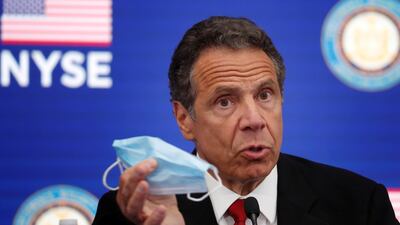
New York Governor Andrew Cuomo speaks inside the New York Stock Exchange after ringing the opening bell. Reuters -
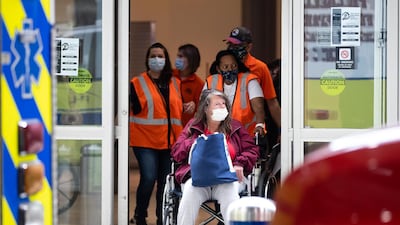
Officials on Tuesday began removing dozens of people who have been sleeping at the city's airport during the coronavirus pandemic. AP -
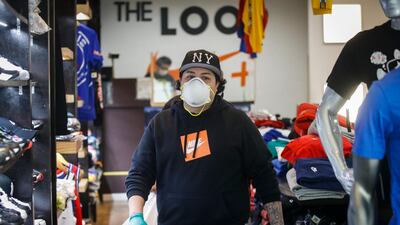
A worker wears protective equipment after assisting a customer select her purchases from curb-side at The Loop fashion and shoe store as businesses slowly begin to reopen in Yonkers city, New York. AP -

A nurse holds her back as she walks down a hallway in the Covid-19 Intensive Care Unit at Harborview Medical Centre. AP, File -
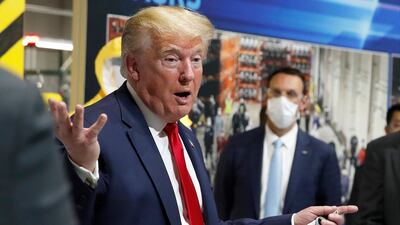
President Donald Trump holds a face mask in his left hand as he speaks during a tour of Ford's Rawsonville Components Plant that has been converted to factory making personal protection and medical equipment. AP -
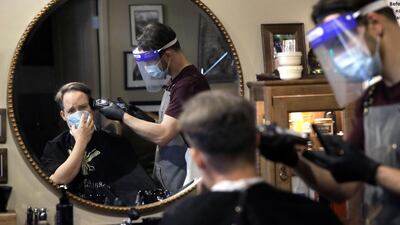
Vin Norton gets a haircut by barber Cristian Lopez at Barber Walter's barbershop, as they both wear masks out of concern for the coronavirus. AP -

People get free Covid-19 tests without showing ID, doctor's note or symptoms at a drive-through and walk up coronavirus testing centre at Barcroft Community Centre in the Arlington, Virginia. AFP -
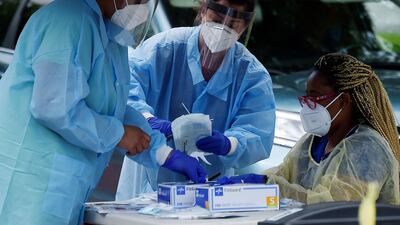
Health workers prepare to give people free Covid-19 tests without asking to show ID, doctor's note or symptoms at a drive-through and walk up Coronavirus testing centre at Barcroft Community Centre in the Arlington, Virginia. AFP


Much of the public has also yet to fully register the economic damage and coming pain. Massive government spending, which is rapidly running out and not being replenished, has kept many Americans from truly feeling the impact. But that is likely to change soon enough as the level of coronavirus devastation, both economic and human, is set to become far more evident in the daily lives and consciousness of Americans.
Prominent observers – including the country's leading expert on international democratisation, Prof Larry Diamond of Stanford University – are increasingly warning that American democracy is in mortal peril. Continuing to chip away at its structures, Mr Trump has systematically purged five inspectors general, watchdogs whose role is internal oversight within the executive branch, to replace them with subordinates who do not ask awkward questions.
With the November election just five months away, and Mr Trump in serious trouble, scores of serious articles and several working groups in Washington have been trying to anticipate various tactics the President could use to circumvent defeat and how US democracy can survive such an assault.
Scenarios ranging from states of emergency to claims of widespread voter fraud to the unleashing of massive violence are all being seriously contemplated because so many of Mr Trump's critics strongly doubt that he would be willing to just walk away. Opinion is divided about how much support he could get, especially from other Republican leaders, but is strikingly unified that he might well refuse to quietly go.
-
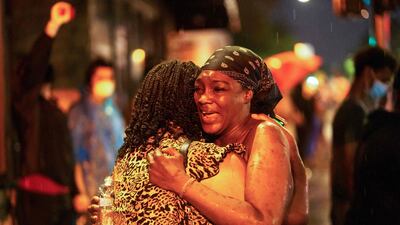
Shawanda Hill (R), the girlfriend of George Floyd reacts near the spot where he died while in custody of the Minneapolis Police in Minneapolis, Minnesota. AFP -
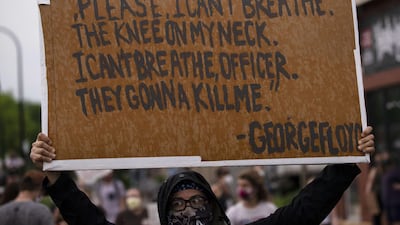
A protester holds a sign while demonstrating against the death of George Floyd outside the 3rd Precinct Police Precinct in Minneapolis, Minnesota. AFP -
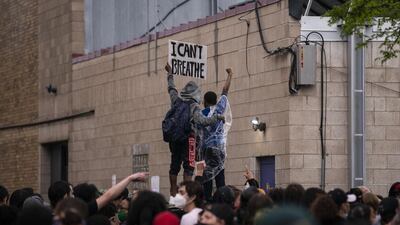
Protesters demonstrate against the death of George Floyd outside the 3rd Precinct Police Precinct in Minneapolis, Minnesota. AFP -
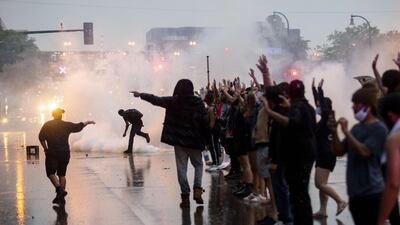
Tear gas is fired as protesters clash with police while demonstrating against the death of George Floyd outside the 3rd Precinct Police Precinct in Minneapolis, Minnesota. AFP -
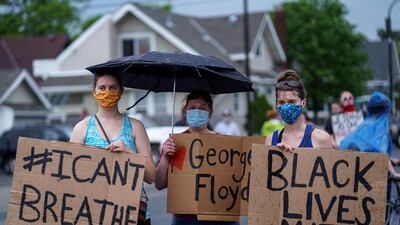
Women hold signs while protesting near the area where a Minneapolis Police Department officer allegedly killed George Floyd, in Minneapolis, Minnesota. AFP -
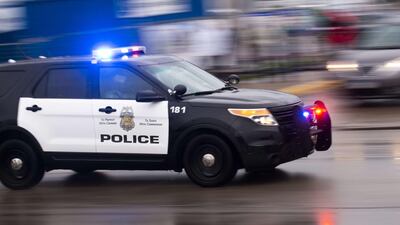
A police car drives by as protesters clash with police while demonstrating against the death of George Floyd outside the 3rd Precinct Police Precinct in Minneapolis, Minnesota. AFP -
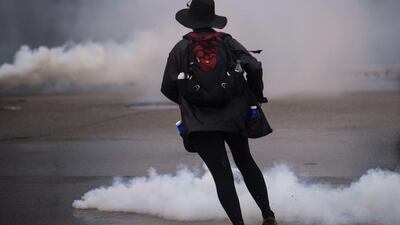
A protesters runs through tear gas while demonstrating against the death of George Floyd outside the 3rd Precinct Police Precinct in Minneapolis, Minnesota. AFP -
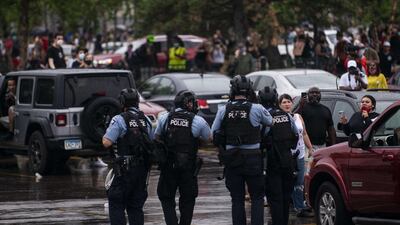
Police dressed in tactical gear attempt to disperse crowds gathered to protest the death of George Floyd outside the 3rd Precinct Police Station in Minneapolis, Minnesota. AFP -
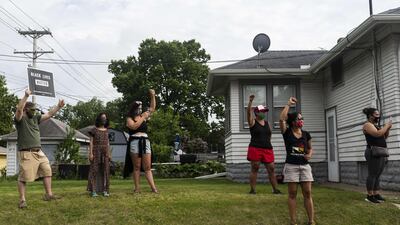
People stand with raised fists as protesters march by while demonstrating against the death of George Floyd in Minneapolis, Minnesota. AFP -
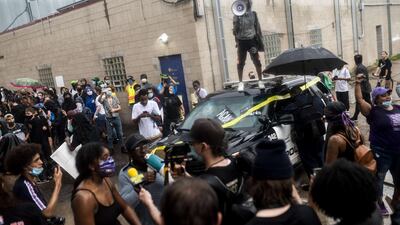
Protesters demonstrate against the death of George Floyd outside the 3rd Precinct Police Precinct in Minneapolis, Minnesota. AFP -
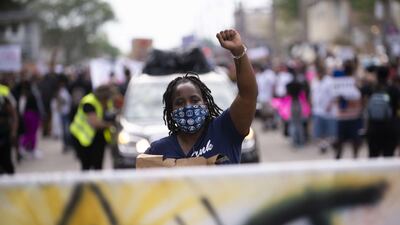
Protesters march through the streets while demonstrating against the death of George Floyd in Minneapolis, Minnesota. AFP -
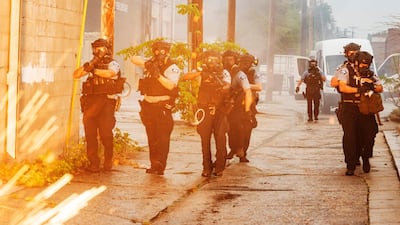
Police officers deploy to disperse protesters gathered for George Floyd in Minneapolis. AP -
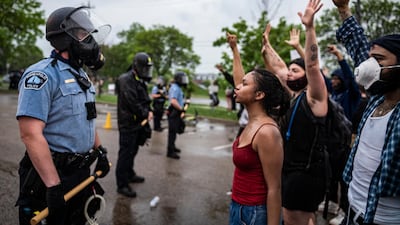
Protesters and police face each other during a rally for George Floyd in Minneapolis. AP -
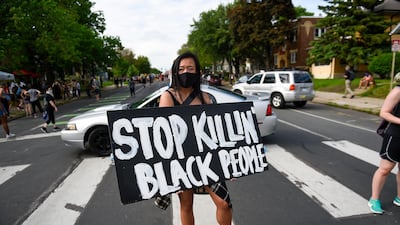
Amy Gee of Minneapolis holds a sign near the scene of the arrest of George Floyd, who later died in police custody, in Minneapolis, Minnesota, USA. EPA


Struggling to come to grips with a historic and ongoing public health calamity, the total meltdown of the economy, cities in flames and the very structures of their venerable democracy shaking under their feet, is it any wonder so many Americans increasingly feel – like Garner and Floyd, and the 100,000 coronavirus victims – that they just cannot breathe?
Hussein Ibish is a senior resident scholar at the Arab Gulf States Institute in Washington

