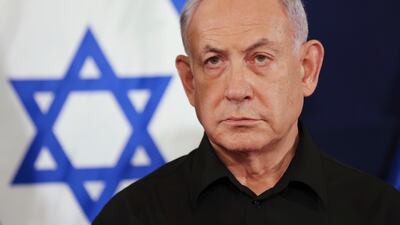

The past week has been rife with speculation over whether the International Criminal Court (ICC) will issue an arrest warrant for Israel’s Prime Minister Benjamin Netanyahu, among other Israeli figures. The source of the speculation is a supposed leak from within Israeli intelligence, which has long been suspected of having ears in the two ICC bodies responsible for issuing such warrants: the Office of the Prosecutor (OTP) and the Pre-Trial Chamber (PTC).
Mr Netanyahu, who is prosecuting a war in Gaza that bears the highest civilian death rate of any conflict so far this century, is understandably alarmed. His support at home was on shaky footing even before the war, thanks in part to Israeli criminal cases filed against him. And now he risks being branded a criminal suspect on the international stage. In his rants against the ICC, Mr Netanyahu has made three claims, all of which have been echoed to varying degrees by Israel’s staunchest western allies – the US, the UK and Germany.
An international warrant for his arrest, Mr Netanyahu says, would – in addition to jeopardising Israel’s right to defend itself and harming chances for peace – violate international law by imposing ICC jurisdiction on Israelis where it has none.
The first two claims are spurious. First, the ICC is an arbiter of international law, which has provisions protecting Israel’s right to defend itself. Second, the court would likely issue warrants not just for Israeli leaders, but Palestinian ones, too. And it is hard to see a scenario in which the prosecution of war crimes on both sides incentivises more war.
But before interrogating the latter claim about jurisdiction, it’s worth mentioning that the speculation itself deserves some scepticism, if only because of its source. Talks between Israel and Hamas, the militant group that runs Gaza, to end the war and free the Israeli hostages the militants took on October 7 are not progressing well. Mr Netanyahu says he is determined to continue the war despite diminishing backing from Israel’s western allies. But those same allies (particularly the ones mentioned above) appear beholden to Israel in a way they are to almost no other country.
An ICC indictment of the Israeli Prime Minister would present a wedge issue in which they might feel obligated to have Israel’s back. That is all to say, until an arrest warrant actually drops, we cannot rule out the possibility that the “leak” was intentional, aimed at diverting the focus of allies and shoring up support for Israel’s government both at home and abroad.
So does the ICC have jurisdiction over Israeli crimes committed in Gaza? Karim Khan, the ICC Prosecutor, says yes. Mr Netanyahu and his allies say no.
In a briefing on April 29, White House spokeswoman Karine Jean-Pierre declined to even explain the logic for “no”: “We don’t believe that they have the jurisdiction,” she said. “I’m just going to leave it there for now.”
Is one side lying? Or is it simply a matter of opinion?
The court has jurisdiction over four kinds of crimes: war crimes, crimes against humanity, genocide and aggression. And it can prosecute these crimes in four cases: when they are committed by nationals of an ICC member state; when they are committed by anyone on the territory of an ICC member state; when they are committed on the territory of a non-member state that has invited the ICC to investigate; and when they are referred to the OTP by the UN Security Council, regardless of whether the suspects or territory belong to a member state.
That’s important to clarify because one of the central arguments made by Israel and its allies against jurisdiction is that Israel is not a member of the ICC, nor has it invited the ICC to investigate, nor has it been referred by the Security Council to the OTP. That’s all true. But the Prosecutor’s counterargument will rest on the fourth case: alleged Israeli crimes were committed on the territory of an ICC member state, Palestine, which applied and was accepted for membership of the court in 2015. So, in principle, anyone from any country who commits one of the four crimes in Palestine could find themselves in the OTP’s crosshairs.
Even so, the issue is not extremely straightforward. The question is better addressed by splitting it into two separate questions. First, does the ICC have jurisdiction in Palestine? And second, what does that jurisdiction really entail?
Both were answered in 2021, when Mr Khan’s predecessor Fatou Bensouda asked the PTC for a ruling on the court's jurisdiction before she opened an investigation into alleged Israeli crimes committed in the occupied Palestinian territories (Gaza and the West Bank, including East Jerusalem). The US and Germany vigorously objected on the grounds that Palestine is not a state; it may have a government in the form of the Palestinian Authority, but for now, at least, lacks a defined territory over which it can exercise sovereignty and legal jurisdiction, and so it should never have been admitted to the court in the first place. (That said, they didn’t challenge Palestinian accession to the court back in 2015.)
Nonetheless, Ms Bensouda got a favourable ruling, albeit not a definitive one.
It was favourable because the PTC’s three judges unanimously agreed that Palestine’s membership of the court is valid and, consequently, the court does have jurisdiction in Palestine. Although the chamber stated it was not competent to decide on whether Palestine is a “state” in other areas of international law, it could agree that Palestine’s accession to the ICC was done properly and in a way the chamber could not reverse, and so it was a “state” for the purposes of ICC proceedings. They also agreed by majority (two out of three) that the jurisdiction extends to all Palestinian territory occupied since 1967.
But the ruling was not definitive for two reasons. First, one judge, Peter Kovacs, dissented with his colleagues on several issues, the most important of which was the idea that Palestinian territory could be defined so precisely at this stage. As the international law scholar Kevin Jon Heller puts it: “The PTC unanimously agreed…the court has jurisdiction over the situation in Palestine. The disagreement…concerns what Palestinian territory should be considered within the court’s jurisdiction.”
Second, the chamber acknowledged the door is still open for challenges at later stages of the legal process. For one thing, the composition of PTC judges today is different from 2021 and they may rule differently on the particulars of jurisdiction in Palestine if Mr Khan applies for an arrest warrant. For another, states or suspects can file a challenge on jurisdictional grounds to the PTC and, in the event of an unfavourable decision, to the ICC Appeals Chamber.
So what is the answer to the two questions asked earlier (does the ICC have jurisdiction in Palestine, and what does that jurisdiction entail)? For the first, it’s a simple “yes”, and for the second, it’s “we’ll see”.
Shortly after the 2021 ruling, US State Department spokesman Ned Price essentially dismissed all the details of the case when he said: “We have serious concerns about the ICC’s attempts to exercise its jurisdiction over Israeli personnel. The US has always taken the position that the court’s jurisdiction should be reserved for countries that consent to it, or that are referred by the UN Security Council.”
But in principle it matters little what countries the US thinks the court’s jurisdiction should be reserved for. The law (which the US helped draft) is clear on what countries (or more accurately, individual people) it is reserved for, and that includes, through a legal ruling, people who commit crimes in Palestine.
And American principles on the subject seem to have changed last year – a fact conveniently ignored by Ms Jean-Pierre – when the White House ordered US agencies to share evidence with the OTP of war crimes allegedly committed in Ukraine by Russian President Vladimir Putin. Like Israel, Russia is not an ICC member state nor has it been referred by the Security Council.
The US might again argue, of course, that Palestine is not a state, whereas Ukraine is, and that the court was wrong to ever acknowledge any form of Palestinian statehood. But it is up to the ICC’s members (a group that does not include the US) to decide the court’s accession process, and if Washington does not believe the court is competent enough to determine its own jurisdiction, why should it be competent enough to prosecute Mr Putin?
The inconsistency – or hypocrisy, many would say – between these two positions suggests Washington’s line has been more a product of political theatre than legal reasoning. Alas, that’s why these things are probably best left to the courts.

