

Since the end of the Cold War, American political scientists have fretted about the rise of illiberal democracies around the globe. Yet the US itself is increasingly becoming the inverse: a liberal non-democracy.
Popularised in a 1997 essay by Fareed Zakaria, the term “illiberal democracy” describes a political system with the trappings and formal processes of democracy – elections, multiple parties, privately-owned media and so on – but in which power is effectively autocratic. Venezuela, Turkey, Russia and Hungary might look democratic on paper, but are clearly not liberal.
The US is becoming strikingly undemocratic but does not resemble such "illiberal democracies". The Republican Party is trying to systematise minority political rule despite an increasing liberalisation of culture and society, which it is powerless to restrain. The US is thus essentially liberal, but increasingly not meaningfully democratic.

In the Donald Trump era, racism plainly lingers, but most racists passionately deny their racism. Misogyny, sexual assault and harassment persist but they are increasingly stigmatised and potentially dangerous to abusers. Homophobia has greatly decreased, and gay marriage is generally accepted. And despite a surge of nativism, most of US society is rapidly re-conceptualising itself as a far broader ethnic and religious rainbow.
Illiberal democracies are often associated with "majoritarian authoritarianism" – the idea that anything over 50 per cent of the population, or even whoever gets the most votes, can do virtually anything, minority and individual rights notwithstanding. But US Republican power is not majoritarian, and it is out of step with most of these liberal social and cultural changes.
Mr Trump was elected president in 2016 despite getting almost three million votes less than his opponent Hillary Clinton. Similarly, the Republican “majority” in the Senate represents 15 million fewer Americans than the Democratic “minority".
In several key swing states, the political outcome is similarly distorted. Partisan gerrymandering has meant that in the states of Pennsylvania, Michigan and North Carolina, for example, Democrats won 54, 53 and 51 per cent of votes in the last election but secured only 45, 47 and 45 per cent of legislative seats respectively.
As I noted recently on these pages, turnout in US elections is now all-important. There are considerably more Democrats, but Republicans are typically better at motivating and mobilising their supporters. Still, Republicans increasingly concede that they simply do not represent a majority and that their national, and sometimes state-level, power often depends on limiting the number of citizens who vote.

Mr Trump recently claimed that if the country generally adopted voting by mail or other reforms making voting simpler and easier, "you’d never have a Republican elected in this country again". Many Republicans have voiced similar sentiments. Last year, Senate Majority Leader Mitch McConnell even described a proposal to facilitate voting by making election day a federal holiday "a political power grab" by Democrats.
The appalling spectacle last Tuesday in the state of Wisconsin, where the Republican legislature refused to consider postponing the election – despite the state being under lockdown due to the coronavirus – was a chilling demonstration of how this works. It could even serve as a dry run for potential efforts to use the pandemic to similarly boost Mr Trump's chances in November.
Mr Trump urged Republicans to "fight very hard" against mail voting initiatives prompted by the pandemic, claiming – contrary to all evidence – that it invites massive fraud. Although he calls it "corrupt", Mr Trump himself voted by mail in March, "because I'm allowed to".
The Supreme Courts of both Wisconsin and the US separately split exactly along partisan lines on the Wisconsin election, with Republicans barring any extension of deadlines for absentee ballots – even though numerous voters applied for, but did not receive, them. Strikingly, both courts refused to meet in person for fear of infection, but then insisted Wisconsin voters must choose between risking their own lives or accepting disenfranchisement.
Under Mr Trump, Republican minority rule is rapidly dispensing with many traditional political guardrails and structural checks. The Republican Senate majority refused to hear a single witness in his impeachment trial, because any testimony was likely to be damning, and was open about its determination to acquit him no matter what.
Now, Mr Trump is taking advantage of the pandemic to purge government inspectors general who made the mistake of doing their duty and telling a variety of inconvenient truths. He seems keen to install cronies who will not engage in troublesome oversight, though that is exactly what inspectors general were created to do.
-
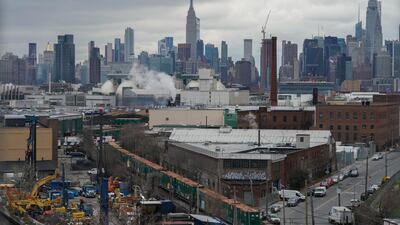
The Manhattan skyline rises over the Borough of Brooklyn on March 31, 2020 in New York. AFP -

A shopper and cashier wear protective equipment at the checkout station at Pat's Farms grocery store in Merrick, New York. AFP -
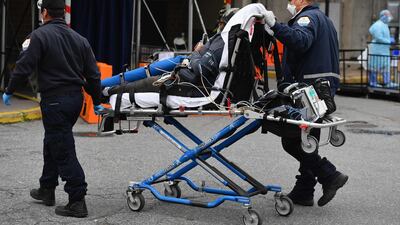
Paramedics push a gurney with a patient to Brooklyn Hospital Centre Emergency Room in the Brooklyn borough of New York. AFP -
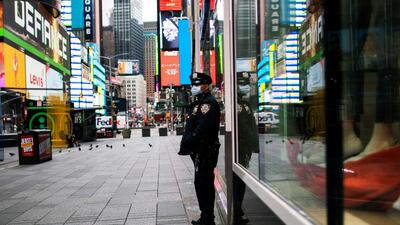
A New York Police officer stands guard in an almost empty Times Square during the outbreak of the coronavirus disease. Reuters -
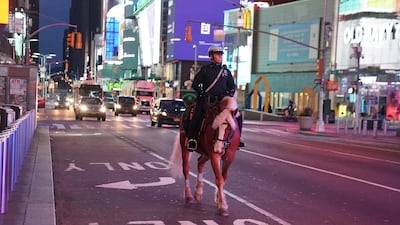
A mounted police officer rides though a mostly deserted Times Square during the outbreak of the coronavirus disease in the Manhattan. Reuters -
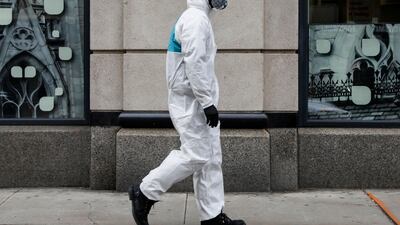
A man wears personal protective equipment as he walks on First Avenue, during the coronavirus disease outbreak in New York City. Reuters -
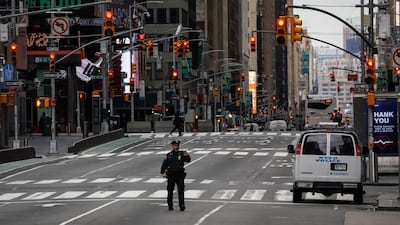
A New York City Police officer takes a selfie while in the middle of the street in an almost empty Times Square. Reuters -

The US Navy hospital ship carrying 1,000 hospital beds moves past the Statue of Liberty as it arrives in New York. AFP -
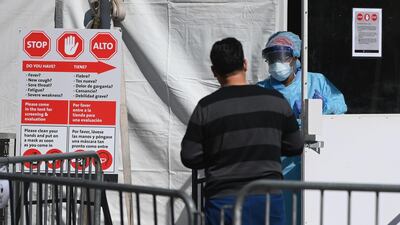
A medical worker walks out of a coronavirus testing tent at Brooklyn Hospital Centre in New York City. AFP -
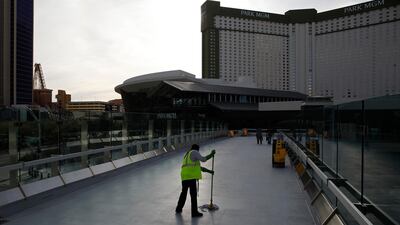
A worker cleans along the Las Vegas Strip devoid of the usual crowds as casinos and other business are shuttered due to the coronavirus outbreak. AP -

Members of the US Army Corps of Engineer Research Development Centre’s Directorate of Public Works construct two temporary hospital room prototypes in Vicksburg. The Vicksburg Post via AP -
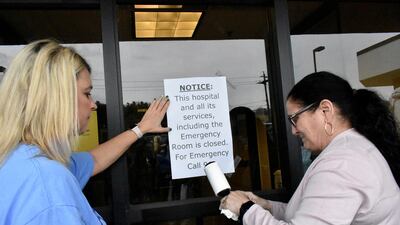
Carol Talkington helps Terri Bonasso tape a notice on the emergency room door following a vigil at the closing of the Fairmont Regional Medical Centre in Fairmont. Times-West Virginian via AP -

A motel sign is lit along a quiet Sunset Boulevard at dusk amid the coronavirus pandemic on March 31, 2020 in Los Angeles. AFP -
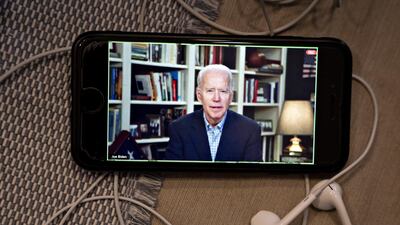
Democratic presidential candidate Joe Biden speaks during a virtual press briefing on March 25, 2020. Bloomberg


Republican minority rule is hardly without consequences, especially profound economic impact. The five-member Republican majority in the Supreme Court – itself established by Mr McConnell's unprecedented and successful ploy of ignoring a well-qualified Democratic nominee for almost a year in hopes of adding another Republican instead – is aggressively conservative and seems fully committed to expanding Republican power.
The court could soon strike down the well-established constitutional guarantee of a woman's right to reproductive choice, allowing state legislatures to effectively prohibit abortions. In many places, no doubt they will.
But most of the country will not. It will still be the case that while "red" America – constituting a Republican and conservative minority – wields political power, "blue" America – representing a Democratic and liberal majority – largely shapes the far deeper contours of culture and society.
This distinction is especially sharp among younger Americans, where Republican conservatives are an even smaller minority.
So, the US is not becoming an illiberal democracy. In most places, and for most of its citizens, it is still an essentially liberal country with a free press, significant personal freedom, largely functional national and state-level institutions, and a vibrant and viable political opposition.
Yet, many Republican leaders really are seeking to manipulate the US political system to entrench obviously undemocratic minority rule. That is increasingly becoming a reality. Mr Trump could well be re-elected with an even bigger vote deficit than in 2016, and that prospect is just the tip of a vast undemocratic iceberg.
Between the White House, the Senate and several key states, minority rule is no longer an American anomaly. Unless the evident Democratic majority reasserts itself nationally in November, or an unexpected Republican majority suddenly materialises, the US will take another major step to becoming a full-fledged liberal non-democracy.
Hussein Ibish is a senior resident scholar at the Arab Gulf States Institute in Washington

