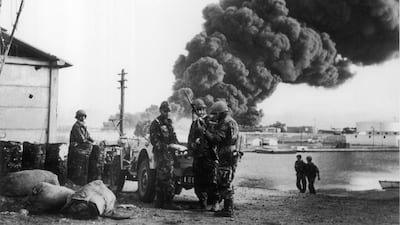

Seventy years after a ceasefire ended the France-Britain-Israel tripartite aggression on Egypt, the Middle East finds itself confronting another historical turning point.
The 1956 Suez Crisis marked more than the decline of British and French imperial power. It exposed the limits of military force, demonstrated the power of political legitimacy and accelerated the emergence of the US as the principal external power shaping the regional order. Today, however, that American predominance is itself under pressure. The question is not simply who might replace Washington, but whether the region can finally move beyond the recurring cycle of external domination and competing regional hegemonies.
The crisis began in July 1956, when then-Egyptian president Gamal Abdel Nasser nationalised the Suez Canal Company after the US and Britain withdrew their promised financing for the Aswan High Dam, asserting Egypt’s economic sovereignty and independence from European colonial control. After three months of diplomatic confrontation, Israel invaded Sinai in October under a secret arrangement with Britain and France, whose subsequent military intervention turned the canal dispute into a co-ordinated assault on Egyptian sovereignty.
The Suez War cannot be understood independently of the transformation in Israeli military strategy that preceded it. In their important study, How the Mouse Got His Roar: The Shift to an Offensive-Defensive Military Strategy in Israel in 1953 and Its Implications, Amiram Oren, Oren Barak and Assaf Shapira identify a consequential doctrinal shift in 1953: Israel moved away from the defensive-offensive strategy adopted after the 1948 war towards an offensive-defensive approach. The new doctrine gave a much greater place to offensive military action as an instrument of national defence, with implications that extended well beyond immediate border security.

This transformation coincided with increasingly aggressive Israeli reprisal operations against neighbouring Arab states and a growing willingness to employ military force to shape the regional security environment. The 1954 Lavon Affair provides a revealing illustration of this emerging approach. Operation Susannah, an Israeli intelligence operation in Egypt, recruited Egyptian Jews to carry out bombings against civilian targets associated with western interests, with the intention of attributing the attacks to Egyptian groups, especially the Muslim Brotherhood, and undermining relations between Egypt and western governments, particularly the US.
The operation failed and became a major political scandal in Israel. Its timing was particularly consequential: Egypt was negotiating the withdrawal of British forces from the Suez Canal Zone, while seeking greater independence from its former colonial power.
The following year, Israel joined Britain and France in the secret planning that culminated in the 1956 invasion. Under the Sevres Protoco, Israel would invade Sinai, creating the pretext for British and French intervention ostensibly to separate the combatants and protect the canal. What Egypt experienced was not simply another Arab-Israeli military confrontation, but a co-ordinated three-country assault. It consequently entered Egyptian political memory as the Tripartite Aggression.
Militarily, Egypt paid a price. Its armed forces incurred significant losses, Israeli forces advanced through Sinai, and British and French forces attacked Egyptian territory. Politically, however, the outcome was profoundly different. Nasser undid the aggression, Egypt retained sovereignty over the Suez Canal and the invading powers were compelled to withdraw. The crisis became a political victory for Egypt and a defining moment for Arab nationalism.
The American response wascentral to this outcome. Then-president Dwight Eisenhower opposed the invasion and exerted considerable pressure on Britain, France and Israel to accept a ceasefire and withdrawal. Washington’s position was not simply an expression of solidarity with Egypt. It reflected American strategic interests, Cold War calculations, opposition to European colonial methods and concern that the invasion would push Arab opinion towards the Soviet Union. Nevertheless, the political consequences were unmistakable: the US publicly sided against the former imperial powers and helped establish the conditions for Egypt’s political survival as a new republic.

This was also a moment of American succession. Washington was increasingly positioning itself as the emerging external power in a region where European imperial authority was becoming untenable. The rise of post-colonial states and nationalist republics presented an opportunity for a new relationship based, at least rhetorically, on sovereignty, self-determination and the rejection of colonial domination. Egypt, with its revolutionary leadership, strategic geography and ambition to modernise, appeared to Washington as a potentially important regional partner, even as relations between Nasser and the Eisenhower administration remained complicated.
Yet the transition was never a straightforward replacement of empire with partnership. The US would increasingly seek to shape the regional order through security guarantees, military assistance and political alliances. The Eisenhower Doctrine of 1957 institutionalised this expanding American role. The Suez Crisis therefore ended one form of European predominance while opening the door to another era of external strategic influence.
Seventy years later, the historical parallel is striking, although the circumstances are different. We may be witnessing the beginnings of another foundational transition, reminiscent in some respects of the end of the British Mandate in Palestine in 1948 and the subsequent formation of a new regional order. The US is increasingly emphasising burden-sharing and the expectation that regional partners assume primary responsibility for their own defence. Its 2026 National Defence Strategy explicitly places greater responsibility for regional deterrence and defence on Middle Eastern allies and partners.
Meanwhile, the damage to American military facilities during the Iran war and the reassessment of the future US military footprint in the region have exposed the costs and vulnerabilities of the existing security architecture.
This is not necessarily an American departure, but it is a significant reconsideration of the terms of American engagement. Washington may be seeking a region that can manage more of its own security without requiring the same level of permanent US military commitment. Yet there is a danger in how this transition unfolds. A reduced external presence does not automatically produce a stable regional order.
If the US disengages selectively while leaving unresolved political and territorial disputes, competing security ambitions and deeply entrenched fault lines, it risks reproducing the very conditions that earlier imperial powers exploited through divide-and-rule strategies. These divisions can remain dormant for years, only to be activated when regional or international circumstances change.
There is, however, an important difference between 1956 and today: regional actors are considerably more conscious of this history. Egypt, Turkey, Iran, Israel and the Gulf states have accumulated their own strategic experiences, capabilities and diplomatic relationships. They are not simply waiting for another external power to determine their future. Nor should the next regional order depend on one state aspiring to become the new hegemon.
The challenge is to recognise that one state’s national security is not synonymous with seeking regional domination. Every state has legitimate interests in protecting its population, borders, resources, political independence and cultural identity. These interests should not require expansionist ambitions, permanent confrontation or the subordination of neighbouring peoples. Equally, the region’s Arab and Muslim majorities must be able to exercise their political and cultural agency without denying the rights of smaller ethnic, religious and national communities. No minority should become an instrument of expansionist rule, and no majority should be deprived of its legitimate place in its own region.
-

US Vice President JD Vance looks on next to US President Donald Trump's son-in-law Jared Kushner, as Iran's Foreign Minister Abbas Araqchi shakes hands with Pakistan's Prime Minister Shehbaz Sharif. Getty Images -

US Vice President JD Vance makes an opening statement at the start of the quadrilateral meeting. Reuters -

JD Vance listens to Jared Kushner. AFP -

JD Vance looks on as Pakistan's Prime Minister Shehbaz Sharif speaks while holding the hand of Sheikh Mohammed bin Abdulrahman, Qatar’s Prime Minister and Minister of Foreign Affairs. Getty images -

JD Vance, second left, US special envoy Steve Witkoff, second right, and Jared Kushner, right, meet Pakistani Prime Minister Shehbaz Sharif, centre, and Chief of Army Staff Field Marshal Asim Munir, left. AFP -

Swiss Vice President Ignazio Cassis, right, with Rafael Grossi, director general of the International Atomic Energy Agency. Photo: IAEA -

Iranian Foreign Minister Abbas Araghchi, second left, meets Mr Cassis, who is also Switzerland's Foreign Minister. Reuters -

Mr Cassis speaks with Qatari Prime Minister and Minister of Foreign Affairs, Sheikh Mohammed bin Abdulrahman bin Jassim Al Thani. Photo: FDFA -

Talks are expected to last for several days at the Burgenstock Resort, authorities said. Reuters -

The media centre in the Tennis Hall at Burgenstock. Reuters


A more sustainable regional order would therefore require a fundamental shift in strategic thinking: from hegemonic ambitions towards defensive security, sovereign equality and reciprocal recognition. Each has its own national interests and historical identity, but none needs to turn those interests into a project of regional domination.
The lesson of 1956 is that military superiority does not guarantee political success, and that an external power’s intervention can produce consequences far beyond its immediate military objectives. Egypt’s experience demonstrated that political legitimacy and national sovereignty can outlast military challenges. The question facing the Middle East now is whether its states can learn from that history before another externally shaped transition leaves them confronting the consequences of an order they did not collectively design.
The end of one imperial era did not guarantee freedom from imperial politics. The end of American predominance, if that is indeed what we are approaching, will not automatically guarantee regional independence or stability either. But it could offer something more consequential: an opportunity for the countries of the Middle East to build an order in which security does not depend on domination, and sovereignty does not come at the expense of the sovereignty of others.

