
For a demonstration of just how badly Britain is blighted by bottlenecks, the loss of a flagship Microsoft data centre deal is Exhibit A.
Just north of London is a piece of waste ground covered with broken concrete. The site, at Loughton in Essex, had been designated as the UK’s flagship entry point into the global data-centre race. Instead, last week it was at the forefront of the markets’ collapsing confidence that the worldwide data-centre boom can ever be delivered.
That market reticence should not let the UK off the hook. There is a particular regulatory and leadership failure in the country that serves as a warning for other nations overly dedicated to a regulatory economy.
When US President Donald Trump made his state visit to the UK just over a year ago, Microsoft announced a $30 billion (Dh110 billion) commitment to the country. Of that, $2 billion was allotted to this patch of London’s suburban fringe for a data centre. A Microsoft blog post read: “This investment will enable us to build the country’s largest supercomputer – with more than 23,000 Nvidia GPUs – in partnership with Nscale.” The good vibes kept on coming with Jensen Huang, the Nvidia boss, saying the UK would be an “AI superpower” with all this investment in the pipeline.
What went wrong was that the failures in the UK’s national electricity grid have come home to roost. Instead of connecting to the electric network next year as had been billed in Nscale’s contracts, now the facility will not have a connection date until the 2030s. Nscale has quietly accepted the blow with a sigh of futility. "This unfortunate London-wide grid issue has no impact on our other contracts," it said. The British technology company’s other projects are in alternative locations outside the UK, such as Norway, Portugal and the US.
The growth blight for the UK as a result of the decline in its electric architecture is only just beginning. The country has the most expensive electricity of any major nation. Large-scale industrial operations based around petrochemicals or refining of oil into products such as diesel have steadily shut down across the country. In the 1980s when the coal mines were shutting down, their names would be tagged in labels across large banners that followed the colliery bands. Now the loss of names such as Grangemouth, which made two thirds of all the refined oil products used by Scotland, are briefly noted inside newspapers.
The idea of Prime Minister Andy Burnham’s government is that the UK can re-industrialise. Contrary to expectations, the country had until recent years done a decent job of maintaining a network of facilities that were supplying its own and export markets. This is now stuck in a vortex of decline that largely centres around the National Grid and its projected shortages. The data centre boom is catching it out in new ways.
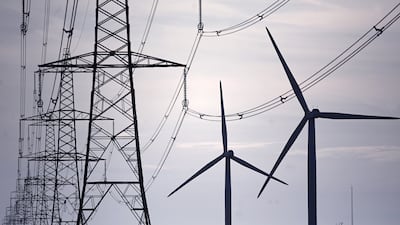
The UK has been a trailblazer in harnessing wind from offshore turbines that have been constructed in massive arrays. Yet even this generation is not being exploited in the ways that it could. The National Grid has failed to match its capacity to transmit the energy into its systems. In fact, Britain spends more than £1.5 billion (Dh7.34 billion) a year on “constraint payments” to turn off wind farms and use gas plant generation instead because the electricity grid could become unbalanced.
That is not all. Note the Nscale statement said there was a London-wide problem with the grid. The gas plants have clustered in the middle of the country and so getting their output to the country’s largest economy – London – is problematic.
The country is also being forced to make payments to obtain emergency supplies through interconnectors from foreign nations at an increasing rate. Last week an emergency drawn down from France is believed to have cost almost £40 million alone. The figure for all of September for “balancing payments” ran to £500 million.
This time of year, European countries that use a lot of wind power are often confronted by a lack of wind. Worryingly for the UK, this year there has been good wind availability, yet the country is still facing increasing and steep payments to keep its electric network functioning. That is while charging vast sums for its output to customers. It is also unable to deliver an architecture of future capacity growth that meets the needs of flagship investors.
All the while planners in other parts of the system worry that the UK has failed, like Germany, to upgrade its storage of imported natural gas, a commodity undergoing a supply crunch because of the Iran war and the arrival of El Nino. The figures show that the underground gas storage available to the UK energy suppliers was only 48 per cent full at the start of October, the lowest among its neighbours.
With the rise of the digital economy and the data boom, one would expect electricity to be the greatest priority in the UK’s economic management. Allow me to let you down with some figures.
The National Energy System Operator, which draws that interconnector power to balance the system, says that electricity should represent 70 per cent of the UK’s power mix by 2050. Last year it was just a shade under 20 per cent, with 25 years to go to the deadline.. Last year it was just a shade under 20 per cent, with 25 years ago. Go back 25 years to the year 2000 and the electric part of the power mix was also hovering at 20 per cent.
In a world of rapid advances, the UK is effectively running too hard just to stand still.

