


Russia is making progress in its battle for territory between Donetsk and Crimea according to the intelligence assessments of the British Ministry of Defence. In daily overnight tweets it has charted the conflict since late February. The updates now show that while Russia is advancing, the gains have been “limited and achieved at significant cost to Russian forces”.
However, the focus on territorial movement misses a large part of what this offensive has become. New dimensions have been steadily added to the conflict in Ukraine, many with a focus far beyond that country’s borders.
The Kremlin had been thought to be eyeing a drive to cap hostilities by May 9 Victory Day celebrations, which mark the end of the Second World War. Increasingly this deadline appears to be a chimera, and the struggle could shift to one between East and West with a far longer duration.
President Vladimir Putin has reason to be both concerned by the level of assistance that the Ukrainian state is getting from the West, as well as the latter's increasingly belligerent rhetoric. Andrey Kortunov, the director general of the Russian International Affairs Council, is one close observer who believes the current situation has consequences beyond the signals of a shift in battlefield tactics.
Noting that Liz Truss, the British foreign secretary, said last week that Russia should be defeated, Mr Kortunov says that aim goes beyond the war aims of Ukraine itself. While he says Russia is unlikely to use nuclear weapons to change the course of the conflict in Ukraine, he adds that Mr Putin cannot afford a defeat, bringing into play other strategic moves the Kremlin could employ just short of that terrible threshold.
-
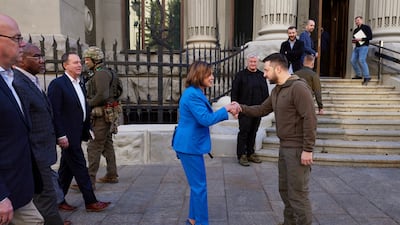
Ukrainian President Volodymyr Zelenskyy and US Speaker of the House Nancy Pelosi shake hands as they meet in Kyiv. AP -
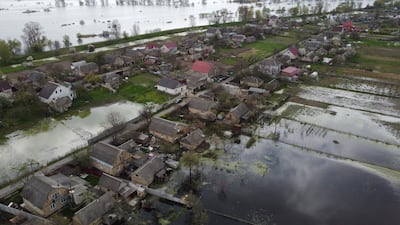
Floodwater edges towards homes in the small Ukrainian town of Demydiv. AFP -

Lila stands inside her apartment after a missile strike damaged a residential building in Dobropillia, in the Donetsk region of eastern Ukraine. Reuters -
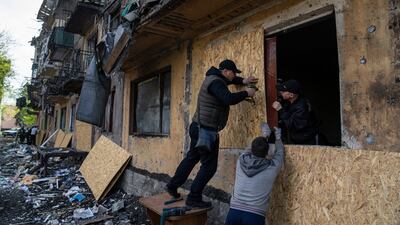
Residents board-up windows of a damaged apartment building with plywood after Russian shelling in Dobropillya, Donetsk region. AP -
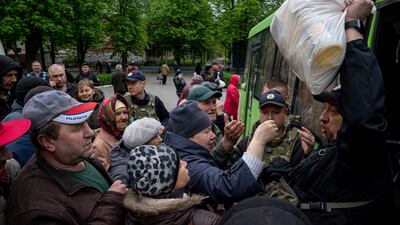
A police officer distributes humanitarian aid to people in Lyman, Donetsk. AP -
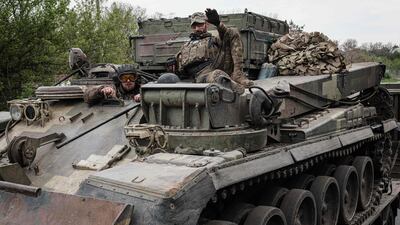
Ukrainian soldiers near Kramatorsk, eastern Ukraine. AFP -
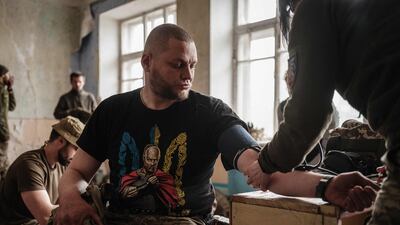
A Ukrainian soldier receives medical treatment as he and others rest after fighting on the front line for two months near Kramatorsk. AFP -
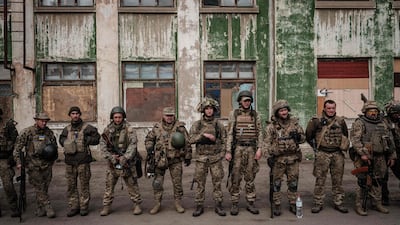
Exhausted Ukrainian soldiers arrive at an abandoned building to rest and for medical treatment after fighting on the front line near Kramatorsk. AFP -
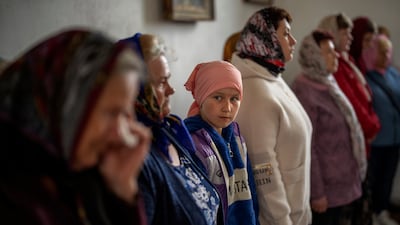
Ukrainians attend a solemn religious service to commemorate the fallen in the Russian occupation in Zdvyzhivka, on the outskirts of Kyiv. AP -

Hanna Selivon, 77, surveys what remains of her house, which she says was destroyed by Russian shelling on the outskirts of Chernihiv, Ukraine. Reuters -

Women cry as they take part in a rally demanding international leaders organise a humanitarian corridor for the evacuation of Mariupol, the besieged Ukrainian city where thousands are trapped. Reuters -
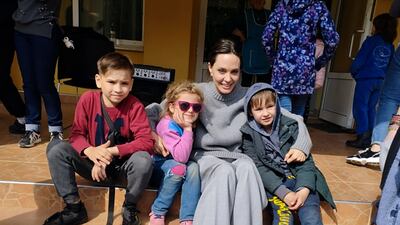
Angelina Jolie, Hollywood movie star and UNHCR goodwill ambassador, poses for photo with kids in Lviv, Ukraine. AP -
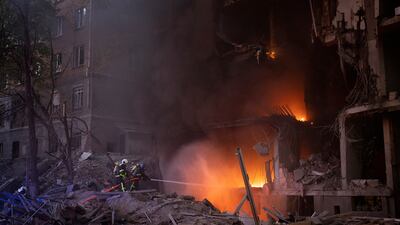
Firefighters try to put out a blaze after an explosion in Kyiv as Russia mounts attacks across Ukraine. AP -
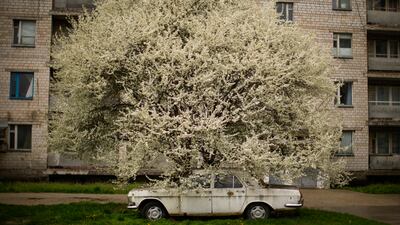
A car parked under a tree in the partially abandoned town of Chernobyl. AP -
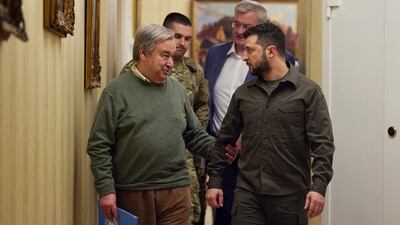
Ukrainian President Volodymyr Zelenskyy, right, and UN Secretary General Antonio Guterres leave a news conference in Kyiv. AP -
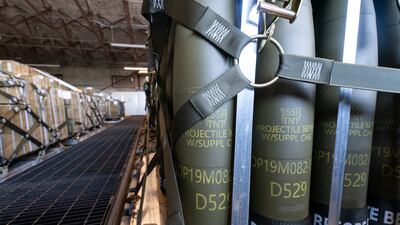
Military aid bound for Ukraine at Dover Air Force Base in Delaware. President Joe Biden has asked Congress to agree to $33 billion to bolster Ukraine's fight against Russia. AP -
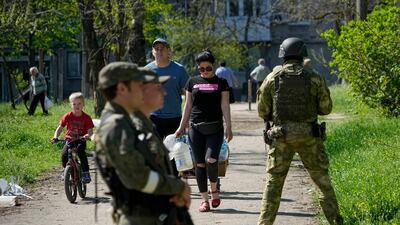
Members of the pro-Russia Donetsk People's Republic militia stand guard as civilians go to receive aid in Mariupol. AP -
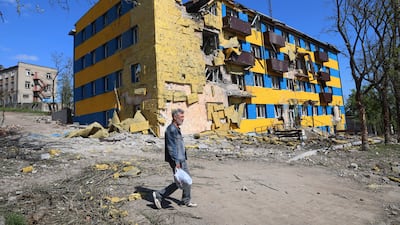
A destroyed building in the south-eastern city of Mariupol. AP -

A Ukrainian girl with other civilians on a bus as they flee the violence in Slovyansk, in the Donetsk region. Reuters -
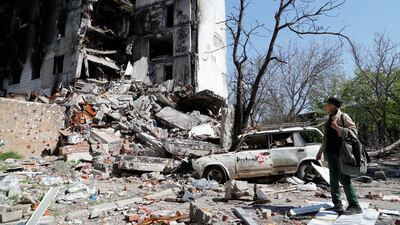
A block of flats reduced to rubble in Mariupol. Reuters -
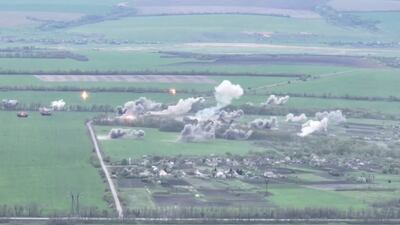
Explosions in a village near the eastern city of Izium. Reuters -
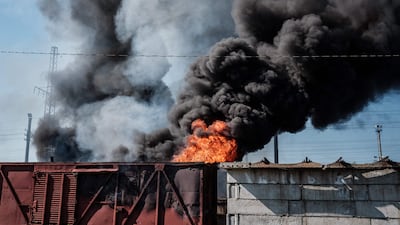
A car and piled sleepers in flames after shelling near Lyman station in Lyman, eastern Ukraine. AFP -
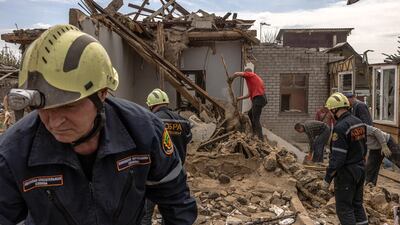
Residents and members of the Ukrainian emergency services clear debris after a recent Russian rocket attack in Zaporizhzhia, Ukraine. EPA -
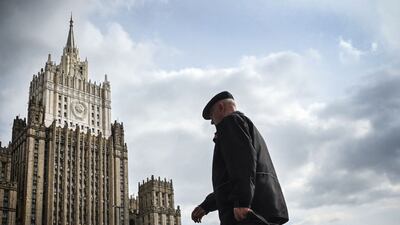
The Russian Foreign Ministry in Moscow, where spokeswoman Maria Zakharova recently said that Ukraine had either carried out the executions of civilians in Bucha itself or positioned the bodies so as to incriminate Russian forces. AFP -
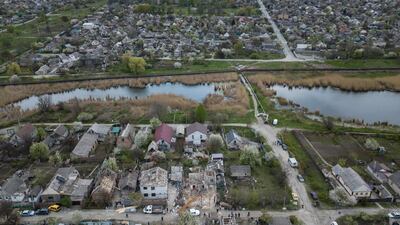
An aerial view of in a neighbourhood in Zaporizhzhia on the 65th day of the Russian invasion of Ukraine. AFP -
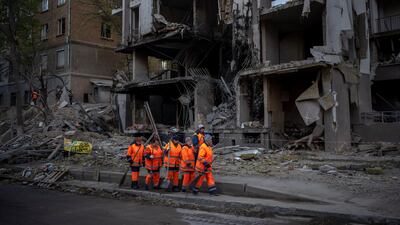
Clean-up crews at the site of an explosion in Kyiv, Ukraine. Russia struck the Ukrainian capital of Kyiv shortly after a meeting between President Volodymyr Zelenskyy and UN Secretary General Antonio Guterres. AP -
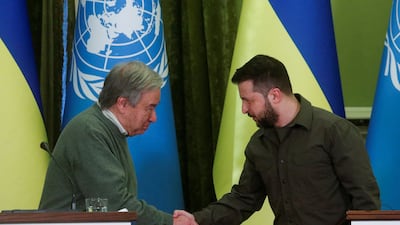
UN Secretary General Antonio Guterres and Ukraine's President Volodymyr Zelenskyy at a joint news conference in Kyiv as Russia's attack on Ukraine continues. Reuters -
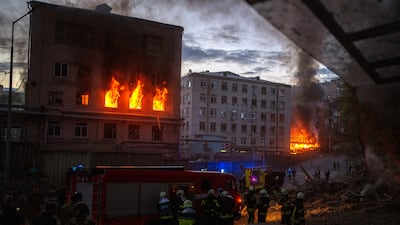
Russia struck Kyiv shortly after the meeting between President Volodymyr Zelenskyy and UN Secretary General Antonio Guterres. AP Photo -

Volodymyr Tykhonov, 76, opens the door of his garage, which is riddled with bullet holes, in Zahaltsi, Ukraine. Getty Images -
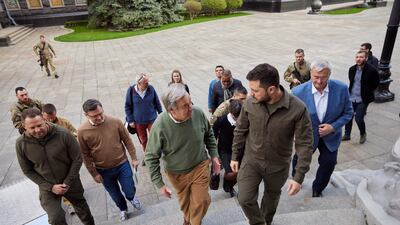
President Zelenskyy welcomes UN Secretary General Antonio Guterres before their meeting. Reuters -
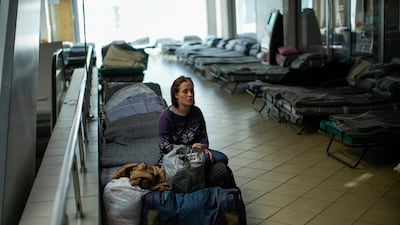
Iulia Shevchuk rests in a reception centre for displaced people in Dnipro, Ukraine. AP Photo -
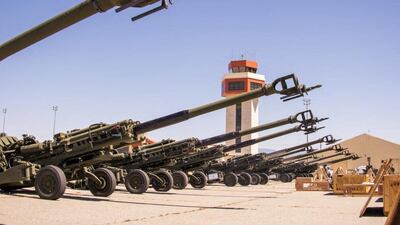
American 155 mm howitzers due to be being loaded on to a US Air Force plane to Ukraine. AFP -
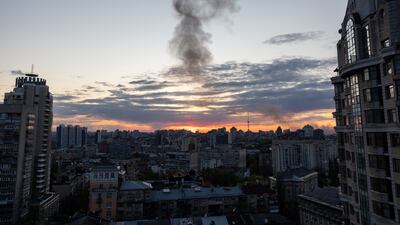
Smoke rises after an explosion at sunset in Kyiv. Getty Images -
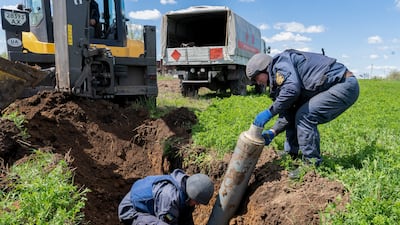
Ukrainian rescuers pull out a part of a rocket that remained after shelling in the eastern city of Kharkiv. EPA -
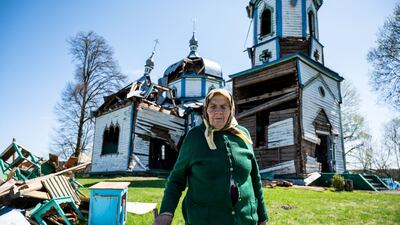
Lyubov, 85, stands in front of a 19th century wooden church, damaged by rocket attack, in the Zhytomyr region of Ukraine. Reuters -
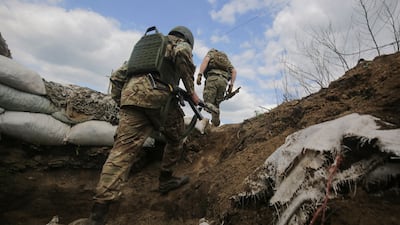
Ukrainian servicemen on patrol in Luhanske village. EPA


“The threat of tactical weapons is probably a message that Russia would like to send to the West,” he told an interviewer last week. “Russia reserves the right to escalate.”
There is a great deal of questioning about the potential for spillover from the Ukraine conflict, and consensus that the use of nuclear weapons has a global impact. But scholars also see another category of attack that has ramifications beyond the territory of conflict. In a report for the International Institute of Strategic Studies (IISS), these were defined as “weapons systems below the nuclear threshold that can achieve decisive strategic effect”.
There have already been examples in the current conflict of this sort of action, such as when Kyiv was struck by cruise missiles last week just minutes after the UN Secretary General Antonio Guterres appeared alongside the country’s president. This was interpreted by many as signalling a rejection of Mr Guterres' mission in a direct message from the Russian high command.
On top of this, there are many who argue that the Russian Kinzhal hypersonic missile, which Moscow says it has now used for the first time, does not actually meet the hypersonic designation that its designers have granted. However, its use in Ukraine nonetheless had ramifications far larger than the strike itself. When it was fired by Russia to hit an arms deport at a western Ukraine military base, the incident was reported as putting “fear into the heart of Ukrainians”. Experts pointed out that the choice of an expensive and newly developed missile was deliberate over the other more plentiful but older weapons in Russia’s arsenal. That in itself was something that made the strategic planners of other nations take note.

Strategic weapons need not be arms. There is a range of other tools and campaigns that can be ramped up, such as cyber attacks on strategic infrastructure or prestige entities. Also in the mix are electronic warfare capabilities to shut down rival airspace, plus misinformation or disinformation. What is key in this sphere is to distinguish the context of the action. This is what can ultimately elevate an attack towards the nuclear threshold.
“Nuclear weapons are the weapons of the weak in many ways,” argued strategic analyst Mark Massa at a panel organised by the IISS on these issues last week. “If you are overwhelmed conventionally, then you might need to rely on nuclear weapons to achieve your offensive or defensive goals.
“I think we'll see if non-nuclear strategic weapons are the same. If you can’t achieve your tactical and operational aims [for] strategic gains, you might rely on non-nuclear strategic weapons earlier – even if they are more escalatory or more risky. Russia’s poor performance does not give me great confidence.”
The deeper lessons for war planners further afield are already clear, whatever the progress of the fighting in the Donbas and Black Sea coast. The Ukraine conflict has already devastated much of that nation. Attacks are no longer aimed solely at Kiev. It has triggered the displacement of at least 12 million people. The battle has drawn in dozens of other states, principally the Europeans. Worst of all, the direct pain globally from the conflict won’t go away this year or next at least.

