Competitors run from the starting point during the annual Beirut Marathon, in the Lebanese capital, on Sunday. AFP


Lebanese society is far less divided than you think


  • English
  • Arabic

November 16, 2021

Most policymakers and pundits are confounded by what to do about Lebanon. They ask: "What do the Lebanese people want? How strong is the hold that the sectarian elites and Hezbollah, the Iranian proxy, have over the population? And is change even possible in Lebanon?"

In an effort to answer these questions, the American Task Force on Lebanon and Zogby Research Services conducted a nationwide poll of 859 Lebanese citizens in September. Broadly speaking, the poll was constituted to assess their current situation and to identify their political priorities and their hopes for the future.

The findings are both instructive and fascinating.

There are, for example, multiple areas where a consensus on critical issues exists from every demographic and religious sub-group. And despite the extreme hardships, for a strong majority, next year's parliamentary election presents a make-or-break moment for the future of their country. What comes through clearly from the findings is the profound impact the economic collapse is having across the country.

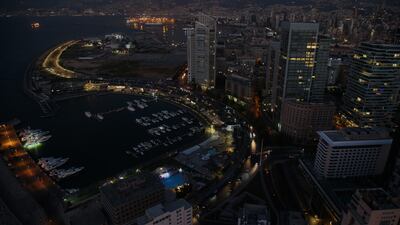
  • A view of Lebanon's capital, Beirut, with the lights on only in some buildings. Lebanese rely on highly polluting diesel generators run by private neighbourhood operators to make up for shortfalls in electricity supply from the state utility. EPA
    A view of Lebanon's capital, Beirut, with the lights on only in some buildings. Lebanese rely on highly polluting diesel generators run by private neighbourhood operators to make up for shortfalls in electricity supply from the state utility. EPA
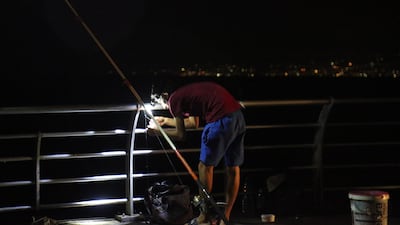
  • A fisherman uses a headlamp at the seaside corniche in Beirut, Lebanon. EPA
    A fisherman uses a headlamp at the seaside corniche in Beirut, Lebanon. EPA
  • A vendor sells LED balloons in full darkness at the corniche in Beirut. EPA
    A vendor sells LED balloons in full darkness at the corniche in Beirut. EPA
  • The near collapse of the national grid has increased the duration of power cuts across Lebanon. EPA
    The near collapse of the national grid has increased the duration of power cuts across Lebanon. EPA
  • Residents of Beirut are experiencing power cuts of up to 20 hours a day. EPA
    Residents of Beirut are experiencing power cuts of up to 20 hours a day. EPA

Nine in 10 respondents said that they are worse off now than they had been just five years earlier. More than eight in 10 said they have experienced shortages in fuel, electricity and drinking water. For one third of respondents, there are occasions when they have been forced to go without food. Among the poorest Lebanese, one in five said they "very often go without meals". And almost two thirds reported that they do not have enough income to make ends meet. As a result, a disturbing two thirds conceded that, if given the opportunity, they would emigrate to another country.

These figures are hardly surprising, given that the country has been through much political turmoil over the past few years that has led to the economic hardships its people are currently facing.

However, despite these hardships, people retain confidence in some of their country's institutions. Scoring high among all religious sects and demographic sub-groups are the Lebanese Armed Forces, civil society, the religious leadership, judiciary and what has come to be known as the 17 October Revolution, the national protests in 2019 that were triggered by planned taxes on gasoline, tobacco and VoIP calls on applications such as WhatsApp.

Attitudes towards Hezbollah are divided, leaning negative, and confidence in Parliament and in the traditional parties are low. On the issue of Hezbollah, it is striking that two thirds of all Lebanese, including a majority of respondents from every religious sect, expressed the belief that their weapons and forces should not be allowed to operate independent of the state and, instead, should be under the control of the armed forces.

Lebanese army special forces soldiers protect teachers as they flee their school after deadly clashes erupted in Beirut last month. AP Photo
Hezbollah supporters commemorate their annual Martyrs' Day in Nabatieh, Lebanon, on Thursday. Reuters

It is important to note that despite their desperate situation, people are looking forward to next year's election. Three in five respondents say that they believe that the "elections will bring the political change Lebanon needs", with two thirds expressing their intention to vote for the "new alternative parties". On the other hand, only one in five say that they would vote for the traditional parties.

What people want from their government also comes through clearly in the survey results. When asked to identify the number one issue facing the country, far and away, "ending corruption" was the top-rated priority followed by education, health care and employment. A substantial majority also said they want to see an end to the Taif formula of sectarian governance.

When asked to provide their primary source of personal identity, eight in 10 respondents said “Lebanese", while fewer than one in 10 said their "sect" provides their primary identification. And, most significantly, 97 per cent of respondents said that it is important that there be "a full investigation of and accountability for the explosion in the Beirut Port".

These are only a few topline results from the poll, which the remainder of the findings serve to accentuate.

The grain silo that was damaged during last year's Beirut Port blast. Reuters

In summation, the people are hurting from the economic collapse. They are fed up with an ossified and broken sectarian political system that they want to see changed, and they want an end to government corruption. Hezbollah needs to be reined in and brought under the control of the state. The government needs to be held accountable for its failings – in particular the devastating explosion in the port. Despite all their frustrations, they have their hopes pinned on the belief that next year's election will bring much-needed change.

It is vital when speaking about Lebanon that these areas of consensus be factored into any discussion about the future of the country. For years now, Lebanon has been said to be at the breaking point.

One can only conclude that, if the 2022 vote does not happen because the sectarian elites or Hezbollah sense that they pose a risk to their control, or if the elections are not free and fair, or if the country's sectarian electoral system brings the same old traditional elites back into power, then the hopes of the Lebanese people will be shattered.

At which point, the country will go from the breaking point to being broken.

UAE v Gibraltar

What: International friendly

When: 7pm kick off

Where: Rugby Park, Dubai Sports City

Admission: Free

Online: The match will be broadcast live on Dubai Exiles’ Facebook page

UAE squad: Lucas Waddington (Dubai Exiles), Gio Fourie (Exiles), Craig Nutt (Abu Dhabi Harlequins), Phil Brady (Harlequins), Daniel Perry (Dubai Hurricanes), Esekaia Dranibota (Harlequins), Matt Mills (Exiles), Jaen Botes (Exiles), Kristian Stinson (Exiles), Murray Reason (Abu Dhabi Saracens), Dave Knight (Hurricanes), Ross Samson (Jebel Ali Dragons), DuRandt Gerber (Exiles), Saki Naisau (Dragons), Andrew Powell (Hurricanes), Emosi Vacanau (Harlequins), Niko Volavola (Dragons), Matt Richards (Dragons), Luke Stevenson (Harlequins), Josh Ives (Dubai Sports City Eagles), Sean Stevens (Saracens), Thinus Steyn (Exiles)

German intelligence warnings
  • 2002: "Hezbollah supporters feared becoming a target of security services because of the effects of [9/11] ... discussions on Hezbollah policy moved from mosques into smaller circles in private homes." Supporters in Germany: 800
  • 2013: "Financial and logistical support from Germany for Hezbollah in Lebanon supports the armed struggle against Israel ... Hezbollah supporters in Germany hold back from actions that would gain publicity." Supporters in Germany: 950
  • 2023: "It must be reckoned with that Hezbollah will continue to plan terrorist actions outside the Middle East against Israel or Israeli interests." Supporters in Germany: 1,250 

Source: Federal Office for the Protection of the Constitution

Analysis

Members of Syria's Alawite minority community face threat in their heartland after one of the deadliest days in country’s recent history. Read more

The specs

Engine: 1.5-litre 4-cyl turbo

Power: 194hp at 5,600rpm

Torque: 275Nm from 2,000-4,000rpm

Transmission: 6-speed auto

Price: from Dh155,000

On sale: now

The%20BaaS%20ecosystem
%3Cp%3EThe%20BaaS%20value%20chain%20consists%20of%20four%20key%20players%3A%3C%2Fp%3E%0A%3Cp%3E%3Cstrong%3EConsumers%3A%3C%2Fstrong%3E%20End-users%20of%20the%20financial%20product%20delivered%3C%2Fp%3E%0A%3Cp%3E%3Cstrong%3EDistributors%3A%3C%2Fstrong%3E%20Also%20known%20as%20embedders%2C%20these%20are%20the%20firms%20that%20embed%20baking%20services%20directly%20into%20their%20existing%20customer%20journeys%3C%2Fp%3E%0A%3Cp%3E%3Cstrong%3EEnablers%3A%3C%2Fstrong%3E%20Usually%20Big%20Tech%20or%20FinTech%20companies%20that%20help%20embed%20financial%20services%20into%20third-party%20platforms%3C%2Fp%3E%0A%3Cp%3E%3Cstrong%3EProviders%3A%3C%2Fstrong%3E%20Financial%20institutions%20holding%20a%20banking%20licence%20and%20offering%20regulated%20products%3C%2Fp%3E%0A
Water waste

In the UAE’s arid climate, small shrubs, bushes and flower beds usually require about six litres of water per square metre, daily. That increases to 12 litres per square metre a day for small trees, and 300 litres for palm trees.

Horticulturists suggest the best time for watering is before 8am or after 6pm, when water won't be dried up by the sun.

A global report published by the Water Resources Institute in August, ranked the UAE 10th out of 164 nations where water supplies are most stretched.

The Emirates is the world’s third largest per capita water consumer after the US and Canada.

The specs

Engine: 1.5-litre turbo

Power: 181hp

Torque: 230Nm

Transmission: 6-speed automatic

Starting price: Dh79,000

On sale: Now

The five pillars of Islam

1. Fasting 

2. Prayer 

3. Hajj 

4. Shahada 

5. Zakat 

Employment lawyer Meriel Schindler of Withers Worldwide shares her tips on achieving equal pay
 
Do your homework
Make sure that you are being offered a fair salary. There is lots of industry data available, and you can always talk to people who have come out of the organisation. Where I see people coming a cropper is where they haven’t done their homework.
 
Don’t be afraid to negotiate

It’s quite standard to negotiate if you think an offer is on the low side. The job is unlikely to be withdrawn if you ask for money, and if that did happen I’d question whether you want to work for an employer who is so hypersensitive.
 
Know your worth
Women tend to be a bit more reticent to talk about their achievements. In my experience they need to have more confidence in their own abilities – men will big up what they’ve done to get a pay rise, and to compete women need to turn up the volume.
 
Work together
If you suspect men in your organisation are being paid more, look your boss in the eye and say, “I want you to assure me that I’m paid equivalent to my peers”. If you’re not getting a straight answer, talk to your peer group and consider taking direct action to fix inequality.

War and the virus

Know your camel milk:
Flavour: Similar to goat’s milk, although less pungent. Vaguely sweet with a subtle, salty aftertaste.
Texture: Smooth and creamy, with a slightly thinner consistency than cow’s milk.
Use it: In your morning coffee, to add flavour to homemade ice cream and milk-heavy desserts, smoothies, spiced camel-milk hot chocolate.
Goes well with: chocolate and caramel, saffron, cardamom and cloves. Also works well with honey and dates.

In 2018, the ICRC received 27,756 trace requests in the Middle East alone. The global total was 45,507.


There are 139,018 global trace requests that have not been resolved yet, 55,672 of these are in the Middle East region.


More than 540,000 individuals approached the ICRC in the Middle East asking to be reunited with missing loved ones in 2018.


The total figure for the entire world was 654,000 in 2018.

EPL's youngest
  • Ethan Nwaneri (Arsenal)
    15 years, 181 days old
  • Max Dowman (Arsenal)
    15 years, 235 days old
  • Jeremy Monga (Leicester)
    15 years, 271 days old
  • Harvey Elliott (Fulham)
    16 years, 30 days old
  • Matthew Briggs (Fulham)
    16 years, 68 days old
Updated: November 16, 2021, 4:00 AM