

In the opening scene of the harrowing 2015 Second World War drama Land of Mine, Roland Moller plays Sgt Carl Rasmussen, a Danish soldier returning to his newly liberated country in May 1945.
Wearing the uniform of Britain’s Parachute Regiment, Rasmussen is driving past a line of bedraggled Wehrmacht troops who are trudging their way home after the collapse of the Nazis’ five-year occupation.
Something one of the soldiers has tucked under his arm catches Rasmussen’s eye, and the burly commando brings his jeep to a sudden stop. Striding over to the young man, Rasmussen can now see clearly what the German is carrying: a pilfered Danish flag.
Already seething with pent-up rage, Rasmussen lets loose, battering the solider to the ground and snatching the flag back. “This is not yours!” he yells in German. To the rest of the retreating troops he shouts: “This is my land! Understood? Get out!”
It is difficult to think of a more visceral depiction of the power of flags and emblems. Although some say that flags are merely coloured fabric – like NFL player Colin Kaepernick who said in 2016: "I am not going to value a piece of cloth over people's lives" – these emblems are alive with political and cultural voltage.
In the UAE, which celebrates Flag Day this week, the colours designed in 1971 by 19-year-old Abdullah Mohammad Al Maainah were first flown at Union House in Dubai and Mushrif Palace in Abu Dhabi on December 2 that year – the day of unification.
The UAE flag, with its pan-Arab colours, is an important symbol of statehood and played an important part in forging a strong Emirati identity. The flag is universally accepted by Emiratis as their emblem and it can be said that the UAE flag, for want of a better word, works.
This is not always the case. In 2004, Iraqis furiously rejected a new national flag that was intended to underline the break with the Saddam Hussein era.
The new flag – designed in London by the renowned Iraqi architect Rifat Chadirji – ditched the pan-Arab colours of the country’s previous flags in favour of a blue crescent and two blue lines on a white background.
For many Iraqis, the new flag was that of the occupying forces and, in a fatal blow to the flag’s chances of success, was unnervingly close in appearance to that of Israel’s. After protests, the new flag was quietly folded up and put away.

Obsolete flags can retain their power, too. In Germany, for example, the illegal display of the swastika comes with a three-year jail sentence.
But even an uncontroversial flag that works can raise strong feelings. New Zealanders spent 16 months and nearly $17.5 million in designing a series of alternatives to its existing flag only for the electorate to keep the original Southern Cross design in a 2016 referendum.
That flags are more than just pieces of coloured cloth is even borne about by those who destroy them. Rows over flag burning as free speech in the US have rumbled through the American judicial system for years. Many countries punish those who insult their flag, or other national symbols, with a fine or jail time.
Not quite so in Iran, where a canny company that makes US, British and Israeli flags for protesters to burn reported in January that business was booming, with its workers producing about 2,000 conveniently combustible symbols of imperialism a month during peak demand.
-
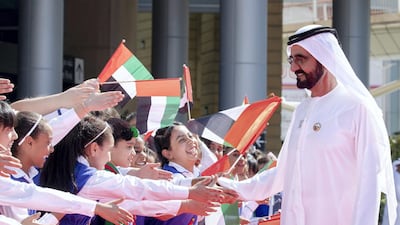
Sheikh Mohammed bin Rashid, Vice President and Ruler of Dubai, greets a crowd of young people on Flag Day on November 3, 2019. Courtesy Wam -
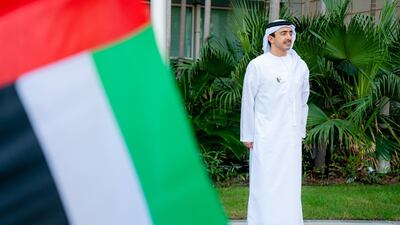
Sheikh Abdullah bin Zayed, Minister of Foreign Affairs and International Cooperation, attended the Flag Day celebrations at the ministry on November 3, 2019. Wam -
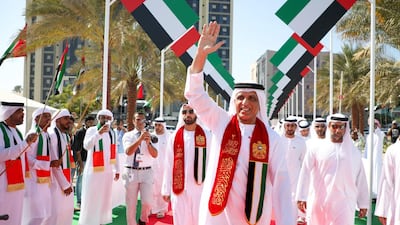
Ras Al Khaimah ruler Sheikh Saud bin Saqr Al Qasimi raises flag in Al Qawasim Corniche. Wam -
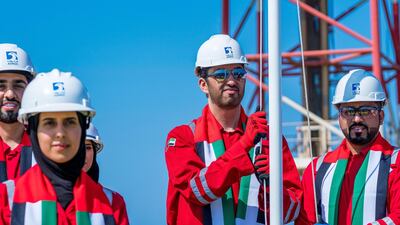
In a flag raising ceremony on the Umm Shaif platform, Dr. Sultan Al Jaber, Minister of State and CEO of ADNOC, hoisted the UAE flag in the presence of ADNOC employees. Wam -
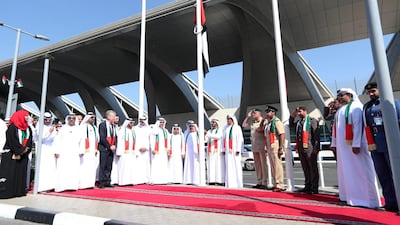
Sheikh Ahmed bin Saeed Al Maktoum (C), chairman and chief executive of Emirates Airline and Group, raises the UAE flag in front of Dubai International Airport. EPA -
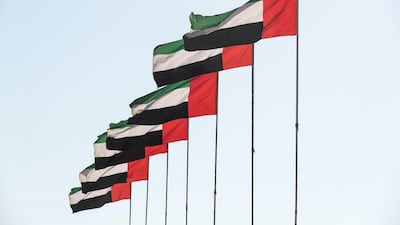
The UAE Flag flies proudly in the winter sunlight in Sharjah. Antonie Robertson/The National -
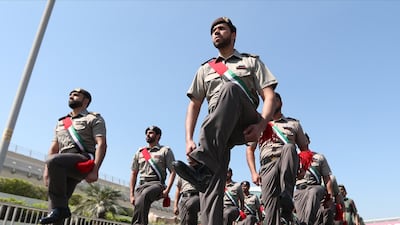
Members from Dubai Police take part in a parade in front of Dubai International Airport during UAE Flag Day in Dubai. EPA -
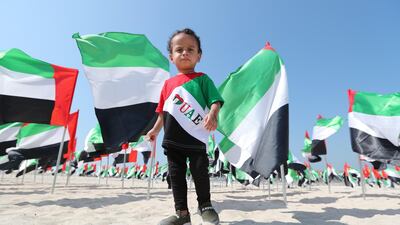
A child wears a T-shirt printed with an UAE sign at Kite beach which is decorated by UAE flag in Dubai. EPA -
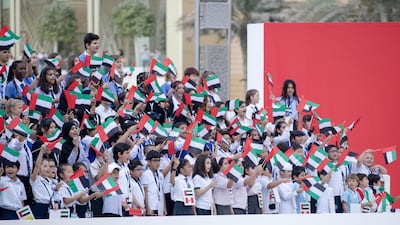
There was a sea of red, white, black and green on Flag Day. Wam -
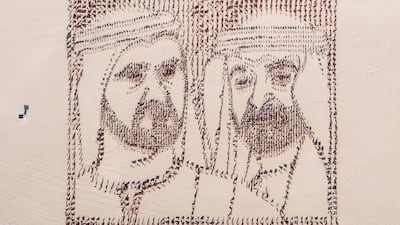
The ‘Flag Garden’ features 4,500 UAE flags arranged to create portraits of Sheikh Mohammed bin Rashid and Sheikh Mohamed bin Zayed. Wam -
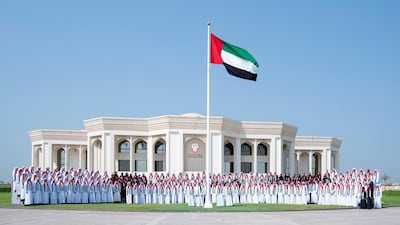
Sheikh Theyab bin Mohamed bin Zayed, Abu Dhabi Executive Council member and Chairman of the Abu Dhabi Crown Prince Court, stands for a photograph with CPC staff members during Flag Day celebrations, at Crown Prince Court. Hamad Al Kaabi / Ministry of Presidential Affairs


In keeping with this rather prosaic use of flags, there is their workaday role in the media. In the 90s a journalism tutor in Northern Ireland cheerfully told me about his so-called flag bag: a satchel of various, pristine emblems he would take with him when summoned by one paramilitary faction or another to photograph a statement or show of strength.
But, what actually makes a flag work? US librarian and vexillologist Steven Knowlton cast his expert eye over the UAE's flag for The National.
“The UAE's flag consists entirely of blocks of primary colours,” he said. “It is easy to make, even by amateurs at sewing, and to draw. This simplicity also makes it inexpensive if ordered from a manufacturer.
“Although UAE uses four colours, they are all colours commonly found in standard fabrics, and they contrast well when seen at a distance, which makes them easily visible against a clear blue sky or a cloudy sky.”
And although the UAE shares its colours with other countries in the Middle East, Mr Knowlton says the flag’s design helps to make it unique.
“The colour set of UAE's flag relates clearly to other Arab nations, such as Jordan, Sudan, Palestine, Iraq, Syria, Libya and Kuwait. But the distinctive use of only rectangular shapes helps it stand out against the other flags, which rely on triangles or horizontal stripes.”
When a teenage Abdullah Mohammad Al Maainah – who went on to become an Emirati diplomat – entered Aletihad newspaper's flag competition in 1971, little did he know the impact his red, black, green and white banner would have.
His winning flag will be ubiquitous this week, but as with so much this year, 2020's Flag Day will be one like no other. From being displayed to deliver stay-home messages or to encourage unity among the 200 nationalities who live and work here, the UAE's flag remains part of the fabric of this country.
Declan McVeigh is a sub-editor for The National

