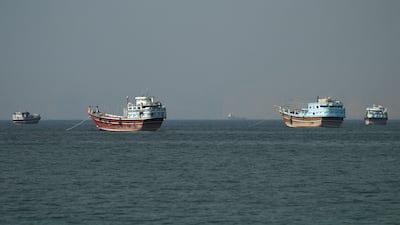

At least 115 vessels carrying about 2,500 seafarers have been evacuated from the Strait of Hormuz since Tuesday, the head of the UN maritime agency said on Friday, after the organisation suspended wider evacuation efforts following an attack on a vessel in the Gulf of Oman.
International Maritime Organisation chief Arsenio Dominguez told reporters in New York that the evacuations had been conducted under a UN safe-passage programme launched on Tuesday to help ships stranded by the US-Iran war.
The IMO paused the operation on Thursday after an attack on a vessel in the Gulf of Oman, leaving about 600 ships and 11,000 sailors still awaiting evacuation.
Tehran on Friday reasserted its right to control shipping in the critical waterway and warned its Gulf neighbours against siding with Washington.
Mr Dominguez said the IMO remained in contact with Iranian and Omani authorities to clarify what had led to the attack and restore the guarantees that underpinned the evacuation framework.
“I maintain conversations with the government of Iran, as well as with the government of Oman,” he said.
The IMO chief added that Iran's and Oman's foreign ministers had held a high-level meeting on Monday during which the evacuation mechanism was discussed, paving the way for its launch the following day.
“Right now, I'm still engaging with Iran in relation to the position that was taken at foreign affairs level, and then the actions that were taken by the IRGC [Iran's Islamic Revolutionary Guard Corps],” he said.
“As soon as I get further confirmations … that vessels would not be targeted, we're ready to reinitiate the process of evacuation.”
Mr Dominguez said the evacuation would resume gradually once security guarantees were restored.
“It will be progressively,” he said when asked about the time frame, adding that it would probably take “a few weeks” to evacuate the remaining vessels.
The evacuations are being conducted through two temporary shipping corridors, a northern route running close to Iran's coast and a southern route near Oman, after the IMO's long-established traffic lane through the Strait of Hormuz was deemed unsafe.
Mr Dominguez said the traditional Traffic Separation Scheme, in place since 1968 to reduce the risk of collisions, cannot be used because of reported mines in the waterway.
The US and Iran are still negotiating terms of the interim peace deal, including issues such as getting ships through the key strait and addressing the future of Iran’s stockpile of highly enriched uranium. Under the deal, the two sides were given 60 days to work out the details.
Meanwhile, President Donald Trump on Friday accused Iran of violating its ceasefire agreement with the US after launching what he said were four one-way attack drones at ships transiting the Strait of Hormuz.
“The Islamic Republic of Iran shot at least four One Way Attack Drones at ships transversing the Strait of Hormuz,” Mr Trump wrote on Truth Social.
He said one of the drones “solidly hit the upper deck of a large and very expensive cargo carrying ship” but that the ship was able to proceed. He added that US forces had intercepted the three other drones.
“Obviously, this is a foolish violation of our Ceasefire Agreement,” he said.
Jihan Abdalla contributed to this report from Washington