Live updates: Follow the latest on Israel-Gaza
A war between Hezbollah and Israel poses a significantly greater threat than Hamas, France’s ambassador to the UN told The National, as he warned of the risks of a full-scale regional spillover erupting along the country's northern border.
"Tensions between Hezbollah and Israel could have devastating effects on both sides, not just Israel," Nicolas de Riviere said.
He said France is working with Israeli and Lebanese authorities to try to prevent such an outcome, which would rapidly inflame tension across the Middle East.
“We are very concerned with the situation along the Blue Line in the northern part of Israel and southern Lebanon … the situation is very fragile,” Mr de Riviere said in an exclusive interview at UN headquarters in New York this week.
“It needs to stay under control … The impact of such a crisis would be huge.”
Hezbollah, which like Hamas is backed by Iran, has been engaging in almost daily cross-border exchanges of fire with Israeli forces since the Hamas-led attacks on October 7.
Lebanese authorities have little control over the militant group, which operates with impunity and controls much of southern Lebanon.
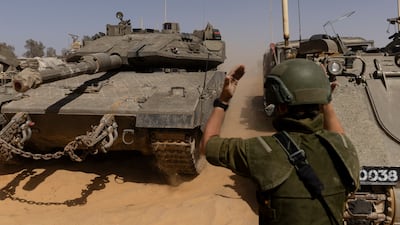
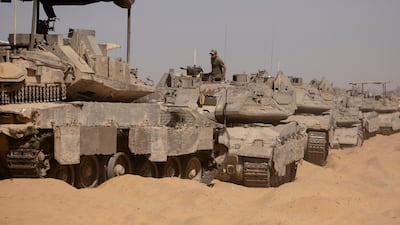
Hezbollah has further intensified its actions since Israel launched its incursion into Rafah, a city in the southern Gaza Strip, over the past two weeks.
A Hezbollah drone this week struck an Israeli surveillance blimp. Intelligence analysts told The National that Hezbollah is seeking to blind northern Israel’s detection systems, potentially ahead of a more serious assault.
Hezbollah has repeatedly stated that its attacks against Israel will stop only if a ceasefire in Gaza is enacted.
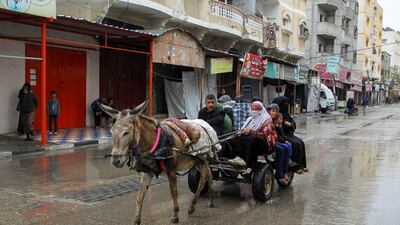
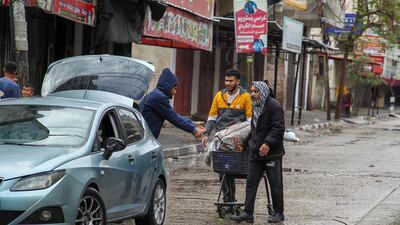
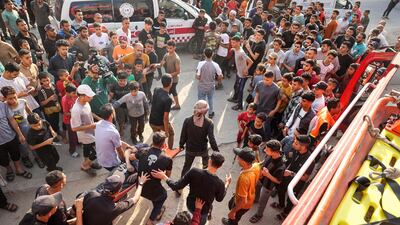
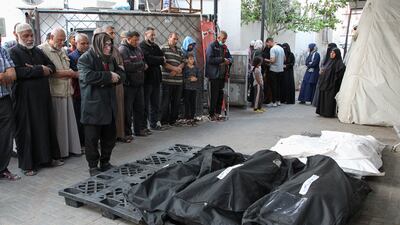
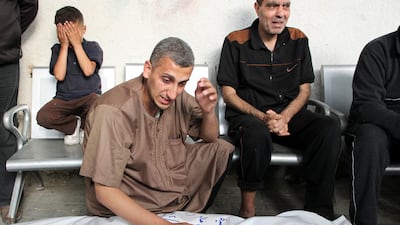
The war in Gaza, now in its eighth month, has killed more than 35,000 Palestinians, according to local authorities, and Israel's gradual invasion of the southern city of Rafah is putting hundreds of thousands of civilians at risk.
The US has paused one shipment of high-yield bombs over fears Israel would use them indiscriminately in Rafah, but has vowed to keep supplying its ally as it fights Hamas.
“The Geneva Conventions, the law of the war, doesn't prevent you from fighting fighters … and it doesn't prevent you from eradicating terrorists,” Mr de Riviere said.
“What is totally off limits is to launch a large-scale operation, to use indiscriminate bombings and to kill a large number of civilians, women and children … It's totally off limits. The sooner this war comes to an end, the better.”
Civilians ordered to flee eastern Rafah as Israel begins invasion – in pictures
But the ambassador said an arms embargo on Israel would be unacceptable.
“Israel has to defend itself and we will never, ever negotiate about the security of Israel for obvious reasons,” he said, highlighting Iran’s attack on Israel last month in retaliation for an Israeli strike on the Iranian consulate in Damascus, which killed senior military commanders.
The October 7 attack saw about 1,200 people killed in Israel and more than 200 hostages taken by Hamas and other militants, according to Israeli officials. Three French citizens are still being held captive.
When questioned about the “day after” the war's end, Mr de Riviere said that as long as there is no Palestinian statehood, Israel's security will remain “fragile”.
Without addressing such fundamental aspirations, events like October 7 could recur, leading to continual conflict.
“We should all together make an effort to break this vicious circle,” he said.
The ambassador also criticised the approach of determining Palestine's future solely through negotiations involving Israel and other nations, stating that it “won't work”.
He further highlighted the risk of the Palestinian issue becoming a marginal concern in the normalisation process that envisions broad Israeli economic integration with Arab nations.
“We cannot continue with the same mistakes which have been made in the past. We need to encourage the parties, both of them, and to put pressure on them to negotiate to find a sustainable political solution.”
Discussing a post-conflict governance strategy in Gaza, Mr de Riviere underscored the necessity of reforming the “very weak” Palestinian Authority and putting in place a security arrangement for Gaza.
“We need to define the role of the Palestinian Authority, which Palestinian Authority, which Palestinian governance … role of the UN, what should be done in terms of reconstruction,” Mr De Riviere said.
When asked about Hamas's potential inclusion in any future political process, he responded: “I don't think this is possible.”
The UN General Assembly voted on May 10 to support Palestine's bid for full membership, with a resolution sponsored by the UAE on behalf of 22 Arab nations and co-sponsored by about 65 countries. The US, Israel and seven other members opposed the measure. France voted in favour.
Despite the conversation around Palestinian statehood gaining momentum in Europe, especially with Slovenia, Spain and Ireland moving towards formal recognition, France is not ready to officially recognise Palestine as a sovereign state.
“We need to make sure that it makes a real difference … we want probably something to be part of the process, of a solution, that would lead to a peace agreement,” he said.
“It's not just the one thing you announce one morning on TV.”
Mohammed bin Zayed Majlis
Two-step truce
The UN-brokered ceasefire deal for Hodeidah will be implemented in two stages, with the first to be completed before the New Year begins, according to the Arab Coalition supporting the Yemeni government.
By midnight on December 31, the Houthi rebels will have to withdraw from the ports of Hodeidah, Ras Issa and Al Saqef, coalition officials told The National.
The second stage will be the complete withdrawal of all pro-government forces and rebels from Hodeidah city, to be completed by midnight on January 7.
The process is to be overseen by a Redeployment Co-ordination Committee (RCC) comprising UN monitors and representatives of the government and the rebels.
The agreement also calls the deployment of UN-supervised neutral forces in the city and the establishment of humanitarian corridors to ensure distribution of aid across the country.
Wicked: For Good
Director: Jon M Chu
Starring: Ariana Grande, Cynthia Erivo, Jonathan Bailey, Jeff Goldblum, Michelle Yeoh, Ethan Slater
Rating: 4/5
Mercer, the investment consulting arm of US services company Marsh & McLennan, expects its wealth division to at least double its assets under management (AUM) in the Middle East as wealth in the region continues to grow despite economic headwinds, a company official said.
Mercer Wealth, which globally has $160 billion in AUM, plans to boost its AUM in the region to $2-$3bn in the next 2-3 years from the present $1bn, said Yasir AbuShaban, a Dubai-based principal with Mercer Wealth.
“Within the next two to three years, we are looking at reaching $2 to $3 billion as a conservative estimate and we do see an opportunity to do so,” said Mr AbuShaban.
Mercer does not directly make investments, but allocates clients’ money they have discretion to, to professional asset managers. They also provide advice to clients.
“We have buying power. We can negotiate on their (client’s) behalf with asset managers to provide them lower fees than they otherwise would have to get on their own,” he added.
Mercer Wealth’s clients include sovereign wealth funds, family offices, and insurance companies among others.
From its office in Dubai, Mercer also looks after Africa, India and Turkey, where they also see opportunity for growth.
Wealth creation in Middle East and Africa (MEA) grew 8.5 per cent to $8.1 trillion last year from $7.5tn in 2015, higher than last year’s global average of 6 per cent and the second-highest growth in a region after Asia-Pacific which grew 9.9 per cent, according to consultancy Boston Consulting Group (BCG). In the region, where wealth grew just 1.9 per cent in 2015 compared with 2014, a pickup in oil prices has helped in wealth generation.
BCG is forecasting MEA wealth will rise to $12tn by 2021, growing at an annual average of 8 per cent.
Drivers of wealth generation in the region will be split evenly between new wealth creation and growth of performance of existing assets, according to BCG.
Another general trend in the region is clients’ looking for a comprehensive approach to investing, according to Mr AbuShaban.
“Institutional investors or some of the families are seeing a slowdown in the available capital they have to invest and in that sense they are looking at optimizing the way they manage their portfolios and making sure they are not investing haphazardly and different parts of their investment are working together,” said Mr AbuShaban.
Some clients also have a higher appetite for risk, given the low interest-rate environment that does not provide enough yield for some institutional investors. These clients are keen to invest in illiquid assets, such as private equity and infrastructure.
“What we have seen is a desire for higher returns in what has been a low-return environment specifically in various fixed income or bonds,” he said.
“In this environment, we have seen a de facto increase in the risk that clients are taking in things like illiquid investments, private equity investments, infrastructure and private debt, those kind of investments were higher illiquidity results in incrementally higher returns.”
The Abu Dhabi Investment Authority, one of the largest sovereign wealth funds, said in its 2016 report that has gradually increased its exposure in direct private equity and private credit transactions, mainly in Asian markets and especially in China and India. The authority’s private equity department focused on structured equities owing to “their defensive characteristics.”
GOLF’S RAHMBO
- 5 wins in 22 months as pro
- Three wins in past 10 starts
- 45 pro starts worldwide: 5 wins, 17 top 5s
- Ranked 551th in world on debut, now No 4 (was No 2 earlier this year)
- 5th player in last 30 years to win 3 European Tour and 2 PGA Tour titles before age 24 (Woods, Garcia, McIlroy, Spieth)
Vikram%20Vedha
%3Cp%3E%3Cstrong%3EDirectors%3A%3C%2Fstrong%3E%20Gayatri%2C%20Pushkar%3C%2Fp%3E%0A%3Cp%3E%3Cstrong%3EStars%3A%3C%2Fstrong%3E%20Hrithik%20Roshan%2C%20Saif%20Ali%20Khan%2C%20Radhika%20Apte%3C%2Fp%3E%0A%3Cp%3E%3Cstrong%3ERating%3A%C2%A0%3C%2Fstrong%3E3.5%2F5%3C%2Fp%3E%0A
What is type-1 diabetes
Type 1 diabetes is a genetic and unavoidable condition, rather than the lifestyle-related type 2 diabetes.
It occurs mostly in people under 40 and a result of the pancreas failing to produce enough insulin to regulate blood sugars.
Too much or too little blood sugar can result in an attack where sufferers lose consciousness in serious cases.
Being overweight or obese increases the chances of developing the more common type 2 diabetes.
Benefits of first-time home buyers' scheme
- Priority access to new homes from participating developers
- Discounts on sales price of off-plan units
- Flexible payment plans from developers
- Mortgages with better interest rates, faster approval times and reduced fees
- DLD registration fee can be paid through banks or credit cards at zero interest rates
Blackpink World Tour [Born Pink] In Cinemas
Starring: Rose, Jisoo, Jennie, Lisa
Directors: Min Geun, Oh Yoon-Dong
Rating: 3/5
Where to buy
Limited-edition art prints of The Sofa Series: Sultani can be acquired from Reem El Mutwalli at www.reemelmutwalli.com
MATCH INFO
Asian Champions League, last 16, first leg:
Al Jazira 3 Persepolis 2
Second leg:
Monday, Azizi Stadium, Tehran. Kick off 7pm
The biog
Favourite hobby: I love to sing but I don’t get to sing as much nowadays sadly.
Favourite book: Anything by Sidney Sheldon.
Favourite movie: The Exorcist 2. It is a big thing in our family to sit around together and watch horror movies, I love watching them.
Favourite holiday destination: The favourite place I have been to is Florence, it is a beautiful city. My dream though has always been to visit Cyprus, I really want to go there.
Some of Darwish's last words
"They see their tomorrows slipping out of their reach. And though it seems to them that everything outside this reality is heaven, yet they do not want to go to that heaven. They stay, because they are afflicted with hope." - Mahmoud Darwish, to attendees of the Palestine Festival of Literature, 2008
His life in brief: Born in a village near Galilee, he lived in exile for most of his life and started writing poetry after high school. He was arrested several times by Israel for what were deemed to be inciteful poems. Most of his work focused on the love and yearning for his homeland, and he was regarded the Palestinian poet of resistance. Over the course of his life, he published more than 30 poetry collections and books of prose, with his work translated into more than 20 languages. Many of his poems were set to music by Arab composers, most significantly Marcel Khalife. Darwish died on August 9, 2008 after undergoing heart surgery in the United States. He was later buried in Ramallah where a shrine was erected in his honour.