

A group of Lebanese political parties, independent figures and civil society representatives launched the first coalition borne from massive anti-government protests in 2019 on Tuesday, in a bid to topple Lebanon’s traditional ruling class in parliamentary elections next year.
“We think that the Lebanese people as one, not sectarian, not divided, will come together for a better future for our country,” said former independent MP Paula Yacoubian during a press conference held at the Beirut headquarters of secular political party the National Bloc.
Ms Yacoubian resigned shortly after the devastating explosion at Beirut’s port last August along with a handful of other lawmakers.
In a speech, artist and activist Nada Sehnaoui presented the coalition’s “rescue initiative” that calls for an independent transitional government with exceptional powers to implement long-awaited reforms and steer Lebanon to parliamentary elections scheduled for 2022.
The current caretaker government resigned after the port explosion and prime minister designate Saad Hariri, embroiled in bitter political bickering with his rivals over ministerial posts, has not formed a Cabinet yet.
Political paralysis and lack of decision-making has worsened the country’s severe economic crisis that began in mid-2019 and pushed hundreds of thousands of people to the streets for several months later that year.
Tuesday’s press conference was scheduled to coincide with the anniversary of the beginning of Lebanon’s devastating 1975-1990 civil war.
-
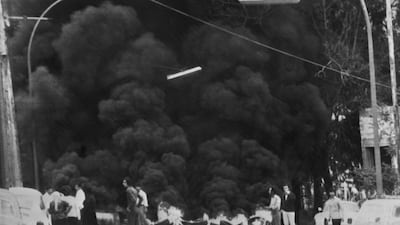
Smoke rises in a Beirut street during clashes between Palestinians and members of Christian militia the Lebanese Forces, backed by Lebanon's Christian Kataeb Phalangist party, on April 15, 1975. AFP -

Guerrilla fighters on a tank in a street in Beirut during Lebanon's civil war, in December 1975. Getty Images -
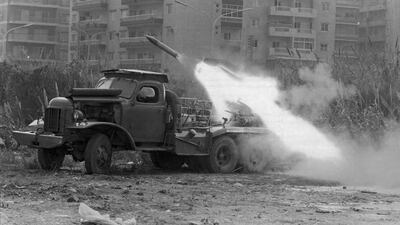
A Katyusha rocket is fired from the back of an army lorry into an apartment complex during the first year of the Lebanese civil war, in 1975. Getty Images -
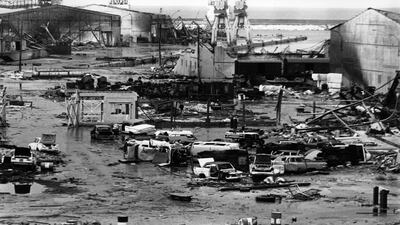
A mass of burnt vehicles in the harbour area of Beirut after the outbreak of civil war in 1975. Getty Images -
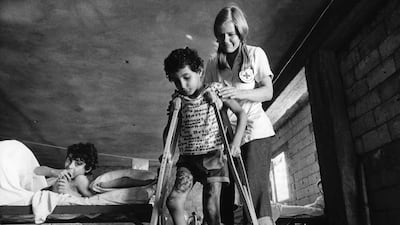
A Red Cross nurse from Sweden takes care of a boy shot in the heel by a sniper, on September 9, 1976, at a hospital in the Coral Beach Hotel, on the road between Beirut and Saida. AFP -
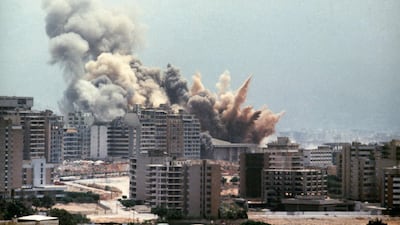
Israeli shelling on west Beirut on August 2, 1982. AFP -

A man sits on rubble in a desolated area of west Beirut on August 20, 1982. AFP -
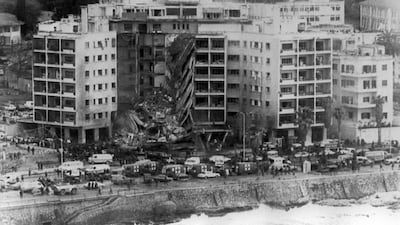
The US embassy in Beirut on April 18, 1983, after a bomb destroyed part of the building. AFP -
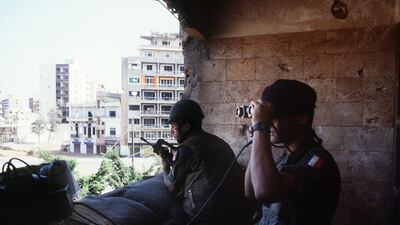
French soldiers watch the skyline in Beirut on September 26, 1983. The troops were part of the Beirut security multinational force sent to keep security after the Israeli invasion of 1982. AFP -
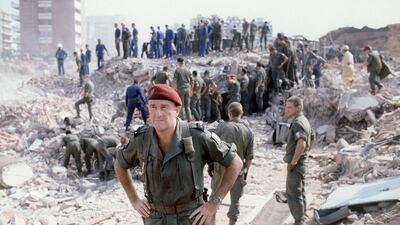
General Francois Cann, commander of the French troops of the multinational forces, on October 23, 1983, as rescuers search for survivors in Beirut through the rubble of a building that was destroyed by a suicide lorry bomber overnight. Fifty-eight French soldiers and five Lebanese were killed in the attack. AFP -
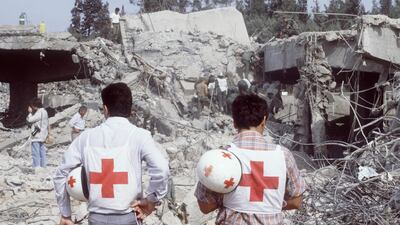
Rescuers continue to search on October 31, 1983, for corpses and identify the victims of the attack on October 23 on the headquarters of US troops from the multinational force in Beirut. AFP -
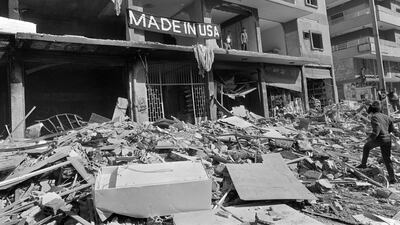
Rescuers search for victims on March 8, 1985, 15 minutes after a car, packed with an estimated 250kg of TNT, exploded in a crowded street of the southern Bir Al Aabed district in mainly Shiite southern suburb of Beirut. At least 75 people were killed and 256 injured in the explosion. AFP -
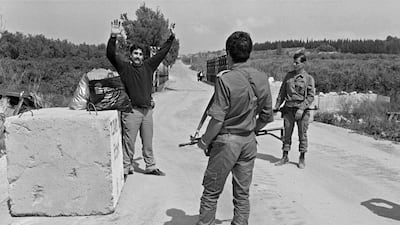
Israeli Defence Force soldiers on March 19, 1985, confront a civilian at Kasmyah bridge after troops the month before evacuated about 500 sq km around Saida. AFP -
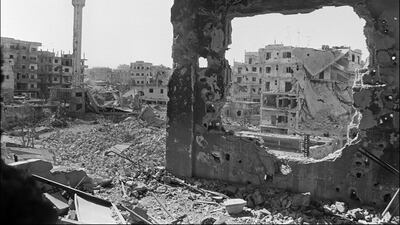
Tripoli, in northern Lebanon, on October 4, 1985, after a ceasefire between pro-Palestine and pro-Syrian militias was agreed to in Damascus. AFP -
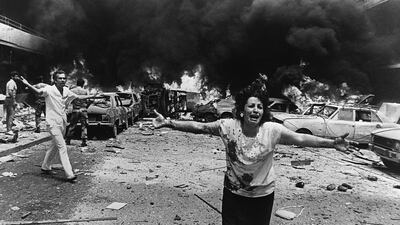
A woman cries in shock, minutes after a car bomb exploded in a crowded neighbourhood of mainly-Muslim west Beirut on August 8, 1986, killing 13 people, including three children, and wounding at least 92. AFP -
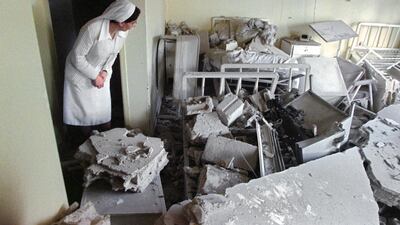
A nun inspects a damaged room in the Hotel Dieu Hospital in east Beirut on February 25, 1990, after a break in the battle between rival Christian factions. AFP


Hinting at the possibility of a new war, Ms Sehnaoui said the coalition aims to “lift Lebanon from its crisis and prevent the ruling political class from dragging the country into a new April 13”.
Sixteen groups attended the press conference, including grassroots civil society movements from outside the capital. They urged others to join them.
"For the past 45 years, sectarian groups in power and militia leaders have prevented a real opposition to emerge. We have been working together for over a year and we have strong hope that we'll be able to change the balance of power and cause the downfall of the ruling mafia," the National Bloc's secretary general Pierre Issa told The National.
In parallel, the Kataeb, a Christian political party, is spearheading a similar initiative that has yet to be announced. The Kataeb have been trying to shed their image of a right-wing civil-war era militia and embraced the 2019 protest movement.
The National Bloc’s Naji Abou Khalil said that Tuesday’s initiative is “open to everybody”.
“We are trying to gather as many forces as possible around a non-sectarian national identity, as long as those forces are very clearly positioned against Lebanon’s political class and especially the six sectarian leaders that head it,” he said.
He was referring to rival Christians President Michel Aoun and politician Samir Geagea, Sunni Muslim representative Saad Hariri, Shiite Muslim allies Parliament speaker Nabih Berri and Hezbollah secretary general Hassan Nasrallah, as well as Druze head Walid Joumblatt.
Hussein Al Achi from Mintashreen, a political party borne from the 2019 protests, said that he hoped that Lebanese voters will not turn to traditional political parties for protection as the country’s economic crisis deepens.
The latter have sought to strengthen their popularity by opening subsidised supermarkets in their strongholds or securing the Covid-19 vaccine for their constituents.
“We want to create a real state where any citizen gets his rights from the state directly without the proxy of sectarian leaders or sectarian communities,” said Mr Al Achi.

