



Follow live Lebanese election coverage here
At the headquarters of the “Beirut the Change” list, a polling delegate runs up to candidate Nohad Yazbeck and announces her first five votes — the first of many, he says.
As the biggest anti-establishment list in Beirut II, the Change list has high hopes of electing at least two candidates to parliament. Such a move would double the number of civil society candidates elected in the 2018 election.
With counting under way, voters are eagerly awaiting the results of an election that will determine the direction of the country well beyond the parliament's four-year term.
Hariri vacuum could pave the way for a new kind of vote
-

Beirut children play in an inflatable swimming pool set up by supporters of former Lebanese prime minister Saad Hariri, who have boycotted the country's elections. AFP -

Mr Hariri, seen in poster, suspended his participation in Lebanese politics last year and called on his supporters to boycott Sunday’s vote. AP -
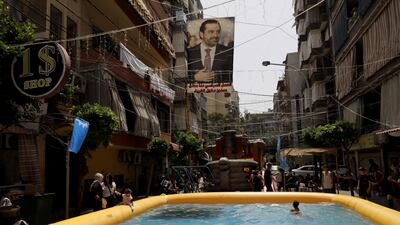
Supporters of former prime minister Saad Hariri set up an inflatable swimming pool in the Tarik El Jdideh neighborhood of Beirut, as they boycott Lebanon's elections. Getty -
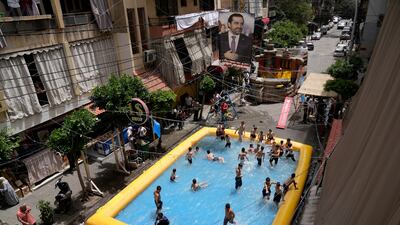
Beirut children swim in an inflatable pool that supporters of former prime minister Saad Hariri set up to illustrate their intention to boycott parliamentary elections. AP


Historically the Beirut II district has been a stronghold for Saad Hariri, two-time prime minister and leader of the Future Movement, Lebanon’s dominant Sunni political party.
But in January, Mr Hariri announced he would not be running in the election nor put forward any candidates from his party. He called on supporters to boycott the elections.
Ibrahim Mneimne, another candidate on the Change list — and one that the party has high hopes of winning a seat — says Mr Hariri’s absence has left a vacuum in the Beirut II district that has changed the field.
The newly formed political parties that stand in opposition to Lebanon’s traditional sectarian blocs hope that change will skew in their favour.
“Of course, it will affect the results, but not necessarily towards us,” he says. “But it has liberated many voters who would typically vote for the Future Movement. Once Hariri was out of the scene, they became free to make new selections.”
Lebanon has been hit by crises over the last four years, making the 2022 parliamentary elections a critical moment for the country in the eyes of many voters.
The results will dictate the trajectory of the next four years and beyond — MPs must oversee negotiations with international donors for a bailout, pass vital economic reforms and select the next president.
And the Parliamentary elections come against the backdrop of a mass protest movement against Lebanon’s established political class which erupted in 2019, as the first major signs of Lebanon’s economic collapse began to emerge.
A massive explosion in Beirut’s port followed in 2020 which killed over 200 people. And in 2021, old sectarian wounds were reopened with clashes in the Tayyouneh neighbourhood, situated on an old civil war fault line, between Shiite supporters of the Amal Movement and Hezbollah against supporters of the Lebanese Forces, a Christian rival.
High expectations but low turnout
As Lebanon struggles to extricate itself from the mire of a prolonged economic collapse marked by severe electricity, oil and medicine shortages as well as high inflation, many Lebanese people had high hopes for the elections.
Many accuse the entrenched ruling parties of being responsible for running the country into the ground.
But voter turnout has been low, with the Interior Ministry's preliminary tally standing at just 41 per cent — lower than a final voter turnout of nearly 50 per cent in 2018.
Mneimne, however, is undeterred.
Either way, “we know we won’t get a majority in parliament,” he said, underscoring the difficulty newer anti-establishment political parties face in Lebanon’s political landscape.
Rabih Haddad, a political expert and professor at the University of St Joseph, blames Lebanon’s complicated electoral law for the difficulty opposition parties have in breaking through during elections.
Adopted in 2016, Mr Haddad says that the electoral law was “created by warlords left over from the war who created the electoral law to their advantage.”
“The electoral law is hopeless. It is criminal.”
The rules were a consensus agreement after elements of proposals put forward by the major parties were merged into a single law.
Dominated by traditional parties but undeterred
-

Druze opposition candidate Firas Hamdan greets members of the sect in a hall in the village of Kfeir in South Lebanon. All Photos: Oliver Marsden for The National -
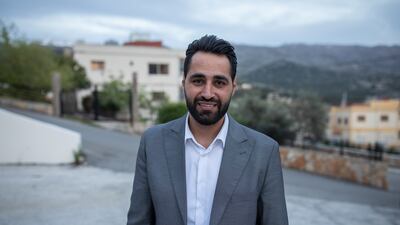
Mr Hamdan is running for the first time in parliamentary elections scheduled for next month. -
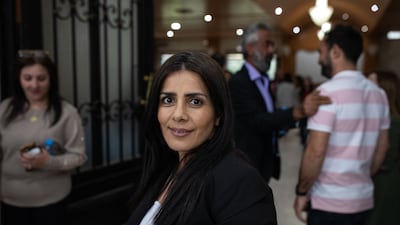
Hweida Al Halabi, who works in a medical laboratory, stands outside the hall in Kfeir after a meeting with Mr Hamdan. -
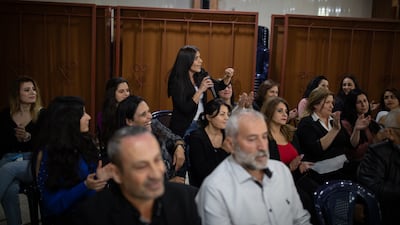
Ms Al Halabi is applauded as she poses a question to Mr Hamdan. -
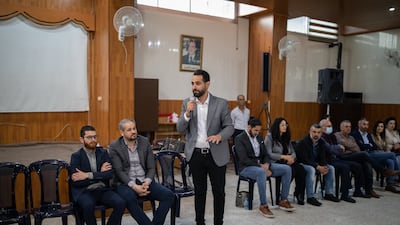
Mr Hamdan answers questions from the audience. -
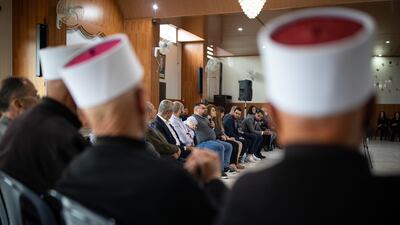
This is the first year that such a meeting has taken place in the area before an election. -

Men of the Druze sect gather at the hall in the village of Kfeir. -
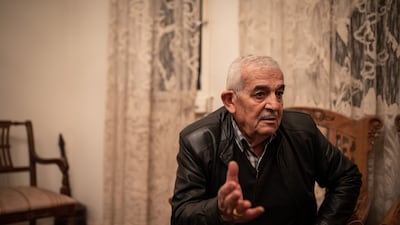
Retired teacher and member of the Druze Progressive Socialist Party Faysal Naoufal explains why he will be voting for the opposition in this year’s elections.


Voters turned out in especially high numbers in the Christian towns of Byblos and Keserwan and in predominantly Shiite Muslim areas in southern Lebanon that tend to vote for Hezbollah and its allies.
Electoral experts say that this means the next parliament could well be dominated by Shiite allies Hezbollah and Amal and its strongest opposition, the Lebanese Forces.
But the independents are undeterred by a potentially polarised landscape.
“Listen, we’re not going to get electricity overnight,” candidate Nohad Yazbeck said of the chronic power shortages that have plagued Lebanon since the end of the war but have got worse since the crisis started.
“We know what we’re up against. We are not selling an illusion.”

