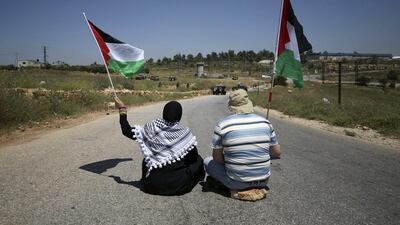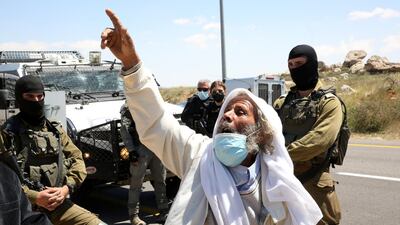
A Palestinian protester argues with Israeli security forces as he protests against Israeli settlement building activities on their land in the village of West Bank Yatta, near Hebron. EPA

Israeli settler attacks on Palestinians spike to 210 so far this year, says UN


James Reinl
  • English
  • Arabic

UN investigators on Wednesday warned of a spike in attacks by Israeli settlers on Palestinians in the occupied West Bank in recent months, saying the aggressors too often eluded justice.

Michael Lynk and other UN human rights experts described 771 such attacks by Israeli settlers last year and more than 210 recorded incidents in the first three months of this year, including one that left a Palestinian dead.

“We call upon the Israeli military and police to investigate and prosecute these violent acts with vigour and resolve,” Mr Lynk and two other investigators said in a statement.

Israeli settler attacks last year resulted in injuries to 133 Palestinians and damage to 184 vehicles and nearly 10,000 trees, mostly around the population centres of Hebron, Jerusalem, Nablus and Ramallah.

“They primarily target the livelihoods of rural Palestinians, vandalising livestock, agricultural lands, trees and homes,” the experts said.

“Besides the presence and expansion of Israeli settlements, which are intended to establish illegal claims for Israeli sovereignty, settler violence is meant to make the daily lives of Palestinians untenable.”

  • Palestinian protesters wave flags as Israeli troops take position during a protest against Jewish settlements in the West Bank village of Nabi Saleh, near Ramallah. Reuters
    Palestinian protesters wave flags as Israeli troops take position during a protest against Jewish settlements in the West Bank village of Nabi Saleh, near Ramallah. Reuters
  • Now that Prime Minister Benjamin Netanyahu has secured a new term in office, there’s little to prevent him from annexing large parts of the West Bank as early as this summer. AP
    Now that Prime Minister Benjamin Netanyahu has secured a new term in office, there’s little to prevent him from annexing large parts of the West Bank as early as this summer. AP
  • An Israeli soldier stands guard during a tour made by Israeli parliament members in the Jordan Valley near the Jewish settlement of Maale Efrayim. Reuters
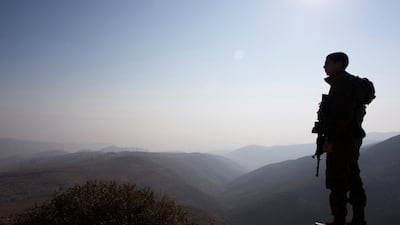
    An Israeli soldier stands guard during a tour made by Israeli parliament members in the Jordan Valley near the Jewish settlement of Maale Efrayim. Reuters
  • Israeli soldiers take position as Palestinian demonstrators gather during a protest against expansion of Israeli settlements in the West Bank. AP
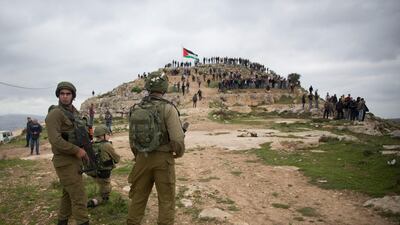
    Israeli soldiers take position as Palestinian demonstrators gather during a protest against expansion of Israeli settlements in the West Bank. AP
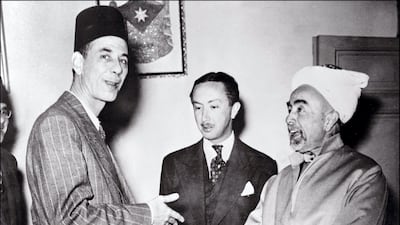
  • King Abdullah (r) of Transjordan on May 13, 1948 in Amman with Abed Al Rahman Azzam, the secretary general of the Arab League and Abd Al Elah Ibn Ali, the Prince Regent of Iraq, the day before the beginning of the first Arab-Israeli War. AFP
    King Abdullah (r) of Transjordan on May 13, 1948 in Amman with Abed Al Rahman Azzam, the secretary general of the Arab League and Abd Al Elah Ibn Ali, the Prince Regent of Iraq, the day before the beginning of the first Arab-Israeli War. AFP
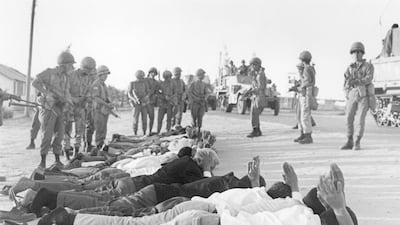
  • Palestinians surrender to Israeli soldiers in June 1967 in the occupied territory of the West Bank after Israel launched a pre-emptive attack on Egypt and Syria and seized the Gaza Strip, Sinai Peninsula and the Golan Heights in Syria as well as the West Bank and Arab East Jerusalem. AFP
    Palestinians surrender to Israeli soldiers in June 1967 in the occupied territory of the West Bank after Israel launched a pre-emptive attack on Egypt and Syria and seized the Gaza Strip, Sinai Peninsula and the Golan Heights in Syria as well as the West Bank and Arab East Jerusalem. AFP
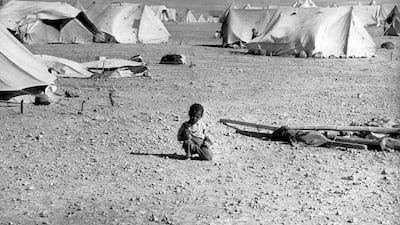
  • A Palestinian child plays in a refugee camp in Jordan on June 23, 1967. AFP
    A Palestinian child plays in a refugee camp in Jordan on June 23, 1967. AFP
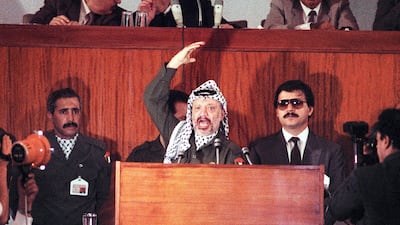
  • PLO chairman Yasser Arafat delivers a speech to the Palestine National Council meeting to make the historic proclamation of a Palestinian state in the Israeli-occupied territories and to recognize Israel in the Palace of Nations conference hall on November 12, 1988, in Algiers. AFP
    PLO chairman Yasser Arafat delivers a speech to the Palestine National Council meeting to make the historic proclamation of a Palestinian state in the Israeli-occupied territories and to recognize Israel in the Palace of Nations conference hall on November 12, 1988, in Algiers. AFP
  • US President Bill Clinton stands between PLO leader Yasser Arafat and Israeli Prime Minister Yitzahk Rabin as they shake hands for the first time on September 13, 1993 at the White House. AFP
    US President Bill Clinton stands between PLO leader Yasser Arafat and Israeli Prime Minister Yitzahk Rabin as they shake hands for the first time on September 13, 1993 at the White House. AFP
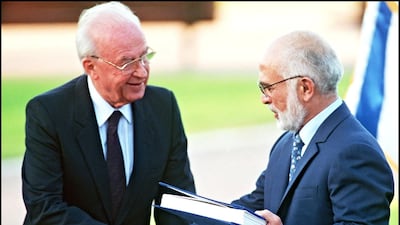
  • Hussein Ibn Talal, King of Jordan and Israeli Premier Yitzhak Rabin shake hands after they exchanged the documents of the Peace Treaty at Beit Gabriel conference centre on November 10, 1994 on the southern shore of the Sea of Galilee. AFP
    Hussein Ibn Talal, King of Jordan and Israeli Premier Yitzhak Rabin shake hands after they exchanged the documents of the Peace Treaty at Beit Gabriel conference centre on November 10, 1994 on the southern shore of the Sea of Galilee. AFP
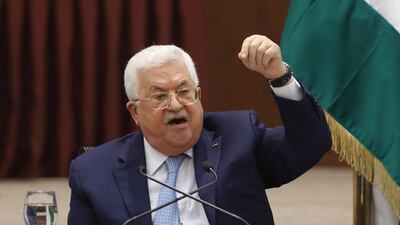
  • Palestinian President Mahmoud Abbas speaks during the Palestinian leadership meeting and threatened to end security coordination with Israel and the United States, saying Israeli annexation would ruin chances for peace. AFP
    Palestinian President Mahmoud Abbas speaks during the Palestinian leadership meeting and threatened to end security coordination with Israel and the United States, saying Israeli annexation would ruin chances for peace. AFP
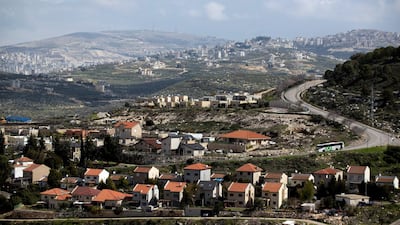
  • Houses in the Israeli settlement of settlement of Kedumim are seen in the foreground as part of the Palestinian city of Nablus is seen in the background (far left) in the Israeli-occupied West Bank. Reuters
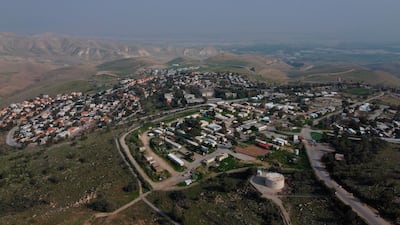
    Houses in the Israeli settlement of settlement of Kedumim are seen in the foreground as part of the Palestinian city of Nablus is seen in the background (far left) in the Israeli-occupied West Bank. Reuters
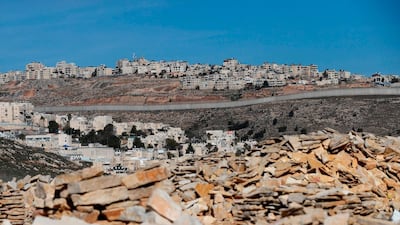
  • Israel's controversial concrete barrier (C) separating the Jewish settlement of Neve Yaakov (foreground) in the northern part of east Jerusalem and the Palestinian area of al-Ram (background) in the occupied West Bank. AFP
    Israel's controversial concrete barrier (C) separating the Jewish settlement of Neve Yaakov (foreground) in the northern part of east Jerusalem and the Palestinian area of al-Ram (background) in the occupied West Bank. AFP
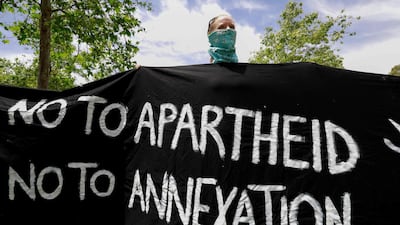
  • An Israeli activist holds a banner during a protest against the US peace plan for the Middle East, in front of the US ambassador's residence in Jerusalem, on May 15, 2020, as Palestinians commemorate the 72nd anniversary of the 1948 Nakba or "catastrophe". AFP
    An Israeli activist holds a banner during a protest against the US peace plan for the Middle East, in front of the US ambassador's residence in Jerusalem, on May 15, 2020, as Palestinians commemorate the 72nd anniversary of the 1948 Nakba or "catastrophe". AFP
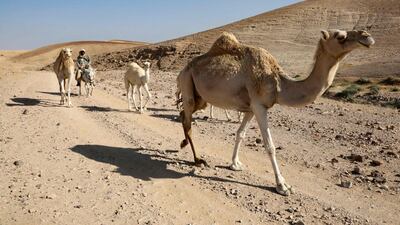
  • A Palestinian shepherd tends to his camels on arid land considered to be in "Area C" (under Israeli security and administrative control), southeast of Yatta town in the southern West Bank district of Hebron. AFP
    A Palestinian shepherd tends to his camels on arid land considered to be in "Area C" (under Israeli security and administrative control), southeast of Yatta town in the southern West Bank district of Hebron. AFP
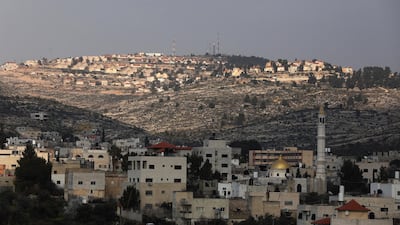
  • A general view of the Israeli settlement of Elon Moreh, as seen from the Palestinian village of Azmout near the West Bank City of Nablus. EPA
    A general view of the Israeli settlement of Elon Moreh, as seen from the Palestinian village of Azmout near the West Bank City of Nablus. EPA
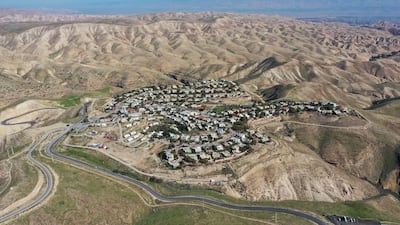
  • The West Bank Jewish settlement of Maale Michmash. AP
    The West Bank Jewish settlement of Maale Michmash. AP

Last month in southern Hebron, a Palestinian couple with eight children was attacked by 10 Israeli settlers, some of them armed, in an incident that left the adults needing medical treatment and the children traumatised, the experts said.

More than 70 families in Sheikh Jarrah in East Jerusalem are currently under threat of forced eviction to make way for new settler homes, the experts added.

“We are deeply worried by the atmosphere of impunity in which these attacks are taking place,” the experts said.

“In many cases, the Israeli military has been present, or nearby, and has not taken sufficient steps to protect the Palestinians from this violence.”

The officials behind the report were Mr Lynk, a special rapporteur on the situation of human rights in the Palestinian territory, Balakrishnan Rajagopal, a special rapporteur on adequate housing and non-discrimination, and independent expert Claudia Mahler.

Israel's mission to the UN did not immediately answer The National's request for comment.

The spike in settler attacks comes as peace talks between the two sides in a decades-old struggle have ground to a halt and uncertainty on the political horizon for both peoples.

Palestinians are readying to hold long-delayed elections, while in Israel four elections in two years have not yielded a stable government and Prime Minister Benjamin Netanyahu is on trial for corruption.

The Palestinians seek an independent state in the West Bank, East Jerusalem and Gaza, all territory captured by Israel in 1967. Most countries view Israeli settlements as illegal.

Israel and some Israeli settler groups cite biblical and historical links to the land.

Moon Music

Artist: Coldplay

Label: Parlophone/Atlantic

Number of tracks: 10

Rating: 3/5

'Panga'

Directed by Ashwiny Iyer Tiwari

Starring Kangana Ranaut, Richa Chadha, Jassie Gill, Yagya Bhasin, Neena Gupta

Rating: 3.5/5

MATCH INFO

Uefa Champions League semi-final, first leg

Tottenham v Ajax, Tuesday, 11pm (UAE).

Second leg

Ajax v Tottenham, Wednesday, May 8, 11pm

Games on BeIN Sports

Notable salonnières of the Middle East through history

Al Khasan (Okaz, Saudi Arabia)

Tamadir bint Amr Al Harith, known simply as Al Khasan, was a poet from Najd famed for elegies, earning great renown for the eulogy of her brothers Mu’awiyah and Sakhr, both killed in tribal wars. Although not a salonnière, this prestigious 7th century poet fostered a culture of literary criticism and could be found standing in the souq of Okaz and reciting her poetry, publicly pronouncing her views and inviting others to join in the debate on scholarship. She later converted to Islam.


Maryana Marrash (Aleppo)

A poet and writer, Marrash helped revive the tradition of the salon and was an active part of the Nadha movement, or Arab Renaissance. Born to an established family in Aleppo in Ottoman Syria in 1848, Marrash was educated at missionary schools in Aleppo and Beirut at a time when many women did not receive an education. After touring Europe, she began to host salons where writers played chess and cards, competed in the art of poetry, and discussed literature and politics. An accomplished singer and canon player, music and dancing were a part of these evenings.


Princess Nazil Fadil (Cairo)

Princess Nazil Fadil gathered religious, literary and political elite together at her Cairo palace, although she stopped short of inviting women. The princess, a niece of Khedive Ismail, believed that Egypt’s situation could only be solved through education and she donated her own property to help fund the first modern Egyptian University in Cairo.


Mayy Ziyadah (Cairo)

Ziyadah was the first to entertain both men and women at her Cairo salon, founded in 1913. The writer, poet, public speaker and critic, her writing explored language, religious identity, language, nationalism and hierarchy. Born in Nazareth, Palestine, to a Lebanese father and Palestinian mother, her salon was open to different social classes and earned comparisons with souq of where Al Khansa herself once recited.

Company%20profile
%3Cp%3E%3Cbr%3E%3Cstrong%3EName%3A%3C%2Fstrong%3E%20Khodar%3Cbr%3E%3Cstrong%3EBased%3A%3C%2Fstrong%3E%20Cairo%20and%20Alexandria%2C%20in%20Egypt%3Cbr%3E%3Cstrong%3EFounders%3A%3C%2Fstrong%3E%20Ayman%20Hamza%2C%20Yasser%20Eidrous%20and%20Amr%20El%20Sheikh%3Cbr%3E%3Cstrong%3ESector%3A%3C%2Fstrong%3E%20agriculture%20technology%3Cbr%3E%3Cstrong%3EFunding%3A%3C%2Fstrong%3E%20%24500%2C000%3Cbr%3E%3Cstrong%3EInvestors%3A%3C%2Fstrong%3E%20Saudi%20Arabia%E2%80%99s%20Revival%20Lab%20and%20others%3Cbr%3E%3Cstrong%3EEmployees%3A%3C%2Fstrong%3E%2035%3C%2Fp%3E%0A
Imperial%20Island%3A%20A%20History%20of%20Empire%20in%20Modern%20Britain
%3Cp%3EAuthor%3A%20Charlotte%20Lydia%20Riley%3Cbr%3EPublisher%3A%20Bodley%20Head%3Cbr%3EPages%3A%20384%3C%2Fp%3E%0A
Kanguva
Director: Siva
Stars: Suriya, Bobby Deol, Disha Patani, Yogi Babu, Redin Kingsley
Rating: 2/5
 
The biog

Age: 59

From: Giza Governorate, Egypt

Family: A daughter, two sons and wife

Favourite tree: Ghaf

Runner up favourite tree: Frankincense 

Favourite place on Sir Bani Yas Island: “I love all of Sir Bani Yas. Every spot of Sir Bani Yas, I love it.”

Mubadala World Tennis Championship 2018 schedule

Thursday December 27

Men's quarter-finals

Kevin Anderson v Hyeon Chung 4pm

Dominic Thiem v Karen Khachanov 6pm

Women's exhibition

Serena Williams v Venus Williams 8pm

Friday December 28

5th place play-off 3pm

Men's semi-finals

Rafael Nadal v Anderson/Chung 5pm

Novak Djokovic v Thiem/Khachanov 7pm

Saturday December 29

3rd place play-off 5pm

Men's final 7pm

Zidane's managerial achievements

La Liga: 2016/17
Spanish Super Cup: 2017
Uefa Champions League: 2015/16, 2016/17, 2017/18
Uefa Super Cup: 2016, 2017
Fifa Club World Cup: 2016, 2017

The%20specs
%3Cp%3E%3Cstrong%3EEngine%3A%3C%2Fstrong%3E%201.8-litre%204-cyl%20turbo%0D%3Cbr%3E%3Cstrong%3EPower%3A%20%3C%2Fstrong%3E190hp%20at%205%2C200rpm%0D%3Cbr%3E%3Cstrong%3ETorque%3A%3C%2Fstrong%3E%20320Nm%20from%201%2C800-5%2C000rpm%0D%3Cbr%3E%3Cstrong%3ETransmission%3A%20%3C%2Fstrong%3ESeven-speed%20dual-clutch%20auto%0D%3Cbr%3E%3Cstrong%3EFuel%20consumption%3A%3C%2Fstrong%3E%206.7L%2F100km%0D%3Cbr%3E%3Cstrong%3EPrice%3A%3C%2Fstrong%3E%20From%20Dh111%2C195%0D%3Cbr%3E%3Cstrong%3EOn%20sale%3A%20%3C%2Fstrong%3ENow%3C%2Fp%3E%0A
The five pillars of Islam

1. Fasting 

2. Prayer 

3. Hajj 

4. Shahada 

5. Zakat 

What is graphene?

Graphene is extracted from graphite and is made up of pure carbon.

It is 200 times more resistant than steel and five times lighter than aluminum.

It conducts electricity better than any other material at room temperature.

It is thought that graphene could boost the useful life of batteries by 10 per cent.

Graphene can also detect cancer cells in the early stages of the disease.

The material was first discovered when Andre Geim and Konstantin Novoselov were 'playing' with graphite at the University of Manchester in 2004.

How to protect yourself when air quality drops

Install an air filter in your home.

Close your windows and turn on the AC.

Shower or bath after being outside.

Wear a face mask.

Stay indoors when conditions are particularly poor.

If driving, turn your engine off when stationary.

The%C2%A0specs%20
%3Cp%3E%3Cstrong%3EEngine%3A%20%3C%2Fstrong%3E3.5-litre%2C%20twin-turbo%20V6%0D%3Cbr%3E%3Cstrong%3ETransmission%3A%20%3C%2Fstrong%3E10-speed%20auto%0D%3Cbr%3E%3Cstrong%3EPower%3A%20%3C%2Fstrong%3E410hp%0D%3Cbr%3E%3Cstrong%3ETorque%3A%20%3C%2Fstrong%3E495Nm%0D%3Cbr%3E%3Cstrong%3EPrice%3A%20%3C%2Fstrong%3Estarts%20from%20Dh495%2C000%20(Dh610%2C000%20for%20the%20F-Sport%20launch%20edition%20tested)%0D%3Cbr%3E%3Cstrong%3EOn%20sale%3A%20%3C%2Fstrong%3Enow%3C%2Fp%3E%0A
Our legal consultant

Name: Hassan Mohsen Elhais

Position: legal consultant with Al Rowaad Advocates and Legal Consultants.

The years Ramadan fell in May

1987

1954

1921

1888

Ferrari
%3Cp%3E%3Cstrong%3EDirector%3A%3C%2Fstrong%3E%20Michael%20Mann%26nbsp%3B%3C%2Fp%3E%0A%3Cp%3E%3Cstrong%3EStarring%3A%3C%2Fstrong%3E%20Adam%20Driver%2C%20Penelope%20Cruz%2C%20Shailene%20Woodley%2C%20Patrick%20Dempsey%3C%2Fp%3E%0A%3Cp%3E%3Cstrong%3ERating%3A%3C%2Fstrong%3E%203%2F5%3C%2Fp%3E%0A
Race card

6.30pm: Handicap (TB) $68,000 (Dirt) 1,200m

7.05pm: Meydan Cup – Listed Handicap (TB) $88,000 (Turf) 2,810m

7.40pm: UAE 2000 Guineas – Group 3 (TB) $125,000 (D) 1,600m

8.15pm: Firebreak Stakes – Group 3 (TB) $130,000 (D) 1,600m

9.50pm: Meydan Classic – Conditions (TB) $$50,000 (T) 1,400m

9.25pm: Dubai Sprint – Listed Handicap (TB) $88,000 (T) 1,200m

Living in...

This article is part of a guide on where to live in the UAE. Our reporters will profile some of the country’s most desirable districts, provide an estimate of rental prices and introduce you to some of the residents who call each area home.

Sonchiriya

Director: Abhishek Chaubey

Producer: RSVP Movies, Azure Entertainment

Cast: Sushant Singh Rajput, Manoj Bajpayee, Ashutosh Rana, Bhumi Pednekar, Ranvir Shorey

Rating: 3/5

Mercer, the investment consulting arm of US services company Marsh & McLennan, expects its wealth division to at least double its assets under management (AUM) in the Middle East as wealth in the region continues to grow despite economic headwinds, a company official said.

Mercer Wealth, which globally has $160 billion in AUM, plans to boost its AUM in the region to $2-$3bn in the next 2-3 years from the present $1bn, said Yasir AbuShaban, a Dubai-based principal with Mercer Wealth.

Within the next two to three years, we are looking at reaching $2 to $3 billion as a conservative estimate and we do see an opportunity to do so,” said Mr AbuShaban.

Mercer does not directly make investments, but allocates clients’ money they have discretion to, to professional asset managers. They also provide advice to clients.

“We have buying power. We can negotiate on their (client’s) behalf with asset managers to provide them lower fees than they otherwise would have to get on their own,” he added.

Mercer Wealth’s clients include sovereign wealth funds, family offices, and insurance companies among others.

From its office in Dubai, Mercer also looks after Africa, India and Turkey, where they also see opportunity for growth.

Wealth creation in Middle East and Africa (MEA) grew 8.5 per cent to $8.1 trillion last year from $7.5tn in 2015, higher than last year’s global average of 6 per cent and the second-highest growth in a region after Asia-Pacific which grew 9.9 per cent, according to consultancy Boston Consulting Group (BCG). In the region, where wealth grew just 1.9 per cent in 2015 compared with 2014, a pickup in oil prices has helped in wealth generation.

BCG is forecasting MEA wealth will rise to $12tn by 2021, growing at an annual average of 8 per cent.

Drivers of wealth generation in the region will be split evenly between new wealth creation and growth of performance of existing assets, according to BCG.

Another general trend in the region is clients’ looking for a comprehensive approach to investing, according to Mr AbuShaban.

“Institutional investors or some of the families are seeing a slowdown in the available capital they have to invest and in that sense they are looking at optimizing the way they manage their portfolios and making sure they are not investing haphazardly and different parts of their investment are working together,” said Mr AbuShaban.

Some clients also have a higher appetite for risk, given the low interest-rate environment that does not provide enough yield for some institutional investors. These clients are keen to invest in illiquid assets, such as private equity and infrastructure.

“What we have seen is a desire for higher returns in what has been a low-return environment specifically in various fixed income or bonds,” he said.

“In this environment, we have seen a de facto increase in the risk that clients are taking in things like illiquid investments, private equity investments, infrastructure and private debt, those kind of investments were higher illiquidity results in incrementally higher returns.”

The Abu Dhabi Investment Authority, one of the largest sovereign wealth funds, said in its 2016 report that has gradually increased its exposure in direct private equity and private credit transactions, mainly in Asian markets and especially in China and India. The authority’s private equity department focused on structured equities owing to “their defensive characteristics.”

COMPANY%20PROFILE
%3Cp%3E%3Cstrong%3EName%3A%20%3C%2Fstrong%3ETelr%3Cbr%3E%3Cstrong%3EBased%3A%20%3C%2Fstrong%3EDubai%2C%20UAE%3Cbr%3E%3Cstrong%3ELaunch%20year%3A%3C%2Fstrong%3E%202014%3Cbr%3E%3Cstrong%3ENumber%20of%20employees%3A%20%3C%2Fstrong%3E65%3Cbr%3E%3Cstrong%3ESector%3A%20%3C%2Fstrong%3EFinTech%20and%20payments%3Cbr%3E%3Cstrong%3EFunding%3A%20%3C%2Fstrong%3Enearly%20%2430%20million%20so%20far%3C%2Fp%3E%0A
How Filipinos in the UAE invest

A recent survey of 10,000 Filipino expatriates in the UAE found that 82 per cent have plans to invest, primarily in property. This is significantly higher than the 2014 poll showing only two out of 10 Filipinos planned to invest.

Fifty-five percent said they plan to invest in property, according to the poll conducted by the New Perspective Media Group, organiser of the Philippine Property and Investment Exhibition. Acquiring a franchised business or starting up a small business was preferred by 25 per cent and 15 per cent said they will invest in mutual funds. The rest said they are keen to invest in insurance (3 per cent) and gold (2 per cent).

Of the 5,500 respondents who preferred property as their primary investment, 54 per cent said they plan to make the purchase within the next year. Manila was the top location, preferred by 53 per cent.

Who's who in Yemen conflict

Houthis: Iran-backed rebels who occupy Sanaa and run unrecognised government

Yemeni government: Exiled government in Aden led by eight-member Presidential Leadership Council

Southern Transitional Council: Faction in Yemeni government that seeks autonomy for the south

Habrish 'rebels': Tribal-backed forces feuding with STC over control of oil in government territory