• Smoke rises from the Kharg. EPA
    Smoke rises from the Kharg. EPA
  • The Iranian navy support ship burns in still from a video. Asriran.com via AP
    The Iranian navy support ship burns in still from a video. Asriran.com via AP
  • The blaze began at about 2.25am. Asriran.com via AP
    The blaze began at about 2.25am. Asriran.com via AP
  • The vessel, captured in a satellite image, sank near the Iranian port of Jask. Planet Labs Inc. via AP
    The vessel, captured in a satellite image, sank near the Iranian port of Jask. Planet Labs Inc. via AP
  • The Kharg was one of the few vessels in the Iranian navy capable of resupplying its other ships at sea. AFP
    The Kharg was one of the few vessels in the Iranian navy capable of resupplying its other ships at sea. AFP
  • It was also designed to lift heavy cargo and serve as a launch point for helicopters. Iranian army via AP
    It was also designed to lift heavy cargo and serve as a launch point for helicopters. Iranian army via AP
  • The British-built ship became part of the Iranian naval fleet in 1984. Iranian army via AP
    The British-built ship became part of the Iranian naval fleet in 1984. Iranian army via AP
  • A plume billows from the Kharg in Gulf of Oman. EPA
    A plume billows from the Kharg in Gulf of Oman. EPA
  • It is not yet clear how the fire started. EPA
    It is not yet clear how the fire started. EPA
  • The Kharg was the largest Iranian navy support ship. EPA
    The Kharg was the largest Iranian navy support ship. EPA
  • The Kharg docked in Sudan. Reuters
    The Kharg docked in Sudan. Reuters
  • No casualties were reported after the ship sank. AFP
    No casualties were reported after the ship sank. AFP
  • Flames engulf the Kharg. Reuters
    Flames engulf the Kharg. Reuters

Iran's largest naval ship sinks in Gulf of Oman after being engulfed in flames


Robert Tollast
  • English
  • Arabic

Iran's largest naval ship, the Kharg, sank on Wednesday morning after fire swept through the vessel from bow to stern.

State-affiliated media, including the Tasnim news agency, published video footage from the rescue effort.

All crew members were rescued from the 207-metre long vessel, according to reports.

Fire reportedly broke out at about 2.25am and quickly grew out of control. The ship was abandoned in the Gulf of Oman, near the Strait of Hormuz and the Iranian port of Jask.

The loss of the Kharg leaves Iran without a second support ship, after damage to the MV Saviz, which was attacked in the Red Sea in March with limpet mines.

The Saviz did not sink, but was put out of action for an extended period after explosions caused its engine room to flood.

The Kharg has been described as a logistical support ship, carrying fuel and supplies for other vessels, as well as being able to carry helicopters.

Like many of Iran's large surface vessels, it was ageing and may have suffered maintenance problems.

The Kharg was bought from Britain in 1977 as a civilian vessel, before being adapted for the Iranian Navy in 1984.

Iran is forced to reverse-engineer spare parts for ships purchased from abroad because of international sanctions preventing the import of new components.

Iran's navy is also prone to training accidents.

In May last year, 19 Iranian sailors were killed when the Konarak was struck by an Iranian missile. The vessel had been towing a target ship for a missile test.

While the loss of the Konarak was accidental, the fate of the Kharg could prompt speculation that a foreign state had conducted a sabotage operation, following the attack on the Saviz.

The Saviz, which Iran claimed was a civilian vessel, was long thought to have had a military role.

"Saviz is, foremost, a floating armoury ship," Farzin Nadimi, an analyst at the Washington Institute for Near East Policy think tank, told The National at the time.

Read more: Iran showcases new ships in Gulf of Oman

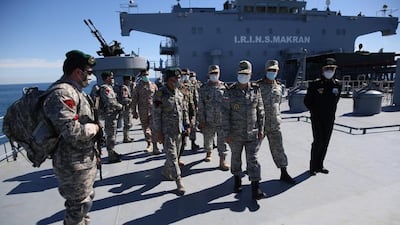
  • Military personnel stand on the Iranian warship Makran before a drill. Iranian Army office / AFP
    Military personnel stand on the Iranian warship Makran before a drill. Iranian Army office / AFP
  • The two-day missile drill was being held in the Gulf of Oman's southeastern waters. EPA
    The two-day missile drill was being held in the Gulf of Oman's southeastern waters. EPA
  • Iran has stepped up its military drills in recent weeks. Iranian Army via AP
    Iran has stepped up its military drills in recent weeks. Iranian Army via AP
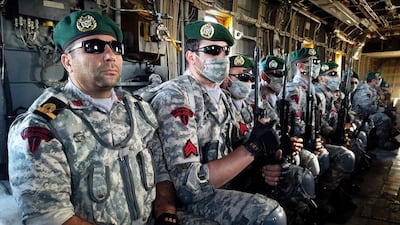
  • Iranian soldiers sit in a helicopter during a drill. Iranian Army via AP
    Iranian soldiers sit in a helicopter during a drill. Iranian Army via AP
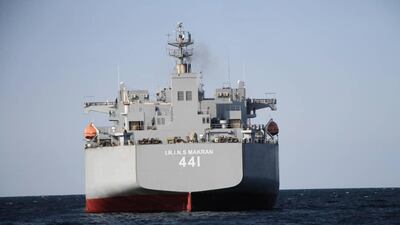
  • The warship Makran in the Gulf of Oman. EPA
    The warship Makran in the Gulf of Oman. EPA
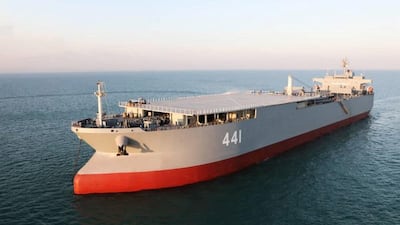
  • The Makran is a logistics vessel with a helicopter pad. EPA
    The Makran is a logistics vessel with a helicopter pad. EPA
  • Iran sometimes announces military achievements that cannot be independently verified. AFP
    Iran sometimes announces military achievements that cannot be independently verified. AFP
Paatal Lok season two

Directors: Avinash Arun, Prosit Roy 

Stars: Jaideep Ahlawat, Ishwak Singh, Lc Sekhose, Merenla Imsong

Rating: 4.5/5

Avatar: Fire and Ash

Director: James Cameron

Starring: Sam Worthington, Sigourney Weaver, Zoe Saldana

Rating: 4.5/5

How will Gen Alpha invest?

Mark Chahwan, co-founder and chief executive of robo-advisory firm Sarwa, forecasts that Generation Alpha (born between 2010 and 2024) will start investing in their teenage years and therefore benefit from compound interest.

“Technology and education should be the main drivers to make this happen, whether it’s investing in a few clicks or their schools/parents stepping up their personal finance education skills,” he adds.

Mr Chahwan says younger generations have a higher capacity to take on risk, but for some their appetite can be more cautious because they are investing for the first time. “Schools still do not teach personal finance and stock market investing, so a lot of the learning journey can feel daunting and intimidating,” he says.

He advises millennials to not always start with an aggressive portfolio even if they can afford to take risks. “We always advise to work your way up to your risk capacity, that way you experience volatility and get used to it. Given the higher risk capacity for the younger generations, stocks are a favourite,” says Mr Chahwan.

Highlighting the role technology has played in encouraging millennials and Gen Z to invest, he says: “They were often excluded, but with lower account minimums ... a customer with $1,000 [Dh3,672] in their account has their money working for them just as hard as the portfolio of a high get-worth individual.”

In-demand jobs and monthly salaries
  • Technology expert in robotics and automation: Dh20,000 to Dh40,000 
  • Energy engineer: Dh25,000 to Dh30,000 
  • Production engineer: Dh30,000 to Dh40,000 
  • Data-driven supply chain management professional: Dh30,000 to Dh50,000 
  • HR leader: Dh40,000 to Dh60,000 
  • Engineering leader: Dh30,000 to Dh55,000 
  • Project manager: Dh55,000 to Dh65,000 
  • Senior reservoir engineer: Dh40,000 to Dh55,000 
  • Senior drilling engineer: Dh38,000 to Dh46,000 
  • Senior process engineer: Dh28,000 to Dh38,000 
  • Senior maintenance engineer: Dh22,000 to Dh34,000 
  • Field engineer: Dh6,500 to Dh7,500
  • Field supervisor: Dh9,000 to Dh12,000
  • Field operator: Dh5,000 to Dh7,000
MATCH INFO

Uefa Champions League semi-final, first leg
Bayern Munich v Real Madrid

When: April 25, 10.45pm kick-off (UAE)
Where: Allianz Arena, Munich
Live: BeIN Sports HD
Second leg: May 1, Santiago Bernabeu, Madrid

Nepotism is the name of the game

Salman Khan’s father, Salim Khan, is one of Bollywood’s most legendary screenwriters. Through his partnership with co-writer Javed Akhtar, Salim is credited with having paved the path for the Indian film industry’s blockbuster format in the 1970s. Something his son now rules the roost of. More importantly, the Salim-Javed duo also created the persona of the “angry young man” for Bollywood megastar Amitabh Bachchan in the 1970s, reflecting the angst of the average Indian. In choosing to be the ordinary man’s “hero” as opposed to a thespian in new Bollywood, Salman Khan remains tightly linked to his father’s oeuvre. Thanks dad. 

ALRAWABI%20SCHOOL%20FOR%20GIRLS
%3Cp%3ECreator%3A%20Tima%20Shomali%3C%2Fp%3E%0A%3Cp%3EStarring%3A%C2%A0Tara%20Abboud%2C%C2%A0Kira%20Yaghnam%2C%20Tara%20Atalla%3C%2Fp%3E%0A%3Cp%3ERating%3A%204%2F5%3C%2Fp%3E%0A
UAE v Gibraltar

What: International friendly

When: 7pm kick off

Where: Rugby Park, Dubai Sports City

Admission: Free

Online: The match will be broadcast live on Dubai Exiles’ Facebook page

UAE squad: Lucas Waddington (Dubai Exiles), Gio Fourie (Exiles), Craig Nutt (Abu Dhabi Harlequins), Phil Brady (Harlequins), Daniel Perry (Dubai Hurricanes), Esekaia Dranibota (Harlequins), Matt Mills (Exiles), Jaen Botes (Exiles), Kristian Stinson (Exiles), Murray Reason (Abu Dhabi Saracens), Dave Knight (Hurricanes), Ross Samson (Jebel Ali Dragons), DuRandt Gerber (Exiles), Saki Naisau (Dragons), Andrew Powell (Hurricanes), Emosi Vacanau (Harlequins), Niko Volavola (Dragons), Matt Richards (Dragons), Luke Stevenson (Harlequins), Josh Ives (Dubai Sports City Eagles), Sean Stevens (Saracens), Thinus Steyn (Exiles)

The%20Mandalorian%20season%203%20episode%201
%3Cp%3E%3Cstrong%3EDirector%3A%20%3C%2Fstrong%3ERick%20Famuyiwa%3C%2Fp%3E%0A%3Cp%3E%3Cstrong%3EStars%3A%20%3C%2Fstrong%3EPedro%20Pascal%20and%20Katee%20Sackhoff%3C%2Fp%3E%0A%3Cp%3E%3Cstrong%3ERating%3A%20%3C%2Fstrong%3E4%2F5%C2%A0%3C%2Fp%3E%0A
Spare

Profile

Company name: Spare

Started: March 2018

Co-founders: Dalal Alrayes and Saurabh Shah

Based: UAE

Sector: FinTech

Investment: Own savings. Going for first round of fund-raising in March 2019

RIDE%20ON
%3Cp%3EDirector%3A%20Larry%20Yang%3C%2Fp%3E%0A%3Cp%3EStars%3A%20Jackie%20Chan%2C%20Liu%20Haocun%2C%20Kevin%20Guo%3C%2Fp%3E%0A%3Cp%3ERating%3A%202%2F5%3C%2Fp%3E%0A
MATCH INFO

Uefa Champions League, last 16, first leg

Tottenham Hotspur v Borussia Dortmund, midnight (Thursday), BeIN Sports

THE BIO

Favourite car: Koenigsegg Agera RS or Renault Trezor concept car.

Favourite book: I Am Pilgrim by Terry Hayes or Red Notice by Bill Browder.

Biggest inspiration: My husband Nik. He really got me through a lot with his positivity.

Favourite holiday destination: Being at home in Australia, as I travel all over the world for work. It’s great to just hang out with my husband and family.


The specs

Engine: 2.0-litre 4-cylinder turbo

Power: 240hp at 5,500rpm

Torque: 390Nm at 3,000rpm

Transmission: eight-speed auto

Price: from Dh122,745

On sale: now

Our legal consultant

Name: Hassan Mohsen Elhais

Position: legal consultant with Al Rowaad Advocates and Legal Consultants.

UAE currency: the story behind the money in your pockets
What is graphene?

Graphene is a single layer of carbon atoms arranged like honeycomb.

It was discovered in 2004, when Russian-born Manchester scientists Andrei Geim and Kostya Novoselov were "playing about" with sticky tape and graphite - the material used as "lead" in pencils.

Placing the tape on the graphite and peeling it, they managed to rip off thin flakes of carbon. In the beginning they got flakes consisting of many layers of graphene. But as they repeated the process many times, the flakes got thinner.

By separating the graphite fragments repeatedly, they managed to create flakes that were just one atom thick. Their experiment had led to graphene being isolated for the very first time.

At the time, many believed it was impossible for such thin crystalline materials to be stable. But examined under a microscope, the material remained stable, and when tested was found to have incredible properties.

It is many times times stronger than steel, yet incredibly lightweight and flexible. It is electrically and thermally conductive but also transparent. The world's first 2D material, it is one million times thinner than the diameter of a single human hair.

But the 'sticky tape' method would not work on an industrial scale. Since then, scientists have been working on manufacturing graphene, to make use of its incredible properties.

In 2010, Geim and Novoselov were awarded the Nobel Prize for Physics. Their discovery meant physicists could study a new class of two-dimensional materials with unique properties.