Hundreds of clay urns found in a burial shaft dating back to the 26th dynasty of ancient Egypt, found at the Abusir necropolis near Cairo. Photo: Ministry of Tourism & Antiquities

Ancient Egyptian embalming materials unearthed near Cairo


Kamal Tabikha
  • English
  • Arabic

A Czech archaeological mission working in the Abusir necropolis, on the outskirts of the Egyptian capital, have unearthed a cache of embalming materials dating back over 2,500 years.

Egypt's Tourism Ministry said the haul was found by accident during excavations of burial shafts in the western portion of the necropolis near Cairo.

The burial shafts were created during the rule of the 26th dynasty of ancient Egypt, the last native dynasty to rule the country before the Persian conquest in 525BC.

Excavation workers unearthed hundreds of clay urns containing traces of embalming materials. Photo: Ministry of Tourism & Antiquities

Mostafa Waziri, head of Egypt's antiquities authority, said the cache was found at the bottom of a particularly large burial shaft 14 metres deep.

The dig uncovered 370 large clay urns containing traces of materials used by priests to embalm bodies before they were mummified and buried, the ministry said.

The team also found empty canopic jars, inscribed with the name of their owner in hieroglyphs.

A set of canopic jars found at the bottom of a burial shaft in the Abusir necropolis. Photo: Ministry of Tourism & Antiquities

Canopic jars were an integral part of the mummification process in ancient Egypt as they were used to preserve the deceased’s visceral organs, which were believed to be vital for them to thrive in the afterlife.

The ministry said the cache of urns will now undergo analysis using the latest scientific techniques.

This clay urn was part of large cache excavated by a Czech archaeological mission working in Egypt. Photo: Ministry of Tourism & Antiquities

Miroslav Barta, head of the Czech mission, said the find was part of a larger excavation at Abusir to unveil details about “a time in ancient Egyptian history when new ways of preserving the national identity were being explored”.

He said the Abusir necropolis had contributed greatly to revealing lesser known aspects of ancient Egypt.

The necropolis is famous for yielding some of the oldest pharaonic relics, including a number of step pyramids which date back to the 3rd dynasty of ancient Egypt (2670–2650BC).

Further excavations at Abusir are planned throughout the year, the ministry said.

Archeologists unearth ancient tombs in Nile Delta - in pictures

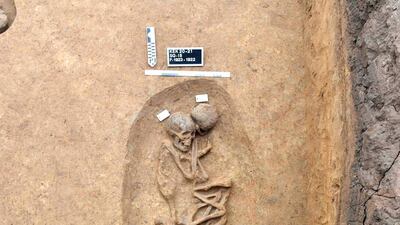
  • This photo provided by the Egyptian Tourism and Antiquities Ministry shows an ancient burial tomb at the Koum El Khulgan archeological site, in the Nile Delta province of Dakahlia. Egypt tourism ministry via AP
    This photo provided by the Egyptian Tourism and Antiquities Ministry shows an ancient burial tomb at the Koum El Khulgan archeological site, in the Nile Delta province of Dakahlia. Egypt tourism ministry via AP
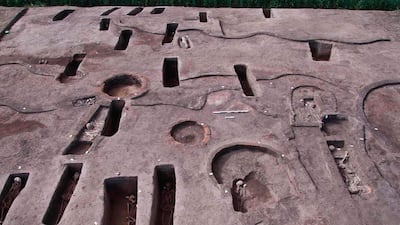
  • Ancient burial tombs unearthed recently, some with human remains, in the Koum El Khulgan archeological site. Egyptian Tourism and Antiquities Ministry via AP
    Ancient burial tombs unearthed recently, some with human remains, in the Koum El Khulgan archeological site. Egyptian Tourism and Antiquities Ministry via AP
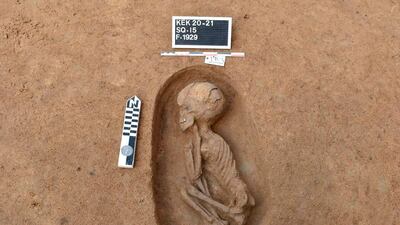
  • An ancient burial tomb unearthed recently with human remains, in the Koum El Khulgan archeological site. Egyptian Tourism and Antiquities Ministry via AP
    An ancient burial tomb unearthed recently with human remains, in the Koum El Khulgan archeological site. Egyptian Tourism and Antiquities Ministry via AP
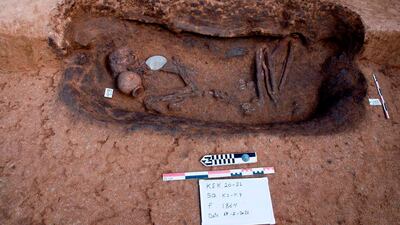
  • An ancient burial tomb unearthed recently with human remains and and pottery, in the Koum El Khulgan archeological site. Egyptian Tourism and Antiquities Ministry via AP
    An ancient burial tomb unearthed recently with human remains and and pottery, in the Koum El Khulgan archeological site. Egyptian Tourism and Antiquities Ministry via AP
What is the FNC?

The Federal National Council is one of five federal authorities established by the UAE constitution. It held its first session on December 2, 1972, a year to the day after Federation.
It has 40 members, eight of whom are women. The members represent the UAE population through each of the emirates. Abu Dhabi and Dubai have eight members each, Sharjah and Ras al Khaimah six, and Ajman, Fujairah and Umm Al Quwain have four.
They bring Emirati issues to the council for debate and put those concerns to ministers summoned for questioning. 
The FNC’s main functions include passing, amending or rejecting federal draft laws, discussing international treaties and agreements, and offering recommendations on general subjects raised during sessions.
Federal draft laws must first pass through the FNC for recommendations when members can amend the laws to suit the needs of citizens. The draft laws are then forwarded to the Cabinet for consideration and approval. 
Since 2006, half of the members have been elected by UAE citizens to serve four-year terms and the other half are appointed by the Ruler’s Courts of the seven emirates.
In the 2015 elections, 78 of the 252 candidates were women. Women also represented 48 per cent of all voters and 67 per cent of the voters were under the age of 40.
 

The specs
Engine: 2.7-litre 4-cylinder Turbomax
Power: 310hp
Torque: 583Nm
Transmission: 8-speed automatic
Price: From Dh192,500
On sale: Now
Without Remorse

Directed by: Stefano Sollima

Starring: Michael B Jordan

4/5

How much do leading UAE’s UK curriculum schools charge for Year 6?
  1. Nord Anglia International School (Dubai) – Dh85,032
  2. Kings School Al Barsha (Dubai) – Dh71,905
  3. Brighton College Abu Dhabi - Dh68,560
  4. Jumeirah English Speaking School (Dubai) – Dh59,728
  5. Gems Wellington International School – Dubai Branch – Dh58,488
  6. The British School Al Khubairat (Abu Dhabi) - Dh54,170
  7. Dubai English Speaking School – Dh51,269

*Annual tuition fees covering the 2024/2025 academic year

Fighting with My Family

Director: Stephen Merchant 

Stars: Dwayne Johnson, Nick Frost, Lena Headey, Florence Pugh, Thomas Whilley, Tori Ellen Ross, Jack Lowden, Olivia Bernstone, Elroy Powell        

Four stars

THE BIO: Martin Van Almsick

Hometown: Cologne, Germany

Family: Wife Hanan Ahmed and their three children, Marrah (23), Tibijan (19), Amon (13)

Favourite dessert: Umm Ali with dark camel milk chocolate flakes

Favourite hobby: Football

Breakfast routine: a tall glass of camel milk

Green ambitions
  • Trees: 1,500 to be planted, replacing 300 felled ones, with veteran oaks protected
  • Lake: Brown's centrepiece to be cleaned of silt that makes it as shallow as 2.5cm
  • Biodiversity: Bat cave to be added and habitats designed for kingfishers and little grebes
  • Flood risk: Longer grass, deeper lake, restored ponds and absorbent paths all meant to siphon off water 
Classification of skills

A worker is categorised as skilled by the MOHRE based on nine levels given in the International Standard Classification of Occupations (ISCO) issued by the International Labour Organisation. 

A skilled worker would be someone at a professional level (levels 1 – 5) which includes managers, professionals, technicians and associate professionals, clerical support workers, and service and sales workers.

The worker must also have an attested educational certificate higher than secondary or an equivalent certification, and earn a monthly salary of at least Dh4,000. 

Why are asylum seekers being housed in hotels?

The number of asylum applications in the UK has reached a new record high, driven by those illegally entering the country in small boats crossing the English Channel.

A total of 111,084 people applied for asylum in the UK in the year to June 2025, the highest number for any 12-month period since current records began in 2001.

Asylum seekers and their families can be housed in temporary accommodation while their claim is assessed.

The Home Office provides the accommodation, meaning asylum seekers cannot choose where they live.

When there is not enough housing, the Home Office can move people to hotels or large sites like former military bases.

Updated: February 11, 2022, 5:28 PM