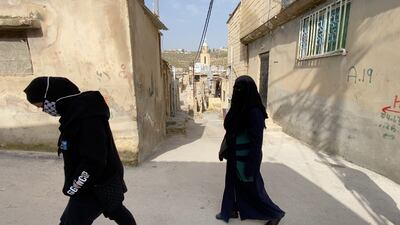
Gaza refugee camp, Jordan, 2020. Amy McConaghy / The National

Gaza-Israel war: Some Palestinian refugees in Jordan express hope for Hamas victory


Khaled Yacoub Oweis
  • English
  • Arabic

In Jordan’s most impoverished Palestinian refugee camp, there is often little to celebrate for thousands of displaced residents.

Over the last two days, however, some of the inhabitants of the Gaza Camp north of Amman have been delving into their meagre cash holdings to distribute sweets to passers-by.

They are celebrating one of the most lethal attacks against Israel in the history of the conflict, which by some counts, may have killed between 400 and 600 people, mostly civilians. Israel, in turn, is bombarding the densely populated Gaza territory, where at least 300 have died in 48 hours.

“Everyone I know cannot believe it. We are flying from joy,” says Ibtisam, a manager of a charity at the camp, one of ten for Palestinian refugees in Jordan.

The surprise attack by the Iranian-supported Hamas militant group on Saturday also resulted in the capture of an unknown number of Israeli soldiers and non-combatants who have been taken hostage.

The news has been followed closely in Jordan. A large percentage of the kingdom’s 10 million population are descendants of Palestinians who fled the 1948 and 1967 conflicts with Israel.

Among them are the 50,000 inhabitants of the Gaza camp, who trace their origin to the strip.

The authorities in Jordan, which is dependent on US aid and has a peace treaty with Israel, have been vocal in their criticism of Israeli pressure on the Palestinians, which mounted in the last two years, with more focus on the West Bank.

But Jordanian officials have had to balance their rhetoric with what they perceive as the need to maintain ties with Israel, and pursuit of diplomatic means to obtain Palestinians rights, away from militant violence outrightly supported by Iran and its Middle East proxies.

Relatives in Gaza

Most people in the camp have relatives in Gaza, but they appeared little concerned about their fate, although thousands of civilians were killed in past Israeli retaliatory strikes against smaller operations by Hamas and other militant groups.

“You might find some Palestinian intellectuals saying that the attack will not change anything and will only bring more misery to Gaza,” says Ibtisam.

“This time it's different. Fear has been instilled in the Israelis, many will be thinking about leaving,” she says.

Like most people at the camp, Ibtisam has dozens of relatives in Gaza, itself populated mostly by refugees from elsewhere in Palestine.

Most of the Palestinians in Jordan have Jordanian citizenship and unimpeded right to work, except for refugees from Gaza, who fled to Jordan in the late 1960s, and their descendants.

Iman, who works illegally as a secretary in the nearby city of Jersah, is in contact with her cousins in Gaza on WhatsApp.

She says that they are not afraid.

“We are not afraid about them either. They have incredible faith,” she says. “Hamas took so many hostages this time, so Israel will have to be careful in its response”.

Jordan maintains channels with Hamas and has a 40-bed field hospital in Gaza, although the authorities expelled the group's leadership from the kingdom in the 1990s.

Ahmad, who is in his 20s and works intermittently as a driver, has several uncles and aunts in Gaza.

“After being surrounded for almost 20 years without electricity or water or jobs, they have nothing to lose,” he says.

“What happened yesterday is bound to serve the cause.”

White hydrogen: Naturally occurring hydrogenChromite: Hard, metallic mineral containing iron oxide and chromium oxideUltramafic rocks: Dark-coloured rocks rich in magnesium or iron with very low silica contentOphiolite: A section of the earth’s crust, which is oceanic in nature that has since been uplifted and exposed on landOlivine: A commonly occurring magnesium iron silicate mineral that derives its name for its olive-green yellow-green colour

How to help

Send “thenational” to the following numbers or call the hotline on: 0502955999
2289 – Dh10
2252 – Dh 50
6025 – Dh20
6027 – Dh 100
6026 – Dh 200

The Written World: How Literature Shaped History
Martin Puchner
Granta

The burning issue

The internal combustion engine is facing a watershed moment – major manufacturer Volvo is to stop producing petroleum-powered vehicles by 2021 and countries in Europe, including the UK, have vowed to ban their sale before 2040. The National takes a look at the story of one of the most successful technologies of the last 100 years and how it has impacted life in the UAE. 

Read part four: an affection for classic cars lives on

Read part three: the age of the electric vehicle begins

Read part one: how cars came to the UAE


Russia's Muslim Heartlands

Dominic Rubin, Oxford

What is blockchain?

Blockchain is a form of distributed ledger technology, a digital system in which data is recorded across multiple places at the same time. Unlike traditional databases, DLTs have no central administrator or centralised data storage. They are transparent because the data is visible and, because they are automatically replicated and impossible to be tampered with, they are secure.

The main difference between blockchain and other forms of DLT is the way data is stored as ‘blocks’ – new transactions are added to the existing ‘chain’ of past transactions, hence the name ‘blockchain’. It is impossible to delete or modify information on the chain due to the replication of blocks across various locations.

Blockchain is mostly associated with cryptocurrency Bitcoin. Due to the inability to tamper with transactions, advocates say this makes the currency more secure and safer than traditional systems. It is maintained by a network of people referred to as ‘miners’, who receive rewards for solving complex mathematical equations that enable transactions to go through.

However, one of the major problems that has come to light has been the presence of illicit material buried in the Bitcoin blockchain, linking it to the dark web.

Other blockchain platforms can offer things like smart contracts, which are automatically implemented when specific conditions from all interested parties are reached, cutting the time involved and the risk of mistakes. Another use could be storing medical records, as patients can be confident their information cannot be changed. The technology can also be used in supply chains, voting and has the potential to used for storing property records.

Updated: October 08, 2023, 2:25 PM
