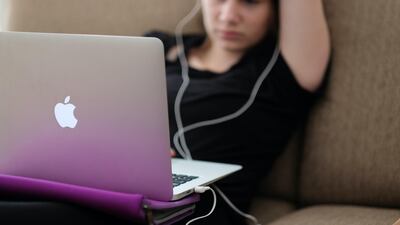
The number of people living with mental health disorders amid the coronavirus crisis has undoubtedly soared, but teenagers are particularly at risk, says one UAE psychologist.
Tanya Dharamshi, clinical director and counselling psychologist at Dubai’s Priory Wellbeing Centre, says the clinic has seen an upsurge in teenagers visiting, as they have been diagnosed with issues such as anxiety, depression and obsessive compulsive disorder since schooling went virtual.
“Without the normal routine and structure of school and college attendance, teenagers have been starved of some of the support and reassurance they are accustomed to as they grow in emotional maturity and approach adulthood,” Dharamshi explains.
These circumstances can leave teenagers feeling overwhelmed, damaging their self-confidence and motivation
“Many teenagers have seen life as they know it completely turned upside down. Even with the gradual lifting of restrictions, their situation remains unchanged. They have had to contend with home learning, isolation from their friends, cancellation of ‘major’ events in their calendars such as the school prom, graduation ceremonies and launching themselves into the job market.”
Teenagers may feel a monumental time in their lives has been snatched away from them, she adds.
“Many teens may also be dealing with the illness directly if a family member has been affected, or if their families have lost income as a result of job cuts or salary reductions,” she says. “These circumstances can leave them feeling overwhelmed, damaging their self-confidence and motivation.”
A recent UK survey revealed that more than 80 per cent of young people with a history of mental health problems say their condition has worsened since the pandemic started. More research needs to be done, however, in order to ascertain the true long-term effects of this situation on teenage mental health across the world.
Here in the UAE, Dharamshi says the current lack of structure also has to the ability to pose challenges for those who haven’t dealt with mental illness before. “Some may be depressed, as well as anxious, and turned, or returned, to self-harming,” she says. “They need support to define and manoeuvre their thoughts, emotions and behavioural responses.”
Masa Karleusa Valkanou, a psychologist and psychotherapist at Thrive Wellbeing Centre by Dr Sarah Rasmi, previously told The National that teenagers are the most "endangered species" in this global crisis.
“Psychological development dictates that a teenager is separating self from family and attaching more to a peer group,” she said.
“In the situation of isolation, they lose the comfort of their peer group … Teenagers need love and support and someone to calm their anxiety and fears, but they can’t turn to parents, and can’t get it from friends, either. They can face serious feelings of loneliness and psychological isolation.”
So what can parents do to help their ‘quaranteenager’?
As a parent of teenagers, it’s important not to despair. Through regular, reassuring and open conversations among the family, Dharamshi says caregivers will be better able to support their children through the pandemic.
“Desperately missing the ‘normality’ of their lives prior to Covid-19 and reflecting on what they have ‘lost’ – albeit temporarily – can only exacerbate feelings of anger and disappointment,” she says. “Many may take this out on their parents and other family members as they look for someone to apportion blame and vent their frustrations towards. Mood swings at this time can also be extremely common.”
It’s imperative parents react accordingly in order to alleviate their child’s concerns. Dharamshi says there are a number of things parents can do to help, starting with reassuring them that change is a normal part of life.
“Being able to embrace change and develop coping strategies is key and something to aspire to during this time, which can often save them from a lot of unhappiness and heartache in the future.”
Nurturing their friendships with their peers is also a positive step forward. “They learn and develop their identity and beliefs as a result of mixing, socialising and chatting about key issues with their friends. They learn how to read behaviours and non-verbal cues, how to interact with their peers and teachers in a variety of situations.” As face-to-face time has been severely restricted, encouraging children to engage in video calls with friends and extended family is important.
That being said, limiting their dependence on electronic devices is also crucial, particularly when it comes to social media and the barrage of news reports and statistics we all contend with on a daily basis.
Most importantly, parents should lead by example. “Children, no matter their age, regard their parents and caregivers as role models and look to them for guidance and reassurance,” Dharamshi explains. “Calm, confident and reassuring adults will naturally help to encourage the same qualities in young people.”
Remember, even the most ‘grown-up’, independent teenagers need a hug every so often, she adds.
“Normalise and validate what they are feeling and share how this is impacting you as well, but look towards developing skills to help support each other; check-ins, daily hugs and rituals that you can develop to create a safe, secure space to feel and also to strengthen yourselves and each other.”
And as difficult as it may be, try not to predict the future. “When we try, it can make us more anxious or result in us putting a negative spin on things, which only perpetuates our worry. Discuss with your teen how they can prepare themselves for their future, rather than worry about it.”
How are schools helping in this situation?
Yasmine Dannawy, vice principal at Dubai's Hartland International School, says it is impossible for global mental health to have not been affected in some way by “enforced but necessary isolation”. However, this is something that she, and her colleagues, have been mindful of since day one.
“Lack of socialisation has affected many of the students, as they comment about this regularly,” she says. “Some of the boys who are in a gaming culture still enjoy the interaction with their friends virtually, but all students still say they miss going to the movies together or hanging out on their bikes at the end of the school day.”
Accept that this is challenging and different for them and expect a few tumbles along the way
While it’s difficult for teachers to monitor what happens outside school hours, the Hartland team has introduced a number of measures to mitigate the impact of the crisis on their students’ mental health.
This includes twice-daily, face-to-face sessions with their tutor, availability of a full-time counsellor, weekly assemblies, charity drives that connect the community, and weekly activities that take place outside of lesson time, such as art, music, debate and Model United Nations. Regular house challenges and competitions are also still ongoing.
“Our secondary students have the opportunity to engage in open discussions about this pandemic twice daily during their check-in with their form tutors,” Dannawy adds. “Each tutor from Years 7 to 10 has engaged the students in reflective exercises that have ranged from writing poetry to reflect their feelings, sharing stories from a selection of literature shared by our librarian, to creating fun challenges and videos that bring the whole class together.”
The school counsellor also uploads a video on well-being each week, with tips on how to manage the stress of being cooped up indoors. “During the past few weeks, we have [also] been working on a Covid-19 time capsule.”
For the most part, Dannawy has seen positive feedback on the new learning format from her students, and she believes they have all been “incredibly creative” during this trying time. “Their motivation to be online for 59 days so far at near 97 per cent attendance is a testament to the structure they say they like and the routine it sets for their day,” she says.
“There has only been one or two examples of young people who have not responded as we might have hoped to the structure of distance learning, but even in these cases we have added additional support and a different framework to suit their needs.”
There is the potential for us all to become much stronger, accepting and kinder individuals
Of course, policies regarding distance learning varies greatly from school to school, however.
For instance, Arya Lalvani, 17, previously told The National that she was struggling with her homeschooling situation. "It's not been the best," the student of Dubai International Academy said in April. "At first I was super motivated, getting all my assignments done before they were due. Recently, my motivation is decreasing. I've been finding it harder to get in touch with friends; everyone is tired. It's hard keeping up with the workload."
Dannawy, who also has a background in psychology and career counselling, offers this advice to parents: “Be patient; talk to your children; empower them to stay active; limit further screen time after school, but not at the expense of cutting off their connectivity to friends in a social setting.
“Most of all, accept that this is challenging and different for them and expect a few tumbles along the way. Actively listen to their concerns and try to engage in an open and honest dialogue wherever possible.”
‘Teenagers need lots of support’
The main thing to remember – no matter what circumstances you find yourselves in as a family – is that these are tough times for everyone, but all is not lost.
“Children and young people can be extremely versatile and adaptable to change,” says Dharamshi.
“What’s important is to help them recognise how we are all in this together and while it may not feel like it at the moment, there are huge positives that can result from this current situation. There is the potential, for example, for us all to become much stronger, accepting and kinder individuals as we emerge from this on the other side.
“No matter their age or what they say, teenagers need lots of support – verbally and emotionally – not forgetting plenty of hugs as we all try to navigate these extraordinary times together.”
If we do this right, we can actually turn a time of turmoil into an opportunity for growth – both for our children and us.

Who's who in Yemen conflict
Houthis: Iran-backed rebels who occupy Sanaa and run unrecognised government
Yemeni government: Exiled government in Aden led by eight-member Presidential Leadership Council
Southern Transitional Council: Faction in Yemeni government that seeks autonomy for the south
Habrish 'rebels': Tribal-backed forces feuding with STC over control of oil in government territory
Fight card
Preliminaries:
Nouredine Samir (UAE) v Sheroz Kholmirzav (UZB); Lucas Porst (SWE) v Ellis Barboza (GBR); Mouhmad Amine Alharar (MAR) v Mohammed Mardi (UAE); Ibrahim Bilal (UAE) v Spyro Besiri (GRE); Aslamjan Ortikov (UZB) v Joshua Ridgwell (GBR)
Main card:
Carlos Prates (BRA) v Dmitry Valent (BLR); Bobirjon Tagiev (UZB) v Valentin Thibaut (FRA); Arthur Meyer (FRA) v Hicham Moujtahid (BEL); Ines Es Salehy (BEL) v Myriame Djedidi (FRA); Craig Coakley (IRE) v Deniz Demirkapu (TUR); Artem Avanesov (ARM) v Badreddine Attif (MAR); Abdulvosid Buranov (RUS) v Akram Hamidi (FRA)
Title card:
Intercontinental Lightweight: Ilyass Habibali (UAE) v Angel Marquez (ESP)
Intercontinental Middleweight: Amine El Moatassime (UAE) v Francesco Iadanza (ITA)
Asian Featherweight: Zakaria El Jamari (UAE) v Phillip Delarmino (PHI)
Terror attacks in Paris, November 13, 2015
- At 9.16pm, three suicide attackers killed one person outside the Atade de France during a foootball match between France and Germany
- At 9.25pm, three attackers opened fire on restaurants and cafes over 20 minutes, killing 39 people
- Shortly after 9.40pm, three other attackers launched a three-hour raid on the Bataclan, in which 1,500 people had gathered to watch a rock concert. In total, 90 people were killed
- Salah Abdeslam, the only survivor of the terrorists, did not directly participate in the attacks, thought to be due to a technical glitch in his suicide vest
- He fled to Belgium and was involved in attacks on Brussels in March 2016. He is serving a life sentence in France
Mercer, the investment consulting arm of US services company Marsh & McLennan, expects its wealth division to at least double its assets under management (AUM) in the Middle East as wealth in the region continues to grow despite economic headwinds, a company official said.
Mercer Wealth, which globally has $160 billion in AUM, plans to boost its AUM in the region to $2-$3bn in the next 2-3 years from the present $1bn, said Yasir AbuShaban, a Dubai-based principal with Mercer Wealth.
“Within the next two to three years, we are looking at reaching $2 to $3 billion as a conservative estimate and we do see an opportunity to do so,” said Mr AbuShaban.
Mercer does not directly make investments, but allocates clients’ money they have discretion to, to professional asset managers. They also provide advice to clients.
“We have buying power. We can negotiate on their (client’s) behalf with asset managers to provide them lower fees than they otherwise would have to get on their own,” he added.
Mercer Wealth’s clients include sovereign wealth funds, family offices, and insurance companies among others.
From its office in Dubai, Mercer also looks after Africa, India and Turkey, where they also see opportunity for growth.
Wealth creation in Middle East and Africa (MEA) grew 8.5 per cent to $8.1 trillion last year from $7.5tn in 2015, higher than last year’s global average of 6 per cent and the second-highest growth in a region after Asia-Pacific which grew 9.9 per cent, according to consultancy Boston Consulting Group (BCG). In the region, where wealth grew just 1.9 per cent in 2015 compared with 2014, a pickup in oil prices has helped in wealth generation.
BCG is forecasting MEA wealth will rise to $12tn by 2021, growing at an annual average of 8 per cent.
Drivers of wealth generation in the region will be split evenly between new wealth creation and growth of performance of existing assets, according to BCG.
Another general trend in the region is clients’ looking for a comprehensive approach to investing, according to Mr AbuShaban.
“Institutional investors or some of the families are seeing a slowdown in the available capital they have to invest and in that sense they are looking at optimizing the way they manage their portfolios and making sure they are not investing haphazardly and different parts of their investment are working together,” said Mr AbuShaban.
Some clients also have a higher appetite for risk, given the low interest-rate environment that does not provide enough yield for some institutional investors. These clients are keen to invest in illiquid assets, such as private equity and infrastructure.
“What we have seen is a desire for higher returns in what has been a low-return environment specifically in various fixed income or bonds,” he said.
“In this environment, we have seen a de facto increase in the risk that clients are taking in things like illiquid investments, private equity investments, infrastructure and private debt, those kind of investments were higher illiquidity results in incrementally higher returns.”
The Abu Dhabi Investment Authority, one of the largest sovereign wealth funds, said in its 2016 report that has gradually increased its exposure in direct private equity and private credit transactions, mainly in Asian markets and especially in China and India. The authority’s private equity department focused on structured equities owing to “their defensive characteristics.”
The Florida Project
Director: Sean Baker
Starring: Bria Vinaite, Brooklynn Prince, Willem Dafoe
Four stars
Dust and sand storms compared
Sand storm
- Particle size: Larger, heavier sand grains
- Visibility: Often dramatic with thick "walls" of sand
- Duration: Short-lived, typically localised
- Travel distance: Limited
- Source: Open desert areas with strong winds
Dust storm
- Particle size: Much finer, lightweight particles
- Visibility: Hazy skies but less intense
- Duration: Can linger for days
- Travel distance: Long-range, up to thousands of kilometres
- Source: Can be carried from distant regions
The more serious side of specialty coffee
While the taste of beans and freshness of roast is paramount to the specialty coffee scene, so is sustainability and workers’ rights.
The bulk of genuine specialty coffee companies aim to improve on these elements in every stage of production via direct relationships with farmers. For instance, Mokha 1450 on Al Wasl Road strives to work predominantly with women-owned and -operated coffee organisations, including female farmers in the Sabree mountains of Yemen.
Because, as the boutique’s owner, Garfield Kerr, points out: “women represent over 90 per cent of the coffee value chain, but are woefully underrepresented in less than 10 per cent of ownership and management throughout the global coffee industry.”
One of the UAE’s largest suppliers of green (meaning not-yet-roasted) beans, Raw Coffee, is a founding member of the Partnership of Gender Equity, which aims to empower female coffee farmers and harvesters.
Also, globally, many companies have found the perfect way to recycle old coffee grounds: they create the perfect fertile soil in which to grow mushrooms.
White hydrogen: Naturally occurring hydrogen
Chromite: Hard, metallic mineral containing iron oxide and chromium oxide
Ultramafic rocks: Dark-coloured rocks rich in magnesium or iron with very low silica content
Ophiolite: A section of the earth’s crust, which is oceanic in nature that has since been uplifted and exposed on land
Olivine: A commonly occurring magnesium iron silicate mineral that derives its name for its olive-green yellow-green colour
Electoral College Victory
Trump has so far secured 295 Electoral College votes, according to the Associated Press, exceeding the 270 needed to win. Only Nevada and Arizona remain to be called, and both swing states are leaning Republican. Trump swept all five remaining swing states, North Carolina, Georgia, Pennsylvania, Michigan and Wisconsin, sealing his path to victory and giving him a strong mandate.
Popular Vote Tally
The count is ongoing, but Trump currently leads with nearly 51 per cent of the popular vote to Harris’s 47.6 per cent. Trump has over 72.2 million votes, while Harris trails with approximately 67.4 million.
Key findings of Jenkins report
- Founder of the Muslim Brotherhood, Hassan al Banna, "accepted the political utility of violence"
- Views of key Muslim Brotherhood ideologue, Sayyid Qutb, have “consistently been understood” as permitting “the use of extreme violence in the pursuit of the perfect Islamic society” and “never been institutionally disowned” by the movement.
- Muslim Brotherhood at all levels has repeatedly defended Hamas attacks against Israel, including the use of suicide bombers and the killing of civilians.
- Laying out the report in the House of Commons, David Cameron told MPs: "The main findings of the review support the conclusion that membership of, association with, or influence by the Muslim Brotherhood should be considered as a possible indicator of extremism."
The President's Cake
Director: Hasan Hadi
Starring: Baneen Ahmad Nayyef, Waheed Thabet Khreibat, Sajad Mohamad Qasem
Rating: 4/5
Tips to keep your car cool
- Place a sun reflector in your windshield when not driving
- Park in shaded or covered areas
- Add tint to windows
- Wrap your car to change the exterior colour
- Pick light interiors - choose colours such as beige and cream for seats and dashboard furniture
- Avoid leather interiors as these absorb more heat
Killing of Qassem Suleimani
Mohammed bin Zayed Majlis
Director: Laxman Utekar
Cast: Vicky Kaushal, Akshaye Khanna, Diana Penty, Vineet Kumar Singh, Rashmika Mandanna
Rating: 1/5
Family reunited
Nazanin Zaghari-Ratcliffe was born and raised in Tehran and studied English literature before working as a translator in the relief effort for the Japanese International Co-operation Agency in 2003.
She moved to the International Federation of Red Cross and Red Crescent Societies before moving to the World Health Organisation as a communications officer.
She came to the UK in 2007 after securing a scholarship at London Metropolitan University to study a master's in communication management and met her future husband through mutual friends a month later.
The couple were married in August 2009 in Winchester and their daughter was born in June 2014.
She was held in her native country a year later.
Singham Again
Director: Rohit Shetty
Stars: Ajay Devgn, Kareena Kapoor Khan, Ranveer Singh, Akshay Kumar, Tiger Shroff, Deepika Padukone
Rating: 3/5
SPECS
%3Cp%3E%3Cstrong%3EEngine%3A%20%3C%2Fstrong%3E2-litre%204-cylinder%20petrol%20(V%20Class)%3B%20electric%20motor%20with%2060kW%20or%2090kW%20powerpack%20(EQV)%0D%3Cbr%3E%3Cstrong%3EPower%3A%3C%2Fstrong%3E%20233hp%20(V%20Class%2C%20best%20option)%3B%20204hp%20(EQV%2C%20best%20option)%0D%3Cbr%3E%3Cstrong%3ETorque%3A%3C%2Fstrong%3E%20350Nm%20(V%20Class%2C%20best%20option)%3B%20TBA%20(EQV)%0D%3Cbr%3E%3Cstrong%3EOn%20sale%3A%20%3C%2Fstrong%3EMid-2024%0D%3Cbr%3E%3Cstrong%3EPrice%3A%20%3C%2Fstrong%3ETBA%0D%3C%2Fp%3E%0A
Company%C2%A0profile
%3Cp%3E%3Cstrong%3EDate%20started%3A%20%3C%2Fstrong%3EMay%202022%3Cbr%3E%3Cstrong%3EFounder%3A%20%3C%2Fstrong%3EHusam%20Aboul%20Hosn%3Cbr%3E%3Cstrong%3EBased%3A%20%3C%2Fstrong%3EDIFC%3Cbr%3E%3Cstrong%3ESector%3A%20%3C%2Fstrong%3EFinTech%20%E2%80%94%20Innovation%20Hub%3Cbr%3E%3Cstrong%3EEmployees%3A%20%3C%2Fstrong%3Eeight%3Cbr%3E%3Cstrong%3EStage%3A%20%3C%2Fstrong%3Epre-seed%3Cbr%3E%3Cstrong%3EInvestors%3A%20%3C%2Fstrong%3Epre-seed%20funding%20raised%20from%20family%20and%20friends%20earlier%20this%20year%3C%2Fp%3E%0A
Groom and Two Brides
Director: Elie Semaan
Starring: Abdullah Boushehri, Laila Abdallah, Lulwa Almulla
Rating: 3/5
UAE currency: the story behind the money in your pockets
THE BIO
Favourite car: Koenigsegg Agera RS or Renault Trezor concept car.
Favourite book: I Am Pilgrim by Terry Hayes or Red Notice by Bill Browder.
Biggest inspiration: My husband Nik. He really got me through a lot with his positivity.
Favourite holiday destination: Being at home in Australia, as I travel all over the world for work. It’s great to just hang out with my husband and family.
Super Bowl LIII schedule
What Super Bowl LIII
Who is playing New England Patriots v Los Angeles Rams
Where Mercedes-Benz Stadium in Atlanta, United States
When Sunday (start time is 3.30am on Monday UAE time)
Who has lived at The Bishops Avenue?
- George Sainsbury of the supermarket dynasty, sugar magnate William Park Lyle and actress Dame Gracie Fields were residents in the 1930s when the street was only known as ‘Millionaires’ Row’.
- Then came the international super rich, including the last king of Greece, Constantine II, the Sultan of Brunei and Indian steel magnate Lakshmi Mittal who was at one point ranked the third richest person in the world.
- Turkish tycoon Halis Torprak sold his mansion for £50m in 2008 after spending just two days there. The House of Saud sold 10 properties on the road in 2013 for almost £80m.
- Other residents have included Iraqi businessman Nemir Kirdar, singer Ariana Grande, holiday camp impresario Sir Billy Butlin, businessman Asil Nadir, Paul McCartney’s former wife Heather Mills.
Hunting park to luxury living
- Land was originally the Bishop of London's hunting park, hence the name
- The road was laid out in the mid 19th Century, meandering through woodland and farmland
- Its earliest houses at the turn of the 20th Century were substantial detached properties with extensive grounds
'Saand Ki Aankh'
Produced by: Reliance Entertainment with Chalk and Cheese Films
Director: Tushar Hiranandani
Cast: Taapsee Pannu, Bhumi Pednekar, Prakash Jha, Vineet Singh
Rating: 3.5/5 stars
More from Neighbourhood Watch
