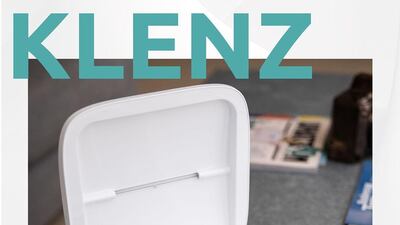
The Klenz box, launched by Dubai entrepreneurs, sanitises mobile devices safely. Klenz / Instagram

The importance of sanitising your mobile phone during the pandemic


Sophie Prideaux
  • English
  • Arabic

The pandemic has drilled into us the importance of washing our hands regularly, and spurred us all to clean the surfaces in our home with renewed vigour. But have we given enough thought to the cleanliness of the thing most of us use all day, every day – our phones?

Studies have shown that the average person touches their mobile phone as many as 2,617 times every day – that’s a lot of opportunity for germs to be transferred back and forth between our hands and the devices that are seemingly always in them.

And scientists have now revealed that, in certain environments, the coronavirus can survive on a mobile phone for as long as 28 days. In October, scientists at the Australian Centre for Disease Preparedness said the virus was "extremely robust", surviving for up to four weeks on smooth surfaces such as phone screens and plastic banknotes, when kept at room temperature, or 20°C.

The study, published in Virology Journal, also found that the virus lasted 10 days longer than influenza. "Establishing how long the virus really remains viable on surfaces enables us to more accurately predict and mitigate its spread, and do a better job of protecting our people," said Dr Larry Marshall, the chief executive of Australia's National Science Agency.

However, as research has shown that direct sunlight can kill the virus, all experiments were conducted in the dark to remove the impact of ultraviolet light. "So in the real world results would likely be shorter than what we were able to show," the study's lead researcher Shane Riddell said.

Unlike your hands and surfaces in the home, phones are a little trickier to clean with traditional methods, but it’s the impact of ultraviolet light, as mentioned by Riddell, that helped Dubai entrepreneurs Chris Wright and Annabel Jean Demana to come up with a safe solution for sanitising mobile and electronic devices.

The newly launched Klenz device promises to sanitise mobile devices and AirPod headphones using UVC rays, which have the shortest wavelength and are capable of removing 99 per cent of contamination in the air and on surfaces, according to the FDA. UVC rays are particularly good at destroying genetic material, whether in humans or viral particles, but if harnessed correctly and safely, they can be an extremely effective form of sterilisation. This method has been used since the 1870s, and is commonplace in hospitals, factories and on aeroplanes.

The Klenz will also charge your devices wirelessly as it sanitises them. It is also suitable for use with remote controls, wallets, keys and make-up brushes.

The Klenz comes in two different sizes, the Dh199 Klenz Lite, suitable for mobile phones and AirPods, or the bigger Klenz Pro, priced at Dh349. It is compatible to charge the latest Apple, Samsung, Huawei and Xiaomi handsets.

"You can unwittingly spread germs by using your smart devices and waste all your hand scrubbing efforts. This is where Klenz comes in. The founders, Wright and Demana, noticed the futility of sanitising your hands to just pick up a dirty phone seconds after and the idea for sanitisation boxes was born," the company website reads.

“Keeping yourself free from germs was of course the top priority in this busy digital era we live in, we thought, why not give you more for your money. The UV Klenz boxes not only keep your essentials clean but they’ll charge them wirelessly too. We’re all about efficiency, speed and safety at Klenz.”

More information can be found at www.klenzshop.com

NEW%20PRICING%20SCHEME%20FOR%20APPLE%20MUSIC%2C%20TV%2B%20AND%20ONE
%3Cp%3E%3Cstrong%3EApple%20Music%3Cbr%3EMonthly%20individual%3A%20%3C%2Fstrong%3E%2410.99%20(from%20%249.99)%3Cstrong%3E%3Cbr%3EMonthly%20family%3A%20%3C%2Fstrong%3E%2416.99%20(from%20%2414.99)%3Cstrong%3E%3Cbr%3EIndividual%20annual%3A%20%3C%2Fstrong%3E%24109%20(from%20%2499)%3C%2Fp%3E%0A%3Cp%3E%3Cstrong%3EApple%20TV%2B%3Cbr%3EMonthly%3A%20%3C%2Fstrong%3E%246.99%20(from%20%244.99)%3Cstrong%3E%3Cbr%3EAnnual%3A%20%3C%2Fstrong%3E%2469%20(from%20%2449.99)%3C%2Fp%3E%0A%3Cp%3E%3Cstrong%3EApple%20One%3Cbr%3EMonthly%20individual%3A%20%3C%2Fstrong%3E%2416.95%20(from%20%2414.95)%3Cstrong%3E%3Cbr%3EMonthly%20family%3A%20%3C%2Fstrong%3E%2422.95%20(from%20%2419.95)%3Cstrong%3E%3Cbr%3EMonthly%20premier%3A%20%3C%2Fstrong%3E%2432.95%20(from%20%2429.95)%3C%2Fp%3E%0A

Mercer, the investment consulting arm of US services company Marsh & McLennan, expects its wealth division to at least double its assets under management (AUM) in the Middle East as wealth in the region continues to grow despite economic headwinds, a company official said.

Mercer Wealth, which globally has $160 billion in AUM, plans to boost its AUM in the region to $2-$3bn in the next 2-3 years from the present $1bn, said Yasir AbuShaban, a Dubai-based principal with Mercer Wealth.

Within the next two to three years, we are looking at reaching $2 to $3 billion as a conservative estimate and we do see an opportunity to do so,” said Mr AbuShaban.

Mercer does not directly make investments, but allocates clients’ money they have discretion to, to professional asset managers. They also provide advice to clients.

“We have buying power. We can negotiate on their (client’s) behalf with asset managers to provide them lower fees than they otherwise would have to get on their own,” he added.

Mercer Wealth’s clients include sovereign wealth funds, family offices, and insurance companies among others.

From its office in Dubai, Mercer also looks after Africa, India and Turkey, where they also see opportunity for growth.

Wealth creation in Middle East and Africa (MEA) grew 8.5 per cent to $8.1 trillion last year from $7.5tn in 2015, higher than last year’s global average of 6 per cent and the second-highest growth in a region after Asia-Pacific which grew 9.9 per cent, according to consultancy Boston Consulting Group (BCG). In the region, where wealth grew just 1.9 per cent in 2015 compared with 2014, a pickup in oil prices has helped in wealth generation.

BCG is forecasting MEA wealth will rise to $12tn by 2021, growing at an annual average of 8 per cent.

Drivers of wealth generation in the region will be split evenly between new wealth creation and growth of performance of existing assets, according to BCG.

Another general trend in the region is clients’ looking for a comprehensive approach to investing, according to Mr AbuShaban.

“Institutional investors or some of the families are seeing a slowdown in the available capital they have to invest and in that sense they are looking at optimizing the way they manage their portfolios and making sure they are not investing haphazardly and different parts of their investment are working together,” said Mr AbuShaban.

Some clients also have a higher appetite for risk, given the low interest-rate environment that does not provide enough yield for some institutional investors. These clients are keen to invest in illiquid assets, such as private equity and infrastructure.

“What we have seen is a desire for higher returns in what has been a low-return environment specifically in various fixed income or bonds,” he said.

“In this environment, we have seen a de facto increase in the risk that clients are taking in things like illiquid investments, private equity investments, infrastructure and private debt, those kind of investments were higher illiquidity results in incrementally higher returns.”

The Abu Dhabi Investment Authority, one of the largest sovereign wealth funds, said in its 2016 report that has gradually increased its exposure in direct private equity and private credit transactions, mainly in Asian markets and especially in China and India. The authority’s private equity department focused on structured equities owing to “their defensive characteristics.”

Bio

Born in Dubai in 1994
Her father is a retired Emirati police officer and her mother is originally from Kuwait
She Graduated from the American University of Sharjah in 2015 and is currently working on her Masters in Communication from the University of Sharjah.
Her favourite film is Pacific Rim, directed by Guillermo del Toro

While you're here
Timeline

2012-2015

The company offers payments/bribes to win key contracts in the Middle East

May 2017

The UK SFO officially opens investigation into Petrofac’s use of agents, corruption, and potential bribery to secure contracts

September 2021

Petrofac pleads guilty to seven counts of failing to prevent bribery under the UK Bribery Act

October 2021

Court fines Petrofac £77 million for bribery. Former executive receives a two-year suspended sentence 

December 2024

Petrofac enters into comprehensive restructuring to strengthen the financial position of the group

May 2025

The High Court of England and Wales approves the company’s restructuring plan

July 2025

The Court of Appeal issues a judgment challenging parts of the restructuring plan

August 2025

Petrofac issues a business update to execute the restructuring and confirms it will appeal the Court of Appeal decision

October 2025

Petrofac loses a major TenneT offshore wind contract worth €13 billion. Holding company files for administration in the UK. Petrofac delisted from the London Stock Exchange

November 2025

180 Petrofac employees laid off in the UAE

Who's who in Yemen conflict

Houthis: Iran-backed rebels who occupy Sanaa and run unrecognised government

Yemeni government: Exiled government in Aden led by eight-member Presidential Leadership Council

Southern Transitional Council: Faction in Yemeni government that seeks autonomy for the south

Habrish 'rebels': Tribal-backed forces feuding with STC over control of oil in government territory

The rules on fostering in the UAE

A foster couple or family must:

  • be Muslim, Emirati and be residing in the UAE
  • not be younger than 25 years old
  • not have been convicted of offences or crimes involving moral turpitude
  • be free of infectious diseases or psychological and mental disorders
  • have the ability to support its members and the foster child financially
  • undertake to treat and raise the child in a proper manner and take care of his or her health and well-being
  • A single, divorced or widowed Muslim Emirati female, residing in the UAE may apply to foster a child if she is at least 30 years old and able to support the child financially
Zayed%20Centre%20for%20Research
%3Cp%3EThe%20Zayed%20Centre%20for%20Research%20is%20a%20partnership%20between%20Great%20Ormond%20Street%20Hospital%2C%20University%20College%20London%20and%20Great%20Ormond%20Street%20Hospital%20Children%E2%80%99s%20Charity%20and%20was%20made%20possible%20thanks%20to%20a%20generous%20%C2%A360%20million%20gift%20in%202014%20from%20Sheikha%20Fatima%20bint%20Mubarak%2C%20Chairwoman%20of%20the%20General%20Women's%20Union%2C%20President%20of%20the%20Supreme%20Council%20for%20Motherhood%20and%20Childhood%2C%20and%20Supreme%20Chairwoman%20of%20the%20Family%20Development%20Foundation.%3C%2Fp%3E%0A
What can victims do?

Always use only regulated platforms

Stop all transactions and communication on suspicion

Save all evidence (screenshots, chat logs, transaction IDs)

Report to local authorities

Warn others to prevent further harm

Courtesy: Crystal Intelligence

The Details

Kabir Singh

Produced by: Cinestaan Studios, T-Series

Directed by: Sandeep Reddy Vanga

Starring: Shahid Kapoor, Kiara Advani, Suresh Oberoi, Soham Majumdar, Arjun Pahwa

Rating: 2.5/5 

UAE currency: the story behind the money in your pockets
Defence review at a glance

• Increase defence spending to 2.5% of GDP by 2027 but given “turbulent times it may be necessary to go faster”

• Prioritise a shift towards working with AI and autonomous systems

• Invest in the resilience of military space systems.

• Number of active reserves should be increased by 20%

• More F-35 fighter jets required in the next decade

• New “hybrid Navy” with AUKUS submarines and autonomous vessels

Syria squad

Goalkeepers: Ibrahim Alma, Mahmoud Al Youssef, Ahmad Madania.
Defenders: Ahmad Al Salih, Moayad Ajan, Jehad Al Baour, Omar Midani, Amro Jenyat, Hussein Jwayed, Nadim Sabagh, Abdul Malek Anezan.
Midfielders: Mahmoud Al Mawas, Mohammed Osman, Osama Omari, Tamer Haj Mohamad, Ahmad Ashkar, Youssef Kalfa, Zaher Midani, Khaled Al Mobayed, Fahd Youssef.
Forwards: Omar Khribin, Omar Al Somah, Mardik Mardikian.

About Seez

Company name/date started: Seez, set up in September 2015 and the app was released in August 2017  

Founder/CEO name(s): Tarek Kabrit, co-founder and chief executive, and Andrew Kabrit, co-founder and chief operating officer

Based in: Dubai, with operations also in Kuwait, Saudi Arabia and Lebanon 

Sector:  Search engine for car buying, selling and leasing

Size: (employees/revenue): 11; undisclosed

Stage of funding: $1.8 million in seed funding; followed by another $1.5m bridge round - in the process of closing Series A 

Investors: Wamda Capital, B&Y and Phoenician Funds 

Fifa Club World Cup quarter-final

Kashima Antlers 3 (Nagaki 49’, Serginho 69’, Abe 84’)
Guadalajara 2 (Zaldivar 03’, Pulido 90')

Brief scores:

Day 1

Toss: India, chose to bat

India (1st innings): 215-2 (89 ov)

Agarwal 76, Pujara 68 not out; Cummins 2-40

Breaking News: The Remaking of Journalism and Why It Matters Now
Alan Rushbridger, Canongate
