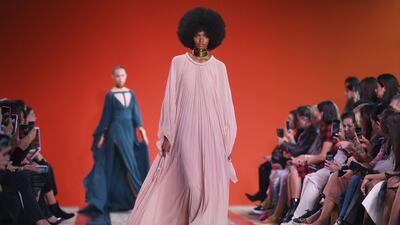
Normally, in the first week of July, I would be in Paris reporting on the haute couture collections, experiencing live catwalk shows and observing the feverish excitement of the occasion.
There would be guests running the gauntlet of street-style snappers outside gilded venues, elaborate sets, celeb-watching the front row and the anticipation of what new vision would be revealed on the catwalk. Then there was the dash backstage to join the scrum for post-show comments from the designer.

From the chaos of shows to the comfort of my sofa
Not so this July. Travel bans and social distancing measures due to the coronavirus have meant that this season, the collections have had to be showcased in a very different way. Catwalk shows have been replaced by a range of digital film and video presentations, viewed from the comfort of my sofa.

It has been a novel and somewhat relaxed experience. No stress from dealing with Paris traffic between venues. No mouthy security on the door, no pack of photographers tripping over one's feet to capture a celebrity arrival, no endless waits for shows to start. The digital clips have been released online punctually on a Netflix-style homepage created by the Federation de la Haute Couture et de la Mode.
Is the traditional fashion show dead?
So, are fashion shows dead? And can the digital equivalent successfully replace the excitement of the catwalk? For me, at least for now, the answer is no.
Why?
Haute couture is the ultimate expression of luxury. It as an art form: a beautifully composed showcase of a couturier at the pinnacle of their creativity and a celebration of the traditional craftsmanship of the atelier. It is something, especially for clients, that you have to witness, feel, smell and touch. Haute couture becomes a very emotional experience for everyone involved.

The very first haute couture show I attended 30 years ago was Gianni Versace’s debut Atelier show at the Ritz Paris. It was a riot of print, colour and imagination that had the audience enraptured. Then there was Jean-Paul Gaultier’s debut in 1997, which was all jet beading and denim, as daring a choice of fabric for the couture catwalk as Yves Saint Laurent scandalising the Dior catwalk in 1958 with a leather jacket.
There were the magical years of John Galliano’s theatrical flights of fantasy at Dior – from the Masai look of his spring / summer 1997 debut to the Dior 60th anniversary collection at the Palace of Versailles in 2007, and the spine-tingling sight in 2004 of supermodel Erin O'Connor in a gilded gown and magnificent Nefertiti headdress almost fainting with the effort as she glided down the catwalk.

It was the era of supermodels such as Naomi, Linda, Claudia and Kate, and with limited Internet access to the catwalk before Style.com (now Vogue Runway) was allowed access, I would rapidly sketch every outfit on the catwalk and name the models wearing each look for my reports, which just added to the nervous tension.
Now, of course, we photograph key looks and upload to Instagram in nano seconds. Even as a seasoned reporter, I was still thrilled to sit behind Celine Dion at Alexandre Vauthier last July; or seek quotes from stars such as Sophia Loren and Cate Blanchett. Not something you can do from behind a computer screen.
I witnessed the retirements of great names including Yves Saint Laurent, Valentino, Hubert de Givenchy, the brilliant colourist Christian Lacroix, who could transport us anywhere with his opulent historic fantasies, and the poignant swansong of Chanel’s great showman Karl Lagerfeld. There were also the arrivals of Elie Saab, Zuhair Murad and Giorgio Armani, Pier Paolo Piccioli and Maria Grazia Chiuri, and Galliano’s first show for Maison Margiela – too many landmark shows to chart them all.
Democratising the catwalk
Of course, as a journalist, I’ve had access to the grand rituals of haute couture, entering an exclusive rarefied world, but now the power of the internet has democratised the catwalk show, taking it beyond the clients and the media to vast global audiences to experience and enjoy. This season has been an experiment forced upon the couture maisons by the pandemic to explore different ways of telling their stories.
Under the auspices of the FHCM, couture maisons have used the digital space to develop new ways to articulate their ideas, some successfully, some not so. Maria Grazia Chiuri at Dior, Franck Sorbier and Antonio Grimaldi have been very cinematic, while others have taken us behind the scenes, filming the creative process.

Another group has given us either the briefest snapshots of their collections, filming outfits on socially distanced models in a studio or the Parisian twilight, or aired what amounted to teasers from Valentino and Elie Saab for upcoming catwalk shows that have not been altogether abandoned.
A computer screen can't compare
Of course, the result of the pandemic has meant couturiers have had less access to their ateliers to complete their collections. Schiaparelli closed its atelier altogether when creative director Daniel Roseberry was stuck quarantining in New York. The film of him sketching the collection in Washington Square Park was one of the highlights of the online experience, and his designs so well received that Schiaparelli decided to not abandon the season, but make a selection of samples to go on a world tour.
Creating these digital presentations telegraphs haute couture through another medium that everyone can access, but having experienced the heady atmosphere of haute couture’s physical displays, watching fashion in two dimensions on a screen is, for me, not the same as being there in the moment.

