Yousif Al Lootah has been embedded in the UAE’s green economy since 2010, long before it was a global conversation. The chief executive and founder of Lootah Biofuels, the UAE’s – and possibly the region’s – first biofuel company, was aged 19 when he started out. His brother, who owned a diesel-guzzling Hummer, was not convinced by the idea of putting used cooking oil into his car, but Mr Al Lootah persisted. “Now he loves it. They all love it,” he tells The National.
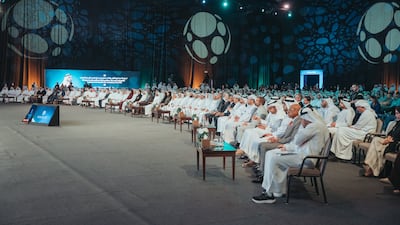
Mr Al Lootah was one of the speakers on Thursday at the 12th World Green Economy Summit, taking place at the Dubai World Trade Centre. He was one among dozens of policymakers, multilateral lenders, debt market analysts, fund managers and entrepreneurs, all of whom were there to talk about where the green economy is actually headed – and how the UAE, which has hosted WGES since its founding, has built a model that other markets are starting to study.
"We get all this knowledge, we cook it in a cocktail, and we make our own decision and system for our country,” said Mr Al Lootah, adding that he’s proud that the UAE has achieved so much in this sector in such little time.

‘Exciting’ opportunities
The Emirates has got a “very important” role to play in the world’s green economy, said Jonathan Maxwell, founder and group chief executive of Sustainable Development Capital LLP, who was an attendee at the summit’s first edition. “In my personal experience, Dubai is probably the best place in the world to convene people [because of] the facilities and the capability here, the focus, the sense of authenticity you get,” he said. “The future world green economy stage – Dubai has an absolutely firm place on that.”
Mr Maxwell said he was “excited” about the opportunities presented throughout the summit. “We’re having some extremely constructive conversations about opportunities – talking about agency to actually do something together, which I’m excited about.”
A summit like this is about developing a narrative, he added. “That’s what’s needed to penetrate government and private sector – use cases, success cases, rationale, bringing different experience together so that people can actually get around a table and come away with new ideas.”
A decarbonising economy
This should bring people comfort, said Syed Adeel Abbas, regional climate lead for the World Bank. “The green economy is a trend that’s not going to be halted anytime soon, regardless of what happens to the rest of the world,” he said.
“The global economy is decarbonising. Products and services around the world are going to be more and more green and sustainable, and socially responsible, so if you’re a company or a layman or a government, you need to understand that that’s the trend that we need to follow. And if we do not follow that trend, we will stay behind.”
The UAE is ahead in this regard, particularly in terms of competitive advantages, he added. "The UAE has sufficient capital to decarbonise its own industry and to achieve net zero targets committed at COP 28," he said. "It has the right frameworks for investments as well.”
Meanwhile, green hydrogen is a credible export industry in the making and the EU’s carbon border adjustment mechanism, which will apply a carbon cost to imported goods, creates a direct near-term incentive for UAE industry to move faster than competitors. "The UAE has huge aluminium exports," he said, "and if they are produced in a less carbon emission intensity than other countries, the UAE will have a significant competitive advantage in terms of exports."
His broader argument – and the message he wanted policymakers at WGES to take away – was that financing should follow this kind of competitive logic. Green bonds, blue bonds and sustainability-linked instruments are useful instruments, but "financing is not the solution and shouldn't be the starting point", he said. "It should be reliable, predictable policies that fall behind the targets and commitments that governments have made."
Green financing in action
Green financing is a “bigger story”, said Bashar Al Natoor, managing director and global head of Islamic Finance at Fitch Ratings. Outstanding green sukuk and bonds from the GCC have reached $73 billion. In the first nine months of 2026, GCC ESG issuance represented around 40 per cent of all US dollar ESG issuance from emerging markets, excluding China. The World Bank's IFC catalysed $112 billion in private sector investment in financial year 2026 alone.
Last week, First Abu Dhabi Bank issued a digital green sukuk. Qatar has begun issuing in local currency and Saudi Arabia's Public Investment Fund placed a 100-year green bond. "The momentum has been there over the years, where we're seeing more and more coming,” said Mr Al Natoor.
“Governments have their agendas. Banks are playing their roles. So, it’s a multi-dimensional story – and each one of them deserves to be told separately,” he added.

Who pays for what should not be the focus, however, said Mr Maxwell. “The question shouldn’t be: should we pay for this? The question should be: how much better can we do with the same resources or less? How can we do the same or more work with less? And that will drive competitiveness," he said.
His three-word summary of what a green investment case should look like is: cheaper, cleaner, faster. In that order, because cost is the most reliable metric and revenue matters. “If we can be more efficient – and that is the lens that I look at the world through – a green economy, a sustainable economy, where sustainability is consistent and synonymous, even with resource efficiency – then that’s better for the economy.”
At the end of the day, everyone is on the same “big mission to save the environment”, said Mr Lootah. “With our young generation, who we’re going to give this world to, with the AI and robotics, and all these new technologies, it’s going to enhance the transition to a sustainable lifestyle. It’s happening.”

