Prince Mohammed bin Salman says peace with Iran is possible if Tehran stops backing regional militias


  • English
  • Arabic

Saudi Arabia wants regional stability and is not opposed to talks with Iran, provided Tehran stops sponsoring regional militias, Crown Prince Mohammed bin Salman said on Tuesday night.

Prince Mohammed also said Iran's continued nuclear programme was a serious source of contention.

There is no country in the world that would accept the presence of armed militias on its borders

Riyadh is also maintaining strong ties with the US, he said, in a wide-ranging interview with the Liwan Al Mudaifer Show on Tuesday night, which was broadcast on state TV.

Prince Mohammed, who rarely gives TV interviews, described in detail aspects of the country's ambitious Vision 2030 programme of reforms.

He said the success of this programme was partly based on having pragmatic foreign relations.

"It is based on our interests," Prince Mohammed said. "The majority of investments have come through the fact that our interests have aligned with the international community."

Relations with Biden

He said reports of Washington turning its back on Saudi Arabia  were exaggerated.

"Relations between states are not 100 per cent on the same page," Prince Mohammed said.

"Our interests align with the Biden administration by more than 90 per cent.

"There is no doubt that there are differences in views between Saudi Arabia and even other Gulf states, but within a single family views differ and that's normal."

He was keen to stress the historic relationship between the two countries.

"The US is a strategic and historic partner to the kingdom," Prince Mohammed said. "This relationship has had a profound impact on both states.

"With every new American administration differences appear and that is normal.

"We are working on strengthening our ties and alliances with our international partners."

Iran rapprochement 

He said that the kingdom was not interested in perpetual hostility with Iran, but any thawing of relations would be conditional.

"Iran is a neighbouring state," Prince Mohammed said. "We are seeking to have good relations with Iran.

"We have interests in Iran, we aim to see a prosperous Iran.

"We are working with our partners in the region to overcome our differences with Iran, especially with its support for militias and the development of its nuclear programme."

This month, government and diplomatic sources in Baghdad said Saudi and Iranian government officials held back-channel talks, below Cabinet level, in Baghdad.

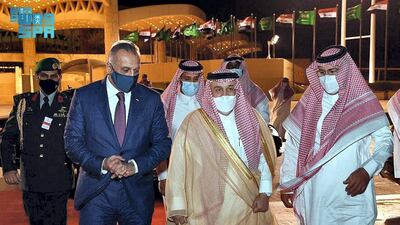
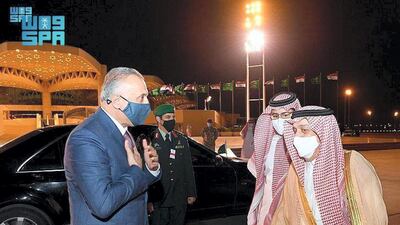
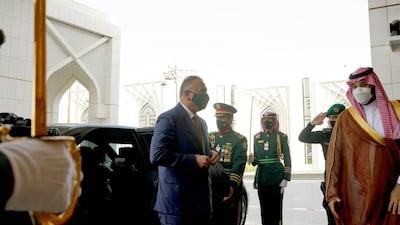
  • Iraqi Prime Minister Mustafa Al Kadhimi leaves Riyadh after a visit aimed at boosting co-operation with Saudi Arabia. Saudi Press Agency
    Iraqi Prime Minister Mustafa Al Kadhimi leaves Riyadh after a visit aimed at boosting co-operation with Saudi Arabia. Saudi Press Agency
  • Mr Al Kadhimi says relations between Iraq and Saudi Arabia 'accelerated in a positive direction'. SPA
    Mr Al Kadhimi says relations between Iraq and Saudi Arabia 'accelerated in a positive direction'. SPA
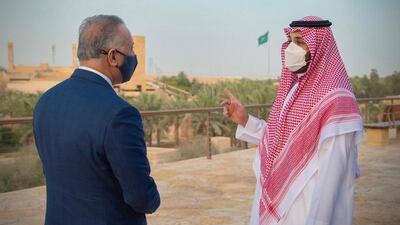
  • Saudi Crown Prince Mohammed bin Salman and Mr Al Kadhimi visit the historical city Ad Diriyah on the outskirts of Riyadh. Reuters
    Saudi Crown Prince Mohammed bin Salman and Mr Al Kadhimi visit the historical city Ad Diriyah on the outskirts of Riyadh. Reuters
  • Prince Mohammed and Mr Al Kadhimi at Ad Diriyah during the Iraqi prime minister's visit to Saudi Arabia. Reuters
    Prince Mohammed and Mr Al Kadhimi at Ad Diriyah during the Iraqi prime minister's visit to Saudi Arabia. Reuters
  • Mr Al Kadhimi says Iraq and Saudi Arabia overcame challenges that were 'obstructing relations' between the countries. SPA
    Mr Al Kadhimi says Iraq and Saudi Arabia overcame challenges that were 'obstructing relations' between the countries. SPA
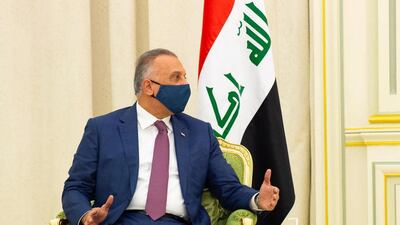
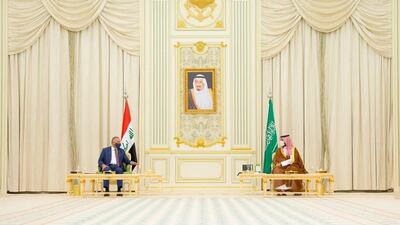
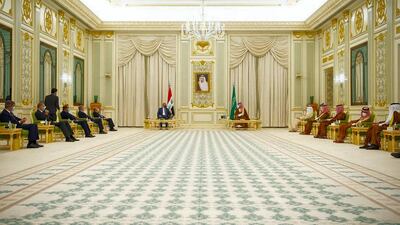
  • Mr Al Kadhimi holds talks with Prince Mohammed. SPA
    Mr Al Kadhimi holds talks with Prince Mohammed. SPA
  • Mr Al Kadhimi speaks to Prince Mohammed during a visit to Saudi Arabia. SPA
    Mr Al Kadhimi speaks to Prince Mohammed during a visit to Saudi Arabia. SPA
  • Prince Mohammed meets Mr Al Kadhimi during the Iraqi prime minister's trip to Saudi Arabia. Iraqi Prime Minister Media Office
    Prince Mohammed meets Mr Al Kadhimi during the Iraqi prime minister's trip to Saudi Arabia. Iraqi Prime Minister Media Office
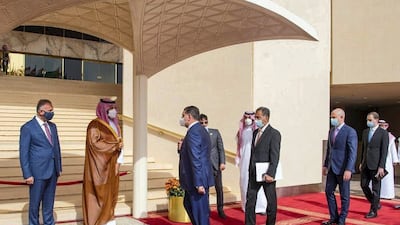
  • Prince Mohammed welcomes Mr Al Kadhimi to Riyadh. Iraqi Prime Minister Media Office
    Prince Mohammed welcomes Mr Al Kadhimi to Riyadh. Iraqi Prime Minister Media Office
  • Mr Al Kadhimi held talks with Prince Mohammed during the visit. Iraqi Prime Minister Media Office
    Mr Al Kadhimi held talks with Prince Mohammed during the visit. Iraqi Prime Minister Media Office
  • Iraqi Prime Minister Mustafa Al Kadhimi meets with Saudi Crown Prince Mohammed bin Salman. Iraqi Prime Minister Media Office
    Iraqi Prime Minister Mustafa Al Kadhimi meets with Saudi Crown Prince Mohammed bin Salman. Iraqi Prime Minister Media Office
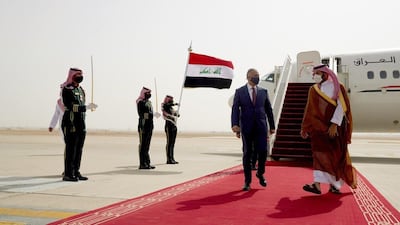
  • Crown Prince of Saudi Arabia Mohammed bin Salman and Iraq's Prime Minister Mustafa Al Kadhimi walk together on his arrival in Riyadh. SPA
    Crown Prince of Saudi Arabia Mohammed bin Salman and Iraq's Prime Minister Mustafa Al Kadhimi walk together on his arrival in Riyadh. SPA
  • Saudi Crown Prince Mohammed bin Salman welcomes Iraqi Prime Minister Mustafa Al Kadhimi. Iraqi Prime Minister Media Office
    Saudi Crown Prince Mohammed bin Salman welcomes Iraqi Prime Minister Mustafa Al Kadhimi. Iraqi Prime Minister Media Office
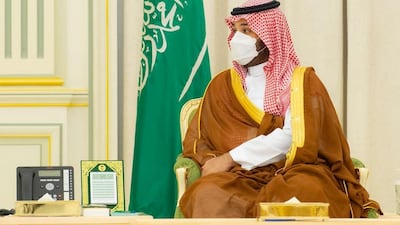
  • Crown Prince of Saudi Arabia Mohammed bin Salman. SPA
    Crown Prince of Saudi Arabia Mohammed bin Salman. SPA
  • Crown Prince of Saudi Arabia Mohammed bin Salman and Iraq's Prime Minister Mustafa Al Kadhimi in Riyadh. SPA
    Crown Prince of Saudi Arabia Mohammed bin Salman and Iraq's Prime Minister Mustafa Al Kadhimi in Riyadh. SPA
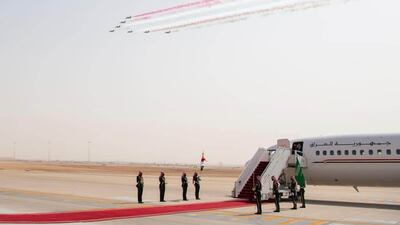
  • Preparations to welcome Iraqi Prime Minister Mustafa Al Kadhimi in Riyadh. SPA
    Preparations to welcome Iraqi Prime Minister Mustafa Al Kadhimi in Riyadh. SPA
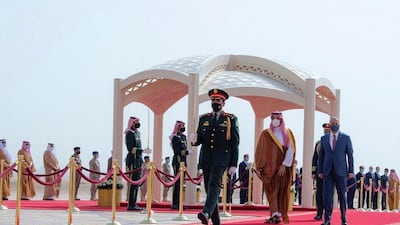
  • The welcome ceremony in Riyadh for Iraqi Prime Minister Mustafa Al Kadhimi. SPA
    The welcome ceremony in Riyadh for Iraqi Prime Minister Mustafa Al Kadhimi. SPA
  • Iraqi Prime Minister Mustafa Al Kadhimi meets with Saudi Crown Prince Mohammed bin Salman. Iraqi Prime Minister Media Office
    Iraqi Prime Minister Mustafa Al Kadhimi meets with Saudi Crown Prince Mohammed bin Salman. Iraqi Prime Minister Media Office
  • Iraqi Prime Minister Mustafa Al Kadhimi meets with Saudi Crown Prince Mohammed bin Salman. Iraqi Prime Minister Media Office
    Iraqi Prime Minister Mustafa Al Kadhimi meets with Saudi Crown Prince Mohammed bin Salman. Iraqi Prime Minister Media Office

Iran and Saudi Arabia denied that the talks took place.

Any momentum is likely to be complicated by Iran's continued sponsorship of proxy militia groups in the region, including Hezbollah in Lebanon and Kataib Hezbollah in Iraq.

Kataib Hezbollah said it would resist efforts by Iraqi Prime Minister Mustafa Al Kadhimi to build ties with Riyadh.

At the start of April, Mr Al Kadhimi visited Riyadh and discussed co-operation in investment with the kingdom, including the establishment of a $3bn infrastructure investment fund.

Conflict in Yemen

The conflict in Yemen is also a sticking point in any rapprochement.

"We will not allow any armed militias on our borders," Prince Mohammed said. "The Houthis must come to the negotiating table.

"The Houthis have strong relations with Iran but at the end of the day, they are Yemenis and we are hoping to have a Yemeni solution to end the conflict.

"The Houthis' coup against the internationally recognised government is illegal and Saudi Arabia will not accept any armed militias on its borders.

"There is no country in the world that would accept the presence of armed militias on its borders, such as the Houthis.

"The Houthis must accept the Saudi ceasefire initiative and participate in talks. We hope that they will reach a solution that guarantees the rights for all."


UK-EU trade at a glance

EU fishing vessels guaranteed access to UK waters for 12 years

Co-operation on security initiatives and procurement of defence products

Youth experience scheme to work, study or volunteer in UK and EU countries

Smoother border management with use of e-gates

Cutting red tape on import and export of food

Honeymoonish
%3Cp%3E%3Cstrong%3EDirector%3A%3C%2Fstrong%3E%20Elie%20El%20Samaan%3C%2Fp%3E%0A%3Cp%3E%3Cstrong%3EStarring%3A%20%3C%2Fstrong%3ENour%20Al%20Ghandour%2C%20Mahmoud%20Boushahri%3C%2Fp%3E%0A%3Cp%3E%3Cstrong%3ERating%3A%3C%2Fstrong%3E%203%2F5%3C%2Fp%3E%0A
Lexus LX700h specs

Engine: 3.4-litre twin-turbo V6 plus supplementary electric motor

Power: 464hp at 5,200rpm

Torque: 790Nm from 2,000-3,600rpm

Transmission: 10-speed auto

Fuel consumption: 11.7L/100km

On sale: Now

Price: From Dh590,000

The specs

Engine: 2.0-litre 4-cyl turbo

Power: 247hp at 6,500rpm

Torque: 370Nm from 1,500-3,500rpm

Transmission: 10-speed auto

Fuel consumption: 7.8L/100km

Price: from Dh94,900

On sale: now

The specs
Engine: 3.0-litre twin-turbo flat-six

Power: 480hp at 6,500rpm

Torque: 570Nm from 2,300-5,000rpm

Transmission: 8-speed dual-clutch auto

Fuel consumption: 10.4L/100km

Price: from Dh547,600

On sale: now 

Who was Alfred Nobel?

The Nobel Prize was created by wealthy Swedish chemist and entrepreneur Alfred Nobel.

  • In his will he dictated that the bulk of his estate should be used to fund "prizes to those who, during the preceding year, have conferred the greatest benefit to humankind".
  • Nobel is best known as the inventor of dynamite, but also wrote poetry and drama and could speak Russian, French, English and German by the age of 17. The five original prize categories reflect the interests closest to his heart.
  • Nobel died in 1896 but it took until 1901, following a legal battle over his will, before the first prizes were awarded.
MATCH INFO

Europa League final

Who: Marseille v Atletico Madrid
Where: Parc OL, Lyon, France
When: Wednesday, 10.45pm kick off (UAE)
TV: BeIN Sports

THE BIO

Age: 30

Favourite book: The Power of Habit

Favourite quote: "The world is full of good people, if you cannot find one, be one"

Favourite exercise: The snatch

Favourite colour: Blue

Seven tips from Emirates NBD

1. Never respond to e-mails, calls or messages asking for account, card or internet banking details

2. Never store a card PIN (personal identification number) in your mobile or in your wallet

3. Ensure online shopping websites are secure and verified before providing card details

4. Change passwords periodically as a precautionary measure

5. Never share authentication data such as passwords, card PINs and OTPs  (one-time passwords) with third parties

6. Track bank notifications regarding transaction discrepancies

7. Report lost or stolen debit and credit cards immediately

%20Ramez%20Gab%20Min%20El%20Akher
%3Cp%3E%3Cstrong%3ECreator%3A%3C%2Fstrong%3E%20Ramez%20Galal%3C%2Fp%3E%0A%3Cp%3E%3Cstrong%3EStarring%3A%3C%2Fstrong%3E%20Ramez%20Galal%3C%2Fp%3E%0A%3Cp%3E%3Cstrong%3EStreaming%20on%3A%20%3C%2Fstrong%3EMBC%20Shahid%3C%2Fp%3E%0A%3Cp%3E%3Cstrong%3ERating%3A%20%3C%2Fstrong%3E2.5%2F5%3C%2Fp%3E%0A
Timeline

1947
Ferrari’s road-car company is formed and its first badged car, the 125 S, rolls off the assembly line

1962
250 GTO is unveiled

1969
Fiat becomes a Ferrari shareholder, acquiring 50 per cent of the company

1972
The Fiorano circuit, Ferrari’s racetrack for development and testing, opens

1976
First automatic Ferrari, the 400 Automatic, is made

1987
F40 launched

1988
Enzo Ferrari dies; Fiat expands its stake in the company to 90 per cent

2002
The Enzo model is announced

2010
Ferrari World opens in Abu Dhabi

2011
First four-wheel drive Ferrari, the FF, is unveiled

2013
LaFerrari, the first Ferrari hybrid, arrives

2014
Fiat Chrysler announces the split of Ferrari from the parent company

2015
Ferrari launches on Wall Street

2017
812 Superfast unveiled; Ferrari celebrates its 70th anniversary

Four-day collections of TOH

Day             Indian Rs (Dh)        

Thursday    500.75 million (25.23m)

Friday         280.25m (14.12m)

Saturday     220.75m (11.21m)

Sunday       170.25m (8.58m)

Total            1.19bn (59.15m)

(Figures in millions, approximate)

THE CLOWN OF GAZA

Director: Abdulrahman Sabbah 

Starring: Alaa Meqdad

Rating: 4/5

Mercer, the investment consulting arm of US services company Marsh & McLennan, expects its wealth division to at least double its assets under management (AUM) in the Middle East as wealth in the region continues to grow despite economic headwinds, a company official said.

Mercer Wealth, which globally has $160 billion in AUM, plans to boost its AUM in the region to $2-$3bn in the next 2-3 years from the present $1bn, said Yasir AbuShaban, a Dubai-based principal with Mercer Wealth.

Within the next two to three years, we are looking at reaching $2 to $3 billion as a conservative estimate and we do see an opportunity to do so,” said Mr AbuShaban.

Mercer does not directly make investments, but allocates clients’ money they have discretion to, to professional asset managers. They also provide advice to clients.

“We have buying power. We can negotiate on their (client’s) behalf with asset managers to provide them lower fees than they otherwise would have to get on their own,” he added.

Mercer Wealth’s clients include sovereign wealth funds, family offices, and insurance companies among others.

From its office in Dubai, Mercer also looks after Africa, India and Turkey, where they also see opportunity for growth.

Wealth creation in Middle East and Africa (MEA) grew 8.5 per cent to $8.1 trillion last year from $7.5tn in 2015, higher than last year’s global average of 6 per cent and the second-highest growth in a region after Asia-Pacific which grew 9.9 per cent, according to consultancy Boston Consulting Group (BCG). In the region, where wealth grew just 1.9 per cent in 2015 compared with 2014, a pickup in oil prices has helped in wealth generation.

BCG is forecasting MEA wealth will rise to $12tn by 2021, growing at an annual average of 8 per cent.

Drivers of wealth generation in the region will be split evenly between new wealth creation and growth of performance of existing assets, according to BCG.

Another general trend in the region is clients’ looking for a comprehensive approach to investing, according to Mr AbuShaban.

“Institutional investors or some of the families are seeing a slowdown in the available capital they have to invest and in that sense they are looking at optimizing the way they manage their portfolios and making sure they are not investing haphazardly and different parts of their investment are working together,” said Mr AbuShaban.

Some clients also have a higher appetite for risk, given the low interest-rate environment that does not provide enough yield for some institutional investors. These clients are keen to invest in illiquid assets, such as private equity and infrastructure.

“What we have seen is a desire for higher returns in what has been a low-return environment specifically in various fixed income or bonds,” he said.

“In this environment, we have seen a de facto increase in the risk that clients are taking in things like illiquid investments, private equity investments, infrastructure and private debt, those kind of investments were higher illiquidity results in incrementally higher returns.”

The Abu Dhabi Investment Authority, one of the largest sovereign wealth funds, said in its 2016 report that has gradually increased its exposure in direct private equity and private credit transactions, mainly in Asian markets and especially in China and India. The authority’s private equity department focused on structured equities owing to “their defensive characteristics.”