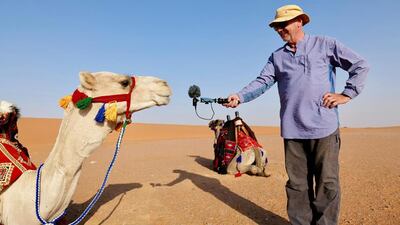
• British explorer Mark Evans and Reem Philby are greeted at the launch of the second leg of the Heart of Arabia expedition. All photos: Ana-Maria Pavalache / Heart of Arabia expedition
    British explorer Mark Evans and Reem Philby are greeted at the launch of the second leg of the Heart of Arabia expedition. All photos: Ana-Maria Pavalache / Heart of Arabia expedition
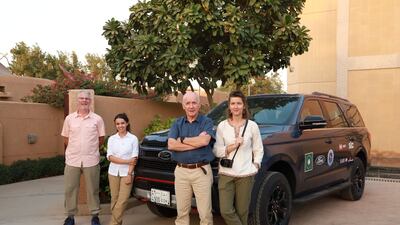
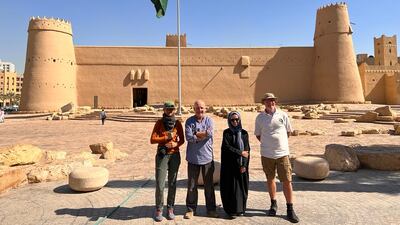
  • Mr Evans, left, with Sara Philby, Mandy Oates, Michael Engelbach and his wife, Reem Philby and Sami Alotaibi in the historic At-Turaif District
    Mr Evans, left, with Sara Philby, Mandy Oates, Michael Engelbach and his wife, Reem Philby and Sami Alotaibi in the historic At-Turaif District
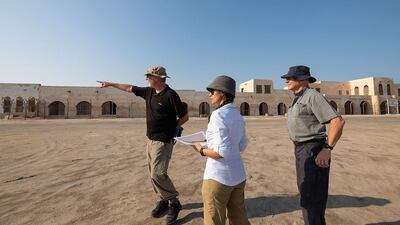
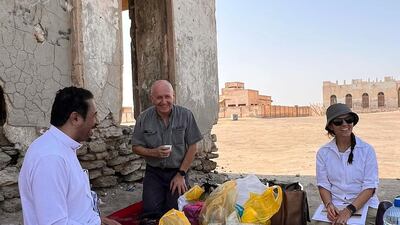
  • Logistics lead Alan Morrisey, left, Mr Evans, right, with members of the Philby family and Saudi officials
    Logistics lead Alan Morrisey, left, Mr Evans, right, with members of the Philby family and Saudi officials
  • Mr Evans is leading the team in the footsteps of Harry St John Philby, who crossed the Arabian Peninsula by foot and camel in 1917
    Mr Evans is leading the team in the footsteps of Harry St John Philby, who crossed the Arabian Peninsula by foot and camel in 1917
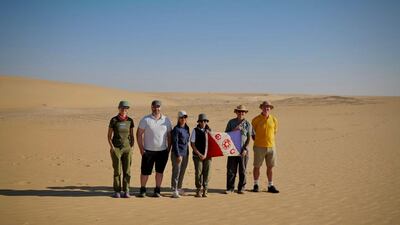
  • Mr Evans holds up the Explorers Club flag with officials from the Saudi Ministry of Culture ahead of the second leg of the Heart of Arabia expedition
    Mr Evans holds up the Explorers Club flag with officials from the Saudi Ministry of Culture ahead of the second leg of the Heart of Arabia expedition
  • The team set off from the Unesco World Heritage centre of At-Turaif
    The team set off from the Unesco World Heritage centre of At-Turaif
  • They left Al Diriyah along the Wadi Hanifa valley
    They left Al Diriyah along the Wadi Hanifa valley
  • They will travel westward across the deserts that separate Riyadh from the Hijaz mountains and eventually to the Red Sea
    They will travel westward across the deserts that separate Riyadh from the Hijaz mountains and eventually to the Red Sea
  • They aim to reach the coastal city of Jeddah by January 30
    They aim to reach the coastal city of Jeddah by January 30
  • The Jabal Tuwaiq is seen in the background as the team cross the desert
    The Jabal Tuwaiq is seen in the background as the team cross the desert
  • The team must now navigate muddy terrain because of the rain
    The team must now navigate muddy terrain because of the rain
  • The limestone ridge of Jabal Tuwaiq can be ascended by a series of winding paths
    The limestone ridge of Jabal Tuwaiq can be ascended by a series of winding paths
  • These paths allowed travellers to traverse the ridge while riding camels
    These paths allowed travellers to traverse the ridge while riding camels
  • Reem Philby and Mark Evans on Jabal Tuwaiq
    Reem Philby and Mark Evans on Jabal Tuwaiq
  • Jabal Tuwaiq is a 600m-high limestone ridge that cuts through the region
    Jabal Tuwaiq is a 600m-high limestone ridge that cuts through the region
  • The escarpment is usually dry and dusty, but rainy weather in winter months can cause mud and floods
    The escarpment is usually dry and dusty, but rainy weather in winter months can cause mud and floods
  • The ridge offers spectacular views of the desert
    The ridge offers spectacular views of the desert
  • Views from Jabal Tuwaiq
    Views from Jabal Tuwaiq
  • The Saudi desert in its splendour
    The Saudi desert in its splendour
  • The expedition brought together two wings of Philby's family for the first time
    The expedition brought together two wings of Philby's family for the first time
  • The trip has the support of the Royal Geographical Society and its patron Princess Anne, who officially launched the expedition in September, and Saudi Arabian authorities
    The trip has the support of the Royal Geographical Society and its patron Princess Anne, who officially launched the expedition in September, and Saudi Arabian authorities

Heart of Arabia expedition sets off across the desert towards Jeddah


Tommy Hilton
  • English
  • Arabic

The Heart of Arabia expedition began the second leg of its 1,300km trek across Saudi Arabia this week in rain that caused heavy floods across the kingdom.

British explorer Mark Evans is leading an expedition in the footsteps of Harry St John Philby, who crossed the Arabian Peninsula by foot and camel in 1917.

The team — which includes Philby’s granddaughter Reem Philby, photographer Ana-Maria Pavalache and logistics lead Alan Morrissey — completed the first leg from the port of Al Uqair to Riyadh in November.

On Monday, they set off from the Unesco World Heritage centre of At-Turaif in Al Diriyah district on the outskirts of Riyadh.

They will travel west across the vast deserts that separate Riyadh from the western Hijaz mountains and on to the Red Sea, aiming to reach the city of Jeddah by January 30.

Wet and cold weather in the desert

After a dry and windy first leg, the expedition must deal with wet weather and new terrain.

They left Al Diriyah along the Wadi Hanifa valley and reached Jabal Tuwaiq — an imposing 600-metre-high limestone ridge that cuts through the region — under blue skies.

However, rain started, and the team has had to navigate muddy terrain.

Winter rains in Saudi Arabia often cause flooding, and several people have been killed in the Makkah region this season.

Despite the risk, Mr Evans told The National the weather would not affect their plans.

Philby recorded difficult weather in his 1922 account of his trip, Heart of Arabia, and lows of 5°C.

“It was the coldest day I experienced in all my sojourn in Arabia,” Philby wrote from the same spot close to Jabal Tuwaiq, where the 2023 expedition camped on Tuesday.

Following Philby’s mission

Philby travelled to Riyadh on an official British mission, but the second leg was a journey he was not supposed to make.

In 1917, Philby was a 32-year-old civil servant stationed in Iraq, where he was employed to help the British Empire in its struggle against the Ottoman Empire during the First World War.

Along with two other British officials, Philby was sent to Riyadh to ask if Ibn Saud would put more pressure on the Ottomans.

While British officials disputed the mission's scope, Philby considered himself as having the authority to offer Ibn Saud military and financial support for an attack on the Al Rashid family, who were allied with the Ottomans.

The first leg of his trip went to plan, and he met Ibn Saud in Riyadh on November 30, 1917.

After 10 days of negotiations, the two officials who had accompanied Philby returned to Iraq.

Philby was expected to follow, but he had other plans.

He asked for a private audience with Ibn Saud, aiming to convince the leader to allow him to continue travelling west.

According to Philby, he persuaded Ibn Saud that the trip would prove the Saudis could provide safe passage in the western deserts of his realm.

This would strengthen Ibn Saud's claim over areas contested by his rival, King Hussein, who ruled the Hijaz region.

Philby later admitted his motives “were of a mixed character, and not wholly based on the requirements of the situation”. As an avid adventurer, he wanted to join the ranks of the few Europeans to have crossed the peninsula and the trek would enhance his prestige.

Ibn Saud allowed Philby to make the journey with an escort and the team set off on December 9, 1917.

He took meticulous notes along the way that were published in his 1922 book — the inspiration for today’s expedition.

Harry St John Philby on his 1917 trek across the Arabian Peninsula, which he recorded in his 1922 book Heart of Arabia. Photo: Heart of Arabia Expedition

Philby family lines meet

The expedition launch brought together two lines of Philby's family for the first time.

Philby had two wives. He had four children with his first wife, British citizen Dora Johnson, whom he married in India in 1910.

Dora and their children settled in England after Philby travelled to Arabia, where he spent much of the rest of his life as a close friend and adviser of Ibn Saud.

In Arabia, Philby converted to Islam, taking the name Abdullah, and he married a Saudi woman called Rozy, with whom he had several children.

Saudi explorer Reem Philby is from this line of the family.

At the expedition's launch, Ms Philby met Michael Engelbach, Philby's British grandson, for the first time.

This week, Mr Engelbach and his cousin Mandy Oates made their first visit to the kingdom to see the expedition off.

“Having read many of his letters and his books giving the account of his travels and his love of Arabia, we are very excited to be finally viewing the country and the people first hand,” said Mr Engelbach.

Ms Philby described the reunion as a “special” celebration of the late explorer's “life and legacy in his second home”.

The trip has the support of the Royal Geographical Society and Saudi authorities. As well as following Philby’s footsteps, the team are collecting data for three scientific projects and aiming to encourage people to explore Saudi Arabia.

Heart of Arabia expedition stage one — in pictures:

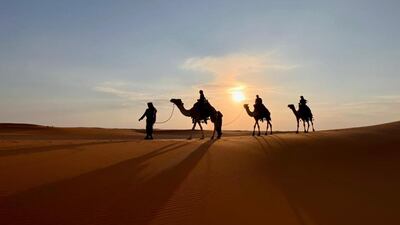
  • The Heart of Arabia team travels across the Saudi desert on camels. All photos unless stated: Ana-Maria Pavalache / Heart of Arabia expedition
    The Heart of Arabia team travels across the Saudi desert on camels. All photos unless stated: Ana-Maria Pavalache / Heart of Arabia expedition
  • The team - Alan Morrissey, Reem Philby, Mark Evans and Ana-Maria Pavalache. Photo: Osama Farhan / British Embassy Riyadh
    The team - Alan Morrissey, Reem Philby, Mark Evans and Ana-Maria Pavalache. Photo: Osama Farhan / British Embassy Riyadh
  • The team at the starting point of their expedition in Uqair, on the shores of the Gulf
    The team at the starting point of their expedition in Uqair, on the shores of the Gulf
  • The Heart of Arabia team at the historical fort in Uqair
    The Heart of Arabia team at the historical fort in Uqair
  • The team are greeted with hospitality in Uqair, at the beginning of the trip
    The team are greeted with hospitality in Uqair, at the beginning of the trip
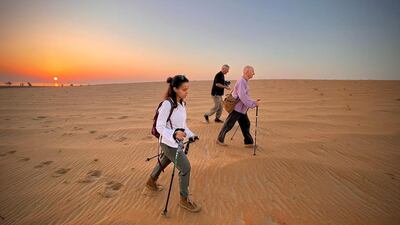
  • Alan Morrissey, Mark Evans and Reem Philby walk across the sand
    Alan Morrissey, Mark Evans and Reem Philby walk across the sand
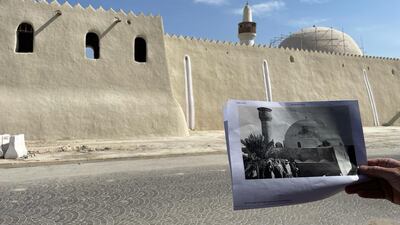
  • A comparison of the Ibrahim Pasha Mosque in Hofuf, now and in 1917, taken by Harry St John Philby in 1917
    A comparison of the Ibrahim Pasha Mosque in Hofuf, now and in 1917, taken by Harry St John Philby in 1917
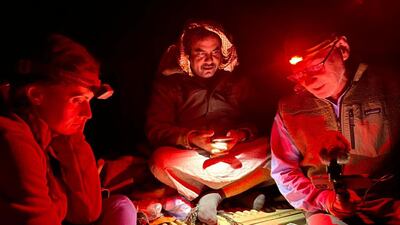
  • The team read by torch-light at night
    The team read by torch-light at night
  • Harry St John Philby on his 1917 trek across the Arabian Peninsula, which he recorded in his 1922 book 'Heart of Arabia'
    Harry St John Philby on his 1917 trek across the Arabian Peninsula, which he recorded in his 1922 book 'Heart of Arabia'
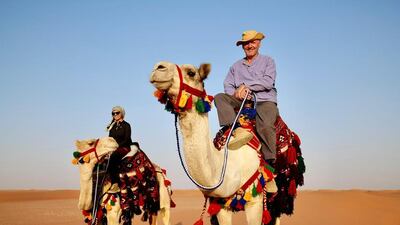
  • Mark Evans and Reem Philby ride camels on the Heart of Arabia expedition
    Mark Evans and Reem Philby ride camels on the Heart of Arabia expedition
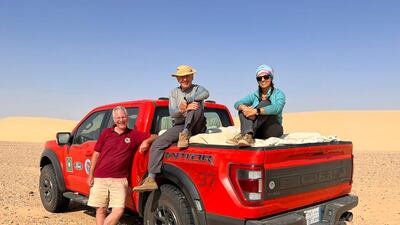
  • Alan Morrissey, Mark Evans, and Reem Philby with one of the support vehicles for the trip, nicknamed "the beast" by Mr Morrissey
    Alan Morrissey, Mark Evans, and Reem Philby with one of the support vehicles for the trip, nicknamed "the beast" by Mr Morrissey
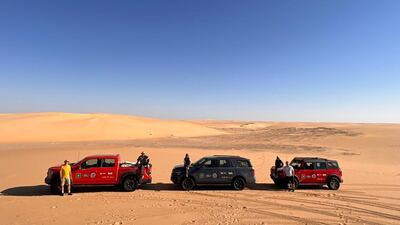
  • The team with the three support vehicles that took them south into the Empty Quarter
    The team with the three support vehicles that took them south into the Empty Quarter
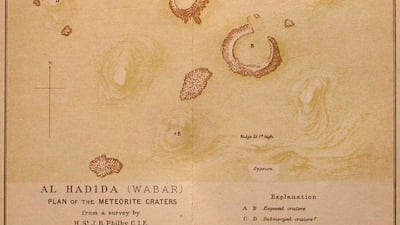
  • The map of the Wabar craters, known as Al Hadida or “the place of iron” to local Bedouin. Philby was the first European to visit the site during his expedition across the Empty Quarter in 1932
    The map of the Wabar craters, known as Al Hadida or “the place of iron” to local Bedouin. Philby was the first European to visit the site during his expedition across the Empty Quarter in 1932
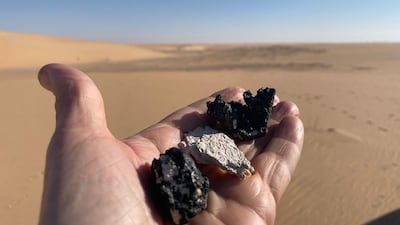
  • Volcanic rock at the Al Wabar craters in the Empty Quarter desert
    Volcanic rock at the Al Wabar craters in the Empty Quarter desert
  • The Heart of Arabia team with the flag of the Explorers Club of New York
    The Heart of Arabia team with the flag of the Explorers Club of New York
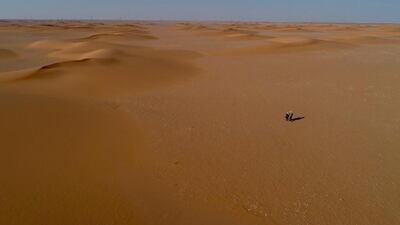
  • The vast deserts of Saudi Arabia captured by drone
    The vast deserts of Saudi Arabia captured by drone
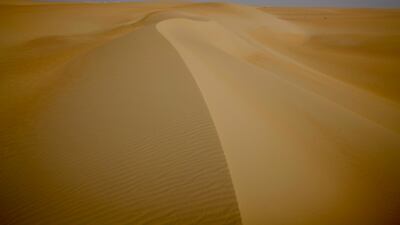
  • A sand dune in the Empty Quarter
    A sand dune in the Empty Quarter
  • A drone captures the team travelling in the Empty Quarter desert
    A drone captures the team travelling in the Empty Quarter desert
  • The Saudi desert in Hawaya, in a photo taken by Philby from his 1932 expedition. Getty
    The Saudi desert in Hawaya, in a photo taken by Philby from his 1932 expedition. Getty
  • The Heart of Arabia team from above in the deserts of Saudi Arabia
    The Heart of Arabia team from above in the deserts of Saudi Arabia
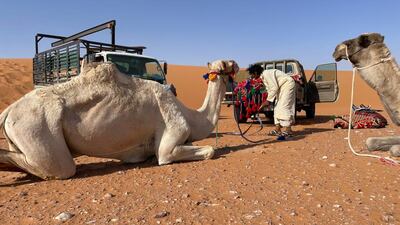
  • Camels ready for the final journey towards Riyadh
    Camels ready for the final journey towards Riyadh
  • Outward Bound Oman founder and expedition leader Mark Evans with a camel in the Saudi desert
    Outward Bound Oman founder and expedition leader Mark Evans with a camel in the Saudi desert
  • A comparison of Harry St John Philby's photo of "The ravine and wells of Abu Jifan", included in his book the Heart of Arabia, with the site today as seen by the expedition of the same name
    A comparison of Harry St John Philby's photo of "The ravine and wells of Abu Jifan", included in his book the Heart of Arabia, with the site today as seen by the expedition of the same name
  • Harry St John Philby and his companions at Wadi Al Shajara, where they stopped for a prayer on his 1917 trip to Riyadh. He included the photo in his 1922 book, The Heart of Arabia
    Harry St John Philby and his companions at Wadi Al Shajara, where they stopped for a prayer on his 1917 trip to Riyadh. He included the photo in his 1922 book, The Heart of Arabia
  • The Heart of Arabia team at the spot under a tree in Wadi Al Shajara, where Philby stopped for a prayer in 1917
    The Heart of Arabia team at the spot under a tree in Wadi Al Shajara, where Philby stopped for a prayer in 1917
  • The expedition team with locals in the Saudi desert on their trip
    The expedition team with locals in the Saudi desert on their trip
  • The Heart of Arabia expedition team in front of the Maskmak Fort Museum in Riyadh, the destination of the first leg of their trip
    The Heart of Arabia expedition team in front of the Maskmak Fort Museum in Riyadh, the destination of the first leg of their trip
Key facilities
  • Olympic-size swimming pool with a split bulkhead for multi-use configurations, including water polo and 50m/25m training lanes
  • Premier League-standard football pitch
  • 400m Olympic running track
  • NBA-spec basketball court with auditorium
  • 600-seat auditorium
  • Spaces for historical and cultural exploration
  • An elevated football field that doubles as a helipad
  • Specialist robotics and science laboratories
  • AR and VR-enabled learning centres
  • Disruption Lab and Research Centre for developing entrepreneurial skills
What is the definition of an SME?

SMEs in the UAE are defined by the number of employees, annual turnover and sector. For example, a “small company” in the services industry has six to 50 employees with a turnover of more than Dh2 million up to Dh20m, while in the manufacturing industry the requirements are 10 to 100 employees with a turnover of more than Dh3m up to Dh50m, according to Dubai SME, an agency of the Department of Economic Development.

A “medium-sized company” can either have staff of 51 to 200 employees or 101 to 250 employees, and a turnover less than or equal to Dh200m or Dh250m, again depending on whether the business is in the trading, manufacturing or services sectors. 

Venom

Director: Ruben Fleischer

Cast: Tom Hardy, Michelle Williams, Riz Ahmed

Rating: 1.5/5

Evacuations to France hit by controversy
  • Over 500 Gazans have been evacuated to France since November 2023
  • Evacuations were paused after a student already in France posted anti-Semitic content and was subsequently expelled to Qatar
  • The Foreign Ministry launched a review to determine how authorities failed to detect the posts before her entry
  • Artists and researchers fall under a programme called Pause that began in 2017
  • It has benefited more than 700 people from 44 countries, including Syria, Turkey, Iran, and Sudan
  • Since the start of the Gaza war, it has also included 45 Gazan beneficiaries
  • Unlike students, they are allowed to bring their families to France
ALRAWABI%20SCHOOL%20FOR%20GIRLS
%3Cp%3ECreator%3A%20Tima%20Shomali%3C%2Fp%3E%0A%3Cp%3EStarring%3A%C2%A0Tara%20Abboud%2C%C2%A0Kira%20Yaghnam%2C%20Tara%20Atalla%3C%2Fp%3E%0A%3Cp%3ERating%3A%204%2F5%3C%2Fp%3E%0A
Ten tax points to be aware of in 2026

1. Domestic VAT refund amendments: request your refund within five years

If a business does not apply for the refund on time, they lose their credit.

2. E-invoicing in the UAE

Businesses should continue preparing for the implementation of e-invoicing in the UAE, with 2026 a preparation and transition period ahead of phased mandatory adoption. 

3. More tax audits

Tax authorities are increasingly using data already available across multiple filings to identify audit risks. 

4. More beneficial VAT and excise tax penalty regime

Tax disputes are expected to become more frequent and more structured, with clearer administrative objection and appeal processes. The UAE has adopted a new penalty regime for VAT and excise disputes, which now mirrors the penalty regime for corporate tax.

5. Greater emphasis on statutory audit

There is a greater need for the accuracy of financial statements. The International Financial Reporting Standards standards need to be strictly adhered to and, as a result, the quality of the audits will need to increase.

6. Further transfer pricing enforcement

Transfer pricing enforcement, which refers to the practice of establishing prices for internal transactions between related entities, is expected to broaden in scope. The UAE will shortly open the possibility to negotiate advance pricing agreements, or essentially rulings for transfer pricing purposes. 

7. Limited time periods for audits

Recent amendments also introduce a default five-year limitation period for tax audits and assessments, subject to specific statutory exceptions. While the standard audit and assessment period is five years, this may be extended to up to 15 years in cases involving fraud or tax evasion. 

8. Pillar 2 implementation 

Many multinational groups will begin to feel the practical effect of the Domestic Minimum Top-Up Tax (DMTT), the UAE's implementation of the OECD’s global minimum tax under Pillar 2. While the rules apply for financial years starting on or after January 1, 2025, it is 2026 that marks the transition to an operational phase.

9. Reduced compliance obligations for imported goods and services

Businesses that apply the reverse-charge mechanism for VAT purposes in the UAE may benefit from reduced compliance obligations. 

10. Substance and CbC reporting focus

Tax authorities are expected to continue strengthening the enforcement of economic substance and Country-by-Country (CbC) reporting frameworks. In the UAE, these regimes are increasingly being used as risk-assessment tools, providing tax authorities with a comprehensive view of multinational groups’ global footprints and enabling them to assess whether profits are aligned with real economic activity. 

Contributed by Thomas Vanhee and Hend Rashwan, Aurifer

Dr Afridi's warning signs of digital addiction

Spending an excessive amount of time on the phone.

Neglecting personal, social, or academic responsibilities.

Losing interest in other activities or hobbies that were once enjoyed.

Having withdrawal symptoms like feeling anxious, restless, or upset when the technology is not available.

Experiencing sleep disturbances or changes in sleep patterns.

What are the guidelines?

Under 18 months: Avoid screen time altogether, except for video chatting with family.

Aged 18-24 months: If screens are introduced, it should be high-quality content watched with a caregiver to help the child understand what they are seeing.

Aged 2-5 years: Limit to one-hour per day of high-quality programming, with co-viewing whenever possible.

Aged 6-12 years: Set consistent limits on screen time to ensure it does not interfere with sleep, physical activity, or social interactions.

Teenagers: Encourage a balanced approach – screens should not replace sleep, exercise, or face-to-face socialisation.

Source: American Paediatric Association

((Disclaimer))

The Liechtensteinische Landesbank AG (“Bank”) assumes no liability or guarantee for the accuracy, balance, or completeness of the information in this publication. The content may change at any time due to given circumstances, and the Liechtensteinische Landesbank AG is under no obligation to update information once it has been published. This publication is intended for information purposes only and does not constitute an offer, a recommendation or an invitation by, or on behalf of, Liechtensteinische Landesbank (DIFC Branch), Liechtensteinische Landesbank AG, or any of its group affiliates to make any investments or obtain services. This publication has not been reviewed, disapproved or approved by the United Arab Emirates (“UAE”) Central Bank, Dubai Financial Services Authority (“DFSA”) or any other relevant licensing authorities in the UAE. It may not be relied upon by or distributed to retail clients. Liechtensteinische Landesbank (DIFC Branch) is regulated by the DFSA and this advertorial is intended for Professional Clients (as defined by the DFSA) who have sufficient financial experience and understanding of financial markets, products or transactions and any associated risks.

Details

Through Her Lens: The stories behind the photography of Eva Sereny

Forewords by Jacqueline Bisset and Charlotte Rampling, ACC Art Books

UAE currency: the story behind the money in your pockets
FIGHT%20CARD
%3Cp%3E%3Cstrong%3EFeatherweight%204%20rounds%3A%3C%2Fstrong%3E%3Cbr%3EYousuf%20Ali%20(2-0-0)%20(win-loss-draw)%20v%20Alex%20Semugenyi%20(0-1-0)%3Cbr%3E%3Cstrong%3EWelterweight%206%20rounds%3A%3C%2Fstrong%3E%3Cbr%3EBenyamin%20Moradzadeh%20(0-0-0)%20v%20Rohit%20Chaudhary%20(4-0-2)%3Cbr%3E%3Cstrong%3EHeavyweight%204%20rounds%3A%3C%2Fstrong%3E%3Cbr%3EYoussef%20Karrar%20(1-0-0)%20v%20Muhammad%20Muzeei%20(0-0-0)%3Cbr%3E%3Cstrong%3EWelterweight%206%20rounds%3A%3C%2Fstrong%3E%3Cbr%3EMarwan%20Mohamad%20Madboly%20(2-0-0)%20v%20Sheldon%20Schultz%20(4-4-0)%3Cbr%3E%3Cstrong%3ESuper%20featherweight%208%20rounds%3A%3C%2Fstrong%3E%3Cbr%3EBishara%20Sabbar%20(6-0-0)%20v%20Mohammed%20Azahar%20(8-5-1)%3Cbr%3E%3Cstrong%3ECruiseweight%208%20rounds%3A%3C%2Fstrong%3E%3Cbr%3EMohammed%20Bekdash%20(25-0-0)%20v%20Musa%20N%E2%80%99tege%20(8-4-0)%3Cbr%3E%3Cstrong%3ESuper%20flyweight%2010%20rounds%3A%3C%2Fstrong%3E%3Cbr%3ESultan%20Al%20Nuaimi%20(9-0-0)%20v%20Jemsi%20Kibazange%20(18-6-2)%3Cbr%3E%3Cstrong%3ELightweight%2010%20rounds%3A%3C%2Fstrong%3E%3Cbr%3EBader%20Samreen%20(8-0-0)%20v%20Jose%20Paez%20Gonzales%20(16-2-2-)%3C%2Fp%3E%0A
Timeline

2012-2015

The company offers payments/bribes to win key contracts in the Middle East

May 2017

The UK SFO officially opens investigation into Petrofac’s use of agents, corruption, and potential bribery to secure contracts

September 2021

Petrofac pleads guilty to seven counts of failing to prevent bribery under the UK Bribery Act

October 2021

Court fines Petrofac £77 million for bribery. Former executive receives a two-year suspended sentence 

December 2024

Petrofac enters into comprehensive restructuring to strengthen the financial position of the group

May 2025

The High Court of England and Wales approves the company’s restructuring plan

July 2025

The Court of Appeal issues a judgment challenging parts of the restructuring plan

August 2025

Petrofac issues a business update to execute the restructuring and confirms it will appeal the Court of Appeal decision

October 2025

Petrofac loses a major TenneT offshore wind contract worth €13 billion. Holding company files for administration in the UK. Petrofac delisted from the London Stock Exchange

November 2025

180 Petrofac employees laid off in the UAE

The years Ramadan fell in May

1987

1954

1921

1888

The National's picks

4.35pm: Tilal Al Khalediah
5.10pm: Continous
5.45pm: Raging Torrent
6.20pm: West Acre
7pm: Flood Zone
7.40pm: Straight No Chaser
8.15pm: Romantic Warrior
8.50pm: Calandogan
9.30pm: Forever Young

Name: Peter Dicce

Title: Assistant dean of students and director of athletics

Favourite sport: soccer

Favourite team: Bayern Munich

Favourite player: Franz Beckenbauer

Favourite activity in Abu Dhabi: scuba diving in the Northern Emirates 


The specs: 2018 Nissan 370Z Nismo

The specs: 2018 Nissan 370Z Nismo
Price, base / as tested: Dh182,178
Engine: 3.7-litre V6
Power: 350hp @ 7,400rpm
Torque: 374Nm @ 5,200rpm
Transmission: Seven-speed automatic
​​​​​​​Fuel consumption, combined: 10.5L / 100km

Europe’s rearming plan
  • Suspend strict budget rules to allow member countries to step up defence spending
  • Create new "instrument" providing €150 billion of loans to member countries for defence investment
  • Use the existing EU budget to direct more funds towards defence-related investment
  • Engage the bloc's European Investment Bank to drop limits on lending to defence firms
  • Create a savings and investments union to help companies access capital
Updated: January 18, 2023, 8:30 AM