This photo released by NourNews on Thursday shows the flooded engine room of the Iranian ship ‘MV Saviz’ after it was attacked in the Red Sea off Yemen. NourNews via AP

Limpet mines and mini subs: Iran's war of naval sabotage could spin out of control


Robert Tollast
  • English
  • Arabic

Last Tuesday, the Iranian ship MV Saviz was attacked in the Red Sea with what was later revealed to be limpet mines, causing the ship's engine rooms to flood.

Analysts, including those at the US Naval Institute, say the Saviz – contrary to Iranian claims – is used for gathering intelligence in Bab Al Mandeb.

The strait, which lies between the Arabian Peninsula and the Horn of Africa, is one of the world’s busiest shipping routes.

The attack on the Saviz is remarkably similar to other attacks on ships in the region, including one on the Israeli commercial vessel Helios Ray in February and limpet mine attacks on four commercial ships in the Gulf of Oman in May 2019.

Commandos from Iran’s Islamic Revolutionary Guard Corps have been accused of operations against oil cargoes at sea and anchored in port since the administration of former US president Donald Trump withdrew from the 2015 nuclear deal in 2018 and imposed tough sanctions on Tehran.

But as negotiations on a possible new nuclear deal move forward, another conflict has been under way, with Israel and Iran accusing each other of maritime sabotage attacks.

"Saviz is, foremost, a floating armoury ship where armed anti-piracy security guards – in the case of Iran, members of IRGC navy or national navy special forces – disembark from cargo ships and tankers heading for Suez Canal," said Farzin Nadimi, an analyst at the Washington Institute for Near East Policy who specialises in Iran's naval strategy.

“They hand over their weapons, because Suez Canal regulations preclude arms or armed guards aboard civilian vessels using the canal,” he said.

“But its role doesn’t end there and beyond this legitimate role it also collects intel on passing ships, especially naval vessels of hostile nations. It is believed to pass targeting information to Houthis,” Mr Nadimi said, referring to Iran-backed rebels in Yemen.

"They did it at least in 2018 when Houthis were much more active in the sea. It is also believed to have a key role in smuggling personnel into Houthi-controlled areas. Western, Saudi and Israeli intelligence have been monitoring Saviz closely with concern for the past few years."

Bab Al Mandeb chokepoint

The deployment of the Saviz at a maritime chokepoint could be seen as an additional pressure point for Iranian foreign policy, representing the ability to exert leverage on regional enemies.

This is in addition to the Strait of Hormuz, the narrow passage at the mouth of the Arabian Gulf through which ships carried 20 million barrels of oil per day prior to the pandemic.

“The Red Sea, which was secure, is no longer secure for the presence of Americans,” IRGC Quds Force commander Qassem Suleimani said in 2018.

“The Quds force and I are your match. We don’t go to sleep at night before thinking about you.”

  • Iranian missiles at an underground 'missile city' belonging to the Islamic Revolutionary Guard Corps. Reuters
    Iranian missiles at an underground 'missile city' belonging to the Islamic Revolutionary Guard Corps. Reuters
  • Members of Iran's Islamic Revolutionary Guard Corps marching during the annual Sacred Defence Week military parade. AFP
    Members of Iran's Islamic Revolutionary Guard Corps marching during the annual Sacred Defence Week military parade. AFP
  • Members of Iran's Islamic Revolutionary Guard Corps (IRGC) during the annual military parade marking the anniversary of the outbreak of the devastating 1980-1988 war with Saddam Hussein's Iraq. AFP PHOTO / HO / IRANIAN PRESIDENCY
    Members of Iran's Islamic Revolutionary Guard Corps (IRGC) during the annual military parade marking the anniversary of the outbreak of the devastating 1980-1988 war with Saddam Hussein's Iraq. AFP PHOTO / HO / IRANIAN PRESIDENCY
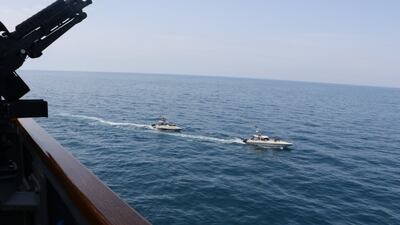
  • A US Navy file photo shows Iranian Islamic Revolutionary Guard Corps Navy vessels conducting unsafe and unprofessional actions against the guided-missile destroyer USS Paul Hamilton (DDG 60) and other US military ships. AFP
    A US Navy file photo shows Iranian Islamic Revolutionary Guard Corps Navy vessels conducting unsafe and unprofessional actions against the guided-missile destroyer USS Paul Hamilton (DDG 60) and other US military ships. AFP
  • Iran's Islamic Revolutionary Guard Corps (pictured at a military parade) are controlling a network of militia. AFP
    Iran's Islamic Revolutionary Guard Corps (pictured at a military parade) are controlling a network of militia. AFP
  • An Iranian navy vessel closing in on the 'USS Paul Hamilton'. AFP
    An Iranian navy vessel closing in on the 'USS Paul Hamilton'. AFP
  • epa08366165 A handout photo made available by the US Naval Forces Central Command / US 5th Fleet via the Defense Visual Information Distribution Service (DVIDS) shows Iranian Islamic Revolutionary Guard Corps Navy (IRGCN) vessels near US Military ships at close range while operating in international waters of the North Arabian Gulf, 15 April 2020 (issued 16 April 2020). The US Navy accuses Iran of conducting 'unsafe' actions close to US warships. EPA/US NAVY HANDOUT HANDOUT EDITORIAL USE ONLY/NO SALES
    epa08366165 A handout photo made available by the US Naval Forces Central Command / US 5th Fleet via the Defense Visual Information Distribution Service (DVIDS) shows Iranian Islamic Revolutionary Guard Corps Navy (IRGCN) vessels near US Military ships at close range while operating in international waters of the North Arabian Gulf, 15 April 2020 (issued 16 April 2020). The US Navy accuses Iran of conducting 'unsafe' actions close to US warships. EPA/US NAVY HANDOUT HANDOUT EDITORIAL USE ONLY/NO SALES

Suleimani was assassinated in a US air strike near Baghdad airport in January 2020, after hostility between US forces in Iraq and Iran’s allied militias escalated.

Bab Al Mandeb could be even more important for Iran now, not least because cutting off the Strait of Hormuz has been seen as a last resort for Tehran – perhaps in the event of total war, and even then an economically self-defeating move.

Swarming tactics

The Iranians have long developed a naval strategy focused on “swarms” of lightly armed fast boats, an approach devised to overwhelm the US Navy around the confines of the Strait of Hormuz.

Countering this swarming strategy has been central to the US approach in the narrow waterway ever since a US war-game, Millennium Challenge, in 2002, when a simulated Iranian fleet “defeated” the US Navy, in part by using suicidal small-boat swarms.

Over the years, the US Navy has developed countermeasures to combat the threat, including the Block 1B variant of the Phalanx Close-in Weapons System. The anti-missile system was adapted to be able to pepper small boats with 4,500 rounds of ammunition per minute.

Other weapons systems, from cluster bombs to anti-tank missiles such as the Hellfire, were adapted to be used against small boats.

But the IRGC Navy has also evolved.

“New US approaches have given IRGCN commanders some sleepless nights, but they also have developed their hardware and tactics as well: longer range and more accurate anti-ship missiles – both ballistic and cruise missiles, faster and better armed boats now also armed with missiles with ranges approaching 300km. So no need to swarm,” Mr Nadimi said.

“They’re also developing small submarines, armed drones, both aerial and subsurface drones, complete with thousands – not an exaggeration – of unmanned explosive drone boats, to name a few.”

The damage to the Saviz – whether conducted by Israel, as the Iranians allege, or another regional power, will no doubt have come as a shock to Tehran.

But if recent history is any guide, the IRGC will find other approaches to disrupt global trade for its own political ends.

COMPANY%20PROFILE
%3Cp%3E%3Cstrong%3EName%3A%20%3C%2Fstrong%3EQureos%0D%3Cbr%3E%3Cstrong%3EBased%3A%20%3C%2Fstrong%3EUAE%0D%3Cbr%3E%3Cstrong%3ELaunch%20year%3A%20%3C%2Fstrong%3E2021%0D%3Cbr%3E%3Cstrong%3ENumber%20of%20employees%3A%20%3C%2Fstrong%3E33%0D%3Cbr%3E%3Cstrong%3ESector%3A%20%3C%2Fstrong%3ESoftware%20and%20technology%0D%3Cbr%3E%3Cstrong%3EFunding%3A%20%3C%2Fstrong%3E%243%20million%0D%3Cbr%3E%3C%2Fp%3E%0A
Red flags
  • Promises of high, fixed or 'guaranteed' returns.
  • Unregulated structured products or complex investments often used to bypass traditional safeguards.
  • Lack of clear information, vague language, no access to audited financials.
  • Overseas companies targeting investors in other jurisdictions - this can make legal recovery difficult.
  • Hard-selling tactics - creating urgency, offering 'exclusive' deals.

Courtesy: Carol Glynn, founder of Conscious Finance Coaching

GAC GS8 Specs

Engine: 2.0-litre 4cyl turbo

Power: 248hp at 5,200rpm

Torque: 400Nm at 1,750-4,000rpm

Transmission: 8-speed auto

Fuel consumption: 9.1L/100km

On sale: Now

Price: From Dh149,900

COMPANY%20PROFILE%20
%3Cp%3EName%3A%20DarDoc%3Cbr%3EBased%3A%20Abu%20Dhabi%3Cbr%3EFounders%3A%20Samer%20Masri%2C%20Keswin%20Suresh%3Cbr%3ESector%3A%20HealthTech%3Cbr%3ETotal%20funding%3A%20%24800%2C000%3Cbr%3EInvestors%3A%20Flat6Labs%2C%20angel%20investors%20%2B%20Incubated%20by%20Hub71%2C%20Abu%20Dhabi's%20Department%20of%20Health%3Cbr%3ENumber%20of%20employees%3A%2010%3C%2Fp%3E%0A
COMPANY PROFILE

Name: Lamsa

Founder: Badr Ward

Launched: 2014

Employees: 60

Based: Abu Dhabi

Sector: EdTech

Funding to date: $15 million

How to help

Send “thenational” to the following numbers or call the hotline on: 0502955999
2289 – Dh10
2252 – Dh 50
6025 – Dh20
6027 – Dh 100
6026 – Dh 200

What is the FNC?

The Federal National Council is one of five federal authorities established by the UAE constitution. It held its first session on December 2, 1972, a year to the day after Federation.
It has 40 members, eight of whom are women. The members represent the UAE population through each of the emirates. Abu Dhabi and Dubai have eight members each, Sharjah and Ras al Khaimah six, and Ajman, Fujairah and Umm Al Quwain have four.
They bring Emirati issues to the council for debate and put those concerns to ministers summoned for questioning. 
The FNC’s main functions include passing, amending or rejecting federal draft laws, discussing international treaties and agreements, and offering recommendations on general subjects raised during sessions.
Federal draft laws must first pass through the FNC for recommendations when members can amend the laws to suit the needs of citizens. The draft laws are then forwarded to the Cabinet for consideration and approval. 
Since 2006, half of the members have been elected by UAE citizens to serve four-year terms and the other half are appointed by the Ruler’s Courts of the seven emirates.
In the 2015 elections, 78 of the 252 candidates were women. Women also represented 48 per cent of all voters and 67 per cent of the voters were under the age of 40.
 

It Was Just an Accident

Director: Jafar Panahi

Stars: Vahid Mobasseri, Mariam Afshari, Ebrahim Azizi, Hadis Pakbaten, Majid Panahi, Mohamad Ali Elyasmehr

Rating: 4/5

Manikarnika: The Queen of Jhansi

Director: Kangana Ranaut, Krish Jagarlamudi

Producer: Zee Studios, Kamal Jain

Cast: Kangana Ranaut, Ankita Lokhande, Danny Denzongpa, Atul Kulkarni

Rating: 2.5/5

Other acts on the Jazz Garden bill

Sharrie Williams
The American singer is hugely respected in blues circles due to her passionate vocals and songwriting. Born and raised in Michigan, Williams began recording and touring as a teenage gospel singer. Her career took off with the blues band The Wiseguys. Such was the acclaim of their live shows that they toured throughout Europe and in Africa. As a solo artist, Williams has also collaborated with the likes of the late Dizzy Gillespie, Van Morrison and Mavis Staples.
Lin Rountree
An accomplished smooth jazz artist who blends his chilled approach with R‘n’B. Trained at the Duke Ellington School of the Arts in Washington, DC, Rountree formed his own band in 2004. He has also recorded with the likes of Kem, Dwele and Conya Doss. He comes to Dubai on the back of his new single Pass The Groove, from his forthcoming 2018 album Stronger Still, which may follow his five previous solo albums in cracking the top 10 of the US jazz charts.
Anita Williams
Dubai-based singer Anita Williams will open the night with a set of covers and swing, jazz and blues standards that made her an in-demand singer across the emirate. The Irish singer has been performing in Dubai since 2008 at venues such as MusicHall and Voda Bar. Her Jazz Garden appearance is career highlight as she will use the event to perform the original song Big Blue Eyes, the single from her debut solo album, due for release soon.

if you go

The flights
Flydubai offers three daily direct flights to Sarajevo and, from June, a daily flight from Thessaloniki from Dubai. A return flight costs from Dhs1,905 including taxes.
The trip 
The Travel Scientists are the organisers of the Balkan Ride and several other rallies around the world. The 2018 running of this particular adventure will take place from August 3-11, once again starting in Sarajevo and ending a week later in Thessaloniki. If you’re driving your own vehicle, then entry start from €880 (Dhs 3,900) per person including all accommodation along the route. Contact the Travel Scientists if you wish to hire one of their vehicles. 

FROM%20THE%20ASHES
%3Cp%3EDirector%3A%20Khalid%20Fahad%3C%2Fp%3E%0A%3Cp%3EStarring%3A%20Shaima%20Al%20Tayeb%2C%20Wafa%20Muhamad%2C%20Hamss%20Bandar%3C%2Fp%3E%0A%3Cp%3ERating%3A%203%2F5%3C%2Fp%3E%0A
Ten tax points to be aware of in 2026

1. Domestic VAT refund amendments: request your refund within five years

If a business does not apply for the refund on time, they lose their credit.

2. E-invoicing in the UAE

Businesses should continue preparing for the implementation of e-invoicing in the UAE, with 2026 a preparation and transition period ahead of phased mandatory adoption. 

3. More tax audits

Tax authorities are increasingly using data already available across multiple filings to identify audit risks. 

4. More beneficial VAT and excise tax penalty regime

Tax disputes are expected to become more frequent and more structured, with clearer administrative objection and appeal processes. The UAE has adopted a new penalty regime for VAT and excise disputes, which now mirrors the penalty regime for corporate tax.

5. Greater emphasis on statutory audit

There is a greater need for the accuracy of financial statements. The International Financial Reporting Standards standards need to be strictly adhered to and, as a result, the quality of the audits will need to increase.

6. Further transfer pricing enforcement

Transfer pricing enforcement, which refers to the practice of establishing prices for internal transactions between related entities, is expected to broaden in scope. The UAE will shortly open the possibility to negotiate advance pricing agreements, or essentially rulings for transfer pricing purposes. 

7. Limited time periods for audits

Recent amendments also introduce a default five-year limitation period for tax audits and assessments, subject to specific statutory exceptions. While the standard audit and assessment period is five years, this may be extended to up to 15 years in cases involving fraud or tax evasion. 

8. Pillar 2 implementation 

Many multinational groups will begin to feel the practical effect of the Domestic Minimum Top-Up Tax (DMTT), the UAE's implementation of the OECD’s global minimum tax under Pillar 2. While the rules apply for financial years starting on or after January 1, 2025, it is 2026 that marks the transition to an operational phase.

9. Reduced compliance obligations for imported goods and services

Businesses that apply the reverse-charge mechanism for VAT purposes in the UAE may benefit from reduced compliance obligations. 

10. Substance and CbC reporting focus

Tax authorities are expected to continue strengthening the enforcement of economic substance and Country-by-Country (CbC) reporting frameworks. In the UAE, these regimes are increasingly being used as risk-assessment tools, providing tax authorities with a comprehensive view of multinational groups’ global footprints and enabling them to assess whether profits are aligned with real economic activity. 

Contributed by Thomas Vanhee and Hend Rashwan, Aurifer

World Cricket League Division 2

In Windhoek, Namibia - Top two teams qualify for the World Cup Qualifier in Zimbabwe, which starts on March 4.

UAE fixtures

Thursday, February 8 v Kenya; Friday, February v Canada; Sunday, February 11 v Nepal; Monday, February 12 v Oman; Wednesday, February 14 v Namibia; Thursday, February 15 final