

India has made great strides in increasing its use of green energy but the country is falling short of its targets.
To help meet its renewable energy goals, New Delhi is pushing for greater financial support from wealthier nations at the Cop27 climate summit, which began on Sunday in Sharm El Sheikh, Egypt.
“India would need committed help to meet its targets,” says Shailendra Singh Rao, founder and managing director of Creduce, a climate change and carbon asset management services company in Ahmedabad in the western Indian state of Gujarat.
“Climate finance is to be paid by developed countries — a sum of $100 billion per year — to developing countries. This was committed way back in Cop15. Not a single year [has] the target has been matched.”
India will require $223bn of investment to meet its solar and wind installations by 2030, according to a report by BloombergNEF.
The South Asian country has set a target of 175 gigawatts of renewable energy capacity by the end of this year, with most of it coming from solar.
It is expected to achieve between 70 per cent and 75 per cent of the target, global analytics company Crisil said. India aims to achieve 500 gigawatts of renewable capacity by 2030.
Pranav Master, director of Crisil Market Intelligence and Analytics, put the gap down to lower rooftop solar capacity due to implementation challenges.
“Nevertheless, this achievement is noteworthy, given that India's renewable energy capacity rose about 3.5 times from 2014 to 2022,” he said.
There has been mounting pressure on India — which is home to some of the world’s most polluted cities — from developed countries to phase out the use of coal and reduce its carbon footprint. Asia’s third-largest economy is set to become the most populous country next year.
-

British Prime Minister Rishi Sunak arriving in Sharm El Sheikh, Egypt, to attend the Cop27 summit. Getty Images -

A dancer performs the 'Tanoura' during a street performance in Sharm El Sheikh. EPA -
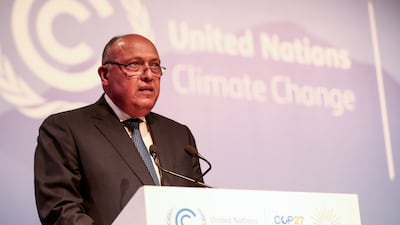
Cop27 President Sameh Shoukry speaks at the climate change conference in Sharm El Sheikh on Sunday. EPA -

Participants and delegates meet in the Pacific Island pavilion at the Sharm El Sheikh International Convention Centre, on the first day of Cop27. AFP -

Participants meet at the Sharm El Sheikh International Convention Centre on the first day of Cop27. AFP -
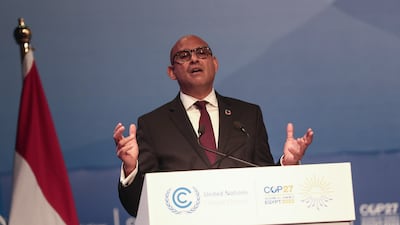
Simon Stiell, the executive secretary of the UN's Framework Convention on Climate Change speaks at the climate summit in Sharm El Sheikh. EPA -

Chairman of the Intergovernmental Panel on Climate Change Hoesung Lee attends the Cop27 opening ceremony. AFP -

From left to right, the UN's climate change communications officer, Alexander Saier; Simon Stiell, the executive secretary of the UN's Framework Convention on Climate Change; and Cop27 President Sameh Shoukry listen to questions following the opening ceremony. AFP -

Alok Sharma, president of the Cop26 climate summit, speaks at Cop27 in Sharm El Sheikh, Egypt. AP -

Delegates arrive at Cop27 in Sharm El Sheikh, Egypt. Mahmoud Nasr / The National -

Delegates arrive at Cop27 in Sharm El Sheikh, Egypt. Mahmoud Nasr / The National -

Delegates arrive at Cop27 in Sharm El Sheikh, Egypt. Mahmoud Nasr / The National -

Activists demonstrate at the entrance of the Sharm El Sheikh International Convention Centre. Reuters -

Delegates arrive at the Sharm El Sheikh International Convention Centre for Cop27. AFP -

More than 120 world leaders plan to attend the crucial event in Sharm El Sheikh. Reuters -

The summit comes at a critical moment with the world regularly experiencing extreme weather events that many – including the UN – have linked to climate change. Reuters -

Two key areas on the agenda are trying to keep the Paris goal of 1.5ºC warming on pre-industrial levels alive and the issue of finance. AP -

The summit begins in earnest on Monday when world leaders arrive at the summit for two days of intense talks. They will also deliver addresses to the event. Reuters -

A delegate from the Cook Islands. AP -

The main entrance of the Sharm El Sheikh International Convention Centre in Egypt where the Cop27 climate summit is opening today. Reuters -

Participants visit the Sharm El Sheikh International Convention Centre. AFP -

Participants at the Sharm El Sheikh International Convention Centre. Reuters -

The climate summit will run from Sunday to Friday, November 18 at the Red Sea resort of Sharm El Sheikh. AFP -

Participants at the Sharm El Sheikh International Convention Centre before Cop27 opens. AFP -

Finance and compensation are expected to dominate two weeks of tough talks in Sharm El Sheikh. Reuters -

It is also expected Cop27 will hear calls for the historically controversial issue of 'loss and damage' funds to be placed on the agenda for the first time. AFP -

Pledges on forests and methane made at last year’s Cop26 that are signed by more countries would be welcome. Reuters -

An illumination of Khafre Pyramid, one of the three ancient pyramids of Giza. AFP


In August, India updated its “nationally determined contributions” that details targets and plans for reducing emissions, which is required under treaties signed by countries that are part of the Cop27 conference.
India has promised to cut the intensity of emissions from its economic output by 45 per cent by 2030, compared with its levels in 2005. It has also pledged to raise its share of installed renewable energy capacity to 50 per cent by 2030, from 40 per cent currently, including large hydroelectric projects.
This will be no easy task, given that India is still heavily dependent on coal, which accounts for about 70 per cent of the country’s electricity generation.
On Friday, the Indian government said it would focus on climate finance at Cop27 as the collective annual funds that had been promised had not been delivered.
“India looks forward to substantial progress on the discussions related to climate finance and clarity on its definition,” the country’s Ministry of Environment, Forest and Climate Change said at the time.
“There is a need now to substantially enhance the ambition to ensure adequate resource flow.
“More clarity is needed on the definition of climate finance for the developing countries to be able to accurately assess the extent of finance flows for climate action,” the ministry said.

India also needs to generate its own funding for the renewables sector.
“Due to increasing energy demand in India, led by strong economic growth, capacity additions in the renewable energy space need to accelerate at a faster pace,” says Vineet Sukumar, founder and managing director of Vivriti Asset Management.
To do this, India needs to significantly scale up investment in green energy, he says.
“Such a barrier to clean energy financing can only be solved via alternative sources of financing like Alternative Investment Funds, which can pool together commercial and impact capital, and especially lock in large international pools of capital,” Mr Sukumar says.
India is making significant progress when it comes to renewables, despite the challenges. But it needs to do much more to achieve its targets, industry sources say.
“As per plan, we are [falling] far behind what was predicted,” says Gautam Das, founder and chief executive of Oorjan Cleantech, a Mumbai-based solar energy company.
“Adoption is not as fast as what was predicted, so we are lagging behind.”
Another major factor holding back the growth of green energy in India is consumer awareness and a lack of cheap finance to enable more rooftop solar capacity can be installed, Mr Das says.
The government should offer “some incentive to the consumer directly or some incentive to the bankers to deploy money in renewable energy”, says Mr Das. India will accelerate its efforts soon, he says.
“The pace is slow, we understand, but it will catch up,” he says. “The outlook is very positive.”
While India is transitioning to renewable power, the government and industry experts recognise that fossil fuels will continue to be a significant source of energy for many years to come, as the country's economy expands and electricity demand surges.
“India’s in a tough position because we are still a middle-income country,” says Nitin Gupta, co-founder and chief executive of Attero, an electronic waste recycling company in India.
“Our GDP [gross domestic product] per capita is very low compared to some of the other developed countries out there. So to make sure that we continue to grow, we can't just say that we are shutting non-fossil fuel, we are completely switching to renewables as a country.
“Along with growth, we need to be mindful of a carbon footprint that is coming along with the growth or what is the cost of environment of the growth.”
Vineet Mittal, chairman of Avaada Group, which develops and operates and solar and wind projects in India, believes that India can realise its green ambitions.
“Despite Covid-related and supply chain-related challenges in the last 12 months, we have added more than 2 gigawatts [worth of] projects,” he says.
However, one of the major hurdles is land acquisition.
“Land is always an emotional and sensitive issue for India,” Mr Mittal says.
“And even though most of the solar projects are coming on wasteland, still, the challenge is significant, to get clearances to secure the land needed for wind and solar projects.”
Working in India's favour are the global partnerships it is forming to grow its renewable energy sector.
The UAE is working closely with India to boost climate action. The countries have agreed to fast-track various initiatives, including public-private partnerships across renewable power, green hydrogen, sustainable finance and carbon market development.
There is no doubt that India will scale up its green energy sector substantially in the coming years, Mr Master of Crisil says.
But areas that would need to be watched closely to achieve its goals are “long-term policy consistency, low-cost availability of finance and land availability in resource rich areas close to transmission stations”, says Mr Master.
Ultimately, India has promised that it will be net-zero by 2070.
Cop27 will be a critical opportunity for the country to seek assistance and clarity on finance, as well as support on technology transfer and capacity building to help to achieve its goals, Mr Master says.
However, the future looks bright.
“Long-term trends, including a shift to electric vehicles as well as green hydrogen, would further boost renewable energy demand in India,” Mr Master says.
“The renewable energy sector is expected to record healthy growth over the long-term given the strong government thrust on clean energy.”
-
-
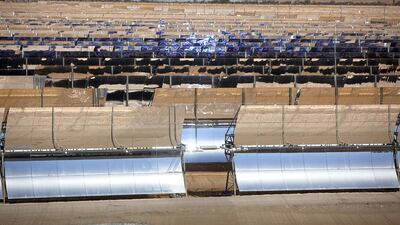
The 100MW Shams 1, Middle East’s largest renewable energy project, covers 2.5 square kilometres and comprises more than 258,000 mirrors mounted on 768 tracking parabolic trough collectors. Silvia Razgova / The National -
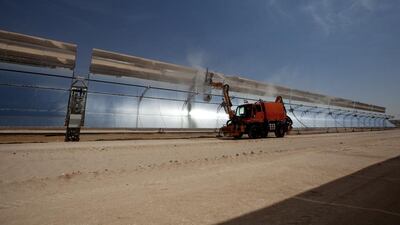
The Shams 1 solar project generates enough electricity to power 20,000 homes in the UAE. Christopher Pike / The National -
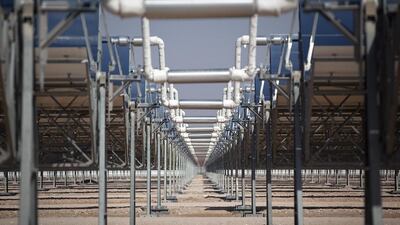
The Shams 1 solar project, inaugurated in March last year, is Masdar’s second solar plant. Silvia Razgova / The National -

The solar power station of Ain Beni Mathar in Morocco. By 2020, Morocco hopes to source 42 per cent of its total power supply from renewable energy. Abdelhak Senna / AFP -
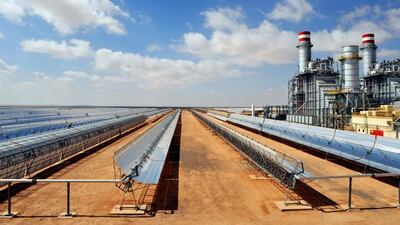
The solar power station of Ain Beni Mathar in Morocco. By 2020, Morocco hopes to source 42 per cent of its total power supply from renewable energy. Abdelhak Senna / AFP -
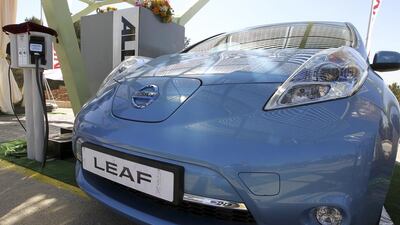
A Nissan Leaf is displayed during the opening of the first solar charging station for electric cars at El Hassan Science City in Amman, Jordan in 2011. Muhammad Hamed / Reuters -
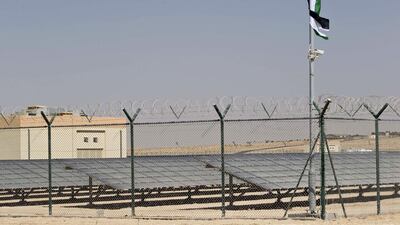
Dubai is building the Dh10bn Mohammed bin Rashid Solar Park, which is forecast to generate 1,000MW. Antonie Robertson / The National



