


Live updates: Follow the latest news on Cop28
More than 100 world leaders have vowed to put greener farming at the heart of their climate plans, in a much-anticipated pledge on the second day of Cop28 that recognises the link between global warming and food.
The Emirates Declaration – signed by 134 countries including the UAE, the US and China – says that “any path” to meeting the world’s key 1.5°C climate goal must involve food and agriculture.
They vowed to cut emissions from farming – about a third of the world’s greenhouse gas footprint – by shifting to “more sustainable production and consumption”, at a summit priding itself on “mainly plant-based” catering.
At the same time, they pledged to help protect farmers from the effects of climate change in the face of “mounting hunger, malnutrition, and economic stresses”.
Mariam Al Mheiri, Minister of Climate Change and Environment, declared it “a historic moment for food systems” as she revealed that the Bill and Melinda Gates Foundation will fund $200 million of research and innovation in agriculture.
Campaigners welcomed the language on greener farming being key to the 1.5°C goal, which is “what we’ve fought for in the last five years”, ProVeg International lobbyist Raphael Podselver told The National.
“It’s really clear there is no way to achieve the Paris Agreement if we don’t fundamentally transform food systems, even if we phase out fossil fuels tomorrow,” Mr Podselver said.
“People laughed at us [at Cop24] in Katowice five years ago for connecting food and climate change,” he said – but leaders in Dubai have now given “a very strong signal”.
The text unveiled on Friday, after the UAE presidency spent months encouraging countries to sign up, says:
· Agriculture and food systems “must urgently adapt and transform in order to respond to the imperatives of climate change"
· Countries will work together to conserve nature and ecosystems, improve soil health and biodiversity and shift from high-emission practices to more sustainable methods, including by reducing food waste
· They also plan to help farmers adapt to climate change with early warning systems for natural disasters, school meal programmes and better water management
· The countries commit to integrating food and environmental policy by 2025, which is when the next round of national climate plans is due
“We stress that any path to fully achieving the long-term goals of the Paris Agreement must include agriculture,” the declaration says, referring to the deal that set the 1.5°C global warming target.
The UAE minister said the countries involved, which include Brazil, the UK, France, Australia, Egypt and Morocco, represent three quarters of the world’s agricultural emissions.
“I did promise many of you over the last few years that we would bring agriculture and food systems to centre stage at Cop28, and here we are,” she told delegates to applause at the summit.
Hopes for AI

Bill Gates said crop failure in Africa because of rising temperatures, leading to malnutrition, underdevelopment and death, was what first made him aware of the effects of climate change.
“There is reason to believe that by using the latest techniques, of being able to sequence genes, using AI, using satellite data, that for all the crops – not just the main cereal crops – we can make them far more productive and far more climate resilient,” he said of his planned investment.
Further discussions on food are planned at Cop28, which is scheduled to run until December 12. An early negotiating text being discussed by all the nearly 200 countries at the summit leaves open what they will say on agriculture.
At Cop28’s food pavilion, Mr Podselver acknowledged that leaders were unlikely to go as far as suggesting plant-based diets – despite the range of salads and vegetarian sandwiches on offer in Dubai.
Cop28 at Expo City Dubai - in pictures
Activists for a vegan diet “have seen that acknowledged more in the catering” even if not in negotiating texts, said Lana Weidgenant, a fellow ProVeg campaigner who also welcomed the Emirates Declaration.
“We have seen these Cops before talk about food systems and agriculture but this is taking to another level in bringing it to a leaders’ declaration,” she said.
As with Cop28’s first-day breakthrough on climate-related loss and damage, campaigners said it was now up to leaders to turn their words in Dubai into action back home.
“This declaration will only be meaningful if we see follow-through on the ground,” said Jennifer Morris, chief executive of the Nature Conservancy, which is co-hosting the food pavilion in Dubai.
“The 134 countries who have committed to the declaration will need to work with every actor in the food system to deliver real lasting change."
-
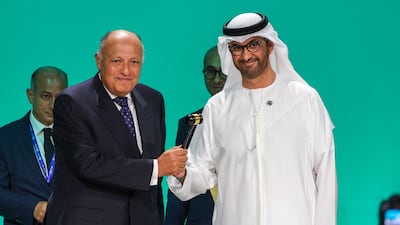
Cop27 President Sameh Shoukry, left, hands over the gavel to Cop28 President Dr Sultan Al Jaber at the UN climate conference's opening ceremony. AFP -
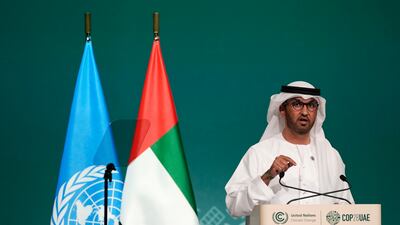
Dr Sultan Al Jaber speaks during the opening session at Expo City Dubai. AP -
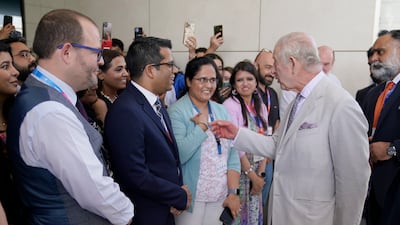
King Charles III visiting Heriot-Watt University Dubai Campus during the Cop28 summit. PA -

Sameh Shoukry, Cop27 President, centre, attends the opening session. AP -
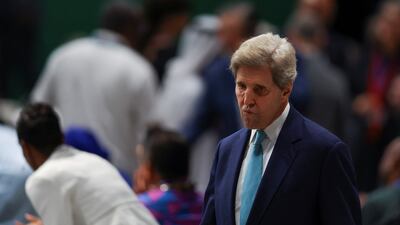
US Special Presidential Envoy for Climate John Kerry attends the Cop28 opening session. Reuters -

Raquel Sousa Chaves from Brazil at Cop28. Chris Whiteoak / The National -

Visitors on the first day of Cop28. Chris Whiteoak / The National -

Recyclable wind turbines on show on the first day of Cop28. Chris Whiteoak / The National -

A plant-based food cafe at Cop28. Chris Whiteoak / The National -

Vegan activists on the first day of Cop28. Chris Whiteoak / The National -

Pollution Pods, an installation by British artist Michael Pinsky, where Cop28 visitors can safely experience the air pollution in Beijing and other cities. Chris Whiteoak / The National -

Indigenous leaders and climate campaigners are among the attendees at Cop28. Chris Whiteoak / The National -

Fair-trade vegan chocolate being handed out at Cop28. Chris Whiteoak / The National -

Day one at Cop28, Dubai. Chris Whiteoak / The National -

Cop28, Dubai Expo City. Chris Whiteoak / The National -

The first day of Cop28. Chris Whiteoak / The National -

Cop28, Dubai. Chris Whiteoak / The National -

The first day of Cop 28 at Expo City, Dubai. Chris Whiteoak / The National -
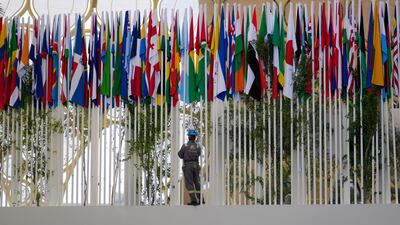
National flags on display at the UN climate summit. AP -
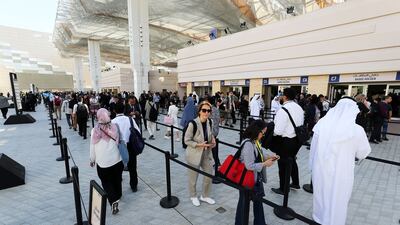
Delegates arriving for the opening of Cop28. Pawan Singh / The National -
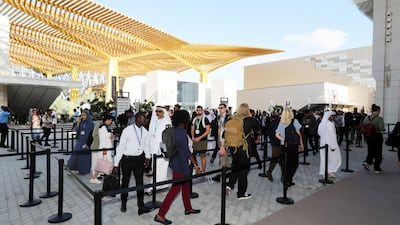
More than 70,000 delegates, including world leaders, climate scientists, business leaders and young people, are expected to attend. Pawan Singh / The National -
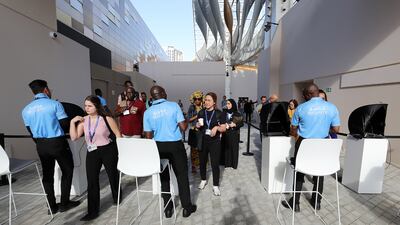
Delegates will engage in a stock take to see how pledges to limit global warming are being implemented. Pawan Singh / The National -
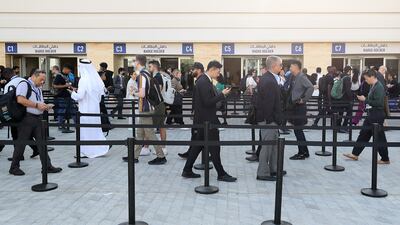
The summit aims to keep on track efforts to restrict global warming to less than 1.5C above pre-industrial levels. Pawan Singh / The National -

Hora – The Unity Dance artwork, by Marius Diaconu, on display at Cop28. Chris Whiteoak / The National -

Cop28 runs until December 12. Chris Whiteoak / The National



