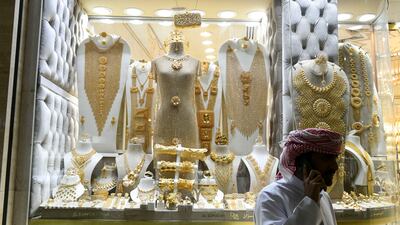
Global jewellery consumption is now back to pre-pandemic levels at 523 tonnes, a 10 per cent annual uptick, according to the World Gold Council. AFP

Global gold demand up 28% in Q3 on strong consumer and central bank buying


Deepthi Nair
  • English
  • Arabic

Global gold demand increased 28 per cent annually to 1,181 tonnes in the third quarter of 2022 as investors used the precious metal as a store of value amid rampant inflation and geopolitical uncertainty, the World Gold Council said.

Gold demand in the three months to the end of September was boosted by consumers and central banks, although there was a notable contraction in investment demand, the trade body said in its latest report.

Strong demand pushed gold's year-to-date total to pre-Covid levels and was up 18 per cent annually, the WGC said.

“Despite a shaky macroeconomic environment, demand this year has reflected gold’s status as a safe-haven asset, underscored by the fact that it has outperformed most asset classes in 2022,” Louise Street, senior markets analyst at World Gold Council, said.

“Looking ahead, we anticipate central bank buying and retail investment to remain strong and that could help offset potential declines in OTC [over-the-counter] and ETF [exchange-traded fund] investment that may prevail if the dollar strength persists.”

Geopolitical and economic uncertainty is mounting across the globe following Russia’s military offensive against Ukraine, with inflation also rising due to higher commodity prices and supply chain disruptions.

The International Monetary Fund cut its global growth forecast for 2023 and warned of a cost-of-living crisis as the world’s economy continues to be affected by the war in Ukraine, broadening inflation pressures and a slowdown in China.

The IMF maintained its global economic estimate for this year at 3.2 per cent but downgraded next year’s forecast to 2.7 per cent — 0.2 percentage points lower than the July forecast.

Gold investment was down 47 per cent year on year, as ETF investors responded to higher interest rates and a strong US dollar with outflows of 227 tonnes, the WGC said.

However, investors sought to hedge inflation with gold bar and coin investment, driving total retail demand up 36 per cent annually to 351 tonnes. This was supported by significant purchasing in Turkey and Germany.

Weakness in OTC demand and negative sentiment in futures markets hampered gold’s price performance, contributing to an 8 per cent quarter-on-quarter decline in price during the third quarter, according to the report.

Meanwhile, jewellery consumption is now back to pre-pandemic levels at 523 tonnes, growing 10 per cent annually, according to the WGC.

Much of this growth was led by India, where urban consumers drove up demand 17 per cent annually to 146 tonnes. Chinese jewellery demand also saw a 5 per cent annual increase.

Jewellery demand across the Middle East benefited from lower gold prices during the quarter, while higher oil revenues and increased tourism also boosted demand in some markets.

Jewellery consumption in Saudi Arabia was up 20 per cent compared with the same time last year, while the UAE recorded a 30 per cent increase.

Demand in Turkey was 19 per cent higher at 11 tonnes, the strongest quarterly total since the fourth quarter of 2017.

____________

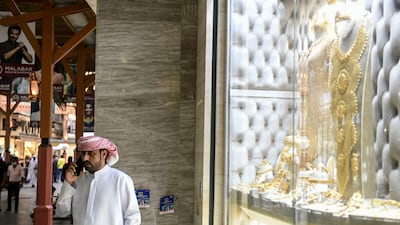
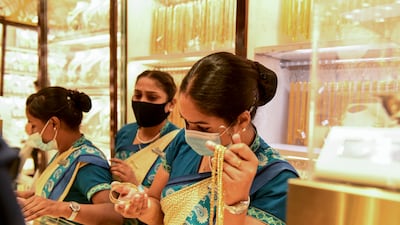
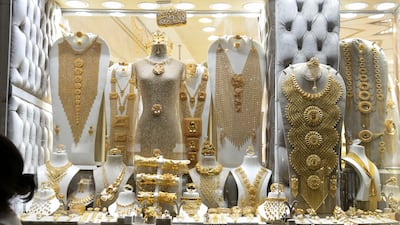
Shoppers in Dubai Gold Souq — in pictures

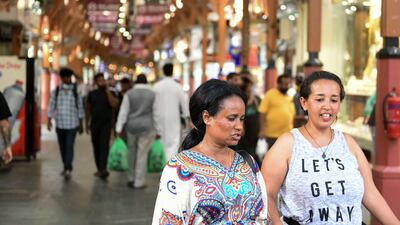
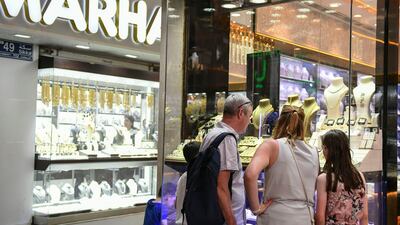
  • Shoppers explore the Deira Gold Souq in Deira. All photos: Khushnum Bhandari / The National
    Shoppers explore the Deira Gold Souq in Deira. All photos: Khushnum Bhandari / The National
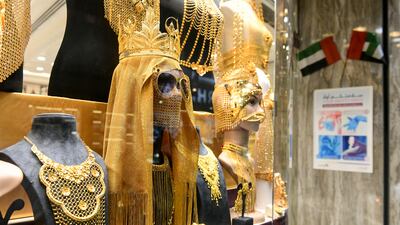
  • The rich displays of the gold souq.
    The rich displays of the gold souq.
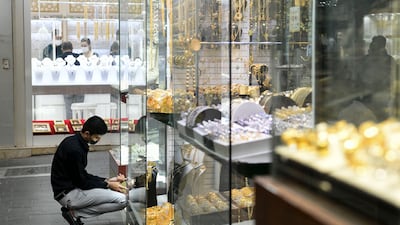
  • A salesman adding pieces to the window display.
    A salesman adding pieces to the window display.
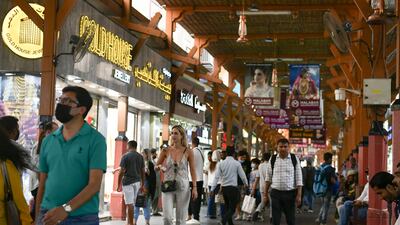
  • Crowds brave the summer heat at the Deira souq.
    Crowds brave the summer heat at the Deira souq.
  • Anil Dhanak, founder of Kanz Jewellers, in the gold souq, Dubai.
    Anil Dhanak, founder of Kanz Jewellers, in the gold souq, Dubai.
  • The gold souq in Deira, Dubai.
    The gold souq in Deira, Dubai.
  • Wares on display at the gold souq in Deira.
    Wares on display at the gold souq in Deira.
  • Sales staff at Kanz Jewellers in the gold souq.
    Sales staff at Kanz Jewellers in the gold souq.
  • A dazzling window display at the gold souq.
    A dazzling window display at the gold souq.
  • A staff member adds pieces to a window display at the gold souq. It is a popular attraction for visitors to Dubai.
    A staff member adds pieces to a window display at the gold souq. It is a popular attraction for visitors to Dubai.
  • Intricately crafted items fill a window at the souq.
    Intricately crafted items fill a window at the souq.
  • A shopkeeper makes sure that his windows gleam as much as the gold items on sale behind them.
    A shopkeeper makes sure that his windows gleam as much as the gold items on sale behind them.
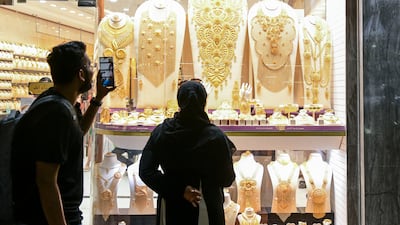
  • Window shopping at the gold souq.
    Window shopping at the gold souq.
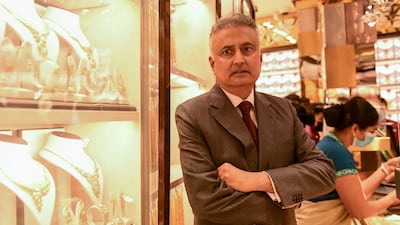
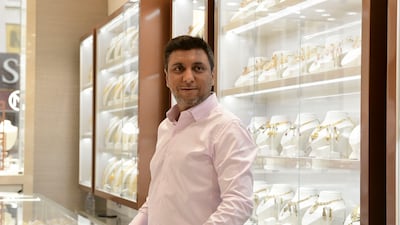
  • Vishal Dhakan, director of Dhakan Jewellers, stands behind his counter, surrounded by an array of gold items.
    Vishal Dhakan, director of Dhakan Jewellers, stands behind his counter, surrounded by an array of gold items.

“We also expect to see jewellery demand continue to perform strongly in some regions such as India and South-east Asia,” Ms Street said.

Central bank buying picked up significantly, with record purchases of about 400 tonnes in the third quarter. Turkey, Uzbekistan and Qatar were among the biggest reported buyers.

Meanwhile, demand for gold in industrial applications fell by 2 per cent annually to 77 tonnes on weakening consumer confidence, the report said. Gold used in the electronics sector declined 9 per cent to 63 tonnes on falling consumer demand.

High inventory levels in the third quarter, US restrictions on China, falling capacity utilisation and weak semiconductor guidance are likely to pressure demand for gold in technology usage in the fourth quarter, the report added.

Total gold supply in the third quarter increased 1 per cent to 1,215 tonnes as lower recycling offset mine production growth. Mine production was up 2 per cent, with gold mining seeing its sixth consecutive quarter of growth, the WGC said.

In contrast, recycling dropped 6 per cent as consumers held onto their gold in the face of surging inflation and an uncertain economic outlook.

____________

Watch: Dubai's Gold Souq reopens

Listen to Extra Time

Mercer, the investment consulting arm of US services company Marsh & McLennan, expects its wealth division to at least double its assets under management (AUM) in the Middle East as wealth in the region continues to grow despite economic headwinds, a company official said.

Mercer Wealth, which globally has $160 billion in AUM, plans to boost its AUM in the region to $2-$3bn in the next 2-3 years from the present $1bn, said Yasir AbuShaban, a Dubai-based principal with Mercer Wealth.

Within the next two to three years, we are looking at reaching $2 to $3 billion as a conservative estimate and we do see an opportunity to do so,” said Mr AbuShaban.

Mercer does not directly make investments, but allocates clients’ money they have discretion to, to professional asset managers. They also provide advice to clients.

“We have buying power. We can negotiate on their (client’s) behalf with asset managers to provide them lower fees than they otherwise would have to get on their own,” he added.

Mercer Wealth’s clients include sovereign wealth funds, family offices, and insurance companies among others.

From its office in Dubai, Mercer also looks after Africa, India and Turkey, where they also see opportunity for growth.

Wealth creation in Middle East and Africa (MEA) grew 8.5 per cent to $8.1 trillion last year from $7.5tn in 2015, higher than last year’s global average of 6 per cent and the second-highest growth in a region after Asia-Pacific which grew 9.9 per cent, according to consultancy Boston Consulting Group (BCG). In the region, where wealth grew just 1.9 per cent in 2015 compared with 2014, a pickup in oil prices has helped in wealth generation.

BCG is forecasting MEA wealth will rise to $12tn by 2021, growing at an annual average of 8 per cent.

Drivers of wealth generation in the region will be split evenly between new wealth creation and growth of performance of existing assets, according to BCG.

Another general trend in the region is clients’ looking for a comprehensive approach to investing, according to Mr AbuShaban.

“Institutional investors or some of the families are seeing a slowdown in the available capital they have to invest and in that sense they are looking at optimizing the way they manage their portfolios and making sure they are not investing haphazardly and different parts of their investment are working together,” said Mr AbuShaban.

Some clients also have a higher appetite for risk, given the low interest-rate environment that does not provide enough yield for some institutional investors. These clients are keen to invest in illiquid assets, such as private equity and infrastructure.

“What we have seen is a desire for higher returns in what has been a low-return environment specifically in various fixed income or bonds,” he said.

“In this environment, we have seen a de facto increase in the risk that clients are taking in things like illiquid investments, private equity investments, infrastructure and private debt, those kind of investments were higher illiquidity results in incrementally higher returns.”

The Abu Dhabi Investment Authority, one of the largest sovereign wealth funds, said in its 2016 report that has gradually increased its exposure in direct private equity and private credit transactions, mainly in Asian markets and especially in China and India. The authority’s private equity department focused on structured equities owing to “their defensive characteristics.”

Lexus LX700h specs

Engine: 3.4-litre twin-turbo V6 plus supplementary electric motor

Power: 464hp at 5,200rpm

Torque: 790Nm from 2,000-3,600rpm

Transmission: 10-speed auto

Fuel consumption: 11.7L/100km

On sale: Now

Price: From Dh590,000

THE%20FLASH
%3Cp%3E%3Cstrong%3EDirector%3A%3C%2Fstrong%3E%20Andy%20Muschietti%3Cbr%3E%3Cstrong%3EStars%3A%3C%2Fstrong%3E%20Sasha%20Calle%2C%20Ben%20Affleck%2C%20Ezra%20Miller%3Cbr%3E%3Cstrong%3ERating%3A%20%3C%2Fstrong%3E3%2F5%3C%2Fp%3E%0A
The White Lotus: Season three

Creator: Mike White

Starring: Walton Goggins, Jason Isaacs, Natasha Rothwell

Rating: 4.5/5

Meatless Days
Sara Suleri, with an introduction by Kamila Shamsie
​​​​​​​Penguin 

Updated: November 02, 2022, 4:00 AM