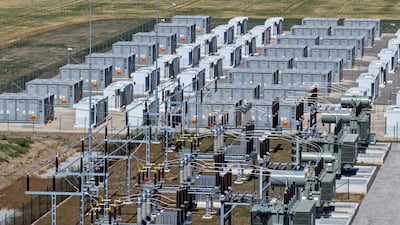

Battery energy storage systems are gaining momentum for good reason. They are in a position to address some of the most pressing needs in the power market.
Often referred to as 'Bess', battery energy storage systems store electricity in rechargeable batteries to release energy when needed, potentially solving the problem faced by renewables and making them more suitable for mainstream use.
They also reduce consumption costs and address another major obstacle to the widespread use of renewables – the integration of energy systems – as countries prepare for the future economy.

Abu Dhabi’s Masdar announced the launch of its second Bess project in the UK on Monday. Bess is critical to battling the effects of climate change, and is a key component of the 2015 Paris Agreement. Without a global energy storage target, the goal of tripling renewables by 2030 is at risk, according to the Global Renewables Alliance.
"The market is gaining momentum as renewable energy deployment, grid modernisation, electrification, data centre expansion and rising demand for power-system flexibility accelerate the adoption of energy storage," said analysts at San Francisco-based Novatrends Market Intelligence.
"Bess supports renewable integration, peak shaving, load shifting, frequency regulation, grid stabilisation, backup power, energy cost optimisation and energy security."
What is Bess and why is it key?
A Bess is a subset of energy storage systems in which an individual or, more commonly, a group of batteries is used to capture and store energy generated by power stations, which can then be tapped into later.
It is an "easy way" to supply power to an off-grid application or to complement a peak in demand, according to the Swedish industrial major Atlas Copco. France's TotalEnergies says using Bess is "essential" to support the growth of renewable electricity production.
Bess is also regarded as a way to address the intermittent nature of renewable energy sources, with solar panels only able to generate power during daylight hours and wind turbines depending on weather conditions.
"As power systems increasingly integrate variable renewable energy sources, such as solar and wind, the need for flexible and reliable power grids that can supply electricity at all times has become essential," the Abu Dhabi-based International Renewable Energy Agency said.
Battery-powered market
The most common battery used in Bess is lithium-ion, which is also widely used in consumer electronics and appliances. Others in use are lead-acid and sodium-sulfur, as well as more expensive solid-state batteries. Aluminium-sulfur and variations of flow batteries are being studied.
Demand for lithium-ion batteries is growing, with production increasing sixfold between 2020 and 2025, according to a report published in May by the International Energy Agency.
Bess, however, was only the second-biggest driver of demand for lithium-ion, "reflecting the growing role of batteries in providing flexibility in power systems", the IEA said. The electric vehicle sector was the largest, with about 70 per cent.
Falling battery prices have helped the lithium-ion market grow, as have advancements in manufacturing and improvements in battery chemistries, the IEA added. The global market was worth $150 billion in 2025.
The role of Bess in energy shifting — or the ability to store large volumes of energy that can be deployed at a later time — has also grown substantially in the past decade, from about 40 per cent in 2015 to more than 90 per cent last year, the IEA said.
The two other markets Bess has outpaced are ancillary services – a lucrative but relatively shallow sector that involves the use of batteries to help balance and stabilise electricity grids – and congestion management, which help ease stress on grids, the IEA said.
Overall, the Bess market is expected to be worth nearly $200 billion by 2031, growing at an compound annual growth rate of about 17.2 per cent from an estimated $89.9 billion this year, data from Mordor Intelligence shows.
In the Middle East
Meanwhile, data compiled by Middle East Energy, the industry event held in Dubai, shows that the growth rate of the region's Bess market is pegged at 53 per cent year-on-year, making it the fastest-growing segment of global battery demand.
The projected Bess capacity to be deployed across the Middle East by the end of this year is estimated at 33.5GWh, with an expected annual deployment of 2-3GWh, Middle East Energy said.
IEA data shows that the Middle East is also among the fastest regions expected to bring Bess projects to the market, averaging 1.7 years: 0.9 years for planning, permitting and licensing and 0.8 years for construction. Europe, Japan, the US, Africa and India are all above two years.
In the UAE, the government is tapping into the potential of Bess. Abu Dhabi clean energy company Masdar unveiled in October a $6 billion round-the-clock renewable energy project, deemed the world's largest, that includes 19GWh of battery storage in the capital, enough to power half a million homes.
That expertise extends overseas. On Monday, Masdar launched its second Bess project in the UK, a 35MW/70MWh plant near Manchester that will be able to power 35,000 homes a day, following a similar venture in Stockport last December.
Saudi Arabia, meanwhile, on Tuesday signed four investment agreements worth $1.16 billion for the first group of Bess projects in the Arab world's biggest economy that will deliver a combined storage capacity of 2,000MW.
The kingdom is also the regional leader and sixth-largest globally when it comes to Bess capacity, with about 32.4GWh, the latest data from Benchmark Mineral Intelligence show. China is the biggest market for Bess with about 721GWh, followed by the US (244.6GWh), Australia (102.9GWh), the UK (6.3GWh) and Chile (41GWh).
Aside from Masdar, the biggest investors in Bess are BlackRock, the world's biggest asset manager; Canada's Brookfield Renewable Partners; and China's State Development and Investment Group. Their investments are part of the estimated $150 billion that has been poured into the sector, according to the IEA.
There is, however, still a long way to go to reach the $1.2 trillion of investment needed in Bess to support the installation of more than 5,900GW of new wind and solar capacity through to 2034, according to analysts from Wood Mackenzie.
The practical role of Bess is to "store energy when system conditions allow and make that capacity available when demand increases ... energy storage provides utilities and infrastructure operators with another critical tool for improving flexibility reliability and resilience", said Mark Garry, chief executive of Bess manufacturer Grid Green Global, which is based in Bahrain.
"Storage is not simply about holding energy," he added. "It is about making energy available at the right time."