

Next month, Tesla plans to deliver the first of its electric Semi lorries — able to haul a full 40-tonne load about 500 miles on a single charge. These massive batteries-on-wheels may accelerate the transition to electrified transport, but those responsible for delivering the power are starting to ask: are we ready for this?
Probably not, according to a sweeping new study of motorway charging requirements conducted by utility company National Grid Plc.
Researchers found that by 2030, electrifying a typical motorway petrol station would require as much power as the average professional sports stadium — and that’s mostly for electrified passenger vehicles only. As more electric lorries hit the road, the projected power needs for a big station by 2035 will equal that of a small town.
Even the authors who planned the study were caught off guard by how quickly motorway power demands will change. A connection to the grid that can handle more than five megawatts takes up to eight years to build, at a cost tens of millions of dollars. If power upgrades don’t start soon, the transition to electric vehicles — let alone electric lorries — will quickly be constrained by a grid unprepared for the demand, warned Bart Franey, vice president of clean energy development at the National Grid.
“We need to start making these investments now,” Mr Franey said in an interview. “We can’t just wait for it to happen, because the market is going to outpace the infrastructure.”
The total amount of new electricity that EVs will consume isn’t the problem. Even if the world stopped making new petrol-powered cars and lorries altogether by the early 2030s — an optimistic scenario — it would add no more than 15 per cent to the world’s electricity consumption by 2040, according to an analysis by BloombergNEF. In the age of cheap wind and solar power, that’s not a lot.
The real challenge is how quickly high-speed chargers will need to deliver electricity at a single place and time. Think of electricity like water flowing through a hose. You could fill an Olympic-size swimming pool with a garden hose if you had a few months, but filling it in a few hours would require a firehose. In the world of EVs, an 18-wheeler is like the swimming pool and the connections available at today’s motorway stops are akin to garden hoses.
It “requires a paradigm shift from a policy and a regulatory perspective”.
“It’s not like plugging in a toaster. If you put 50 trucks somewhere, that is basically equivalent to a factory,” said Dave Mullaney, who leads analysis of electric trucking at the RMI energy research institute. “Utilities know how to build factories, but it’s the process and sequencing required that’s scary to me. Utilities need to be starting half a decade ahead of the trucks in order to not be bottlenecking the transition to electric trucks.”
National Grid studied fuelling behaviour at 71 motorway petrol stations of varying size along interstate corridors in New York and Massachusetts. They applied that behaviour to projections for EV adoption to estimate peak electricity demand. To model the behaviour of passenger-vehicle projections, industry consultants at Stable Auto Corp provided data from 3,000 fast-chargers across the US. For medium and heavy-duty lorry driving, the study used fleet-tracking telematics from Geotab Inc.

Tesla’s upcoming Semi may be the first with a battery range capable of long-haul trips across the country, but it isn’t the first electric lorry.
Daimler Truck Holding and Volvo Group already have Class 8 heavy-duty trucks on the road. These EVs are designed for local and regional deliveries, and charge between deliveries or overnight at the factories and distribution centres where they’re based. But even for short-distance routes, some customers are already running into problems with infrastructure, said Rakesh Aneja, head of electric trucks at Daimler North America.
Several customers had to reconsider buying Daimler’s Freightliner eCascadia after discovering it would take a year longer to connect their chargers than it would to receive their lorries.
“Utilities are waiting for a customer application to come in requesting new service before they start their work, and that process is just too long,” Mr Aneja said. “You really have to anticipate that demand and then get started ahead of time. That requires a paradigm shift from a policy and a regulatory perspective.”
Charging infrastructure for commercial lorries is still in its infancy. More than $1.2 billion of investment has been announced for chargers in 2022 and 2023, enough to build more than 4,000 lorry-charging points in the US and Europe, according to a tally by BloombergNEF. Most of that is for pilot projects, with greater investment to follow.
In the US, government incentives pushed the timeline for mass electric lorry adoption forward by 5 to 10 years, according to an RMI analysis. The landmark climate component of President Joe Biden’s Inflation Reduction Act, passed this year, will supercharge truck demand with a $40,000 incentive for each heavy-duty lorry sale. Biden’s infrastructure package, passed in 2021, set aside $7.5 billion to help fund a national system of chargers, with additional funds to help pay for upgrades to the grid.
Still, for the next few years most of the focus will be on building out charging networks for passenger vehicles. By 2030, it will be electric cars and electric pickup trucks that will be responsible for pushing half of the 71 stations studied by National Grid close to the key five megawatt threshold. That’s typically when major upgrades are required, including a new substation connection to high-voltage power lines.
-
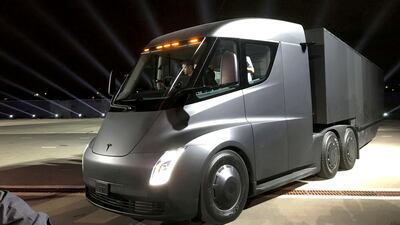
The Tesla Semi, a new electric lorry, is expected to cost $180,000. Reuters -

The battery-powered lorry on display at the Tesla Giga Texas manufacturing plant in Austin, Texas, in April 2022. AFP -

Tesla chairman and chief executive Elon Musk unveils the the Semi electric lorry in Hawthorne, California, near Los Angeles. AFP -
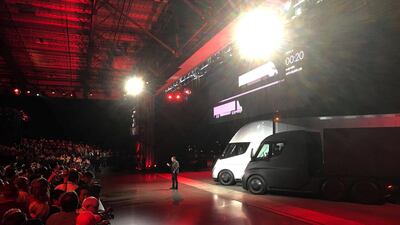
Mr Musk has described electric lorries as Tesla’s next effort to move the economy away from fossil fuels. Reuters -

The Tesla Semi has a range of 805 kilometres. Reuters -
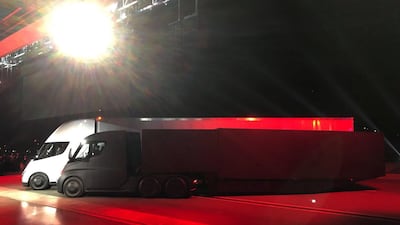
Tesla has begun to produce the electric lorries and Pepsi will receive the first deliveries from December 1. Reuters -
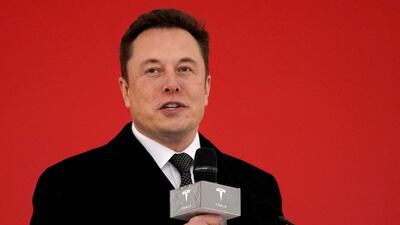
Tesla chief executive Elon Musk. Reuters


The way many utilities are structured, most of the cost would be paid upfront by the petrol station, at the cost of tens of millions of dollars per rest stop, even though the same station could later be used for decades by multiple facilities within a 1.5km radius. That kind of huge expense would halt charger upgrades at many locations, according to US government officials with access to National Grid’s report.
The high-voltage lines that will be central to the coming transformation are extremely robust. In major storms with power cuts, those lines are rarely the problem. Indeed, some towers raised by teams of horses in the early 1900s are still in use more than a century later. Over that time, standards for modifying and upgrading transmission lines evolved gradually, just as demand rose predictably over the decades.
That will not be the case this time. With the amount of change the grid will be experiencing in the next few decades, the old rules for when to build interconnection upgrades — and who pays for them — no longer make sense, said Brian Wilkie, director of transport electrification at National Grid. Building connected electricity motorways will be a competitive advantage for states that move the fastest, and every utility should be conducting similar studies to evaluate future demand, he said.

