


Mubadala Investment Company and the Abu Dhabi National Energy Company, better known as Taqa, have signed agreements to invest in the privatisation of two gas-fired power plants in Uzbekistan.
Mubadala and Taqa will each acquire a 40 per cent stake in the power stations with a combined capacity of 1.6 gigawatts, and take over the associated operations and maintenance activities, the Abu Dhabi entities said on Friday.
They did not disclose the value of the deal.
Uzbekistan's Talimarjan Issiqlik Elektr Stansiyasi will retain the remaining 20 per cent stake in each plant. The transaction is subject regulatory approvals and is expected to be completed in the second half of 2023.
The agreements were signed by Mubadala's chief executive for real estate and infrastructure Khaled Al Qubaisi, Taqa's group chief executive and managing director Jasim Thabet, Uzbekistan's Deputy Prime Minister Jamshid Khodjaev and Talimarjan's general director Yusupov Olim.
The signing ceremony was held in the presence of Suhail Al Mazrouei, UAE Minister of Energy and Infrastructure.
"The strategic partnership between the government of Uzbekistan, Taqa and Mubadala will serve as a vehicle for collaboration for both countries and will create a path for future growth and investment opportunities," Mr Al Mazrouei said.
Uzbekistan is moving forward to improve its energy and power generation sectors, harnessing its natural resources and seeking investments from overseas.
In 2019, the Central Asian nation embarked on a multi-phase transition from a state-owned and subsidised energy sector to a competitive gas, oil and electricity market with significant private sector participation, a move that is expected to provide huge economic benefits, according to the International Energy Agency.
Uzbekistan also unveiled plans to raise the share of renewable energy in total electricity supply to 25 per cent by 2030, from 10 per cent in 2020.
The investments by the Abu Dhabi companies are expected to help Uzbekistan to realise its energy goals.
Mr Al Qubaisi said Mubadala was focused on supporting the energy transition around the world.
"We are confident our partnership will contribute to Uzbekistan’s greater energy stability while preparing for a low carbon future," he said.
Friday's announcement comes after Mubadala's 2020 agreement with Uzbekistan’s Ministry of Investment and Foreign Trade and JSC Thermal Power Plants to privatise and develop the country’s Talimarjan Power Complex.
-

An Adnoc plant in Abu Dhabi's downstream centre of Ruwais. Adnoc is an early pioneer in the emerging hydrogen market. All photos: Adnoc -

An artist's impression of hydrogen-powered lorry. Gulf oil exporters such as Adnoc are looking to capitalise on their oil trading relationships with buyers in Asia to sell hydrogen. -

Fertiglobe, the joint venture between Adnoc and Amsterdam-listed OCI, is developing a large blue ammonia plant in Ruwais that will have a production capacity of 1,000 kilotonnes a year. -

Ruwais, Abu Dhabi. Adnoc formed a hydrogen alliance with ADQ and investment company Mubadala for the development of the hydrogen economy in the UAE. -

The ammonia market was valued at about $48.65 billion in 2016, according to Grand View Research. -
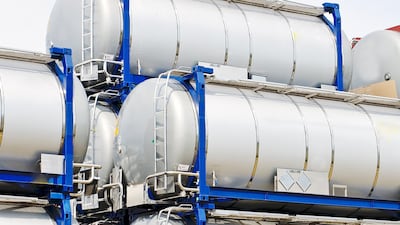
Blue ammonia is a chemical compound produced using hydrogen that is manufactured through steam methane reformation. -
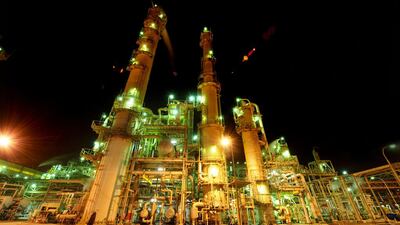
A fertiliser plant in Ruwais. Ammonia, which is used in fertiliser production, allows for the easy transport of hydrogen. -
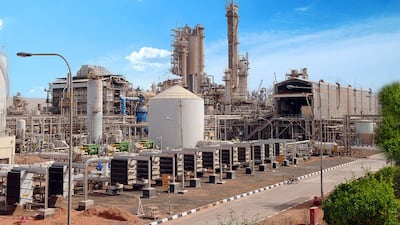
Adnoc already produces 300,000 tonnes of hydrogen on an annual basis for its downstream operations and plans to increase its output significantly. -

Adnoc and ADQ signed an agreement with Japan's Mitsui and South Korea's GS Energy to help develop a blue ammonia project in Ruwais, in partnership with Ta’ziz and Fertiglobe.


The agreement is also part of Taqa's 2030 growth strategy. The utility last year announced plans to invest Dh40 billion ($10.9bn) in infrastructure development as it looks to add about 27 gigawatts of power capacity by the end of the decade and expand its renewables portfolio.
"Investment alongside Mubadala in these power plants means we will become a major generator in Uzbekistan. The deal also significantly expands our operation and maintenance activity, another key part of our strategy, said Farid Al Awlaqi, executive director of generation at the Taqa Group.
Mubadala, whose oil and gas unit was rebranded to Mubadala Energy this week, continues to build up its portfolio in foreign markets. Its $284bn portfolio spans six continents with interests in numerous sectors and asset classes.
Taqa has significant investments in power and water generation and transmission and distribution assets, as well as upstream and midstream oil and gas operations.
In July, it said it was retaining the vast majority of its oil and natural gas assets after a strategic review that took about a year.
Meanwhile, Abu Dhabi is continuing to expand its overseas energy investments. At this week's Gastech Milan, the emirate's Department of Energy showcased hydrogen, natural gas and low-carbon energy solutions at the major global energy conference.

