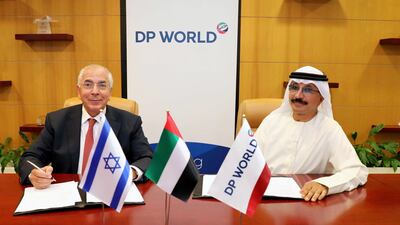
Group chairman and chief executive of DP World, Sultan Ahmed bin Sulayem, signed preliminary agreements with DoverTower, a company owned by Shlomi Fogel, the co-owner of Israel Shipyards and Port of Eilat. Courtesy: DP World
Group chairman and chief executive of DP World, Sultan Ahmed bin Sulayem, signed preliminary agreements with DoverTower, a company owned by Shlomi Fogel, the co-owner of Israel Shipyards and Port of E

DP World and Dubai Customs to explore trade links with Israel


Sarmad Khan
  • English
  • Arabic

DP World, one of the world’s biggest port operators, and Dubai Customs will explore opportunities to develop trade links between the UAE and Israel as the countries normalise relations.

The two sides have already signed a series of agreements to discuss the possibilities of developing trade infrastructure, the company said on Wednesday.

DP World group chairman and chief executive Sultan Ahmed bin Sulayem signed the preliminary agreements with DoverTower, a company owned by Shlomi Fogel, the co-owner of Israel Shipyards and Port of Eilat.

The agreements create a framework for the companies to work together in assessing opportunities to develop infrastructure for trade between Israel and the UAE, as well as within Israel and the region.

DP World will assess the development of Israeli ports and free zones and the potential establishment of a direct shipping route between Eilat and Jebel Ali port, the biggest in the Middle East.

Dubai Customs will facilitate trade between private entities in the two countries. Drydocks World will explore business opportunities with Israel shipyards, the company said.

“The MoUs will contribute to the efforts to tap economic and trade cooperation opportunities, and facilitate development-oriented linkages between the two countries,” Mr bin Sulayem said.

“DP World’s mission is to enable global trade – our work to build trade routes between the UAE, Israel and beyond will help our customers to do business in the region more easily and efficiently.”

Separately Dubai’s Emirates NBD signed a memorandum of understanding with Israel’s two largest lenders.

Dubai's biggest bank by assets said it concluded a preliminary agreement with Bank Hapoalim, in a short statement on Wednesday to the Dubai Financial Market, where its shares trade. In a separate statement, it also announced an agreement with the country's second-biggest lender, Bank Leumi, which has a 30 per cent market share.

"Our agreement demonstrates a further strengthening of our relationship with Israel’s banking industry, which will benefit our brand, our clients and the UAE economy, through new business and trade opportunities,” Emirates NBD's vice chairman and managing director Hesham Al Qassim said in the statement.

Abu Dhabi Islamic Bank (ADIB), also signed an MoU on Wednesday with Bank Leumi to explore areas for future cooperation in the UAE, Israel and other international markets. The preliminary agreement will open new business and trade opportunities for customers, and it supports their banking needs.

The partnership "will support our retail and corporate banking customers in their banking needs when traveling or opening businesses in Israel," said Khamis Buharoon, ADIB’s vice chairman.

The announcements come after the UAE and Israel signed the Abraham Accord on Tuesday at the White House to normalise relations. The deal with Israel allows for bilateral investments and the growth of the tourism, aviation, security, telecoms, technology, financial services, energy and healthcare sectors in both countries.

First Abu Dhabi Bank, the UAE’s biggest bank by assets, is also in discussions with Israeli lenders. These talks are intended to establish relationships that focus on correspondent banking, bilateral trade, technology and innovation, according to FAB.

"Following the signing of a memorandum of understanding between the UAE Central Bank and the Israeli Prime Minister's office, First Abu Dhabi Bank will open discussions with leading financial institutions in Israel, namely Bank Hapoalim and Bank Leumi," it said in a September 1 tweet.

Establishing financial ties between the two countries underpins bilateral trade and investment relations, the prospects of which are “exciting” for both states, UAE Minister of Economy Abdulla bin Touq said earlier this week.

The UAE is looking at eight trade and economic agreements, including double taxation and a free-trade agreement, with Israel at a later stage. Firms from both countries are signing deals together and a host of joint venture agreements are expected in almost all sectors, the minister said.


Six large-scale objects on show
  • Concrete wall and windows from the now demolished Robin Hood Gardens housing estate in Poplar
  • The 17th Century Agra Colonnade, from the bathhouse of the fort of Agra in India
  • A stagecloth for The Ballet Russes that is 10m high – the largest Picasso in the world
  • Frank Lloyd Wright’s 1930s Kaufmann Office
  • A full-scale Frankfurt Kitchen designed by Margarete Schütte-Lihotzky, which transformed kitchen design in the 20th century
  • Torrijos Palace dome
Email sent to Uber team from chief executive Dara Khosrowshahi

From: Dara

To: Team@

Date: March 25, 2019 at 11:45pm PT

Subj: Accelerating in the Middle East

Five years ago, Uber launched in the Middle East. It was the start of an incredible journey, with millions of riders and drivers finding new ways to move and work in a dynamic region that’s become so important to Uber. Now Pakistan is one of our fastest-growing markets in the world, women are driving with Uber across Saudi Arabia, and we chose Cairo to launch our first Uber Bus product late last year.

Today we are taking the next step in this journey—well, it’s more like a leap, and a big one: in a few minutes, we’ll announce that we’ve agreed to acquire Careem. Importantly, we intend to operate Careem independently, under the leadership of co-founder and current CEO Mudassir Sheikha. I’ve gotten to know both co-founders, Mudassir and Magnus Olsson, and what they have built is truly extraordinary. They are first-class entrepreneurs who share our platform vision and, like us, have launched a wide range of products—from digital payments to food delivery—to serve consumers.

I expect many of you will ask how we arrived at this structure, meaning allowing Careem to maintain an independent brand and operate separately. After careful consideration, we decided that this framework has the advantage of letting us build new products and try new ideas across not one, but two, strong brands, with strong operators within each. Over time, by integrating parts of our networks, we can operate more efficiently, achieve even lower wait times, expand new products like high-capacity vehicles and payments, and quicken the already remarkable pace of innovation in the region.

This acquisition is subject to regulatory approval in various countries, which we don’t expect before Q1 2020. Until then, nothing changes. And since both companies will continue to largely operate separately after the acquisition, very little will change in either teams’ day-to-day operations post-close. Today’s news is a testament to the incredible business our team has worked so hard to build.

It’s a great day for the Middle East, for the region’s thriving tech sector, for Careem, and for Uber.

Uber on,

Dara

The biog

Name: Shamsa Hassan Safar

Nationality: Emirati

Education: Degree in emergency medical services at Higher Colleges of Technology

Favourite book: Between two hearts- Arabic novels

Favourite music: Mohammed Abdu and modern Arabic songs

Favourite way to spend time off: Family visits and spending time with friends

COMPANY%20PROFILE%20
%3Cp%3E%3Cstrong%3EName%3A%3C%2Fstrong%3E%20Dooda%20Solutions%0D%3Cbr%3E%3Cstrong%3EBased%3A%3C%2Fstrong%3E%20Lebanon%0D%3Cbr%3E%3Cstrong%3EFounder%3A%20%3C%2Fstrong%3ENada%20Ghanem%0D%3Cbr%3E%3Cstrong%3ESector%3A%3C%2Fstrong%3E%20AgriTech%0D%3Cbr%3E%3Cstrong%3ETotal%20funding%3A%20%3C%2Fstrong%3E%24300%2C000%20in%20equity-free%20funding%0D%3Cbr%3E%3Cstrong%3ENumber%20of%20employees%3A%3C%2Fstrong%3E%2011%3C%2Fp%3E%0A
POWERWASH%20SIMULATOR
%3Cp%3E%3Cstrong%3EDeveloper%3A%3C%2Fstrong%3E%20FuturLab%3Cbr%3E%3Cstrong%3EPublisher%3A%20%3C%2Fstrong%3ESquare%20Enix%20Collective%3Cbr%3E%3Cstrong%3EConsole%3A%20%3C%2Fstrong%3ENintendo%20Switch%2C%3Cstrong%3E%20%3C%2Fstrong%3EPlayStation%204%20%26amp%3B%205%2C%20Xbox%20Series%20X%2FS%20and%20PC%3Cbr%3E%3Cstrong%3ERating%3A%3C%2Fstrong%3E%204%2F5%3C%2Fp%3E%0A
Wicked: For Good

Director: Jon M Chu

Starring: Ariana Grande, Cynthia Erivo, Jonathan Bailey, Jeff Goldblum, Michelle Yeoh, Ethan Slater

Rating: 4/5

COMPANY%20PROFILE
%3Cp%3E%3Cstrong%3ECompany%20name%3A%3C%2Fstrong%3E%20Switch%20Foods%3Cbr%3E%3Cstrong%3EStarted%3A%3C%2Fstrong%3E%202022%3Cbr%3E%3Cstrong%3EFounder%3A%3C%2Fstrong%3E%20Edward%20Hamod%3Cbr%3E%3Cstrong%3EBased%3A%3C%2Fstrong%3E%20Abu%20Dhabi%2C%20UAE%3Cbr%3E%3Cstrong%3EIndustry%3A%3C%2Fstrong%3E%20Plant-based%20meat%20production%3Cbr%3E%3Cstrong%3ENumber%20of%20employees%3A%3C%2Fstrong%3E%2034%3Cbr%3E%3Cstrong%3EFunding%3A%3C%2Fstrong%3E%20%246.5%20million%3Cbr%3E%3Cstrong%3EFunding%20round%3A%3C%2Fstrong%3E%20Seed%3Cbr%3E%3Cstrong%3EInvestors%3A%3C%2Fstrong%3E%20Based%20in%20US%20and%20across%20Middle%20East%3C%2Fp%3E%0A
NBA Finals so far

(Toronto lead 3-1 in best-of-seven series_

Game 1 Raptors 118 Warriors 109

Game 2 Raptors 104 Warriors 109

Game 3 Warriors 109 Raptors 123

Game 4 Warriors 92 Raptors 105

Ten tax points to be aware of in 2026

1. Domestic VAT refund amendments: request your refund within five years

If a business does not apply for the refund on time, they lose their credit.

2. E-invoicing in the UAE

Businesses should continue preparing for the implementation of e-invoicing in the UAE, with 2026 a preparation and transition period ahead of phased mandatory adoption. 

3. More tax audits

Tax authorities are increasingly using data already available across multiple filings to identify audit risks. 

4. More beneficial VAT and excise tax penalty regime

Tax disputes are expected to become more frequent and more structured, with clearer administrative objection and appeal processes. The UAE has adopted a new penalty regime for VAT and excise disputes, which now mirrors the penalty regime for corporate tax.

5. Greater emphasis on statutory audit

There is a greater need for the accuracy of financial statements. The International Financial Reporting Standards standards need to be strictly adhered to and, as a result, the quality of the audits will need to increase.

6. Further transfer pricing enforcement

Transfer pricing enforcement, which refers to the practice of establishing prices for internal transactions between related entities, is expected to broaden in scope. The UAE will shortly open the possibility to negotiate advance pricing agreements, or essentially rulings for transfer pricing purposes. 

7. Limited time periods for audits

Recent amendments also introduce a default five-year limitation period for tax audits and assessments, subject to specific statutory exceptions. While the standard audit and assessment period is five years, this may be extended to up to 15 years in cases involving fraud or tax evasion. 

8. Pillar 2 implementation 

Many multinational groups will begin to feel the practical effect of the Domestic Minimum Top-Up Tax (DMTT), the UAE's implementation of the OECD’s global minimum tax under Pillar 2. While the rules apply for financial years starting on or after January 1, 2025, it is 2026 that marks the transition to an operational phase.

9. Reduced compliance obligations for imported goods and services

Businesses that apply the reverse-charge mechanism for VAT purposes in the UAE may benefit from reduced compliance obligations. 

10. Substance and CbC reporting focus

Tax authorities are expected to continue strengthening the enforcement of economic substance and Country-by-Country (CbC) reporting frameworks. In the UAE, these regimes are increasingly being used as risk-assessment tools, providing tax authorities with a comprehensive view of multinational groups’ global footprints and enabling them to assess whether profits are aligned with real economic activity. 

Contributed by Thomas Vanhee and Hend Rashwan, Aurifer