

In India’s financial capital Mumbai, construction workers sluggishly toil on a residential building in the sweltering heat. Nearby, hawkers at a popular street market take refuge in shady areas, guzzling water as they try to have some respite from the scorching sun.
On the outskirts of the city, factory owners complain of rare power cuts, bringing work to a halt.
Scientists blame climate change for the heatwave, with several parts of India experiencing record high temperatures in recent weeks. But it is not only its people who are suffering; the South Asian country's economy will also have to bear the brunt of extreme weather.
“Currents of this year’s heatwave in India are being felt across sectors — power, harvests, exports [and] water,” says Manish Dabkara, chairman and chief executive of Indian climate change and sustainability advisory EKI Energy Services. "In addition to people's lives," this weather is “a threat” to the Indian economy.
The number of working hours lost in India due to extreme heat will increase approximately 15 per cent by 2030. It translates into a projected 2.5 per cent to 4.5 per cent, or $150 billion to $250bn, risk to the country's gross domestic product, according to a McKinsey report.
-
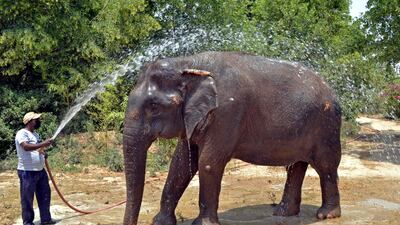
An elephant is given a cooling shower at a conservation reserve in Uttar Pradesh state. AFP -
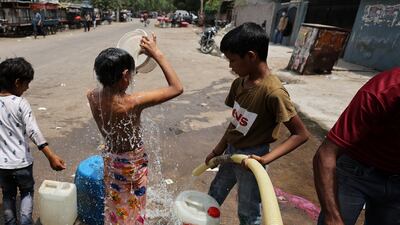
A boy bathes as he waits to collect water from a municipal tanker on a hot summer day in New Delhi. Reuters -
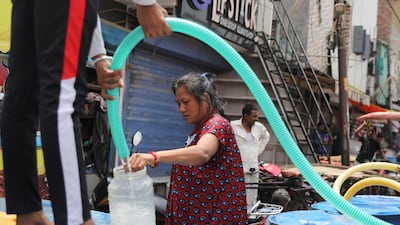
A woman fills a plastic container with drinking water from a municipal tanker in New Delhi. Reuters -

A boy jumps into a pond in Mumbai. Large parts of India are experiencing the hottest April on record. EPA -

A man selling candy floss in Mumbai helps a water vendor who is using an umbrella as a parasol. AP -
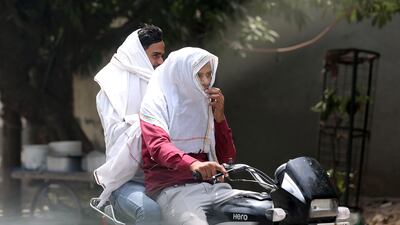
Men ride a motorcycle during a hot afternoon on the outskirts of New Delhi. EPA -

A boy eats an ice lolly on the outskirts of New Delhi. EPA -

Women ride a motorised rickshaw in Amritsar. AFP -

A boy drinks soda beside the Arabian Sea in Mumbai. AP -
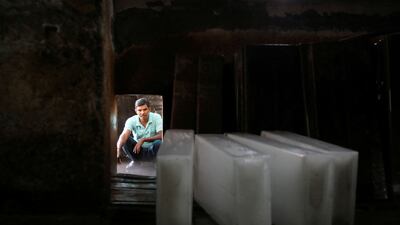
At a factory in New Delhi, a worker waits to load ice blocks on to a vehicle. Reuters -

A child plays near a paddy field on the outskirts of Gauhati, Assam state. AP -

Men enjoy a slide at a water park in New Delhi. AFP -

People take a dip in a wave pool at a water park in New Delhi. AFP -
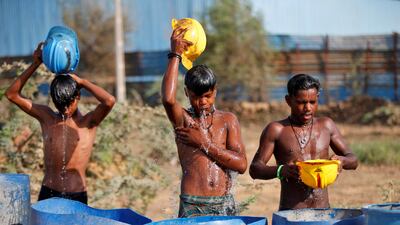
Youths use their helmets to pour water over themselves near a construction site on the outskirts of Ahmedabad. Reuters -
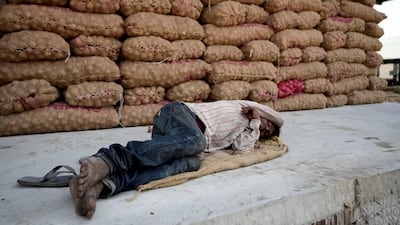
A labourer naps near sacks of vegetables in Jammu. AP -

A boy bathes in the Ranbir Canal in Jammu. AP -
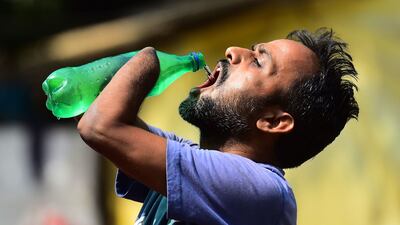
A man drinks water in Allahabad. AFP -

A woman covers her head with a plastic tub near Sangam, the confluence of the Ganges, Yamuna and mythical Saraswati rivers. AFP -

Men walk over the bed of the Yamuna River in search of recyclable material in New Delhi. Reuters -

Residents of New Delhi fill containers with water from a municipal tanker. Bloomberg


India is one “of the most affected countries due to climate change” and its economy can "lose trillions of dollars due to climate change in the coming years", says Ruchika Bhagat, managing director of New Delhi-based NBC Advisors.
The Indian Meteorological Department has warned that six states are likely to be hit by heatwaves this week, including Rajasthan, Haryana, Uttar Pradesh, and Maharashtra, of which Mumbai is the capital.
“These events clearly show just how impactful climate change already is,” says Sunali Goenka, co-founder and chief executive of Mumbai-based interior design company We Create.
“It’s no longer a problem for future generations. It's a problem that strikes now, with very tangible and impactful effects.”
Particularly worrisome is the impact “on informal livelihoods in cities that often occur in cramped, poorly ventilated spaces”, as well as the effects for construction and farm workers outdoors who are fully exposed to the heat, Ms Goenka added.
The current heatwave could be just a glimpse of what is to come for India, experts say.
“The overall impact of climate change on the economy is manifold as it will affect agriculture, infrastructure, [as well as] human health,” says Gaurav Kedia, chairman of the Indian Biogas Association.
There's already a "significant drop in working hours due to heat stress”. Agriculture, one of the major contributors to the Indian GDP, is also "under threat" as extreme heat will affect crop production, including wheat, he added.

Food prices are expected to rise as scorching temperatures take their toll on the agriculture sector.
India has been working on ramping up wheat exports to help to meet the shortfall of grain supplies globally amid Russia's war in Ukraine — with both countries being two of the world's biggest wheat exporters. However, industry insiders say the extreme weather could hamper those plans.
About half of India's population depends on agriculture for their livelihood. The sector accounts for almost 20 per cent of the GDP.
“Climate change aggravates our ability to enhance food production,” says Krishna Kumar, co-founder and chief executive of agricultural technology company Cropin. “Unlike many other sectors, the agriculture sector challenges are beyond human control.”
To manage the situation, the sector needs to “make significant investments in technology to maintain current yields, increase production and food quality”, he added.
The heatwave has also underscored inadequacies of India's power sector and the magnitude of the crisis it is facing, expert have says.
A significant rise in the use of air conditioning to keep homes and offices cool in the blistering heat — at a time when demand for electricity was already surging after Covid-19 restrictions were lifted — has overwhelmed the system, causing power cuts in some areas.
India relies on coal to generate most of its electricity — which, as a highly-polluting fossil fuel, is part of the problem when it comes to carbon emissions and climate change. India is the third-largest greenhouse gas emitter globally.
The country was already struggling to import enough coal to meet its growing power needs, with prices surging even higher due to the squeeze on fossil fuels supplies following Russia's military aggression in Ukraine.
Domestic production of coal has already failed to keep pace with India's appetite for the fossil fuel, while insufficient transportation for coal to reach plants is another challenge the power sector is facing. Domestic coal supply to utilities fell short of targets by 7.6 per cent in April, according to official data.
“We personally feel that the power outage situation is a [result of] mismanagement [by] power-producing companies” says Mr Kedia. “If the companies had anticipated the rise in consumption in time and planned for the transport of coal to the power plants, the [power cuts] could have been avoided.”
Power shortages are a major threat to the country's economic recovery, following the impact of the pandemic and stop-start lockdown restrictions.
“Electricity consumption is at its peak,” says Devang Dave, an IT committee member of the government of Maharashtra and managing director of digital marketing company Social Central Media Solutions.
“Failures of grid, in turn, directly affects the industrial sector for their daily operations, bringing down efficiency and productivity across the country.”
Mayur Misra, co-founder of electric vehicle manufacturer Corrit Electric, says that the Indian corporate and industrial ecosystem is "striving hard to evolve with the drastically changing climatic shift". He added that the power shortage problem is also "turning out to be a massive challenge”.
managing director, Social Central Media Solutions
Vikrant Singh, co-founder and chief technology officer of BatX Energies, agreed.
“Manufacturing businesses are energy demanding and heatwaves will exacerbate the production process,” he says. “To avert future heatwaves, it is now more important than ever to reduce our emissions.”
There are other risks posed by the power crisis.
“The ongoing heatwave and related power shortages in India pose a downside risk to growth, but we think the biggest risk is the upside ... to inflation,” says Adam Hoyes, economist at Capital Economics.
“We aren’t changing our GDP forecast, meaning we still expect growth to be higher than the consensus this year. That says, if power shortages worsen, there may be a small hit to growth in the near-term.”
Although electricity exchange prices have been capped, they are still far higher than levels seen earlier this year, he added.
“Many industrial firms purchase electricity directly from exchanges, so their input costs have risen, which could push inflation even higher if final goods prices rise too,” says Mr Hoyes.
India is already struggling with uncomfortably high inflation, which prompted the Reserve Bank of India to announce a surprise rate increase on Wednesday, before its next monetary policy meeting due next month.
To reach the root of the problem, India — which has some of the world's most polluted cities — needs to be proactive in slowing climate change, experts say.
“India being an agricultural economy and already burdened with population overgrowth needs to take climate change seriously,” Mr Kedia says.
“Deliberate, determined, and diligent efforts need to be undertaken immediately to take remedial measures to slow this impending climate [crisis].”
Increasing the ratio of renewables to the country's energy mix is one way of addressing the climate challenge.
India is striving to increase its use of renewables, with Prime Minister Narendra Modi pledging at Cop26 in November that the country would meet half of its power requirements from renewable energy by 2030. India has also set a target of achieving net-zero carbon emissions by 2070.
The government has “realised the need of hour and has made policies of shifting fossil fuel to low emission fuel, but this initiative has to be consistent", Ms Bhagat says.
In the near-term, though, the mercury continues to rise in parts of India and there is little respite for workers and businesses who are feeling the heat.


