OECD Secretary General Mathias Cormann said the economic and social fallout from the UKraine conflict "is unlikely to be a short-term challenge". EPA

OECD: Ukraine war to shave more than 1% off global growth in 2022


Alice Haine
  • English
  • Arabic

Live updates: follow the latest news on Russia-Ukraine

Russia’s invasion of Ukraine is a major humanitarian and economic shock that is set to derail the global recovery from the Covid-19 pandemic, the Organisation for Economic Co-operation and Development said.

The “severe economic shock will be of “uncertain duration and magnitude”, the Paris-based organisation said, with a twin growth and inflation blow causing the think tank to slash its global growth outlook and raise its inflation forecast.

The OECD, which has 38 developed country members, expects growth of just under 3 per cent in 2022, down more than 1 per cent from its earlier projection of 4.5 per cent, with the war causing “numerous significant economic implications”.

Meanwhile, inflation will rise to about 7.5 per cent, the organisation said, as the soaring cost of energy and food feeds into the economy — a significant uplift on its December cost-of-living expectation of 5 per cent.

Mathias Cormann, Secretary General of the OECD, said the uncertainty the war poses to global growth means the organisation cannot present its usual economic outlook.

“This crisis calls for sensible, well targeted, temporary short-term measures while staying focused on long-term objectives, ensuring the resilience of our global supply chains, ensuring energy, food and digital security, and staying the course on our climate objectives,” he said.

“This is unlikely to be a short-term challenge. We need to prepare ourselves to sustain that humanitarian support to a significantly higher number of people.”

The commodity supply squeeze resulting from the conflict is “exacerbating supply chain disruptions brought on by the pandemic and risks weighing on consumers and firms for a long time”, Mr Cormann added.

Before the outbreak of the war, most key global macroeconomic variables were expected to return to normal over the course of this year and next.

Global growth was on track to return to pre-pandemic rates in 2023 with most OECD nations hitting full employment, inflation converging on levels close to policy objectives and monetary and fiscal policy settings normalising.

However, that has changed, because although Russia and Ukraine are relatively small in output terms, they are large producers and exporters of key food items, minerals and energy.

“The war has already resulted in sizeable economic and financial shocks, particularly in commodity markets, with the prices of oil, gas and wheat soaring,” the group said.

  • A Ukrainian serviceman walks past the vertical tail fin of a Russian Su-34 bomber lying in a damaged building in Kharkiv, Ukraine. AP Photo
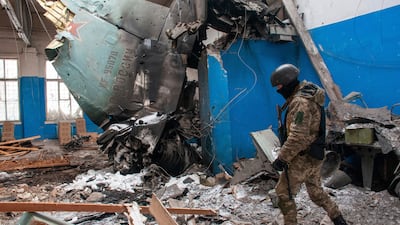
    A Ukrainian serviceman walks past the vertical tail fin of a Russian Su-34 bomber lying in a damaged building in Kharkiv, Ukraine. AP Photo
  • An apartment building damaged after shelling in Kharkiv, Ukraine. AP Photo
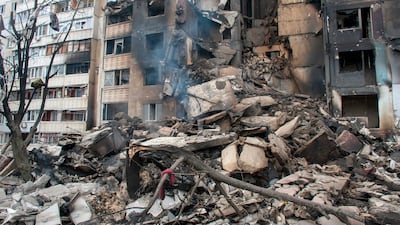
    An apartment building damaged after shelling in Kharkiv, Ukraine. AP Photo
  • A woman puts her head in her hands as she sits on a cot in a shelter, set up for displaced persons fleeing Ukraine, inside a school gymnasium in Przemysl, Poland. AP Photo
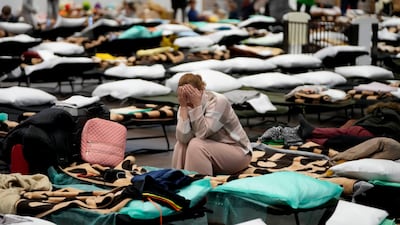
    A woman puts her head in her hands as she sits on a cot in a shelter, set up for displaced persons fleeing Ukraine, inside a school gymnasium in Przemysl, Poland. AP Photo
  • Belarussian and suspected Russian helicopters on the flight line at Machulishchy Air Base outside Minsk, Belarus. AP Photo
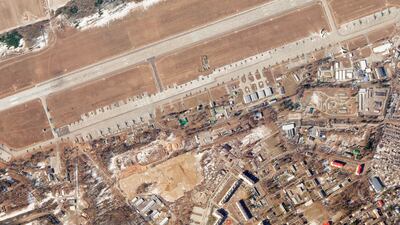
    Belarussian and suspected Russian helicopters on the flight line at Machulishchy Air Base outside Minsk, Belarus. AP Photo
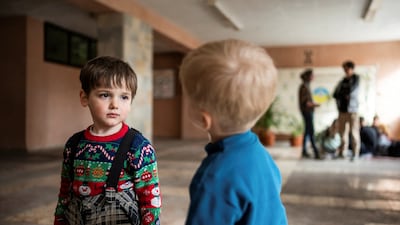
  • Children look on as people fleeing Russia's invasion of Ukraine shelter in a school, in Drohobych, Ukraine. Reuters
    Children look on as people fleeing Russia's invasion of Ukraine shelter in a school, in Drohobych, Ukraine. Reuters
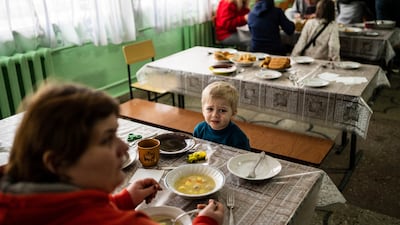
  • Families eat in the shelter. Reuters
    Families eat in the shelter. Reuters
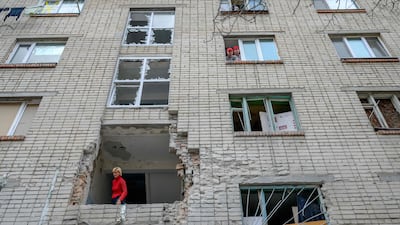
  • A woman looks out from a building damaged by Russian shelling in Mykolaiv, 100 kilometres away from Odesa, western Ukraine. AFP
    A woman looks out from a building damaged by Russian shelling in Mykolaiv, 100 kilometres away from Odesa, western Ukraine. AFP
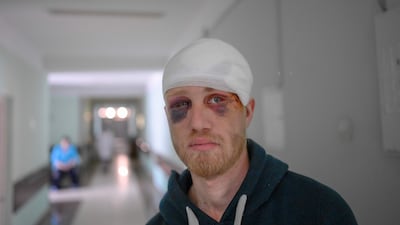
  • A wounded Ukrainian man waits in the corridor of the central hospital of Mykolaiv. AFP
    A wounded Ukrainian man waits in the corridor of the central hospital of Mykolaiv. AFP
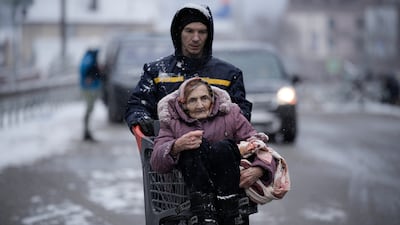
  • An elderly woman is carried in a shopping cart after being rescued from Irpin, on the outskirts of Kyiv, Ukraine. AP
    An elderly woman is carried in a shopping cart after being rescued from Irpin, on the outskirts of Kyiv, Ukraine. AP
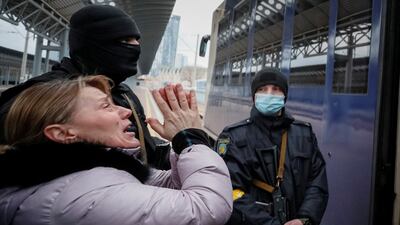
  • A woman reacts as a train carrying children from Kyiv's Central Children's Hospital leaves the Ukrainian capital on its way to Lviv. Reuters
    A woman reacts as a train carrying children from Kyiv's Central Children's Hospital leaves the Ukrainian capital on its way to Lviv. Reuters
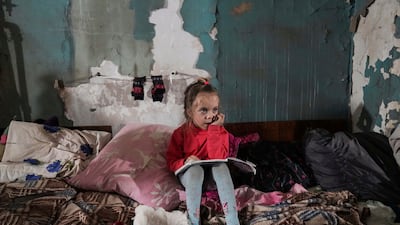
  • A girl sits in an improvised bomb shelter in Mariupol, Ukraine. AP
    A girl sits in an improvised bomb shelter in Mariupol, Ukraine. AP
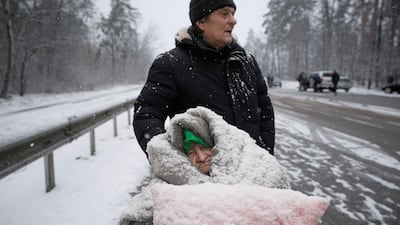
  • An elderly woman is coated in snow as she sits in a wheelchair after being rescued from Irpin. AP
    An elderly woman is coated in snow as she sits in a wheelchair after being rescued from Irpin. AP
  • Belarusian volunteers take part in military exercises at the Belarusian Company base in Kyiv. AP
    Belarusian volunteers take part in military exercises at the Belarusian Company base in Kyiv. AP
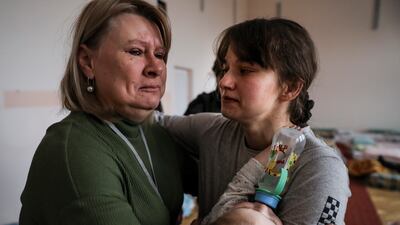
  • Lessa, left, director of a nursery school turned into a refugee shelter, cries as she hugs Olega, who arrived from Kyiv with her baby, near Lviv. EPA
    Lessa, left, director of a nursery school turned into a refugee shelter, cries as she hugs Olega, who arrived from Kyiv with her baby, near Lviv. EPA
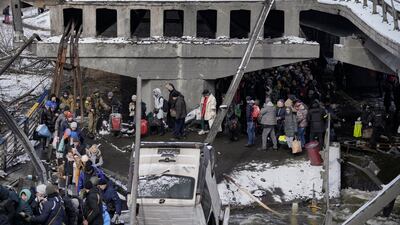
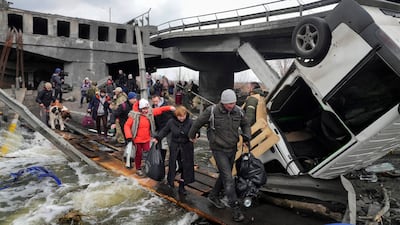
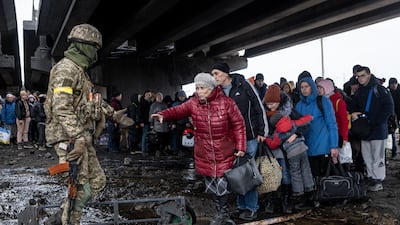
  • Ukrainians pass a damaged bridge as they flee from Irpin. AP
    Ukrainians pass a damaged bridge as they flee from Irpin. AP
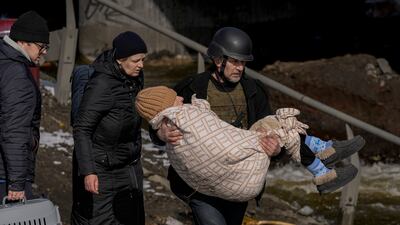
  • A man carries an elderly woman as people continue to leave Irpin. AP
    A man carries an elderly woman as people continue to leave Irpin. AP
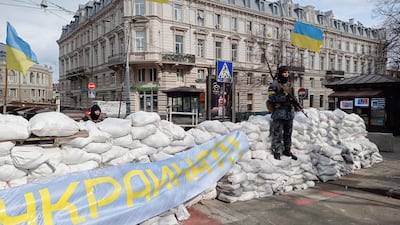
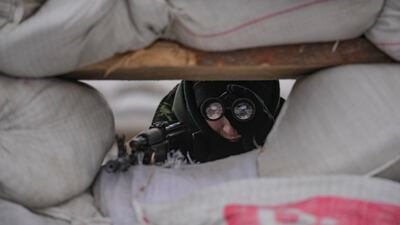
  • A soldier stands on a barricade made of sandbags in central Odesa, Ukraine. Reuters
    A soldier stands on a barricade made of sandbags in central Odesa, Ukraine. Reuters
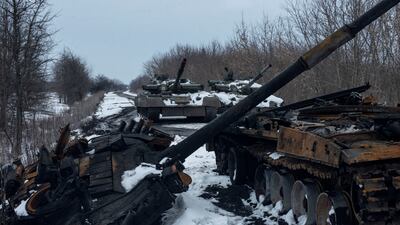
  • A charred Russian tank and captured tanks in the Sumy region. Reuters
    A charred Russian tank and captured tanks in the Sumy region. Reuters
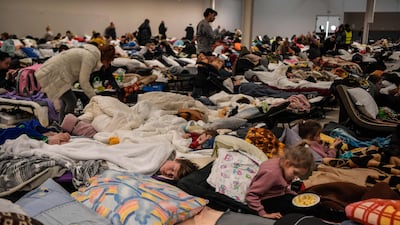
  • People rest at a temporary shelter for Ukrainian refugees in Przemysl, Poland. AFP
    People rest at a temporary shelter for Ukrainian refugees in Przemysl, Poland. AFP
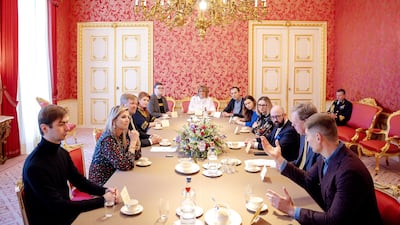
  • Ukraine's ambassador to the Netherlands, Maksym Kononenko, third right, and his wife Tetiana Doroshenko, fourth left, attend a meeting of members of the Ukrainian community with Dutch King Willem-Alexander, third left, and Queen Maxima, second left, to discuss the situation in Ukraine, in The Hague. EPA
    Ukraine's ambassador to the Netherlands, Maksym Kononenko, third right, and his wife Tetiana Doroshenko, fourth left, attend a meeting of members of the Ukrainian community with Dutch King Willem-Alexander, third left, and Queen Maxima, second left, to discuss the situation in Ukraine, in The Hague. EPA
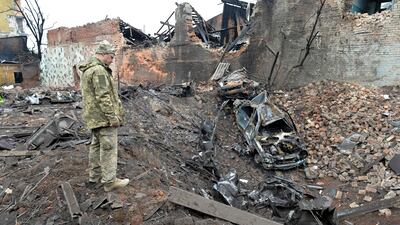
  • A Ukrainian soldier looks at the destruction after shelling in Ukraine's second-largest city of Kharkiv. AFP
    A Ukrainian soldier looks at the destruction after shelling in Ukraine's second-largest city of Kharkiv. AFP
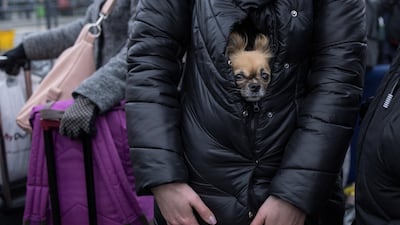
  • A refugee holds her dog as they wait for trains to Poland in Lviv, Ukraine. Reuters
    A refugee holds her dog as they wait for trains to Poland in Lviv, Ukraine. Reuters
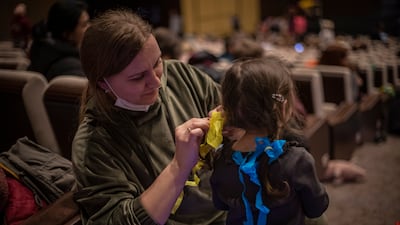
  • A woman ties ribbons in Ukrainian national flag colours in a girl's hair as people wait at a refugee assistance centre in Prague, Czech Republic. EPA
    A woman ties ribbons in Ukrainian national flag colours in a girl's hair as people wait at a refugee assistance centre in Prague, Czech Republic. EPA
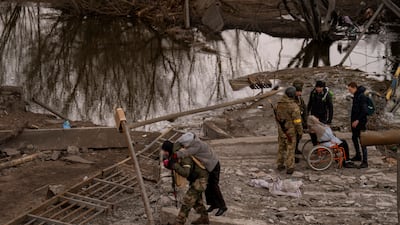
  • A Ukrainian soldier carries an elderly woman crossing the Irpin river on the outskirts of Kyiv. AP
    A Ukrainian soldier carries an elderly woman crossing the Irpin river on the outskirts of Kyiv. AP
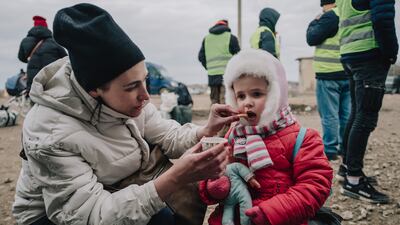
  • Lena, who had never left Ukraine before fleeing into Moldova, feeds Dasha, 3, soon after crossing the border. Erin Clare Brown for The National
    Lena, who had never left Ukraine before fleeing into Moldova, feeds Dasha, 3, soon after crossing the border. Erin Clare Brown for The National
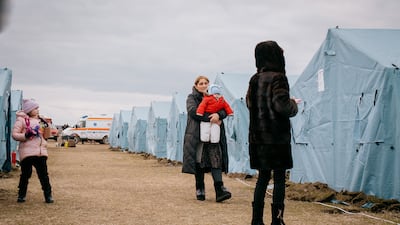
  • Refugees without immediate plans to move further inland can stay the night in tents set up on Moldova's side of the border. Erin Clare Brown for The National
    Refugees without immediate plans to move further inland can stay the night in tents set up on Moldova's side of the border. Erin Clare Brown for The National
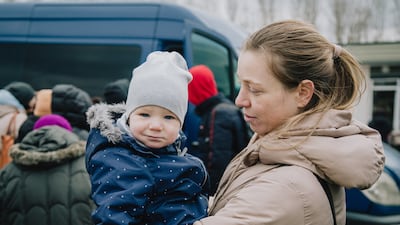
  • Tatiana and her son wait for a van that will carry them from the Moldovan border to Chisinau. Erin Clare Brown for The National
    Tatiana and her son wait for a van that will carry them from the Moldovan border to Chisinau. Erin Clare Brown for The National
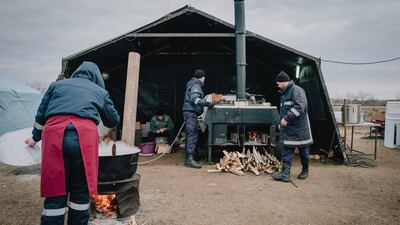
  • Each night, the Palanca refugee camp in Moldova feeds up to 300 people who arrive with no onward plans. Erin Clare Brown for The National
    Each night, the Palanca refugee camp in Moldova feeds up to 300 people who arrive with no onward plans. Erin Clare Brown for The National
  • People pass a damaged bridge while fleeing the town of Irpin, close to the Ukrainian capital of Kyiv. AP
    People pass a damaged bridge while fleeing the town of Irpin, close to the Ukrainian capital of Kyiv. AP
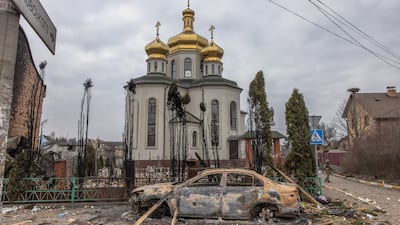
  • A Ukrainian soldier stands guard next to a church in Irpin. EPA
    A Ukrainian soldier stands guard next to a church in Irpin. EPA
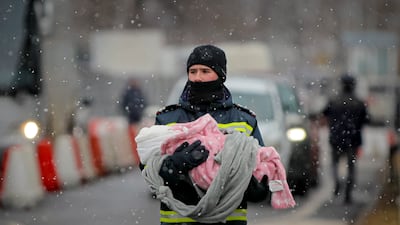
  • A firefighter holds the baby of a Ukrainian refugee at the border in Romania. AP
    A firefighter holds the baby of a Ukrainian refugee at the border in Romania. AP
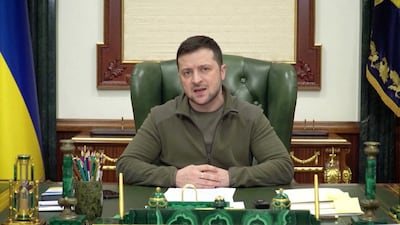
  • Ukrainian President Volodymyr Zelenskyy speaks in Kyiv. Reuters
    Ukrainian President Volodymyr Zelenskyy speaks in Kyiv. Reuters
  • A Ukrainian soldier at a checkpoint in Kyiv. AP
    A Ukrainian soldier at a checkpoint in Kyiv. AP
  • Ukrainian activist Ihor Mazur, left, a veteran of the war in the country's east, looks at a night-vision device in Kyiv. AP
    Ukrainian activist Ihor Mazur, left, a veteran of the war in the country's east, looks at a night-vision device in Kyiv. AP
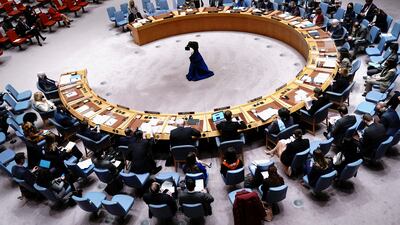
  • Ambassadors attend a UN Security Council meeting on threats to international security after Russia's invasion of Ukraine, in New York. Reuters
    Ambassadors attend a UN Security Council meeting on threats to international security after Russia's invasion of Ukraine, in New York. Reuters
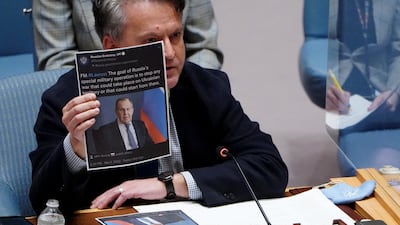
  • Ukraine's UN ambassador Sergey Kyslytsya holds a paper with an image of Russia's Foreign Minister Sergey Lavrov as he addresses the Security Council in New York. Reuters
    Ukraine's UN ambassador Sergey Kyslytsya holds a paper with an image of Russia's Foreign Minister Sergey Lavrov as he addresses the Security Council in New York. Reuters
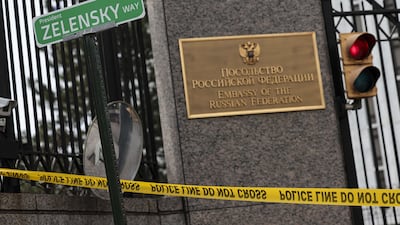
  • A road sign put up in support of Mr Zelenskyy outside Russia's embassy in Washington. AFP
    A road sign put up in support of Mr Zelenskyy outside Russia's embassy in Washington. AFP
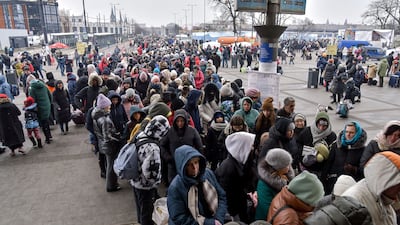
  • Ukrainian refugees at the train station in Lviv, western Ukraine. EPA
    Ukrainian refugees at the train station in Lviv, western Ukraine. EPA
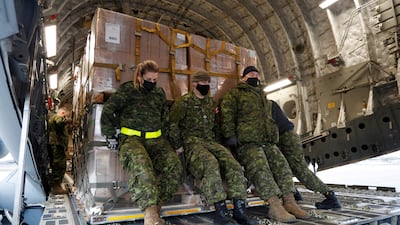
  • Lethal and non-lethal Ukrainian aid is loaded on to a plane bound for Poland by Canadian soldiers in Trenton, Ontario. Reuters
    Lethal and non-lethal Ukrainian aid is loaded on to a plane bound for Poland by Canadian soldiers in Trenton, Ontario. Reuters
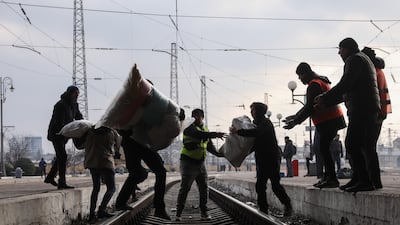
  • Volunteers carry medical aid and necessities at a train station in Lviv. EPA
    Volunteers carry medical aid and necessities at a train station in Lviv. EPA
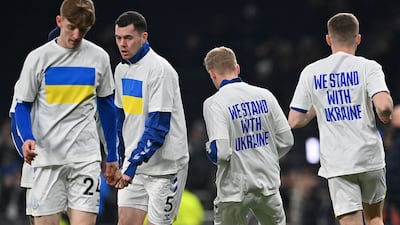
  • Everton players wear T-shirts in support of Ukraine as they warm up for an English Premier League football match against Tottenham Hotspur. AP
    Everton players wear T-shirts in support of Ukraine as they warm up for an English Premier League football match against Tottenham Hotspur. AP
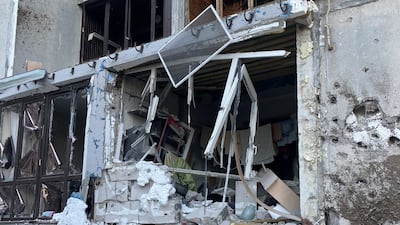
  • A residential building damaged by Russian shelling in Chernihiv, Ukraine. Reuters
    A residential building damaged by Russian shelling in Chernihiv, Ukraine. Reuters
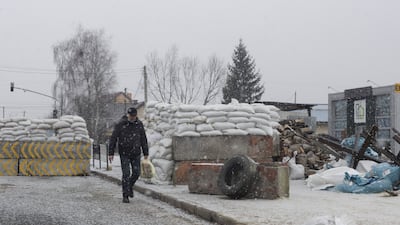
  • A man walks past a checkpoint in heavy snow in Lviv. Getty
    A man walks past a checkpoint in heavy snow in Lviv. Getty
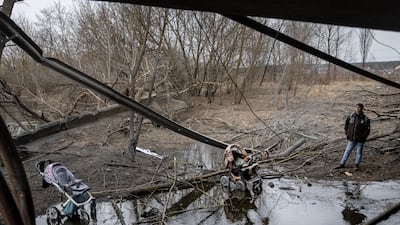
  • A man fleeing fighting in Irpin waits to cross a river after Russian forces entered the city. Getty
    A man fleeing fighting in Irpin waits to cross a river after Russian forces entered the city. Getty
  • Soldiers assist Irpin residents underneath a damaged bridge as they flee. Getty
    Soldiers assist Irpin residents underneath a damaged bridge as they flee. Getty
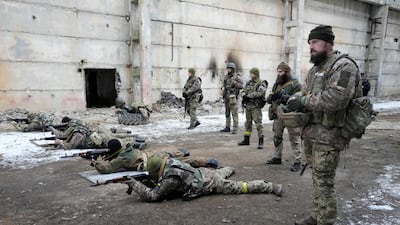
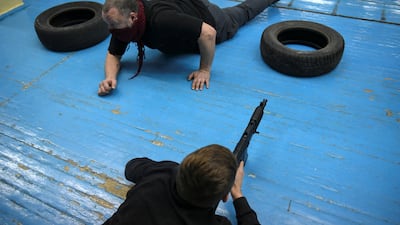
  • Ukrainian civilians who volunteered to join the Territorial Defence Forces take part in a training exercise in Odesa after Russia's invasion. Reuters
    Ukrainian civilians who volunteered to join the Territorial Defence Forces take part in a training exercise in Odesa after Russia's invasion. Reuters
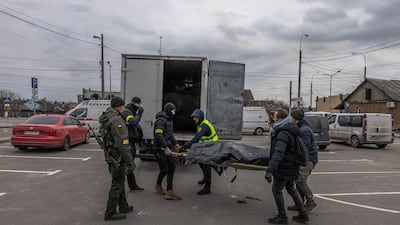
  • Men carry a body to a lorry as people flee from the frontline town of Irpin. EPA
    Men carry a body to a lorry as people flee from the frontline town of Irpin. EPA
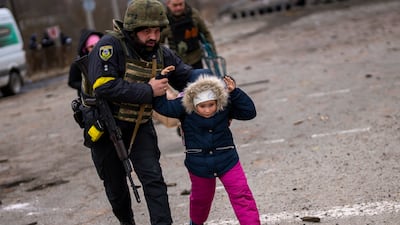
  • A Ukrainian police officer runs with a child as the sound of shelling echoes nearby in Irpin. AP
    A Ukrainian police officer runs with a child as the sound of shelling echoes nearby in Irpin. AP
  • Parents and children struggle to board a train in Lviv. AP
    Parents and children struggle to board a train in Lviv. AP

To help mitigate this, global central banks should focus on fighting inflation and leaving governments to respond with spending to cushion economies from the impact of the war in Ukraine.

This could reduce the negative impact on growth with only a minor extra impetus to inflation.

“In some countries, this could be funded by taxation of windfall gains,” the OECD said.

In terms of the policy and market response, Mr Cormann said the key messages are “that we need to remain cool headed, we need both sensible and pragmatic near-term and sensible longer term actions".

With economies facing a rocky road ahead, monetary policy should remain focused on ensuring well-anchored inflation expectations.

“Most central banks should continue their pre-war plans, with the exception of the most affected economies, where a pause may be needed to fully assess the consequences of the crisis,” the think tank said.

The impact of the war, “if sustained”, would produce “a deep recession in Russia”, the OECD said.

While together Ukraine and Russia represent less than 3 per cent of global trade, said Mr Cormann, and hold less than 2 per cent of the total global foreign direct investment stock, some countries are more exposed than others to the fallout from the war.

The pain would be felt most in Europe, with growth hit by up to 1.4 percentage points in the eurozone as OECD simulations show euro-area growth is most at risk,

Many European governments have already taken action that chimes with its fiscal recommendations, introducing targeted support for firms and households hit by the surge in energy prices.

“We do not yet know how this will fully play out but we do know this will hurt the global recovery and push inflation even higher,” OECD chief economist and Deputy Secretary-General Laurence Boone said. “Government policy has a crucial role to play in re-establishing some of the certainty and security we have lost.”

In the near term, the OECD said many governments will need to cushion the blow of higher energy prices, diversify energy sources and increase efficiency wherever possible.

“For food, higher production in OECD countries, refraining from protectionism and multilateral support for logistics will help the countries most affected by a disruption to supply from Russia and Ukraine,” it said.

“The war has underlined the importance of minimising dependence on Russia for key energy imports.”

It also warned against the risk of a “sharp increase in poverty and hunger”, particularly in developing economies, were supplies of wheat from Russia and Ukraine to be cut off completely, and of the rising cost of supporting refugees fleeing the conflict.

About 3 million people have fled Ukraine with more waves of refugees expected in the weeks ahead.


Results

5pm: Reem Island – Conditions (PA) Dh80,000 (Turf) 1,600m; Winner: Farasah, Antonio Fresu (jockey), Musabah Al Muhairi

5.30pm: Sir Baniyas Island – Maiden (PA) Dh80,000 (T) 1,400m; Winner: SSR Ghazwan, Antonio Fresu, Ibrahim Al Hadhrami

6pm: Wathba Stallions Cup – Handicap (PA) Dh70,000 (T) 1,400m; Winner: Astral Del Sol, Sean Kirrane, Ibrahim Al Hadhrami

6.30pm: Al Maryah Island – Maiden (PA) Dh80,000 (T) 2,200m; Winner: Toumadher, Dane O’Neill, Jaber Bittar

7pm: Yas Island – Handicap (PA) Dh80,000 (T) 2,200m; Winner: AF Mukhrej, Tadhg O’Shea, Ernst Oertel

7.30pm: Saadiyat Island – Handicap (TB) Dh80,000 (T) 2,400m; Winner: Celestial Spheres, Gary Sanchez, Ismail Mohammed

Sole survivors
  • Cecelia Crocker was on board Northwest Airlines Flight 255 in 1987 when it crashed in Detroit, killing 154 people, including her parents and brother. The plane had hit a light pole on take off
  • George Lamson Jr, from Minnesota, was on a Galaxy Airlines flight that crashed in Reno in 1985, killing 68 people. His entire seat was launched out of the plane
  • Bahia Bakari, then 12, survived when a Yemenia Airways flight crashed near the Comoros in 2009, killing 152. She was found clinging to wreckage after floating in the ocean for 13 hours.
  • Jim Polehinke was the co-pilot and sole survivor of a 2006 Comair flight that crashed in Lexington, Kentucky, killing 49.
WORLD RECORD FEES FOR GOALKEEPERS

1) Kepa Arrizabalaga, Athletic Bilbao to Chelsea (£72m)

2) Alisson, Roma to Liverpool (£67m)

3) Ederson, Benfica to Manchester City (£35m)

4) Gianluigi Buffon, Parma to Juventus (£33m)

5) Angelo Peruzzi, Inter Milan to Lazio (£15.7m

UAE currency: the story behind the money in your pockets
Pathaan
%3Cp%3E%3Cstrong%3EDirector%3A%3C%2Fstrong%3E%20Siddharth%20Anand%C2%A0%3C%2Fp%3E%0A%3Cp%3E%3Cstrong%3EStars%3A%3C%2Fstrong%3E%20Shah%20Rukh%20Khan%2C%20Deepika%20Padukone%2C%20John%20Abraham%C2%A0%3C%2Fp%3E%0A%3Cp%3E%3Cstrong%3ERating%3A%3C%2Fstrong%3E%203%2F5%3C%2Fp%3E%0A
The%20specs
%3Cp%3E%3Cstrong%3EEngine%3A%20%3C%2Fstrong%3E4.0-litre%20twin-turbo%20V8%0D%3Cbr%3E%3Cstrong%3EPower%3A%20%3C%2Fstrong%3E640hp%20at%206%2C000rpm%0D%3Cbr%3E%3Cstrong%3ETorque%3A%20%3C%2Fstrong%3E850Nm%20from%202%2C300-4%2C500rpm%0D%3Cbr%3E%3Cstrong%3ETransmission%3A%20%3C%2Fstrong%3E8-speed%20auto%0D%3Cbr%3E%3Cstrong%3EFuel%20consumption%3A%20%3C%2Fstrong%3E11.9L%2F100km%0D%3Cbr%3E%3Cstrong%3EPrice%3A%20%3C%2Fstrong%3EDh749%2C800%0D%3Cbr%3E%3Cstrong%3EOn%20sale%3A%20%3C%2Fstrong%3Enow%3C%2Fp%3E%0A
Ten tax points to be aware of in 2026

1. Domestic VAT refund amendments: request your refund within five years

If a business does not apply for the refund on time, they lose their credit.

2. E-invoicing in the UAE

Businesses should continue preparing for the implementation of e-invoicing in the UAE, with 2026 a preparation and transition period ahead of phased mandatory adoption. 

3. More tax audits

Tax authorities are increasingly using data already available across multiple filings to identify audit risks. 

4. More beneficial VAT and excise tax penalty regime

Tax disputes are expected to become more frequent and more structured, with clearer administrative objection and appeal processes. The UAE has adopted a new penalty regime for VAT and excise disputes, which now mirrors the penalty regime for corporate tax.

5. Greater emphasis on statutory audit

There is a greater need for the accuracy of financial statements. The International Financial Reporting Standards standards need to be strictly adhered to and, as a result, the quality of the audits will need to increase.

6. Further transfer pricing enforcement

Transfer pricing enforcement, which refers to the practice of establishing prices for internal transactions between related entities, is expected to broaden in scope. The UAE will shortly open the possibility to negotiate advance pricing agreements, or essentially rulings for transfer pricing purposes. 

7. Limited time periods for audits

Recent amendments also introduce a default five-year limitation period for tax audits and assessments, subject to specific statutory exceptions. While the standard audit and assessment period is five years, this may be extended to up to 15 years in cases involving fraud or tax evasion. 

8. Pillar 2 implementation 

Many multinational groups will begin to feel the practical effect of the Domestic Minimum Top-Up Tax (DMTT), the UAE's implementation of the OECD’s global minimum tax under Pillar 2. While the rules apply for financial years starting on or after January 1, 2025, it is 2026 that marks the transition to an operational phase.

9. Reduced compliance obligations for imported goods and services

Businesses that apply the reverse-charge mechanism for VAT purposes in the UAE may benefit from reduced compliance obligations. 

10. Substance and CbC reporting focus

Tax authorities are expected to continue strengthening the enforcement of economic substance and Country-by-Country (CbC) reporting frameworks. In the UAE, these regimes are increasingly being used as risk-assessment tools, providing tax authorities with a comprehensive view of multinational groups’ global footprints and enabling them to assess whether profits are aligned with real economic activity. 

Contributed by Thomas Vanhee and Hend Rashwan, Aurifer

Mercer, the investment consulting arm of US services company Marsh & McLennan, expects its wealth division to at least double its assets under management (AUM) in the Middle East as wealth in the region continues to grow despite economic headwinds, a company official said.

Mercer Wealth, which globally has $160 billion in AUM, plans to boost its AUM in the region to $2-$3bn in the next 2-3 years from the present $1bn, said Yasir AbuShaban, a Dubai-based principal with Mercer Wealth.

Within the next two to three years, we are looking at reaching $2 to $3 billion as a conservative estimate and we do see an opportunity to do so,” said Mr AbuShaban.

Mercer does not directly make investments, but allocates clients’ money they have discretion to, to professional asset managers. They also provide advice to clients.

“We have buying power. We can negotiate on their (client’s) behalf with asset managers to provide them lower fees than they otherwise would have to get on their own,” he added.

Mercer Wealth’s clients include sovereign wealth funds, family offices, and insurance companies among others.

From its office in Dubai, Mercer also looks after Africa, India and Turkey, where they also see opportunity for growth.

Wealth creation in Middle East and Africa (MEA) grew 8.5 per cent to $8.1 trillion last year from $7.5tn in 2015, higher than last year’s global average of 6 per cent and the second-highest growth in a region after Asia-Pacific which grew 9.9 per cent, according to consultancy Boston Consulting Group (BCG). In the region, where wealth grew just 1.9 per cent in 2015 compared with 2014, a pickup in oil prices has helped in wealth generation.

BCG is forecasting MEA wealth will rise to $12tn by 2021, growing at an annual average of 8 per cent.

Drivers of wealth generation in the region will be split evenly between new wealth creation and growth of performance of existing assets, according to BCG.

Another general trend in the region is clients’ looking for a comprehensive approach to investing, according to Mr AbuShaban.

“Institutional investors or some of the families are seeing a slowdown in the available capital they have to invest and in that sense they are looking at optimizing the way they manage their portfolios and making sure they are not investing haphazardly and different parts of their investment are working together,” said Mr AbuShaban.

Some clients also have a higher appetite for risk, given the low interest-rate environment that does not provide enough yield for some institutional investors. These clients are keen to invest in illiquid assets, such as private equity and infrastructure.

“What we have seen is a desire for higher returns in what has been a low-return environment specifically in various fixed income or bonds,” he said.

“In this environment, we have seen a de facto increase in the risk that clients are taking in things like illiquid investments, private equity investments, infrastructure and private debt, those kind of investments were higher illiquidity results in incrementally higher returns.”

The Abu Dhabi Investment Authority, one of the largest sovereign wealth funds, said in its 2016 report that has gradually increased its exposure in direct private equity and private credit transactions, mainly in Asian markets and especially in China and India. The authority’s private equity department focused on structured equities owing to “their defensive characteristics.”

Profile

Company: Justmop.com

Date started: December 2015

Founders: Kerem Kuyucu and Cagatay Ozcan

Sector: Technology and home services

Based: Jumeirah Lake Towers, Dubai

Size: 55 employees and 100,000 cleaning requests a month

Funding:  The company’s investors include Collective Spark, Faith Capital Holding, Oak Capital, VentureFriends, and 500 Startups. 

Updated: March 18, 2022, 4:30 AM