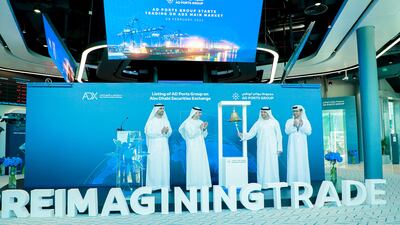

Abu Dhabi Ports Group shares surged more than 16 per cent as the company made its debut on the Abu Dhabi Securities Exchange on Tuesday.
Shares closed at Dh3.62 at the end of the trading session, valuing the company at more than $5 billion.
The operator of industrial cities and free zones in the emirate said its profit more than doubled in 2021 on the back of higher revenue as global trade continues to recover from the pandemic-induced slowdown.
Profit for the financial year climbed to Dh845 million ($230m), the company said on Tuesday. Revenue grew 14 per cent year-on-year to Dh3.9bn.
“We are pleased to see that our continued efforts to drive the growth of trade and industry across the UAE and beyond have achieved another key milestone with the official start of trading of AD Ports Group’s shares on the Abu Dhabi Securities Exchange," Capt Mohamed Juma Al Shamisi, group chief executive of AD Ports Group, said.
AD Ports Group has emerged as a "resilient" entity, meeting challenges faced by global markets in recent years, he added, continuing to "expand in size and capabilities and influencing adoption of innovation".
“And now, as a publicly listed company, we welcome new shareholders in joining us on our remarkable journey to develop the maritime and logistics industries across the region and globally,” he said.
-
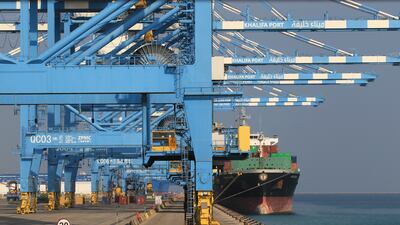
AD Ports, which is owned by ADQ, raised Dh4 billion from its share sale to help the company expand operations. Reuters -
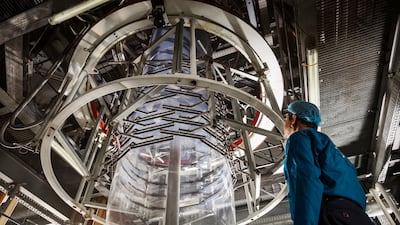
AD Ports Group reveals its polymer sector has grown in line with increased industrial demand. Photo: AD Ports -

AD Ports Group and Shandong Port Group signed an agreement in December 2021 to build the Middle East's first tyre hub. Photo: AD Ports -
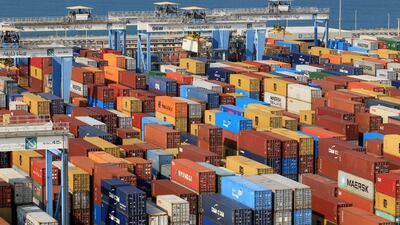
Containers are seen at Abu Dhabi's Khalifa Port. Reuters -
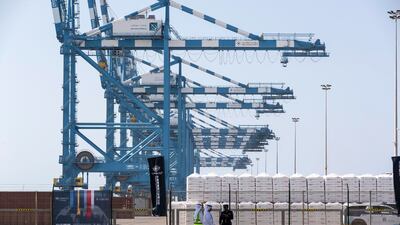
The official inauguration of the CSP Abu Dhabi Terminal in Khalifa Port. Antonie Robertson/The National -

AD Ports Group signs agreements with Aqaba Development Corporation in December 2021. Photo: AD Ports Group -
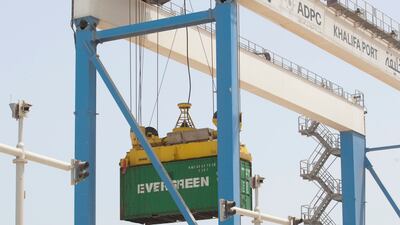
Supplies are unloaded using cranes at the Sheikh Khalifa Port. Razan Alzayani / The National


AD Ports Group's listing is the second one this year for ADX. It "follows a robust pipeline of listings and new products that we introduced in 2021", said Saeed Al Dhaheri, managing director and chief executive of ADX. "As part of our ‘ADX One’ [initiative] we will continue to encourage the listings pipeline to enhance our dynamic capital market."
AD Ports Group handled 45 million metric tonnes of cargo and 3.4 million 20-foot equivalent units (TEUs) of container volumes last year. Both cargo and container volumes grew from the previous year.
AD Ports Group raised Dh4bn from its share sale to help expand its operations globally and boost growth. ADQ, one of the region’s largest holding companies, remains a majority shareholder in AD Ports Group with a 75.44 per cent stake in the listed entity.
The trading of shares began on Tuesday under the ticker symbol ADPORTS on the Abu Dhabi Securities Exchange.
"AD Ports Group delivered strong growth in 2021, driven by excellent performance across our business,” Capt Al Shamisi said.
ADQ also transferred ownership of stakes in two listed companies to AD Ports Group, including a 22.32 per cent stake in logistics firm Aramex and a 10 per cent stake in UAE-based contractor National Marine Dredging Company to help the company grow.
“At the core of these results is the stability of our long-term contract business and our prudent investment strategy,” Martin Aarup, group chief financial officer of AD Ports Group, said.
“AD Ports Group benefits from our well-balanced capital structure, investment-grade credit ratings and stable long-term cash flows.”
Established in 2006, AD Ports Group owns and operates 10 ports in the UAE including Khalifa Port, Zayed Port, Mussaffah Port, Fujairah Terminals, Community Ports, Kamsar Port and the Abu Dhabi Cruise Terminal, as well as a terminal in Guinea.
It also manages more than 550 square kilometres of industrial zones, an end-to-end logistics business, besides offering a range of maritime services.
Total assets of the group stood at Dh28.5bn as of December 31, the company said.

