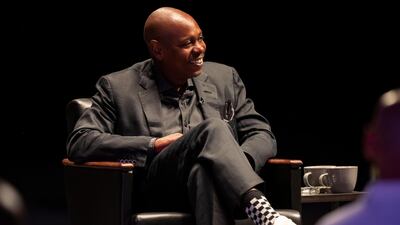
Dave Chappelle’s spiritual awakening began 30 years ago at a pizza shop.
Appearing as a guest in the latest season of the Netflix series My Guest Needs No Introduction with David Letterman, the superstar American comic sat down for a wide-ranging interview that provided a rare insight into how his faith drove his successful career.
"I wanted to have a meaningful life, a spiritual life, not just what my hands can hold,” he said. “I felt like I've always had this notion that life should mean something.”
Chappelle, 47, recalled how that higher purpose was given some shape through his visits to his local pizza shop as 17-year-old in Washington, DC. It was the positive vibes of the Muslim staff that caught his attention.
"The pizza shop was across from my house and it was, like, all these Muslim dudes that worked in there,” he said.
“I used to go in there and crack jokes. And I am also a naturally curious guy and I would ask [the owner] questions about his religion and the guy was so passionate about it. It was very compelling. I liked the perspective of it.”
Working for the greater good
Chappelle described how his faith allowed him to use his comedy for a greater purpose.
An example of which was the decision to undertake a recent run of comedy shows, complete with social-distancing measures, in his home village of Yellow Springs, Ohio, to benefit a community economically battered by the pandemic.
“For the last however many months, we've done like 26 shows here and it's expensive and it's hard,” he said. “Everyone who works on these shows is from Ohio or connected to our community. Many of them were furloughed. They weren't able to work. And just me doing stand-up, we're all able to get back up on our feet. To me, it's very meaningful. I [have] done a million shows, but the last 26 meant so much to me because it's like my community's offering to the world.”
A belief reflected in major faiths
Chappelle expressed his weariness surrounding the public discourse about Islam.
“It's been presented in the public space in such a narrow and dismissive view,” he said. “It's a beautiful religion. And the ideas in that religion are reflected in all the major Abrahamic faiths. You'll see these ideas in both Christianity and Judaism, you know. It is the idea that this place does mean something, you know?”
When asked by host David Letterman about some of the perceived anti-Muslim policies and rhetoric attributed to US president Donald Trump, Chappelle shrugs it off.
“You don't expect necessarily that much empathy, compassion or cultural astuteness from a guy like that,” he said.
“What is sad about it is that the [presidential] chair doesn't have more humanity. But has that chair ever been that humane?”
The miracle of Zamzam water
In rounding off the segment, Chappelle recalled one of his favourite stories from Islamic history, which centered on the origins of Zamzam water.
As detailed in the Quran, the water is said to have miraculously sprung in front of Prophet Abraham's wife Hajar while desperately roaming the desert in search of sustenance. Zamzam remains available to drink within the grounds of the Makkah Grand Mosque in Saudi Arabia.
“The thing that comforts me about it is the idea that all of this is from a singular source and the source is ultimately kind. And even though we may not understand the intentions of this source, we're all connected and bounded by it.”
Inspired by the concept, Letterman expressed that he would like to visit Saudi Arabia with Chappelle one day to see the location where Zamzam water was found.
Chappelle quipped the site is limited to Muslim visitors.
“I could go see it,” he said. “You probably have to make some phone calls.”
‘My Guest Needs No Introduction with David Letterman’ is available to stream now on Netflix.

Vidaamuyarchi
Director: Magizh Thirumeni
Stars: Ajith Kumar, Arjun Sarja, Trisha Krishnan, Regina Cassandra
Rating: 4/5
UAE currency: the story behind the money in your pockets
Paatal Lok season two
Directors: Avinash Arun, Prosit Roy
Stars: Jaideep Ahlawat, Ishwak Singh, Lc Sekhose, Merenla Imsong
Rating: 4.5/5
Company%20Profile
%3Cp%3E%3Cstrong%3ECompany%20name%3A%20%3C%2Fstrong%3ENamara%0D%3Cbr%3E%3Cstrong%3EStarted%3A%20%3C%2Fstrong%3EJune%202022%0D%3Cbr%3E%3Cstrong%3EFounder%3A%20%3C%2Fstrong%3EMohammed%20Alnamara%0D%3Cbr%3E%3Cstrong%3EBased%3A%20%3C%2Fstrong%3EDubai%20%0D%3Cbr%3E%3Cstrong%3ESector%3A%20%3C%2Fstrong%3EMicrofinance%0D%3Cbr%3E%3Cstrong%3ECurrent%20number%20of%20staff%3A%20%3C%2Fstrong%3E16%0D%3Cbr%3E%3Cstrong%3EInvestment%20stage%3A%20%3C%2Fstrong%3ESeries%20A%0D%3Cbr%3E%3Cstrong%3EInvestors%3A%20%3C%2Fstrong%3EFamily%20offices%0D%3Cbr%3E%3C%2Fp%3E%0A
COMPANY%20PROFILE
%3Cp%3E%3Cstrong%3EName%3A%20%3C%2Fstrong%3EYango%20Deli%20Tech%0D%3Cbr%3E%3Cstrong%3EBased%3A%20%3C%2Fstrong%3EUAE%0D%3Cbr%3E%3Cstrong%3ELaunch%20year%3A%20%3C%2Fstrong%3E2022%0D%3Cbr%3E%3Cstrong%3ESector%3A%20%3C%2Fstrong%3ERetail%20SaaS%0D%3Cbr%3E%3Cstrong%3EFunding%3A%20%3C%2Fstrong%3ESelf%20funded%0D%3Cbr%3E%3C%2Fp%3E%0A
Innotech Profile
Date started: 2013
Founder/CEO: Othman Al Mandhari
Based: Muscat, Oman
Sector: Additive manufacturing, 3D printing technologies
Size: 15 full-time employees
Stage: Seed stage and seeking Series A round of financing
Investors: Oman Technology Fund from 2017 to 2019, exited through an agreement with a new investor to secure new funding that it under negotiation right now.
UAE%20SQUAD
%3Cp%3E%0D%3Cstrong%3EMen%3A%3C%2Fstrong%3E%20Saif%20Al%20Zaabi%2C%20Salem%20Al%20Marzooqi%2C%20Zayed%20Al%20Ansaari%2C%20Saud%20Abdulaziz%20Rahmatalla%2C%20Adel%20Shanbih%2C%20Ahmed%20Khamis%20Al%20Blooshi%2C%20Abdalla%20Al%20Naqbi%2C%20Khaled%20Al%20Hammadi%2C%20Mohammed%20Khamis%20Khalaf%2C%20Mohammad%20Fahad%2C%20Abdulla%20Al%20Arimi.%0D%3Cbr%3E%3Cstrong%3EWomen%3A%3C%2Fstrong%3E%20Mozah%20Al%20Zeyoudi%2C%20Haifa%20Al%20Naqbi%2C%20Ayesha%20Al%20Mutaiwei.%3C%2Fp%3E%0A
Types of bank fraud
1) Phishing
Fraudsters send an unsolicited email that appears to be from a financial institution or online retailer. The hoax email requests that you provide sensitive information, often by clicking on to a link leading to a fake website.
2) Smishing
The SMS equivalent of phishing. Fraudsters falsify the telephone number through “text spoofing,” so that it appears to be a genuine text from the bank.
3) Vishing
The telephone equivalent of phishing and smishing. Fraudsters may pose as bank staff, police or government officials. They may persuade the consumer to transfer money or divulge personal information.
4) SIM swap
Fraudsters duplicate the SIM of your mobile number without your knowledge or authorisation, allowing them to conduct financial transactions with your bank.
5) Identity theft
Someone illegally obtains your confidential information, through various ways, such as theft of your wallet, bank and utility bill statements, computer intrusion and social networks.
6) Prize scams
Fraudsters claiming to be authorised representatives from well-known organisations (such as Etisalat, du, Dubai Shopping Festival, Expo2020, Lulu Hypermarket etc) contact victims to tell them they have won a cash prize and request them to share confidential banking details to transfer the prize money.
Company%20profile
%3Cp%3EName%3A%20Tabby%3Cbr%3EFounded%3A%20August%202019%3B%20platform%20went%20live%20in%20February%202020%3Cbr%3EFounder%2FCEO%3A%20Hosam%20Arab%2C%20co-founder%3A%20Daniil%20Barkalov%3Cbr%3EBased%3A%20Dubai%2C%20UAE%3Cbr%3ESector%3A%20Payments%3Cbr%3ESize%3A%2040-50%20employees%3Cbr%3EStage%3A%20Series%20A%3Cbr%3EInvestors%3A%20Arbor%20Ventures%2C%20Mubadala%20Capital%2C%20Wamda%20Capital%2C%20STV%2C%20Raed%20Ventures%2C%20Global%20Founders%20Capital%2C%20JIMCO%2C%20Global%20Ventures%2C%20Venture%20Souq%2C%20Outliers%20VC%2C%20MSA%20Capital%2C%20HOF%20and%20AB%20Accelerator.%3Cbr%3E%3C%2Fp%3E%0A
Scores:
Day 4
England 290 & 346
Sri Lanka 336 & 226-7 (target 301)
Sri Lanka require another 75 runs with three wickets remaining
Jetour T1 specs
Engine: 2-litre turbocharged
Power: 254hp
Torque: 390Nm
Price: From Dh126,000
Available: Now
Mercer, the investment consulting arm of US services company Marsh & McLennan, expects its wealth division to at least double its assets under management (AUM) in the Middle East as wealth in the region continues to grow despite economic headwinds, a company official said.
Mercer Wealth, which globally has $160 billion in AUM, plans to boost its AUM in the region to $2-$3bn in the next 2-3 years from the present $1bn, said Yasir AbuShaban, a Dubai-based principal with Mercer Wealth.
“Within the next two to three years, we are looking at reaching $2 to $3 billion as a conservative estimate and we do see an opportunity to do so,” said Mr AbuShaban.
Mercer does not directly make investments, but allocates clients’ money they have discretion to, to professional asset managers. They also provide advice to clients.
“We have buying power. We can negotiate on their (client’s) behalf with asset managers to provide them lower fees than they otherwise would have to get on their own,” he added.
Mercer Wealth’s clients include sovereign wealth funds, family offices, and insurance companies among others.
From its office in Dubai, Mercer also looks after Africa, India and Turkey, where they also see opportunity for growth.
Wealth creation in Middle East and Africa (MEA) grew 8.5 per cent to $8.1 trillion last year from $7.5tn in 2015, higher than last year’s global average of 6 per cent and the second-highest growth in a region after Asia-Pacific which grew 9.9 per cent, according to consultancy Boston Consulting Group (BCG). In the region, where wealth grew just 1.9 per cent in 2015 compared with 2014, a pickup in oil prices has helped in wealth generation.
BCG is forecasting MEA wealth will rise to $12tn by 2021, growing at an annual average of 8 per cent.
Drivers of wealth generation in the region will be split evenly between new wealth creation and growth of performance of existing assets, according to BCG.
Another general trend in the region is clients’ looking for a comprehensive approach to investing, according to Mr AbuShaban.
“Institutional investors or some of the families are seeing a slowdown in the available capital they have to invest and in that sense they are looking at optimizing the way they manage their portfolios and making sure they are not investing haphazardly and different parts of their investment are working together,” said Mr AbuShaban.
Some clients also have a higher appetite for risk, given the low interest-rate environment that does not provide enough yield for some institutional investors. These clients are keen to invest in illiquid assets, such as private equity and infrastructure.
“What we have seen is a desire for higher returns in what has been a low-return environment specifically in various fixed income or bonds,” he said.
“In this environment, we have seen a de facto increase in the risk that clients are taking in things like illiquid investments, private equity investments, infrastructure and private debt, those kind of investments were higher illiquidity results in incrementally higher returns.”
The Abu Dhabi Investment Authority, one of the largest sovereign wealth funds, said in its 2016 report that has gradually increased its exposure in direct private equity and private credit transactions, mainly in Asian markets and especially in China and India. The authority’s private equity department focused on structured equities owing to “their defensive characteristics.”
