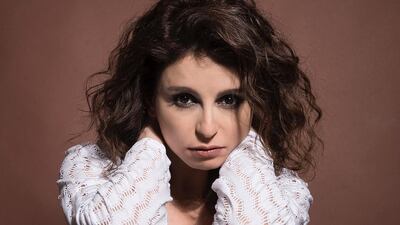
Anjo Rihane is a prominent Lebanese actress who was been in award-winning films and theatres productions. Anjo Rihane

'How sustainable is this life?': how Lebanon's deteriorating economy is crushing the dreams of young and old


Samia Badih
  • English
  • Arabic

Many experts have described it as the worst economic crisis in Lebanon's history.

The Lebanese pound's value has dropped to record lows against the dollar, food prices have gone up and unemployment has risen drastically as more businesses shut their doors.

Coupled with a global pandemic, it has become a hopeless situation for many, including artists in the film and television industry.

A "sinking Titanic" is how director Tony Eli Kanaan, 27, describes it. "I am super frustrated. I'm super numbed. I hate that we have adapted to this situation," Kanaan tells The National.

"We have just adapted to this joke and that is what is frustrating me, other than the denial and the numbness I feel," he adds.

Also a writer and actor, Kanaan's career only recently started to take off, and his ultimate goal is to go to Los Angeles to pursue acting professionally. "I'm trying to get out of here," he says. "I still think whoever has the chance to leave, should leave."

His message might surprise some, considering the success the young filmmaker has started to garner in his home country. Thanks to the comedy skits he posts on his Instagram page, Kanaan has racked up more than 50,000 followers in fewer than five months.

However, despite his growing social media following, Kanaan says it is hard to not have a pessimistic view. "My perception of Lebanon is complete doom. How sustainable is this life?"

Lebanese director Tony Kanaan hopes to pursue a professional acting career in Los Angeles. Tony Kanaan

And these feelings of despair are not just felt by the younger generation. The same sentiment is echoed by creatives who have been in the production industry for years.

'Who is going to invest in films?'

Nasser Fakih is the veteran Lebanese TV director behind popular shows such as La Youmal, Mafi Metlo and Beit El Kell. He says projects have been put on hold because producers have not been able to pay their crews in dollars. Yet, the ramifications are more than merely financial.

Lebanese veteran television director Nasser Fakih. Nasser Fakih

"The problem is also mental and psychological, because an artist has to be in a certain environment in order to work. When the environment is negative and everything around him is falling apart, it becomes difficult for an artist to really excel in his or her field," he says.

Having worked in the industry for almost three decades, it is a situation Fakih says is painful to witness.

"We have such a beautiful country which is [like] a natural studio. But who is going to invest in films when people are losing their jobs and going hungry?"

'I don't want my kids to go through the same pain'

Anjo Rihane, 42, asks a similar question. For the actress, the situation led to the cancellation of a play she was in, which had been running for a year.

"The first thing that people stop doing [during an economic crisis] is going to the theatre. I also had a television series, but that has been postponed," she tells The National.

Lebanon's economic unravelling is beginning to slip out of control as its currency declines, threatening to drag the nation into hyperinflation. Bloomberg

"I don't think there is any Lebanese who has not put in place a plan B, even those who tell you that they are against leaving the country," she says.

As a mother of two, the thought of emigration hovers over her head like a ghost, she says. "I don't want my kids to go through the same pain."

The pain Rihane speaks of is shared by most Lebanese people. Many have seen their life's savings disappear overnight, due to the devaluation of the currency, and on top of it all, they do not have access to their funds at the banks.

"Quite simply, I want my rights," Rihane says. "I want my kids to live in a country where they don't have to be afraid of a stray bullet, where they don't get asked about their religion. Nor do I want them to use 'wasta' to get anything done."

I still have hope and I believe we cannot live without hope

Despite everything, Fakih still has a sense of hope, though he admits optimism is becoming ever harder to find. At 50, he does not consider emigration an option.

"I would not like to throw away everything I have achieved over all these years in my field, and go somewhere else where I might or might not succeed.

"However, I would understand if someone has given up hope and decided to emigrate, whatever field they are in," he says.

"I still have hope and I believe we cannot live without hope. Hope is part of human nature and the disappearance of hope means the end of dreams, of life of everything that is good in this world," the director adds.

While Fakih and Rihane still hold on to hope as they see fellow citizens continue to march on the streets demanding change, the real fear is if they, like Kanaan, also decide it is time to pack their bags and leave Lebanon behind them.


Mercer, the investment consulting arm of US services company Marsh & McLennan, expects its wealth division to at least double its assets under management (AUM) in the Middle East as wealth in the region continues to grow despite economic headwinds, a company official said.

Mercer Wealth, which globally has $160 billion in AUM, plans to boost its AUM in the region to $2-$3bn in the next 2-3 years from the present $1bn, said Yasir AbuShaban, a Dubai-based principal with Mercer Wealth.

Within the next two to three years, we are looking at reaching $2 to $3 billion as a conservative estimate and we do see an opportunity to do so,” said Mr AbuShaban.

Mercer does not directly make investments, but allocates clients’ money they have discretion to, to professional asset managers. They also provide advice to clients.

“We have buying power. We can negotiate on their (client’s) behalf with asset managers to provide them lower fees than they otherwise would have to get on their own,” he added.

Mercer Wealth’s clients include sovereign wealth funds, family offices, and insurance companies among others.

From its office in Dubai, Mercer also looks after Africa, India and Turkey, where they also see opportunity for growth.

Wealth creation in Middle East and Africa (MEA) grew 8.5 per cent to $8.1 trillion last year from $7.5tn in 2015, higher than last year’s global average of 6 per cent and the second-highest growth in a region after Asia-Pacific which grew 9.9 per cent, according to consultancy Boston Consulting Group (BCG). In the region, where wealth grew just 1.9 per cent in 2015 compared with 2014, a pickup in oil prices has helped in wealth generation.

BCG is forecasting MEA wealth will rise to $12tn by 2021, growing at an annual average of 8 per cent.

Drivers of wealth generation in the region will be split evenly between new wealth creation and growth of performance of existing assets, according to BCG.

Another general trend in the region is clients’ looking for a comprehensive approach to investing, according to Mr AbuShaban.

“Institutional investors or some of the families are seeing a slowdown in the available capital they have to invest and in that sense they are looking at optimizing the way they manage their portfolios and making sure they are not investing haphazardly and different parts of their investment are working together,” said Mr AbuShaban.

Some clients also have a higher appetite for risk, given the low interest-rate environment that does not provide enough yield for some institutional investors. These clients are keen to invest in illiquid assets, such as private equity and infrastructure.

“What we have seen is a desire for higher returns in what has been a low-return environment specifically in various fixed income or bonds,” he said.

“In this environment, we have seen a de facto increase in the risk that clients are taking in things like illiquid investments, private equity investments, infrastructure and private debt, those kind of investments were higher illiquidity results in incrementally higher returns.”

The Abu Dhabi Investment Authority, one of the largest sovereign wealth funds, said in its 2016 report that has gradually increased its exposure in direct private equity and private credit transactions, mainly in Asian markets and especially in China and India. The authority’s private equity department focused on structured equities owing to “their defensive characteristics.”

Four-day collections of TOH

Day             Indian Rs (Dh)        

Thursday    500.75 million (25.23m)

Friday         280.25m (14.12m)

Saturday     220.75m (11.21m)

Sunday       170.25m (8.58m)

Total            1.19bn (59.15m)

(Figures in millions, approximate)

The details

Heard It in a Past Life

Maggie Rogers

(Capital Records)

3/5

2019 Asian Cup final

Japan v Qatar
Friday, 6pm
Zayed Sports City Stadium, Abu Dhabi