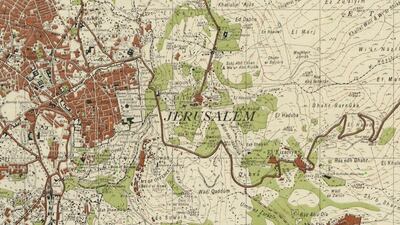
Palestine, Today allows us to travel through time. The interactive platform of maps helps people trace the transformation of nearly 1,200 communities in Palestine from the period of the Nakba in the 1940s to present day.
On Nakba Day, which falls on Friday, Palestinians commemorate a dark period in history, when more than 700,000 Palestinian Arabs were uprooted from their homes due to the 1948 Arab-Israeli conflict. It culminated in the establishment of the State of Israel on May 14, 1948.
The Nakba, Arabic for catastrophe, caused the destruction of Palestinian towns and villages and created a refugee crisis that persists in the region today.
The new platform presents a quick glimpse of this history, but draws a larger picture of the Nakba’s legacy on communities across Palestine, and what is now Israel. Using detailed maps by the British Mandate from the 1940s and recent satellite imagery, the website offers a “then and now” view of towns, villages and cities across this stretch of still-occupied territory.
The website is a project by the organisation Visualising Palestine and builds on existing material from Palestine Open Maps, an open-source platform launched in 2018. It includes a large map from the 1940s that is stitched together from 155 historic sheets drawn by the British Mandate in Palestine.
The same map has been used as the starting point for Palestine, Today. With only a few clicks, visitors can navigate the map’s colour-coded markers, which indicate the areas that have been destroyed, depopulated or remain. Each marker is accompanied with brief information about a particular community and its shifting demographics.
One example is the city of Jaffa, which had a majority Palestinian population in 1945. In May 1948, forces displaced most residents, and today the city is part of Israel, with a 60 per cent Jewish population.
Architect and UX designer Ahmad Barclay, along with members of Visualising Palestine, developed Palestine Open Maps and Palestine, Today. For the latest platform, the team conducted research and gleaned statistics from various sources, including the Palestine Land Society, Zochrot and official census bureaus from both Palestine and Israel.
“We are intentionally launching the platform ahead of Nakba Day as a way for individuals to share the places they are from, whether they are from there or exiled from there,” Barclay says.
“They can share their own stories with friends and family or on social media, and we are already starting to see that.”
Palestine, Today also found support from organisations such as the Institute for Middle East Understanding, Al Shabka and Jewish Voice for Peace, which have shared the project on their platforms.
For Barclay, Palestine, Today underscores a view of the region beyond the events of the Nakba and the state’s current geopolitical narratives.
“One key thing is the choice of title, Palestine, Today. It is intentionally saying that Palestine is a place that continues to exist in the sense that so many of these locations remain and the population remains there,” he says. “Hundreds of [Palestinian] communities may have Israeli citizenship or are recognised as part of the State of Israel, but they are still the same people. [Palestine] is not just the West Bank and Gaza.
“This is a map of one territory,” he adds.
“Colonisation and occupation were imposed on that territory and people were expelled from there, but it does not change the piece of land. We are talking about this continuity in history. There are lines that have been drawn on the map. There is military occupation, the blockade on Gaza, but there is also the continuity of this one territory. In the present day, Israel has maintained a system of apartheid with one power that controls and divides.”
Barclay hopes that this new platform will also encourage the public to use the resources from Palestine Open Maps for their research or projects. The maps have been collected from the public domain and are available for download on the website.
Both projects tie into Visualising Palestine’s aim of promoting social justice and alternative narratives of the Palestine-Israel issue through data visualisation and design.
Visualising Palestine, which was founded in 2012, is known for creating eye-catching infographics and posters that illustrate the issues facing the state.
More information is at Palestine, Today, Palestine Open Maps and Visualizing Palestine

The%C2%A0specs%20
%3Cp%3E%3Cstrong%3EEngine%3A%20%3C%2Fstrong%3Etwo%20permanent%20magnet%20synchronous%20motors%3Cbr%3E%3Cstrong%3ETransmission%3A%20%3C%2Fstrong%3Etwo-speed%3Cbr%3E%3Cstrong%3EPower%3A%20%3C%2Fstrong%3E625hp%3Cbr%3E%3Cstrong%3ETorque%3A%20%3C%2Fstrong%3E850Nm%3Cbr%3E%3Cstrong%3ERange%3A%20%3C%2Fstrong%3E456km%3Cbr%3E%3Cstrong%3EPrice%3A%20%3C%2Fstrong%3Efrom%20Dh737%2C480%3Cbr%3E%3Cstrong%3EOn%20sale%3A%20%3C%2Fstrong%3Enow%3C%2Fp%3E%0A
IPL 2018 FINAL
Sunrisers Hyderabad 178-6 (20 ovs)
Chennai Super Kings 181-2 (18.3 ovs)
Chennai win by eight wickets
Brown/Black belt finals
3pm: 49kg female: Mayssa Bastos (BRA) v Thamires Aquino (BRA)
3.07pm: 56kg male: Hiago George (BRA) v Carlos Alberto da Silva (BRA)
3.14pm: 55kg female: Amal Amjahid (BEL) v Bianca Basilio (BRA)
3.21pm: 62kg male: Gabriel de Sousa (BRA) v Joao Miyao (BRA)
3.28pm: 62kg female: Beatriz Mesquita (BRA) v Ffion Davies (GBR)
3.35pm: 69kg male: Isaac Doederlein (BRA) v Paulo Miyao (BRA)
3.42pm: 70kg female: Thamara Silva (BRA) v Alessandra Moss (AUS)
3.49pm: 77kg male: Oliver Lovell (GBR) v Tommy Langarkar (NOR)
3.56pm: 85kg male: Faisal Al Ketbi (UAE) v Rudson Mateus Teles (BRA)
4.03pm: 90kg female: Claire-France Thevenon (FRA) v Gabreili Passanha (BRA)
4.10pm: 94kg male: Adam Wardzinski (POL) v Kaynan Duarte (BRA)
4.17pm: 110kg male: Yahia Mansoor Al Hammadi (UAE) v Joao Rocha (BRA
Schedule:
Pakistan v Sri Lanka:
28 Sep-2 Oct, 1st Test, Abu Dhabi
6-10 Oct, 2nd Test (day-night), Dubai
13 Oct, 1st ODI, Dubai
16 Oct, 2nd ODI, Abu Dhabi
18 Oct, 3rd ODI, Abu Dhabi
20 Oct, 4th ODI, Sharjah
23 Oct, 5th ODI, Sharjah
26 Oct, 1st T20I, Abu Dhabi
27 Oct, 2nd T20I, Abu Dhabi
29 Oct, 3rd T20I, Lahore
Global Fungi Facts
• Scientists estimate there could be as many as 3 million fungal species globally
• Only about 160,000 have been officially described leaving around 90% undiscovered
• Fungi account for roughly 90% of Earth's unknown biodiversity
• Forest fungi help tackle climate change, absorbing up to 36% of global fossil fuel emissions annually and storing around 5 billion tonnes of carbon in the planet's topsoil
COMPANY PROFILE
Name: Kumulus Water
Started: 2021
Founders: Iheb Triki and Mohamed Ali Abid
Based: Tunisia
Sector: Water technology
Number of staff: 22
Investment raised: $4 million
The Facility’s Versatility
Between the start of the 2020 IPL on September 20, and the end of the Pakistan Super League this coming Thursday, the Zayed Cricket Stadium has had an unprecedented amount of traffic.
Never before has a ground in this country – or perhaps anywhere in the world – had such a volume of major-match cricket.
And yet scoring has remained high, and Abu Dhabi has seen some classic encounters in every format of the game.
October 18, IPL, Kolkata Knight Riders tied with Sunrisers Hyderabad
The two playoff-chasing sides put on 163 apiece, before Kolkata went on to win the Super Over
January 8, ODI, UAE beat Ireland by six wickets
A century by CP Rizwan underpinned one of UAE’s greatest ever wins, as they chased 270 to win with an over to spare
February 6, T10, Northern Warriors beat Delhi Bulls by eight wickets
The final of the T10 was chiefly memorable for a ferocious over of fast bowling from Fidel Edwards to Nicholas Pooran
March 14, Test, Afghanistan beat Zimbabwe by six wickets
Eleven wickets for Rashid Khan, 1,305 runs scored in five days, and a last session finish
June 17, PSL, Islamabad United beat Peshawar Zalmi by 15 runs
Usman Khawaja scored a hundred as Islamabad posted the highest score ever by a Pakistan team in T20 cricket
Mercer, the investment consulting arm of US services company Marsh & McLennan, expects its wealth division to at least double its assets under management (AUM) in the Middle East as wealth in the region continues to grow despite economic headwinds, a company official said.
Mercer Wealth, which globally has $160 billion in AUM, plans to boost its AUM in the region to $2-$3bn in the next 2-3 years from the present $1bn, said Yasir AbuShaban, a Dubai-based principal with Mercer Wealth.
“Within the next two to three years, we are looking at reaching $2 to $3 billion as a conservative estimate and we do see an opportunity to do so,” said Mr AbuShaban.
Mercer does not directly make investments, but allocates clients’ money they have discretion to, to professional asset managers. They also provide advice to clients.
“We have buying power. We can negotiate on their (client’s) behalf with asset managers to provide them lower fees than they otherwise would have to get on their own,” he added.
Mercer Wealth’s clients include sovereign wealth funds, family offices, and insurance companies among others.
From its office in Dubai, Mercer also looks after Africa, India and Turkey, where they also see opportunity for growth.
Wealth creation in Middle East and Africa (MEA) grew 8.5 per cent to $8.1 trillion last year from $7.5tn in 2015, higher than last year’s global average of 6 per cent and the second-highest growth in a region after Asia-Pacific which grew 9.9 per cent, according to consultancy Boston Consulting Group (BCG). In the region, where wealth grew just 1.9 per cent in 2015 compared with 2014, a pickup in oil prices has helped in wealth generation.
BCG is forecasting MEA wealth will rise to $12tn by 2021, growing at an annual average of 8 per cent.
Drivers of wealth generation in the region will be split evenly between new wealth creation and growth of performance of existing assets, according to BCG.
Another general trend in the region is clients’ looking for a comprehensive approach to investing, according to Mr AbuShaban.
“Institutional investors or some of the families are seeing a slowdown in the available capital they have to invest and in that sense they are looking at optimizing the way they manage their portfolios and making sure they are not investing haphazardly and different parts of their investment are working together,” said Mr AbuShaban.
Some clients also have a higher appetite for risk, given the low interest-rate environment that does not provide enough yield for some institutional investors. These clients are keen to invest in illiquid assets, such as private equity and infrastructure.
“What we have seen is a desire for higher returns in what has been a low-return environment specifically in various fixed income or bonds,” he said.
“In this environment, we have seen a de facto increase in the risk that clients are taking in things like illiquid investments, private equity investments, infrastructure and private debt, those kind of investments were higher illiquidity results in incrementally higher returns.”
The Abu Dhabi Investment Authority, one of the largest sovereign wealth funds, said in its 2016 report that has gradually increased its exposure in direct private equity and private credit transactions, mainly in Asian markets and especially in China and India. The authority’s private equity department focused on structured equities owing to “their defensive characteristics.”
The%20specs
%3Cp%3E%3Cstrong%3EEngine%3A%3C%2Fstrong%3E%203.0-litre%20six-cylinder%20turbo%20(BMW%20B58)%3Cbr%3E%3Cstrong%3EPower%3A%3C%2Fstrong%3E%20340hp%20at%206%2C500rpm%3Cbr%3E%3Cstrong%3ETorque%3A%3C%2Fstrong%3E%20500Nm%20from%201%2C600-4%2C500rpm%3Cbr%3E%3Cstrong%3ETransmission%3A%3C%2Fstrong%3E%20ZF%208-speed%20auto%3Cbr%3E%3Cstrong%3E0-100kph%3A%3C%2Fstrong%3E%204.2sec%3Cbr%3E%3Cstrong%3ETop%20speed%3A%3C%2Fstrong%3E%20267kph%3C%2Fp%3E%0A%3Cp%3E%3Cstrong%3EOn%20sale%3A%3C%2Fstrong%3E%20Now%3Cbr%3E%3Cstrong%3EPrice%3A%3C%2Fstrong%3E%20From%20Dh462%2C189%3Cbr%3E%3Cstrong%3EWarranty%3A%3C%2Fstrong%3E%2030-month%2F48%2C000k%3C%2Fp%3E%0A
Recipe
Garlicky shrimp in olive oil
Gambas Al Ajillo
Preparation time: 5 to 10 minutes
Cooking time: 5 minutes
Serves 4
Ingredients
180ml extra virgin olive oil; 4 to 5 large cloves of garlic, minced or pureed (or 3 to 4 garlic scapes, roughly chopped); 1 or 2 small hot red chillies, dried (or ¼ teaspoon dried red chilli flakes); 400g raw prawns, deveined, heads removed and tails left intact; a generous splash of sweet chilli vinegar; sea salt flakes for seasoning; a small handful of fresh flat-leaf parsley, roughly chopped
Method
▶ Heat the oil in a terracotta dish or frying pan. Once the oil is sizzling hot, add the garlic and chilli, stirring continuously for about 10 seconds until golden and aromatic.
▶ Add a splash of sweet chilli vinegar and as it vigorously simmers, releasing perfumed aromas, add the prawns and cook, stirring a few times.
▶ Once the prawns turn pink, after 1 or 2 minutes of cooking, remove from the heat and season with sea salt flakes.
▶ Once the prawns are cool enough to eat, scatter with parsley and serve with small forks or toothpicks as the perfect sharing starter. Finish off with crusty bread to soak up all that flavour-infused olive oil.
