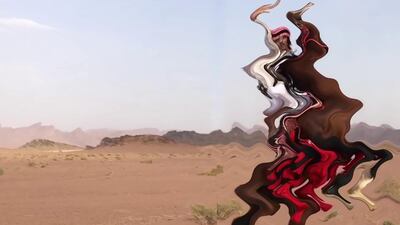
'Refraction Bends Light Rays Towards Cooler Air' by Ahaad Alamoudi, whose work is part of Bawa Gallery's first NFT art exhibition. Courtesy the artist and Bawa Gallery

A new wave of NFT art is taking shape in the Gulf


Alexandra Chaves
  • English
  • Arabic

A new wave of NFT art from the Gulf is set to enter the virtual realm as more artists and gallerists from the region join in on what seems to be a crypto art gold-rush.

NFT art, or digital art that is tokenised on the blockchain and purchased using cryptocurrency, made headlines in March following a Christie's auction where a digital artwork by artist Beeple sold for a staggering $69.4 million.

The main benefit of NFT art is that it puts the artist first, having control over how the works are distributed with an element of transparency is ideally the future of the art industry

It wasn't just the price tag that caught the world's attention, but the technology through which the artwork was sold, too. NFTs, which stands for non-fungible tokens, are digital certificates that authenticate ownership of certain digital assets – videos, music, drawings, or even tweets, memes and articles – through blockchain technology.

In the region, a number of people, including Bandar Al-Wazzan, founder of Gallery Bawa, a digital art gallery in Kuwait, have seen an opportunity to be a pioneer for dealing crypto art.

On Thursday, Bawa launched its latest exhibition titled Suadi Old Man Calling The Camels In The Desert and they run to him like baby run to his mother, then they start Kissing and huging him [sic], a solo show with Saudi artist Ahaad Alamoudi and also the first NFT art exhibition presented by a gallery in the Gulf.

It features six works by Alamoudi, including video compositions of footage found on the internet that humorously reflect upon the kingdom's changing identity.

"Initially, I thought that I would never be a part of that industry," Alamoudi says about entering the NFT space. "Having said that, I believe knowledge is empowering and I'm interested in what this system means for the future of the art world."

Al-Wazzan set up Bawa as an online gallery six months ago with the desire to spotlight Khaleeji artists. The show with Alamoudi had been in the works for months, with the artist and Al-Wazzan expecting to sell prints of the videos via the gallery website. But the Christie's sale changed everything, and Al-Wazzan quickly reconceived the exhibition, "minting" (a term for creating something on the blockchain) the artist's videos and stills into NFTs.

Still from 'Fly Right into the Future' by Ahaad Alamoudi. Courtesy the artist and Bawa Gallery

These videos and stills are currently priced in the range of 0.8 to 0.9 Ether, or $1,870 to $2,100 at the time of writing. Collectors can purchase the works on OpenSea, an online marketplace for NFTs that requires users to possess a digital wallet, where their cryptocurrency is stored. Often, NFTs are sold using Ether, a cryptocurrency built on the Ethereum blockchain.

For Al-Wazzan, NFT technology offers a huge opportunity for digital artists, because it allows for the existence of an original in a virtual world filled with copies. So while artworks that come in the format of jpegs, gifs and video clips can be downloaded and duplicated, the possessor of the certificate still maintains his or her ownership of the asset.

"It's going to change the art market in the next 10 years," Al-Wazzan says. "Anyone can enjoy and download the NFT, but only one person can own it. And that's a human thing in the end. You can own a replica of the Mona Lisa and hang it on your wall, but you will always know that the original hangs in the Louvre. That's the same for NFTs as well."

Other gallerists, such as Sunny Rahbar, founder of The Third Line in Dubai, says it is important to look past the current buzz around NFTs to see if its revolutionary promises are valid.

"I've started to really educate myself on it," she says. "These prices are perhaps what is baffling people … I realise that right now it's kind of like the Wild West, but I do think this technology is very useful for our industry, especially when it comes to provenance and for these contracts where artists continue to get paid in the resale of their work, which doesn't happen in the traditional art world."

Rahbar is referring to one of NFTs’ greatest advantages over traditional art deals – the ability for artists to make money on the secondary market. Typically, when an artwork is bought from a gallery by a collector, he or she can resell the piece privately or at auction for a higher price, without the artist sharing in the profit. With NFTs, however, artists continue to earn a percentage of profit for every resale, and because the NFT is tied to the blockchain, every transaction is logged.

This feature is what drew artist Alamoudi to agree to Bawa's NFT show. "The main benefit is that it puts the artist first, having control over how the works are distributed with an element of transparency is ideally the future of the art industry," she says.

NFTs can also be created for physical artworks, proposes Rahbar, so that all future sales can be recorded. “This is a way of safekeeping artworks,” she says. “It can be a beautiful relationship between the digital realm and the physical one.”

One of the gallery's represented artists, Amir H Fallah, minted his own NFT titled Immortal independently in March. The Tehran-born artist, who lives in California, typically creates paintings and installations, but his venture into NFT shows that more traditional forms of art can adapt to the digital sphere, too.

Even pre-Beeple, artists in the Gulf have sold their NFTs on online marketplaces. Amrita Sethi, a banker-turned-artist, for example, minted her artwork with platform Terra Virtua in October 2020, corresponding with the opening of World Art Dubai last year.

Sethi’s knowledge in finance helped her get in on the game early. She says that the excitement around NFTs will normalise, and the process of collecting the digital works will mirror the way it is done in the physical world, with collectors following the trajectory of creators they like.

Still, some artists and galleries remain wary of the rapid rise of NFT art. For Rahbar, she is willing to explore its potential, especially since the pandemic pushed much of the art world to embrace virtual shows. "I really think with social media and online programming we have already been on this path, and artists are doing this for themselves anyway," she says. Tapping into the crypto art collector network could bring more revenue for artists, she points out.

Currently, The Third Line is in the process of working on NFTs with its roster of artists and participating in collectives for digital shows in the UAE.

Joel Dietz, a crypto entrepreneur who recently moved to Dubai to set up NFT art initiatives, says he wants sceptics to focus on the communities involved in NFTs, rather than just the technology. “Get to know the people who are doing it, not just as a gif or jpeg on the internet... Obviously there’s a lot of speculation involved, but the actual energy and personality of the people behind it are what draws me back.”

Among the biggest concerns with NFTs, and cryptocurrency in general, is its impact on the environment. Since it was established, the Ethereum blockchain has resulted in 96,200,000 tonnes of carbon dioxide, according to ArtNews. The percentage of which NFTs, and specifically NFT art, is responsible and will be responsible for these emissions is not clear.

Editor's note: A previous version of this article incorrectly identified Joel Dietz as the founder of MetaMask and on the founding team of Ethereum. This has been corrected.


RACE CARD

6.30pm: Handicap (TB) $68,000 (Dirt) 1,600m

7.05pm: Meydan Sprint – Group 2 (TB) $163,000 (Turf) 1,000m

7.40pm: Curlin Stakes – Listed Handicap (TB) $88,000 (D) 2,200m

8.15pm: UAE Oaks – Group 3 (TB) $125,000 (D) 1,900m

8.50pm: Zabeel Mile – Group 2 (TB) $163,000 (T) 1,600m

9.25pm: Balanchine – Group 2 (TB) $163,000 (T) 1,800m

10pm: Al Shindagha Sprint – Group 3 (TB) $130,000 (D) 1,200m

MISSION: IMPOSSIBLE – FINAL RECKONING

Director: Christopher McQuarrie

Starring: Tom Cruise, Hayley Atwell, Simon Pegg

Rating: 4/5

Desert Warrior

Starring: Anthony Mackie, Aiysha Hart, Ben Kingsley

Director: Rupert Wyatt

Rating: 3/5

Director: Laxman Utekar

Cast: Vicky Kaushal, Akshaye Khanna, Diana Penty, Vineet Kumar Singh, Rashmika Mandanna

Rating: 1/5

COMPANY PROFILE
Name: HyperSpace
 
Started: 2020
 
Founders: Alexander Heller, Rama Allen and Desi Gonzalez
 
Based: Dubai, UAE
 
Sector: Entertainment 
 
Number of staff: 210 
 
Investment raised: $75 million from investors including Galaxy Interactive, Riyadh Season, Sega Ventures and Apis Venture Partners
BIO

Favourite holiday destination: Turkey - because the government look after animals so well there.

Favourite film: I love scary movies. I have so many favourites but The Ring stands out.

Favourite book: The Lord of the Rings. I didn’t like the movies but I loved the books.

Favourite colour: Black.

Favourite music: Hard rock. I actually also perform as a rock DJ in Dubai.

The Vile

Starring: Bdoor Mohammad, Jasem Alkharraz, Iman Tarik, Sarah Taibah

Director: Majid Al Ansari

Rating: 4/5

Brief scores

Day 1

Toss England, chose to bat

England, 1st innings 357-5 (87 overs): Root 184 not out, Moeen 61 not out, Stokes 56; Philander 3-46

Lexus LX700h specs

Engine: 3.4-litre twin-turbo V6 plus supplementary electric motor

Power: 464hp at 5,200rpm

Torque: 790Nm from 2,000-3,600rpm

Transmission: 10-speed auto

Fuel consumption: 11.7L/100km

On sale: Now

Price: From Dh590,000

Traits of Chinese zodiac animals

Tiger:independent, successful, volatile
Rat:witty, creative, charming
Ox:diligent, perseverent, conservative
Rabbit:gracious, considerate, sensitive
Dragon:prosperous, brave, rash
Snake:calm, thoughtful, stubborn
Horse:faithful, energetic, carefree
Sheep:easy-going, peacemaker, curious
Monkey:family-orientated, clever, playful
Rooster:honest, confident, pompous
Dog:loyal, kind, perfectionist
Boar:loving, tolerant, indulgent   

The%20specs
%3Cp%3E%3Cstrong%3EEngine%3A%3C%2Fstrong%3E%20Dual%20synchronous%20electric%20motors%0D%3Cbr%3E%3Cstrong%3EPower%3A%20%3C%2Fstrong%3E660hp%0D%3Cbr%3E%3Cstrong%3ETorque%3A%20%3C%2Fstrong%3E1%2C100Nm%0D%3Cbr%3E%3Cstrong%3ETransmission%3A%20%3C%2Fstrong%3ESingle-speed%20automatic%0D%3Cbr%3E%3Cstrong%3ETouring%20range%3A%20%3C%2Fstrong%3E488km-560km%0D%3Cbr%3E%3Cstrong%3EPrice%3A%20%3C%2Fstrong%3EFrom%20Dh850%2C000%20(estimate)%0D%3Cbr%3E%3Cstrong%3EOn%20sale%3A%20%3C%2Fstrong%3EOctober%3C%2Fp%3E%0A
'Cheb%20Khaled'
%3Cp%3E%3Cstrong%3EArtist%3A%20%3C%2Fstrong%3EKhaled%3Cbr%3E%3Cstrong%3ELabel%3A%20%3C%2Fstrong%3EBelieve%3Cbr%3E%3Cstrong%3ERating%3A%3C%2Fstrong%3E%204%2F5%3C%2Fp%3E%0A
COMPANY%20PROFILE
%3Cp%3ECompany%20name%3A%20Znap%3C%2Fp%3E%0A%3Cp%3EStarted%3A%202017%3C%2Fp%3E%0A%3Cp%3EFounder%3A%20Uday%20Rathod%3C%2Fp%3E%0A%3Cp%3EBased%3A%20Dubai%2C%20UAE%3C%2Fp%3E%0A%3Cp%3EIndustry%3A%20FinTech%3C%2Fp%3E%0A%3Cp%3EFunding%20size%3A%20%241m%2B%3C%2Fp%3E%0A%3Cp%3EInvestors%3A%20Family%2C%20friends%3C%2Fp%3E%0A
Draw:

Group A: Egypt, DR Congo, Uganda, Zimbabwe

Group B: Nigeria, Guinea, Madagascar, Burundi

Group C: Senegal, Algeria, Kenya, Tanzania

Group D: Morocco, Ivory Coast, South Africa, Namibia

Group E: Tunisia, Mali, Mauritania, Angola

Group F: Cameroon, Ghana, Benin, Guinea-Bissau

SPECS

Engine: 4-litre V8 twin-turbo
Power: 630hp
Torque: 850Nm
Transmission: 8-speed Tiptronic automatic
Price: From Dh599,000
On sale: Now

England Test squad

Joe Root (captain), Moeen Ali, James Anderson, Jonny Bairstow (wicketkeeper), Stuart Broad, Jos Buttler, Alastair Cook, Sam Curran, Keaton Jennings, Dawid Malan, Jamie Porter, Adil Rashid, Ben Stokes.

Mission%3A%20Impossible%20-%20Dead%20Reckoning%20Part%20One
%3Cp%3E%3Cstrong%3EDirector%3A%3C%2Fstrong%3E%20Christopher%20McQuarrie%3Cbr%3E%3Cstrong%3EStars%3A%3C%2Fstrong%3E%20Tom%20Cruise%2C%20Hayley%20Atwell%2C%20Pom%20Klementieff%2C%20Simon%20Pegg%3Cbr%3E%3Cstrong%3ERating%3A%3C%2Fstrong%3E%204%2F5%3C%2Fp%3E%0A
The%20Boy%20and%20the%20Heron
%3Cp%3E%3Cstrong%3EDirector%3A%C2%A0%3C%2Fstrong%3EHayao%20Miyazaki%3C%2Fp%3E%0A%3Cp%3E%3Cstrong%3EStarring%3A%3C%2Fstrong%3E%C2%A0Soma%20Santoki%2C%20Masaki%20Suda%2C%20Ko%20Shibasaki%3C%2Fp%3E%0A%3Cp%3E%3Cstrong%3ERating%3A%20%3C%2Fstrong%3E5%2F5%3C%2Fp%3E%0A
Classification of skills

A worker is categorised as skilled by the MOHRE based on nine levels given in the International Standard Classification of Occupations (ISCO) issued by the International Labour Organisation. 

A skilled worker would be someone at a professional level (levels 1 – 5) which includes managers, professionals, technicians and associate professionals, clerical support workers, and service and sales workers.

The worker must also have an attested educational certificate higher than secondary or an equivalent certification, and earn a monthly salary of at least Dh4,000. 

THE BIO

Bio Box

Role Model: Sheikh Zayed, God bless his soul

Favorite book: Zayed Biography of the leader

Favorite quote: To be or not to be, that is the question, from William Shakespeare's Hamlet

Favorite food: seafood

Favorite place to travel: Lebanon

Favorite movie: Braveheart

What is blockchain?

Blockchain is a form of distributed ledger technology, a digital system in which data is recorded across multiple places at the same time. Unlike traditional databases, DLTs have no central administrator or centralised data storage. They are transparent because the data is visible and, because they are automatically replicated and impossible to be tampered with, they are secure.

The main difference between blockchain and other forms of DLT is the way data is stored as ‘blocks’ – new transactions are added to the existing ‘chain’ of past transactions, hence the name ‘blockchain’. It is impossible to delete or modify information on the chain due to the replication of blocks across various locations.

Blockchain is mostly associated with cryptocurrency Bitcoin. Due to the inability to tamper with transactions, advocates say this makes the currency more secure and safer than traditional systems. It is maintained by a network of people referred to as ‘miners’, who receive rewards for solving complex mathematical equations that enable transactions to go through.

However, one of the major problems that has come to light has been the presence of illicit material buried in the Bitcoin blockchain, linking it to the dark web.

Other blockchain platforms can offer things like smart contracts, which are automatically implemented when specific conditions from all interested parties are reached, cutting the time involved and the risk of mistakes. Another use could be storing medical records, as patients can be confident their information cannot be changed. The technology can also be used in supply chains, voting and has the potential to used for storing property records.