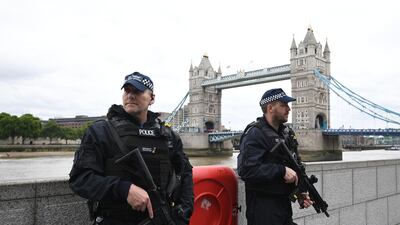
William Shawcross wants to prevent further terror attacks in the UK. EPA

William Shawcross issues open letter on UK's Prevent anti-terror scheme


Nicky Harley
  • English
  • Arabic

The UK's new independent reviewer of its Prevent anti-radicalisation scheme wrote an open letter in which he vowed to help prevent further terrorism tragedies.

William Shawcross will lead the review into the programme, which in the year to March 2020 recorded an increase in Islamist extremist radicalisation referrals for the first time in four years.

Mr Shawcross, previously the UK's special representative for victims of IRA terrorism sponsored by former Libyan leader Muammar Qaddafi, will examine the effectiveness of the anti-radicalisation strategy to stop people being drawn into terrorism.

He is calling for those involved in the controversial scheme to help him to conduct a credible review.

"The key to a credible review is to learn from the experiences of you, Prevent practitioners across the country, the civil society organisations delivering Prevent and also from individuals who have been supported or otherwise impacted by the strategy," he said in the letter.

"I know that Prevent is a controversial issue and one which, at times, has aroused animosity and suspicion. I want to better understand that – and much more."

The Prevent programme, launched to monitor potential terrorist activity in the UK, recorded a 10 per cent increase in cases flagged to the authorities in the year to March 2020.

As the independent reviewer, Mr Shawcross will consider the strategy and delivery of the Prevent programme and make recommendations for the future.

"Terrorism is designed to tear societies apart," he wrote.

"And I am sure that you, like me, think constantly of the victims – all those murdered or wounded at the [Manchester Arena] Ariana Grande concert, and their families; the relatives of those young British Muslims enticed to fight for ISIS in Syria; Jo Cox and her family and other victims of far-right terrorism, such as the attack at Finsbury Park mosque in 2017 in Britain.

"We all have an interest in wishing to prevent such tragedies from occurring again and again. That is just one of the reasons as to why I am proud to have been chosen to review Prevent."

The programme was criticised after it was revealed that the 2017 Parsons Green bomber in London, Ahmed Hassan, was being managed by the scheme at the time of his offence.

William Shawcross said he will lead a robust and evidence-based examination of the UK's Prevent anti-radicalisation programme.

Some Muslim communities also accused the scheme of being a government tool to spy on them.

Mr Shawcross promised to conduct a fair review.

"I am open minded and want to hear all the evidence. And I want to hear the case for Prevent openly and based on evidence that can be tested," he said.

“The aim of the review is to look at the effectiveness of present strategies to protect vulnerable people from being drawn into terrorism and make recommendations for the future.

"The UK faces a range of terrorist threats – including from Islamists and the Far Right – and I am keen to learn more what role Prevent can play in helping address such threats.

"The review is non-partisan and I want to hear from and listen to a wide range of voices from across our different communities. I think the review is an important opportunity to understand the views of critics and supporters of Prevent."

The independent review of Prevent was announced by the government in 2019 as part of the Counter-Terrorism and Border Security Act.

Mr Shawcross’s appointment follows the previous Independent reviewer, Lord Carlile, stepping down in December 2019.

There was a legal challenge against Lord Carlile's appointment by Rights Watch UK. It objected to Lord Carlile because in the past he had declared his strong support for the programme.

Prevent deals with all forms of terrorism, including Islamist and far-right extremism.

From 2012 to March 2020, almost 3,000 people were taken on by Prevent's voluntary and confidential Channel programme.

As part of Prevent, the Channel programme provides tailored support for a person considered vulnerable to being drawn into terrorism.

In the year ended March 31, 2020, there were 6,287 referrals to Prevent.

Of those referred to Prevent in 2019-2020, 1,487 (24 per cent) were referred because of concerns related to Islamist radicalisation and 1,387 (22 per cent) were referred over concerns related to far-right extremism.


UAE tour of Zimbabwe

All matches in Bulawayo
Friday, Sept 26 – UAE won by 36 runs
Sunday, Sept 28 – Second ODI
Tuesday, Sept 30 – Third ODI
Thursday, Oct 2 – Fourth ODI
Sunday, Oct 5 – First T20I
Monday, Oct 6 – Second T20I

Mercer, the investment consulting arm of US services company Marsh & McLennan, expects its wealth division to at least double its assets under management (AUM) in the Middle East as wealth in the region continues to grow despite economic headwinds, a company official said.

Mercer Wealth, which globally has $160 billion in AUM, plans to boost its AUM in the region to $2-$3bn in the next 2-3 years from the present $1bn, said Yasir AbuShaban, a Dubai-based principal with Mercer Wealth.

Within the next two to three years, we are looking at reaching $2 to $3 billion as a conservative estimate and we do see an opportunity to do so,” said Mr AbuShaban.

Mercer does not directly make investments, but allocates clients’ money they have discretion to, to professional asset managers. They also provide advice to clients.

“We have buying power. We can negotiate on their (client’s) behalf with asset managers to provide them lower fees than they otherwise would have to get on their own,” he added.

Mercer Wealth’s clients include sovereign wealth funds, family offices, and insurance companies among others.

From its office in Dubai, Mercer also looks after Africa, India and Turkey, where they also see opportunity for growth.

Wealth creation in Middle East and Africa (MEA) grew 8.5 per cent to $8.1 trillion last year from $7.5tn in 2015, higher than last year’s global average of 6 per cent and the second-highest growth in a region after Asia-Pacific which grew 9.9 per cent, according to consultancy Boston Consulting Group (BCG). In the region, where wealth grew just 1.9 per cent in 2015 compared with 2014, a pickup in oil prices has helped in wealth generation.

BCG is forecasting MEA wealth will rise to $12tn by 2021, growing at an annual average of 8 per cent.

Drivers of wealth generation in the region will be split evenly between new wealth creation and growth of performance of existing assets, according to BCG.

Another general trend in the region is clients’ looking for a comprehensive approach to investing, according to Mr AbuShaban.

“Institutional investors or some of the families are seeing a slowdown in the available capital they have to invest and in that sense they are looking at optimizing the way they manage their portfolios and making sure they are not investing haphazardly and different parts of their investment are working together,” said Mr AbuShaban.

Some clients also have a higher appetite for risk, given the low interest-rate environment that does not provide enough yield for some institutional investors. These clients are keen to invest in illiquid assets, such as private equity and infrastructure.

“What we have seen is a desire for higher returns in what has been a low-return environment specifically in various fixed income or bonds,” he said.

“In this environment, we have seen a de facto increase in the risk that clients are taking in things like illiquid investments, private equity investments, infrastructure and private debt, those kind of investments were higher illiquidity results in incrementally higher returns.”

The Abu Dhabi Investment Authority, one of the largest sovereign wealth funds, said in its 2016 report that has gradually increased its exposure in direct private equity and private credit transactions, mainly in Asian markets and especially in China and India. The authority’s private equity department focused on structured equities owing to “their defensive characteristics.”

Who's who in Yemen conflict

Houthis: Iran-backed rebels who occupy Sanaa and run unrecognised government

Yemeni government: Exiled government in Aden led by eight-member Presidential Leadership Council

Southern Transitional Council: Faction in Yemeni government that seeks autonomy for the south

Habrish 'rebels': Tribal-backed forces feuding with STC over control of oil in government territory

Reading List

Practitioners of mindful eating recommend the following books to get you started:

Savor: Mindful Eating, Mindful Life by Thich Nhat Hanh and Dr Lilian Cheung

How to Eat by Thich Nhat Hanh

The Mindful Diet by Dr Ruth Wolever

Mindful Eating by Dr Jan Bays

How to Raise a Mindful Eaterby Maryann Jacobsen

UAE currency: the story behind the money in your pockets