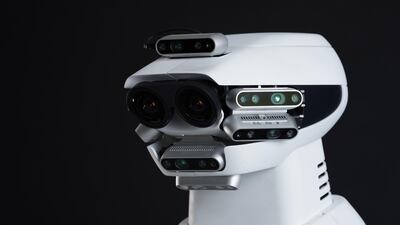

A Japanese inventor who dreams of turning science fiction into reality is building robots that could one day help humans to explore the solar system.
Sho Nakanose, whose start-up Gitai secured an additional $17.1 million dollars in funding this month, is developing a general-purpose robot capable of complicated work such as space station repairs.
Gitai is one of several companies in Japan’s burgeoning commercial space sector planning groundbreaking projects, with Tokyo’s Astroscale hoping to become the first private company to test technologies for removing orbital debris when its ELSA-d mission takes off aboard a Soyuz rocket on March 22.

Mr Nakanose, who founded Gitai in 2016, hopes his robots will one day be able to perform jobs for which astronauts must currently undertake dangerous spacewalks.
Space, he said, is an ideal field for advanced robotics due to the extremely high costs and risk factors associated with human exploration.
"Astronauts can conduct only a few operations in space because it's very dangerous and it's very, very expensive," he told The National.
The 33-year-old chief executive, who earlier this year was selected as one of Japan's top innovators under the age of 35 by the MIT Technology Review, said his robots are designed to complement the work of human astronauts and space engineers rather than compete with them.
“If general purpose robots compete with humans, it will not be good business,” he said.
Gitai is working to develop technology to allow human operators to carry out vital missions like satellite maintenance without exposing themselves to danger.
Part of the latest funding round will go towards covering the costs of a technology demonstration mission due to take place in orbit in 2023. The mission will test one of the company’s robots in space for the first time.
Mr Nakanose said his company’s ultimate aim was to provide on-orbit servicing for customers, performing tasks such as replacing satellite batteries and extending space station solar panels.
“That is our main target,” he said.
He said the company also sees its robots playing a role in the exploration and even colonisation of “the Moon, Mars and beyond.
“We actually have a plan to send our first rover with a general purpose robot to the Moon in five years, but we will need more time to send one to Mars,” he said.
Japan, the world’s third-biggest economy, has an illustrious history of space exploration, and its commercial space industry is booming.
The Japanese government in 2017 published its Space Industry Vision 2030, setting the ambitious target of doubling the size of the space sector, already worth about $11 billion, by the early 2030s.
Though it has traditionally focused on government-funded missions, Japan’s national space agency Jaxa is following the trend set by Nasa and looking to promote the growth of its space industry.
In September last year Gitai and Jaxa entered into a partnership to create a concept for the world’s first space robot business, with the aim of identifying further uses for robots in space.
Mr Nakanose, who named his company after the robot bodies inhabited by the characters of popular cyberpunk anime and Manga franchise Ghost in the Shell, has set his sights on bringing science fiction to life.
“I had a dream to realise a science fiction world,” he said. “I waited for a long time but it didn’t come through, so I decided to do it on my own.”

