!['We are still studying [the response],' State Department spokesman Ned Price said. AFP](https://www.thenationalnews.com/resizer/v2/HSRCHLEIC7EMUWY2ET7DWWBGSI.jpg?smart=true&auth=b04c06a534dc06707cd7dd78683828c7d599a3ecb309fb538724c3f7c374fce3&width=812&height=456)


The US government will need “some time” to study the Iranian response to the European Union proposal to revive the nuclear deal, but said that negotiations are now in their final stage.
“We are still studying [the response],” State Department spokesman Ned Price said on Tuesday, confirming the US receipt of Iran's reply to the final draft proposal aimed at saving the 2015 Joint Comprehensive Plan of Action (JCPOA).
“It will require some time to digest what has been provided to the EU and in turn what has been provided to us.”

On Monday, Iranian news agency ISNA said Tehran expected a response from the West in two days.
Mr Price said the US deliberations involve private consultations with the Europeans, but noted that the talks are now in the final stretch.
The current draft of the deal has taken 16 months of indirect US-Iranian talks, with the EU mediating.
A senior EU official said on August 8 that a “final” offer had been made and a response was expected within a “very, very few weeks”.
Mr Price expressed hope that the Iranian negotiators would take the final negotiations seriously.
“It is our hope that as we have now approached what should be the final stage of this, that the Iranians will demonstrate seriousness of purpose that we have not consistently seen until now,” he said.
-
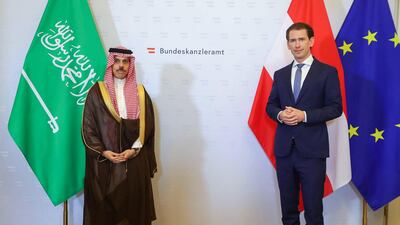
Saudi Arabia's Foreign Minister Prince Faisal bin Farhan with the Chancellor of Austria Sebastian Kurz. SPA -

Wang Qun, China's ambassador to the UN, waits for the start of talks on reviving the 2015 Iran nuclear deal in Vienna. Reuters -

European External Action Service deputy secretary general, Enrique Mora, and Iranian Deputy Foreign Minister, Abbas Araghchi, attend the summit in Vienna. Reuters -
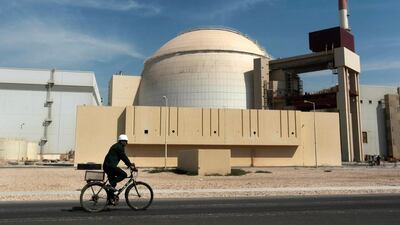
The Bushehr nuclear power plant in Iran. AP Photo -
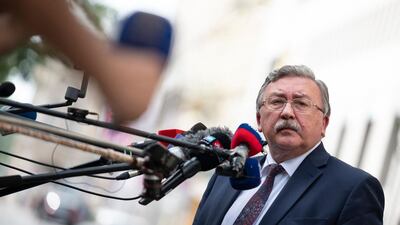
Russia's governor to the International Atomic Energy Agency, Mikhail Ulyanov, updates journalists outside the Grand Hotel Wien after a round of closed-door nuclear talks in Vienna. AFP -
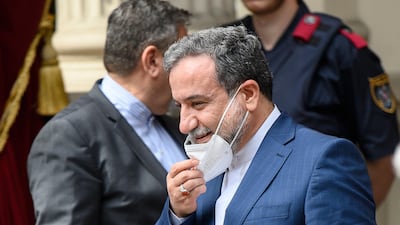
Abbas Araghchi after negotiations come to nothing. EPA -
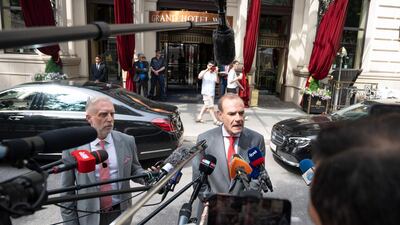
Enrique Mora speaks to the press outside the Grand Hotel Wien where talks were held. AFP -
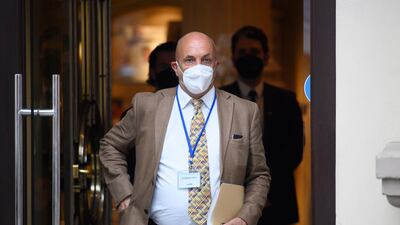
Stephan Klement, EU Ambassador and Special Adviser on Iran Nuclear Issue, attended the talks aimed at reviving the 2015 nuclear deal. EPA -
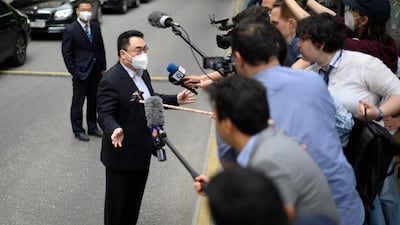
Qun Wang addresses the media in Vienna. EPA -
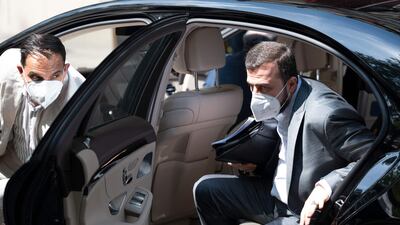
Iran's Governor to the International Atomic Energy Agency (IAEA), Kazem Gharib Abadi is returning to the 'Grand Hotel Wien' during the closed-door nuclear talks in Vienna. AFP -
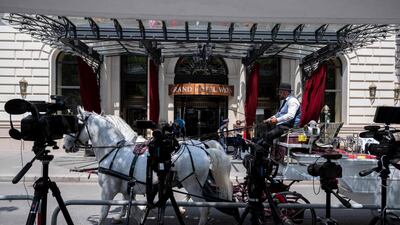
The Grand Hotel Wien held a series of negotiations designed to revive the 2015 nuclear pact. AFP


He declined to share details of Iran's response, which reportedly isolates the sanctions hurdle as the main issue left for negotiation. Mr Price said that more details will need to be resolved before a deal can be reached.
“These are not simple issues. There are some challenging technical details that would need to be worked out,” he said.
The official reiterated Washington’s position that the negotiations over Iran’s nuclear programme are strictly about those issues and not removing the Islamic Revolutionary Guard Corps from the US list of foreign terrorist organisations.
Iranian officials said the removal of sanctions, if an agreement could be reached, would help the global economy and increase energy supplies.
Lifting sanctions would boost Iranian oil exports at a time when the world market has been disrupted by Russia's invasion of Ukraine, Iranian Foreign Ministry spokesman Nasser Kanani explained.
Addressing the issue of US detainees in Iran, Mr Price said the US is also “not tying the fate of American citizens [held in Iran] to the fate of a proposition, namely a mutual return to compliance with the JCPOA”.
American citizens being held in Iran include Siamak Namazi, who on Tuesday marked 2,500 days in detention.
US National Security Adviser Jake Sullivan said Washington is pursuing efforts for his release and that of his father, Baquer Namazi.

