

US Secretary of State Mike Pompeo said on Wednesday that access to Chinese labs will help determine the origin of the Covid-19 virus, and more information was needed over the World Health Organisation's assessment that the disease originated in animals.
“We, collectively the world, still has not had access to the Chinese labs,” Mr Pompeo said.
For the first time, he mentioned several labs beyond Wuhan’s Institute of Virology that would be critical to access to determine the origin of the virus.
He did not specify who should lead the investigation in the event that an international probe is initiated.
Mr Pompeo, in response to a question from The National, said access "would be important to the question presented [determining the origin of the virus] and it's important we get the answer, not just as a historical matter, but so we can prevent such a thing from happening again…it is time that there would be transparency and access so that the world can respond."
The Secretary of State pinpointed multiple labs in China that would need to be examined by the world.
“These labs in China, not just the WIV, there are multiple labs that where the Chinese Communist Party is working on various levels of pathogens,” Mr Pompeo told The National. “It is important that there would be a global effort that those people working with dangerous substances have the capability to prevent accidental release.”
He reiterated that the virus originated in China and slammed the government there for suggesting “through their disinformation campaigns that it began in Europe or brought by US soldiers.”
“This is dangerous," he said, "this is not political, you have to know the nature and the pathway that the virus took in order to save lives, and that didn’t happen, they were too slow.”
Mr Pompeo also criticised the World Health Organisation for not demanding such information quickly. “That information didn’t get out to the world quickly enough, the World Health Organisation didn’t demand it and the Chinese Communist Party (CCP) didn’t deliver it.”
-
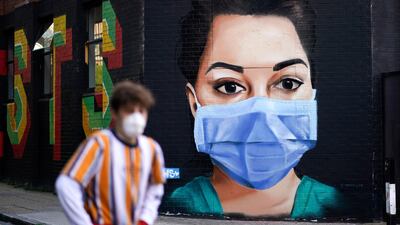
A man wearing a protective mask walks past a mural depicting a nurse in Shoreditch, amid the coronavirus disease (COVID-19) outbreak, in London, Britain. REUTERS -
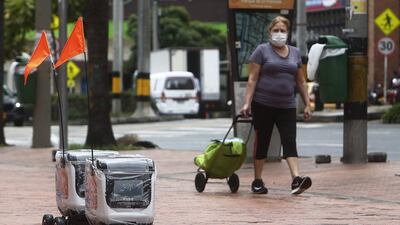
A woman observes two robots that carry home orders, in Medellin, Colombia,. EPA -
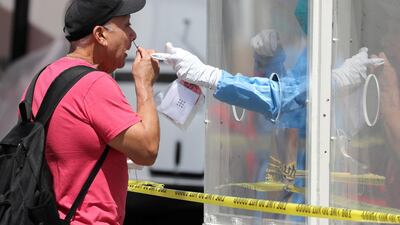
A man is tested for coronavirus disease (COVID-19) at a Los Angeles fire department testing station for the homeless on Skid Row, in Los Angeles, California, U.S. REUTERS -

A man sits next to a fountain at the Sun Yat Sen Memorial Park in Hong Kong on April 21, 2020. Hong Kong has reduced growth of confirmed COVID-19 cases to single digits in recent days, but city authorities say they are not taking any risks. Chief executive Carrie Lam said social distancing measures and some business restrictions would continue for another two weeks until at least May 7. AFP -
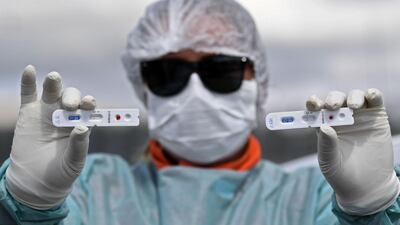
A health worker shows quick tests for COVID-19 with negative results at a drive-through in the parking lot of the Mane Garrincha Stadium in Brasilia, Brazil. The Brazilian government started a mass testing program to improve control of the new coronavirus disease and plan how social isolation will be lifted. AFP -
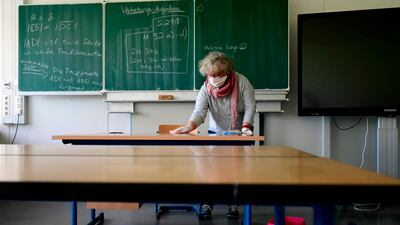
A teacher cleans and disinfects chairs and tables at the the Phoenix Gymnasium secondary school in Dortmund, western Germany. Students preparing for the Abitur high school graduation with exams taking place in May are allowed to turn back to school from April 23, 2020. AFP -
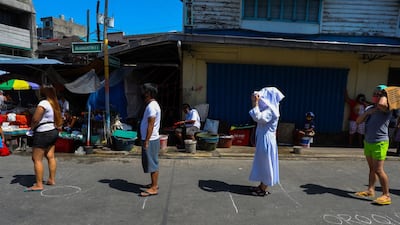
People stand on designated spots to maintain social distancing at a market in Manila. AFP -
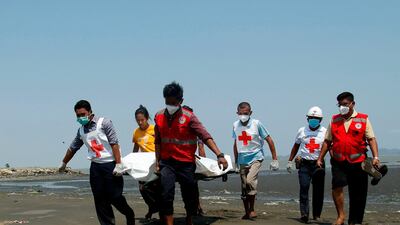
Members of the Myanmar Red Cross carry a dead body of a driver from a boat in Sittwe, Rakhine State killed while delivering test kits for COVID-19 coronavirus. A Myanmar government health worker was injured and his driver killed when their United Nations-marked vehicle was ambushed as they were carrying COVID-19 test samples in conflict-ridden Rakhine state. AFP -
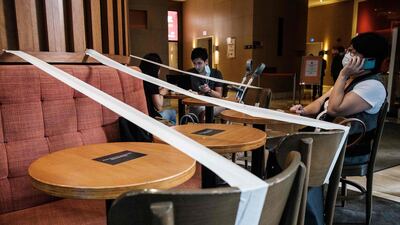
Customers wearing face masks as a precautionary measure against the COVID-19 coronavirus sit in a cafe, which has masking tape on every other table to enforce social distancing, in Hong Kong. AFP -
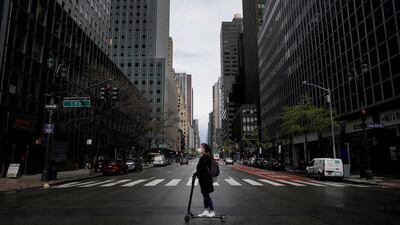
A woman wearing a protective face mask rides a scooter across a nearly empty 3rd Avenue in midtown Manhattan during the outbreak of the coronavirus disease (COVID-19) in New York City, New York, U.S. REUTERS -
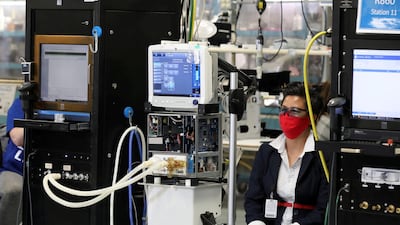
An employee wearing a face mask sits next to a GE Carescape R860 ventilator in an assembly and testing area at a GE Healthcare manufacturing facility during the global coronavirus disease (COVID-19) outbreak in Madison, Wisconsin, U.S. REUTERS -
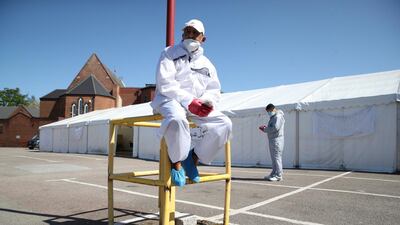
Workers wearing protective equipment are seen on the grounds of the Central Jamia Mosque Ghamkol Sharif, a temporary morgue set up at a Mosque as the spread of the Coronavirus disease (Covid-19) continues, Birmingham, Britain. REUTERS


On the issue of the US suspending funding to the WHO, Mr Pompeo said the decision is “not running away” from supporting global health.
“I don’t think anyone believes that the WHO has shined in its ability to respond and notify the world of the virus. They were slow, they refused to call it a global health pandemic, they rejected closing down international travel,” Mr Pompeo said.
He went as far as arguing that the WHO as an institution “has failed, continues to fail inspite of the massive reforms…it is worthy of evaluating whether delivery of resources will deliver the outcomes.”
Now, he stressed, that several world leaders including the US and Germany’s Chancellor Angela Merkel want an investigation into the origin of the virus. “Those labs are still open, the world is not being permitted to go into these labs to evaluate their security and capacity…to prevent accidental release,” Mr Pompeo said.
He said earlier this week that an American investigation was already under way into how the virus "got out into the world". The disease, which originated in the city of Wuhan, has infected more than 2.5 million people, killed more than 178,000 and left half of humanity under restrictive measures.
Australia has also called for an international investigation into the source of the virus, which the WHO said pointed to transmission from an animal. But speculation has mounted that it may have emanated from a laboratory in the Chinese city, a claim that Beijing has denied.
Mr Pompeo, speaking from the State Department on a range of regional and international issues, said in answers to The National that the Trump administration is committed to deterrence in the Middle East by enforcing presence in the Gulf waters, deployments in Saudi Arabia and achieving a ceasefire in Yemen.
On Iran, Mr Pompeo accused the regime of having “disdain for its people” as it allocates resources to the Assad regime whom Iranian foreign minister Javad Zarif visited this week, and arming militias while the coronavirus cases rise to over 85,000 in the country.
-
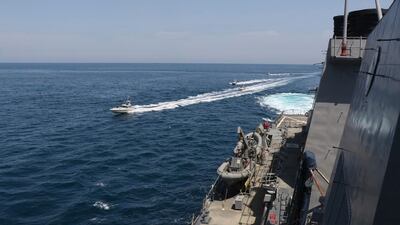
In this Wednesday, April 15, 2020, photo made available by the US Navy, Iranian Revolutionary Guard vessels sail close to US ships in the Arabian Gulf near Kuwait. All Photos supplied by US Navy -
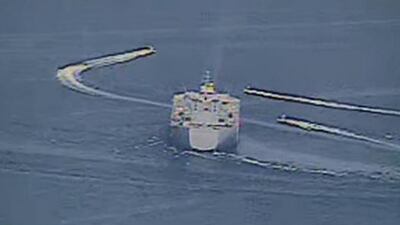
The Iranian vessels conducted unsafe and unprofessional actions, the US Navy said. -
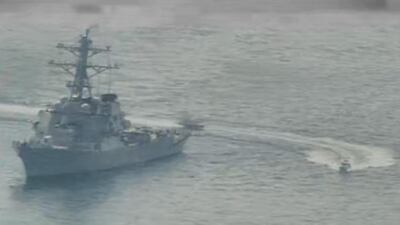
The US Navy said the IRGC vessels crossed the ships’ bows and sterns at close range. -
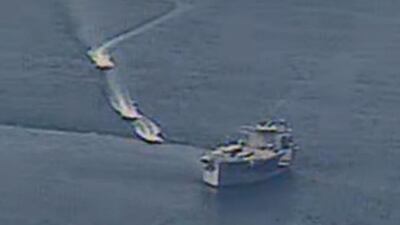
Iranian Revolutionary Guard Corps Navy vessels approach the USS Lewis B Puller in the northern waters of the Arabian Gulf. -
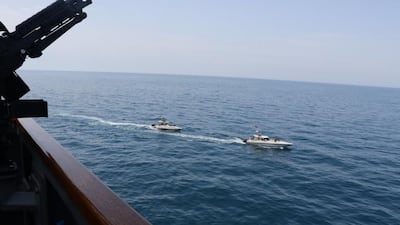
The US Navy said that the US crew took action "deemed appropriate to avoid collision”. -
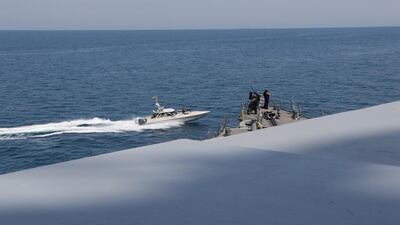
The Revolutionary Guard was blamed after a Hong Kong-flagged ship was boarded in the Gulf of Oman on Tuesday.


Following on from US President Donald Trump's tweet warning Iran of targeting US navy, Mr Pompeo reiterated the US' commitment to establishing deterrence in the region.
"Make no mistake about it, the actions that the United States has taken over the last many months have been designed to provide deterrent effect," Mr Pompeo told The National.
This was manifested, he explained, in the multinational navy task force deployed in Gulf waters to track and protect sea navigations, increased military posture in Saudi Arabia, bringing peace and stability in Yemen and block missile shipments from Iran to the country, as well countering Iran-backed militias in Iraq.
“The US is committed to deter Iranian behavior across the Middle East.”
He stressed however, the need for ceasefires in Yemen, Syria, and Libya where he said there remains no military solution.
Mr Pompeo also said the US is prepared to support a government in Lebanon that meets the aspirations of the people that have been protesting. “It can’t be the case that business as usual continues to exist…that Hezbollah a designated terrorist organisation is exerting influence in ways that adversely impact the Lebanese people,” he said.

